Bitcoin Bear Market Triggers Crypto Layoffs, Yet Fuels Industry's Most Aggressive M&A Wave Ever

marsbitPublished on 2026-06-26Last updated on 2026-06-26

Abstract

A prolonged Bitcoin downturn is forcing crypto companies to lay off employees and automate operations, but has simultaneously triggered the industry's most aggressive wave of mergers and acquisitions (M&A). In the first half of 2026, crypto M&A deal value reached $93.7 billion, 26 times higher than the same period last year. This activity is primarily driven by traditional financial institutions—banks, payment processors, and asset managers—who are acquiring compliant crypto infrastructure like custody solutions, payment rails, and regulatory licenses instead of building them internally. Examples include Mastercard's acquisition of stablecoin firm BVNK and Franklin Templeton's launch of a dedicated crypto division via acquisition. This consolidation contrasts sharply with a shrinking crypto labor market, where active job openings have plummeted. Companies like Coinbase are restructuring to become "AI-native," leading to a sharp increase in roles requiring AI skills, while engineering and compliance positions now dominate hiring. Financially pressured crypto firms, such as Messari which was acquired at a fraction of its prior valuation, are becoming prime targets. Capital remains available but is highly selective, flowing overwhelmingly into businesses that bridge digital assets with traditional finance, such as tokenization platforms and regulated trading venues. The trend indicates a market where capital is rewarding compliant, utility-focused infrastructure while weaker m...

Author: Oluwapelumi Adejumo

Compiled by: Deep Chao TechFlow

Deep Chao's Guide: The ongoing decline of BTC is forcing crypto companies to conduct large-scale layoffs, but it is also spawning the most aggressive wave of mergers and acquisitions in the industry's history - with transaction volumes reaching $9.4 billion in the first half of 2026, 26 times the volume from the same period last year. Traditional financial institutions are no longer building their own infrastructure but are instead directly acquiring licenses, custody solutions, and payment rails. This divergence reveals the true direction of capital flow during a bear market.

Bitcoin's prolonged downturn is forcing cryptocurrency companies to cut staff, automate more tasks, and abandon expansion plans formulated during the last bull run. Simultaneously, it is creating one of the busiest periods for acquisitions in the sector's history.

In the second quarter of 2026, cryptocurrency M&A deals reached $7.23 billion, up from $2.14 billion in the first quarter.

The total transaction value for the two quarters reached $9.37 billion. Data from CryptoRank shows that the overall growth in the first half of the year was 26 times higher than the same period last year, highlighting a dramatic acceleration in deal activity even as spot market conditions worsen.
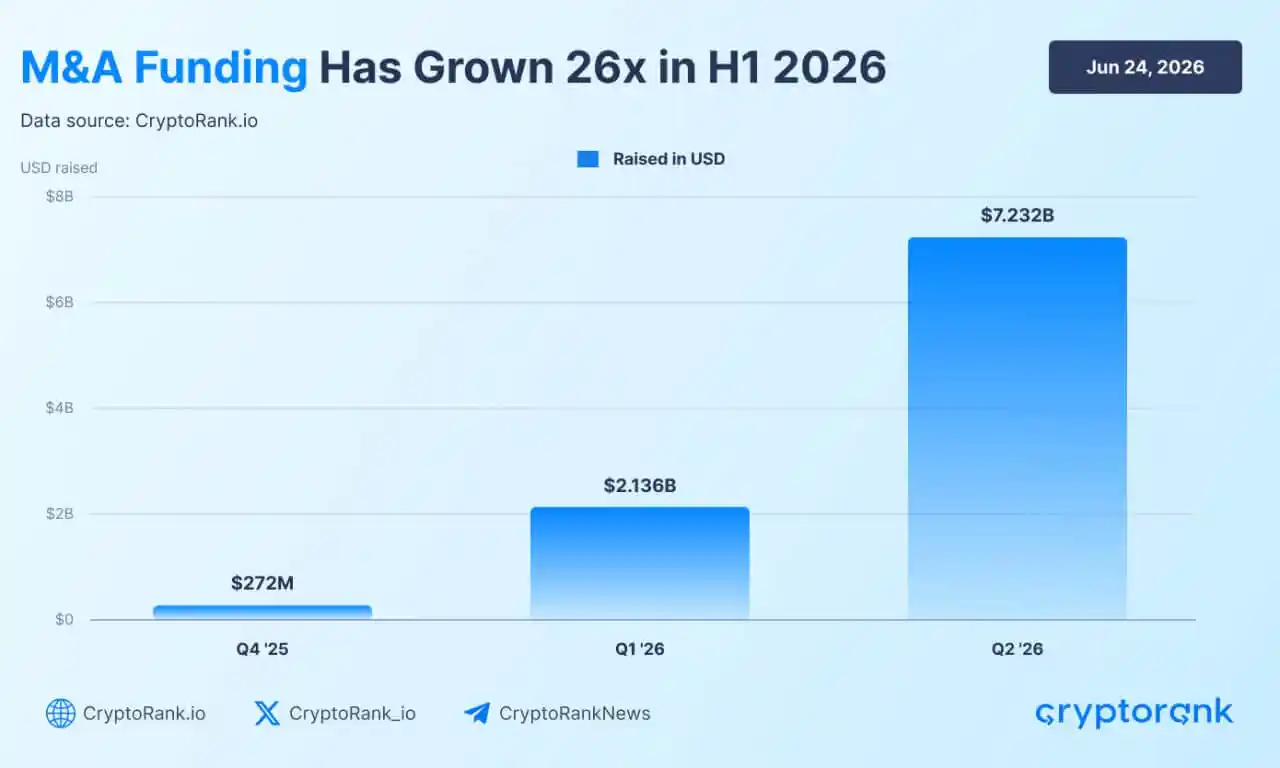
This acceleration is occurring against a backdrop of Bitcoin trading near its lowest levels in nearly two years and continued layoffs at some of the industry's largest employers.

This divergence shows where capital is flowing during the downturn – companies are spending less on broad hiring and speculative growth.

Instead, traditional financial institutions, banks, card networks, trading firms, and well-funded crypto businesses are acquiring payment systems, regulatory licenses, custody businesses, and market infrastructure that could take years to build internally.

The result is a bear market that is weakening many crypto companies but not eliminating institutional demand for their technology.

Traditional Finance Drives Wave of Crypto Infrastructure Acquisitions

Traditional financial institutions are driving the wave of crypto acquisitions, opting to buy fully-fledged digital asset infrastructure rather than building compliance and technical systems from scratch.

Banks, payment processors, and fintech companies are actively targeting startups that already possess custody solutions, payment rails, and regulatory approvals.

This acquisition frenzy is largely driven by the stabilization of global policy. The European Union's Markets in Crypto-Assets (MiCA) framework establishes unified licensing standards, while ongoing stablecoin legislation in the US gives corporate giants the confidence to make long-term bets.

Legal and consulting experts point to this policy support as a primary catalyst. According to Architect Partners' Q1 Crypto M&A and Financing Report, banking and securities industries are fully embracing blockchain, repositioning the technology as a foundational layer for traditional financial markets.

Mastercard's $1.8 billion acquisition of stablecoin company BVNK is a prime example. This acquisition gave the card network immediate access to the technology and licenses needed to process stablecoin payments, bypassing years of internal development.

Other Wall Street giants are also securing strategic footholds through targeted investments. Intercontinental Exchange backed prediction platform Polymarket, Citadel Securities invested in brokerage services provider Alpaca, and Standard Chartered's venture arm funded market maker Keyrock.

Asset managers are also capturing institutional demand through direct acquisitions. Franklin Templeton, which manages $1.7 trillion in assets, recently launched a dedicated digital assets unit called Franklin Crypto.

This move was executed via the acquisition of 250 Digital, which absorbed the firm's investment team and previously managed liquid crypto strategies under CoinFund, to offer actively managed cryptocurrency products directly to Franklin Templeton's global client base.

Overall, private capital strongly favors businesses that connect blockchain to the wider financial system. First-quarter financing data reveals a clear investor preference for stablecoin utility—such as foreign exchange, corporate payments, and cross-border settlement—over speculative crypto-native projects.

In this environment, regulatory credentials have become a major competitive barrier. Acquisition targets with broker-dealer capabilities, federal banking charters, or registered investment advisor qualifications, including Alpaca, Anchorage, and Superstate, attract stronger buyer interest as they provide immediate operational legitimacy.

While traditional finance demonstrates its balance sheet strength, blockchain networks are quietly emerging as a new class of aggressive buyers.

Historically, Layer 1 and Layer 2 networks relied on independent developers to build applications on their chains. Now, faced with fierce competition for users, these networks are directly purchasing consumer-facing applications.

Polygon's recent acquisitions of Coinme and Sequence highlight this shift. By buying payment channels and wallet infrastructure, the blockchain is securing an end-to-end user experience and locking in transaction volume, suggesting that technical capability alone is insufficient to maintain market share.

Crypto Layoffs Deepen, AI and Compliance Reshape Workforce

The pace of corporate acquisitions starkly contrasts with the continued contraction of the digital asset labor market.

According to data compiled by Tiger Research for June 2026, the industry currently has only 2,932 active job openings globally.

This figure pales in comparison to the aggressive hiring sprees of 2021 and early 2022, when trading platforms, DeFi protocols, and NFT markets were all expanding headcount simultaneously.

The employment shrinkage began during the market downturn of 2022 and accelerated after the FTX collapse, leading to roughly a 40% decline in job openings across North America and Europe. The market has not rebounded to previous highs.

Indeed, layoffs have been steadily continuing throughout the first half of this year. Major platforms including Gemini, Coinbase, Kraken, Algorand, Crypto.com, and most recently, the Ethereum Foundation, have initiated new rounds of job cuts.

Executives have attributed the cuts to low token valuations, broader macroeconomic pressures, and AI-driven operational efficiencies. Specifically, Coinbase framed its restructuring as a shift towards an "AI-native" operational model.

This technological pivot is evident in the hiring data: the proportion of crypto jobs requiring AI skills has more than doubled in a year, surging from 23% in early 2025 to over 53% by March 2026.
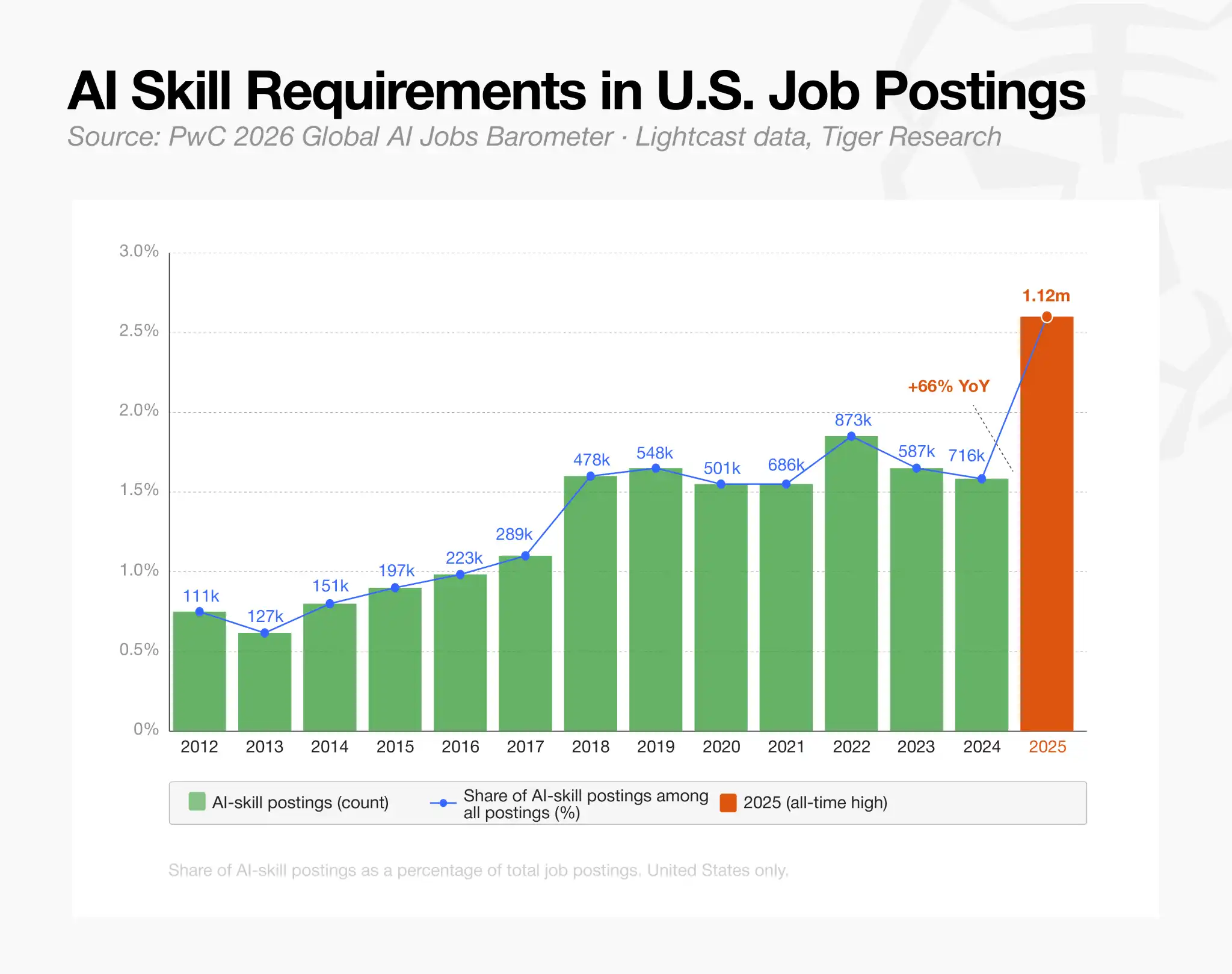
While overall hiring remains sluggish, the composition of the workforce is undergoing a fundamental change. Companies are not implementing a complete hiring freeze. Instead, they are actively narrowing their focus to technical and regulatory expertise.

According to Tiger Research, engineering roles constitute approximately 34% of active openings, while legal and compliance roles account for about 10%. This shift is more pronounced at centralized exchanges, where compliance positions make up 16% of vacancies—more than double the share for sales and business development roles.

This indicates these companies are prioritizing staffing needs to obtain licenses, manage risk, and maintain core infrastructure, while reducing spending on marketing and community growth.

Furthermore, the limited hiring that exists is highly concentrated among a few heavyweights rather than distributed across early-stage startups. Centralized exchanges generate nearly one-third of all open positions.

Stablecoin and payments divisions account for another significant portion, but this activity is highly concentrated. Tether and Ripple alone constitute over 80% of listings in that category.

Ultimately, the data paints a picture of targeted corporate restructuring and a defensive posture, not an industry-wide labor market recovery.

Distressed Crypto Companies Become Acquisition Targets

Blockworks' recent acquisition of Messari perfectly embodies the intersection of large-scale layoffs and accelerated consolidation.

The crypto analytics company Blockworks acquired the analytics provider for approximately $10 million, a significant markdown from its $300 million valuation following a 2022 funding round. Prior to the sale, the research firm underwent three separate rounds of layoffs starting in 2023.

Shortening runways and slow revenue growth are forcing smaller businesses to the negotiating table, enabling well-funded buyers to absorb specialized talent, proprietary data, and distribution channels for a fraction of their former private market valuations.

Industry analysts expect these financial pressures to soon ripple into digital asset treasury sectors. Throughout 2025, many public treasury entities successfully raised capital by trading at a premium relative to their crypto reserves.

Meanwhile, the M&A wave may also eventually encompass Decentralized Autonomous Organizations, thanks to maturing legal frameworks.

Recent legislative progress, such as Wyoming's Decentralized Unincorporated Nonprofit Association (DUNA) structure, provides DAOs with a recognized legal mechanism to hold off-chain assets and intellectual property.

With clearer governance and ownership, protocol treasuries are better positioned to acquire complementary software projects or specialized development teams.

However, compared to the traditional, compliance-driven corporate acquisitions dominating the current market cycle, these decentralized mergers remain highly experimental.

Capital Remains Available, But Has Become Discerning

Despite nearly $10 billion in crypto deal activity in the first half of 2026, capital allocation has become more discerning.

A notable exception to this strict institutional focus is the prediction markets sector. Event-betting platforms have secured significant funding commitments as they vie for mainstream dominance.

For context, Kalshi is reportedly negotiating a funding round that would value the federally regulated exchange at $40 billion, nearly double its previous $22 billion price tag. Polymarket has also absorbed substantial backing as competition for prediction market supremacy intensifies.

However, outside of predictions, the venture capital thesis has narrowed dramatically. Capital is overwhelmingly flowing to businesses acting as bridges between digital assets and the traditional financial system.

Tokenization firms and institutional trading venues secure large checks because they pitch sustainable, isolated revenue models: charging banks, brokerages, and asset managers fees for regulated services, rather than relying on fickle retail crypto traders. Superstate recently closed an $82.5 million funding round to expand its blockchain-based securities issuance, while Alpaca dominates in settling tokenized US stocks and ETFs.

This funding trajectory indicates investors are shifting bets from conceptual tokenization pilots to live, regulated financial products.

Notably, pure DeFi protocols and experimental base-layer blockchains are entirely absent from this quarter's major funding rounds.

This selective deployment of venture capital mirrors the broader M&A trend. Liquidity exists, but it is ring-fenced for startups with regulatory licenses, institutional distribution channels, and specific utility for traditional finance.

The bear market is effectively pruning the industry, forcing weaker models to consolidate or cut staff, while richly rewarding the infrastructure providers built to weather the crypto winter.

Trending Cryptos

Related Questions

QWhat has been the impact of the prolonged Bitcoin downturn on the crypto industry, according to the article?

AThe prolonged Bitcoin downturn has forced crypto companies to conduct mass layoffs, automate more work, and abandon expansion plans from the previous bull market. However, it has simultaneously created one of the industry's busiest periods for mergers and acquisitions (M&A).

QHow does the scale of crypto M&A activity in the first half of 2026 compare to the previous year?

AThe total value of crypto M&A deals in the first half of 2026 reached $9.37 billion. According to CryptoRank, this represented a growth that was 26 times higher compared to the same period in the previous year.

QWhat is the primary driver behind the wave of crypto infrastructure acquisitions by traditional financial institutions?

AThe primary driver is the stabilization of global crypto policy, such as the EU's MiCA framework and ongoing stablecoin legislation in the US. This provides traditional banks and financial institutions the confidence to make long-term bets by purchasing ready-made digital asset infrastructure (like custody, payment rails, and regulatory licenses) instead of building it internally.

QHow is the composition of the crypto workforce changing during this period of layoffs, as highlighted in the article?

AThe composition is shifting towards a greater emphasis on technical and regulatory expertise. Engineering roles now make up about 34% of active job vacancies, while legal and compliance roles account for about 10%. There is also a significant increase in demand for AI skills, with over 53% of crypto job postings requiring them by March 2026.

QWhat type of companies are currently receiving the majority of venture capital funding, according to the article's analysis?

AVenture capital is overwhelmingly flowing to companies that act as bridges between digital assets and the traditional financial system. This includes tokenization firms and institutional trading venues with regulated, fee-based revenue models, rather than speculative crypto-native projects or pure DeFi protocols.

Related Reads

Stablecoins Becoming the Next Policy Challenge for the Fed's Walsh Version

Fed Governor Christopher Waller's speech at the June 22 conference on the U.S. dollar's international role signifies a notable policy shift: stablecoins like USDT and USDC are now being formally considered as potential channels for transmitting U.S. dollar liquidity globally. With their combined market cap surpassing $250 billion and high transaction volumes, these digital assets are moving from the periphery of crypto policy to the core of monetary system research. The key concern for policymakers is how stablecoin flows interact with traditional dollar infrastructure. Their growth could affect bank deposits, demand for short-term Treasury securities (like T-bills), and global access to dollars, depending on whether demand originates overseas or substitutes for domestic bank balances. Issuers' reserve management—holding assets in banks, money market funds, or Treasuries—links stablecoin activity directly to these core markets. The Fed's research agenda now examines whether stablecoins, by combining payment and balance-holding functions on digital rails, could complicate monetary policy implementation or transmit liquidity stress to banks. While current Treasury holdings by issuers are under 1% of the total market, their concentrated demand could marginally impact yields, especially during periods of stress. Consequently, stablecoins are evolving from mere crypto trading tools into a private-layer dollar transmission system with public policy implications, prompting closer regulatory scrutiny of their reserve robustness, redemption mechanisms, and systemic integration.

marsbit5m ago

Stablecoins Becoming the Next Policy Challenge for the Fed's Walsh Version

marsbit5m ago

A 380% Soar, Shenzhen’s 100-Billion-Yuan IPO Rings the Bell

HKC Holdings, a major Chinese display panel manufacturer, has successfully listed on the Shenzhen Stock Exchange's main board. The company's shares surged over 380% on its debut, pushing its market capitalization to around 350 billion yuan (formerly reaching 500 billion yuan). Founded by Wang Zhiyong in Shenzhen's Huaqiangbei electronics market nearly three decades ago, HKC evolved from assembling monitors to becoming a global top-tier supplier of semiconductor display panels for TVs, monitors, and smartphones. The IPO marks a significant milestone for HKC and its backers. The company's growth into the capital-intensive panel manufacturing sector was supported through partnerships with state-owned capital from regions like Chongqing, Mianyang, and Chuzhou. Its shareholder list also includes BOE Technology's investment arm. In recent years, HKC reported strong financials, with core panel business contributing over 70% of revenue and clients including Samsung, TCL, and Xiaomi. This listing is seen as part of a broader trend in Shenzhen's evolving tech landscape. Beyond established giants, the city is nurturing clusters of leading companies in specialized sectors like robotics—exemplified by the "Shenzhen Robot Valley"—and storage chips, where a group of firms dubbed the "Storage Five Tigers" has achieved a combined trillion-yuan market valuation. Shenzhen's strategic focus on emerging industries such as AI terminals, low-altitude economy, and humanoid robotics aims to build new industrial depth and foster the next generation of tech champions.

marsbit17m ago

A 380% Soar, Shenzhen’s 100-Billion-Yuan IPO Rings the Bell

marsbit17m ago

Domestic First Explosion-Proof Certification, World's First Fueling Brain Solution: How Did They Secure Two 'Firsts'?

China's embodied AI sector is booming, with over ¥37 billion in funding this year. The focus has shifted decisively to real-world application, particularly in hazardous, repetitive tasks humans should avoid. A key, often prohibitive, barrier to entry for robots in environments like gas stations and oil fields is obtaining explosion-proof certification, requiring meticulous hardware and circuit design from the ground up. The article explores three main application areas. At gas stations, the challenge lies in executing a long, precise sequence of actions (opening caps, handling the fuel nozzle) with millimeter accuracy across diverse car models. For facility inspections, robots need sustained autonomous patrols combined with real-time anomaly detection and response. Port scenarios introduce the complexity of multi-robot coordination. Addressing the core challenge of long-horizon tasks, the piece highlights a technical breakthrough: a "world model"-driven approach. This enables predictive planning, allowing the AI to visualize the desired end-state (e.g., nozzle returned, cap closed) and work backward to synthesize intermediate visual frames. This "imagination" of the task trajectory, as implemented in the H-GAR architecture, guides action generation, significantly reducing cumulative error in multi-step operations. The three-step H-GAR process involves generating a coarse action draft, synthesizing target-conditioned observation frames, and then refining actions based on visual context and a memory of past successful motions. The conclusion emphasizes that success in specialized, safety-critical fields requires long-term commitment and deep integration of the "embodied brain" (AI) with a purpose-built, certified physical "body." Mastering this brain-body-data闭环 (closed-loop) is positioned as a crucial competitive advantage for commercialization.

marsbit1h ago

Domestic First Explosion-Proof Certification, World's First Fueling Brain Solution: How Did They Secure Two 'Firsts'?

marsbit1h ago

Trading

Spot
Futures

Hot Articles

What is DOGE M

Doge Matrix ($doge m): The New Breed of Community-Driven Cryptocurrency Introduction In the ever-evolving landscape of cryptocurrency, new projects constantly emerge, each aiming to capture the interest of investors and enthusiasts alike. One of the latest entrants to this domain is Doge Matrix, represented by the ticker symbol $doge m. This project has attracted attention thanks to its roots in the popular meme culture surrounding Dogecoin, establishing its place within the web3 space. This article aims to provide a comprehensive analysis of Doge Matrix, covering its overview, creator, investors, functionality, timeline, and notable aspects. What is Doge Matrix ($doge m)? Doge Matrix is a community-driven cryptocurrency project that seemingly builds upon the widespread appeal of Dogecoin, a digital currency known for its Shiba Inu mascot and its meme origins. While the overarching objectives of Doge Matrix are not extensively defined, it is characterized by a commitment to harnessing community involvement and support. Unlike traditional cryptocurrencies that often emphasize utility or intrinsic value through underlying technologies, Doge Matrix positions itself within a space that embraces the cultural phenomenon of cryptocurrencies, particularly appealing to those who resonate with the ethos of meme-based assets. Drawing on the strengths of the Dogecoin community, Doge Matrix operates as part of a broader ecosystem, inviting participation and engagement from users who share an interest in cryptocurrency and the digital landscape. Who is the Creator of Doge Matrix ($doge m)? The identity of the creator of Doge Matrix remains unknown. This lack of transparency is not an uncommon occurrence in the cryptocurrency space, where some projects are launched without revealing the identities of their founders. The absence of information regarding the founding team can raise questions among potential investors about the project’s accountability and direction. Who are the Investors of Doge Matrix ($doge m)? As it stands, there is no publicly available information detailing the investors or investment foundations that back Doge Matrix. The project appears to rely primarily on community support rather than institutional investment. This model aligns with the community-driven nature of the initiative, fostering an environment where the direction of the project is shaped by its participants rather than being dictated by a select few financial backers. How Does Doge Matrix ($doge m) Work? The specifics regarding the operational mechanisms of Doge Matrix are somewhat vague, reflecting a broader trend of projects in the meme coin space where innovative functionalities are not always clearly articulated. Nonetheless, Doge Matrix seems designed to tap into the existing cryptocurrency ecosystem by encouraging user participation while tapping into the familiar cultural references associated with Dogecoin. Its potentially unique characteristics derive from community interactions rather than technological advancements, emphasizing shared experiences and collaboration among token holders. While the exact innovations have not been explicitly outlined, the project appears to create a space where community members can engage, share ideas, and propel the project's potential forward. Timeline of Doge Matrix ($doge m) Reflecting on the project’s timeline reveals notable events that have defined its journey thus far: November 25, 2024: Doge Matrix reached its all-time high value, marking a significant milestone in its early history. January 1, 2025: Conversely, Doge Matrix hit its all-time low value, illustrating the volatility often associated with cryptocurrencies, especially in the early stages of a project's lifecycle. Ongoing: The project continues to be actively traded and supported by its community, although specific future milestones or objectives have yet to be disclosed. Key Points About Doge Matrix ($doge m) Community Focus At the heart of Doge Matrix is a commitment to community engagement. The project thrives on the premise of collaboration and shared objectives among its members, emphasizing the importance of collective effort. Unlike centralized projects that often have a defined leadership structure, Doge Matrix at present showcases a more fluid approach to governance, where every community member's voice matters. Volatility The cryptocurrency market is notorious for its volatility, and Doge Matrix is no exception. Its price history reflects significant fluctuations between high and low values, which is typical of many new cryptocurrencies but underscores the risks associated with investment in emerging tokens. Lack of Detailed Information One of the most striking features about Doge Matrix is the scarcity of detailed information regarding its technological underpinnings and operational mechanisms. This ambiguity necessitates that potential investors conduct thorough due diligence before engaging with the project. Conclusion In summary, Doge Matrix ($doge m) illustrates a new wave of cryptocurrency projects that lean heavily on community engagement and cultural relevance. While lacking in certain specifics—such as clear leadership, defined objectives, and detailed functionality—the project has managed to generate interest within the crypto community, leveraging the established appeal of meme culture. As with any investment in the cryptocurrency space, understanding the inherent risks and conducting comprehensive research is essential for potential participants. Doge Matrix stands as a reminder of the dynamic, sometimes unpredictable nature of the crypto industry, marked by constant evolution and enthusiasm for community-driven initiatives.

3.8k Total ViewsPublished 2025.02.03Updated 2025.02.03

What is DOGE M

What is $M

Understanding Mantis ($M): A New Era in Cross-Chain Interoperability In the continually evolving landscape of Web3 and cryptocurrency, new projects strive to offer innovative solutions aimed at enhancing the user experience and expanding functional possibilities within the decentralized financial ecosystem. One such project garnering attention is Mantis ($M), a pioneering protocol founded on the principles of cross-chain interoperability and intent-based settlements. This article delves into the essential aspects of Mantis, including its core functionality, creators, investment backing, innovative features, and critical milestones. What is Mantis ($M)? Mantis is described as a multi-domain intent settlement protocol that simplifies cross-chain interactions, enabling users to execute complex financial transactions across various blockchain platforms seamlessly. The protocol operates through three primary layers: Intent Expression: Users can articulate their transaction goals using natural language facilitated by the DISE LLM, an advanced AI language model. For instance, a user might express a desire to swap Ethereum (ETH) for Solana (SOL) with a specific slippage tolerance of 1%. Execution: This layer employs a network of solvers that compete to fulfill user intents. Transactions are executed using mechanisms such as Coincidence of Wants (CoWs) and Order Flow Auctions (OFAs), which ensure that user demands are met optimally. Settlement: Leveraging the Inter-Blockchain Communication (IBC) protocol, Mantis enables atomic cross-chain transactions, allowing users to operate across various supported chains, including Ethereum, Solana, and Cosmos. Mantis is engineered to introduce native yield generation for idle assets, employing cryptographic proofs to maintain the integrity of transactions throughout the entire process. Creators & Development Team Mantis was conceived by the Composable Foundation, a research-driven organization notable for its emphasis on blockchain interoperability solutions. This foundation collaborates with esteemed academic institutions, including Harvard University and the University of Lisbon, contributing to extensive research and development efforts that inform Mantis's architecture and functionality. The Composable Foundation’s commitment to fostering innovation in the blockchain space positions Mantis as a robust solution for the growing demand for interoperability among multiple blockchain networks. Investors & Backing While specific details about individual investors have not been publicly disclosed, Mantis enjoys substantial backing from various entities, including: Ecosystem grants from IBC-enabled chains, which support the protocol's growth and integration within decentralized finance ecosystems. Strategic partnerships with infrastructure providers that enhance Mantis's network capabilities and deployment strategies. Funding through the Composable Foundation's treasury, ensuring sustained financial support for ongoing development and operational costs. These collaborative efforts reflect a consensus among stakeholders about the importance of enhancing cross-chain functionality and the potential utility of Mantis's infrastructural innovations. Key Innovations Mantis sets itself apart through several pioneering innovations that enhance its functionality and utility: Chain-Agnostic Intents: Users can initiate transactions from any supported chain while settling on another. This flexibility empowers users, driving increased interaction among different platforms. AI-Powered Interface: The integration of DISE LLM allows users to conduct complex DeFi operations using natural language, thereby simplifying interactions and making blockchain technology accessible to a broader audience. Cross-Domain MEV Capture: Mantis creates an internal market for maximal extractable value (MEV) through competitions among solvers. This innovative approach allows for greater efficiency and value extraction in complex transactions. Modular Settlement Layer: The protocol supports various verification methods, including zero-knowledge proofs and optimistic rollups, providing a versatile framework that can adapt to emerging blockchain technologies. Historical Timeline Mantis's development is marked by several critical milestones that chart its trajectory and growth: | Year | Milestone | |————|————————————————————————-| | 2022 | Initial concept development within the Composable Foundation's research division. | | Q3 2024 | Launch of the testnet with bridging capabilities between Solana and Ethereum. | | Q1 2025 | Anticipated Token Generation Event (TGE) alongside the mainnet launch. | | Q2 2025 | Expected integration of DISE LLM and expansion of cross-chain capabilities. | | 2025 H2 | Planned support for over 15 chains through further IBC upgrades. | This timeline outlines Mantis's evolution, from conceptual discussions to active implementation and future growth phases. Ecosystem Growth Strategy Mantis's strategy for ecosystem growth includes several initiatives designed to encourage user participation and developer engagement: Credits System: Users can earn protocol credits by providing liquidity and engaging in referral programs. These credits are redeemable for incentives in the future, fostering a robust user community. Modular Software Development Kit (SDK): This toolkit empowers developers to create applications based on intent-driven models utilizing Mantis's infrastructure, thus promoting innovation within its ecosystem. Governance Model: As the protocol matures, $M token holders will have a voice in protocol governance, allowing them to vote on proposed upgrades and changes, thereby enhancing community engagement and decentralization. Mantis represents a significant advancement in the realm of cross-chain architecture. By seamlessly integrating advanced AI algorithms with a robust settlement framework, Mantis seeks to tackle the problems of fragmentation within multi-chain ecosystems. Its innovative approach prioritizes improved user experiences while adhering to the foundational principles of decentralization and security, setting a new standard for the future interoperability of blockchain technologies. As Mantis continues its journey of growth and implementation, it promises to be a project to watch closely in the competitive landscape of Web3 and decentralized finance. With its focus on crossing boundaries and elevating user engagement, Mantis is poised to be an integral part of the future developments in the cryptocurrency space.

295 Total ViewsPublished 2025.03.18Updated 2025.03.18

What is $M

How to Buy M

Welcome to HTX.com! We've made purchasing MemeCore (M) simple and convenient. Follow our step-by-step guide to embark on your crypto journey.Step 1: Create Your HTX AccountUse your email or phone number to sign up for a free account on HTX. Experience a hassle-free registration journey and unlock all features.Get My AccountStep 2: Go to Buy Crypto and Choose Your Payment MethodCredit/Debit Card: Use your Visa or Mastercard to buy MemeCore (M) instantly.Balance: Use funds from your HTX account balance to trade seamlessly.Third Parties: We've added popular payment methods such as Google Pay and Apple Pay to enhance convenience.P2P: Trade directly with other users on HTX.Over-the-Counter (OTC): We offer tailor-made services and competitive exchange rates for traders.Step 3: Store Your MemeCore (M)After purchasing your MemeCore (M), store it in your HTX account. Alternatively, you can send it elsewhere via blockchain transfer or use it to trade other cryptocurrencies.Step 4: Trade MemeCore (M)Easily trade MemeCore (M) on HTX's spot market. Simply access your account, select your trading pair, execute your trades, and monitor in real-time. We offer a user-friendly experience for both beginners and seasoned traders.

7.4k Total ViewsPublished 2025.07.02Updated 2026.06.02

How to Buy M

Discussions

Welcome to the HTX Community. Here, you can stay informed about the latest platform developments and gain access to professional market insights. Users' opinions on the price of M (M) are presented below.

活动图片