Bitcoin Analyst Reveals How Long It Usually Takes For Altcoin Season To Happen

bitcoinistPublished on 2026-01-20Last updated on 2026-01-20

Abstract

A Bitcoin analyst highlights that altcoin seasons historically occur rapidly, typically within one to two months, once Bitcoin dominance (BTC.D) begins to decline significantly. Currently, Bitcoin’s dominance stands near 60%, suppressing major altcoin breakouts. However, past cycles—like those in 2017 and 2021—show that when BTC.D drops, capital quickly rotates into altcoins, triggering explosive rallies. For a sustained altcoin season, Bitcoin must first reach a new all-time high to boost market confidence and attract retail investors. Macroeconomic conditions, such as strength in risk-on assets, may also contribute to the shift.

Bitcoin’s dominance over the broader crypto market has become the main reference point for traders trying to determine when an altcoin season will finally take shape. At the moment, Bitcoin still controls close to 60% of the total market, and this has so far kept any meaningful altcoin breakout at bay.

However, according to a Bitcoin analyst, history suggests that once this balance begins to shift, the transition into altcoin season tends to happen quickly, often playing out within a tight one-to-two-month timeframe.

Why Bitcoin Dominance Matters For Altcoin Season

In his analysis, the analyst explained that Bitcoin dominance, also known as BTC.D, is an important factor in determining when capital begins rotating into altcoins. BTC dominance measures Bitcoin’s share of the total crypto market capitalization, and declines in this metric have historically coincided with explosive altcoin rallies. At the time of writing, CoinMarketCap puts the Bitcoin dominance at 59%.

Looking back at 2017, the BTC.D chart shows Bitcoin’s dominance falling very quickly from around 96% in early March to about 60% by mid-May. That drop was the playout of one of the most aggressive altcoin rallies the market has ever seen.
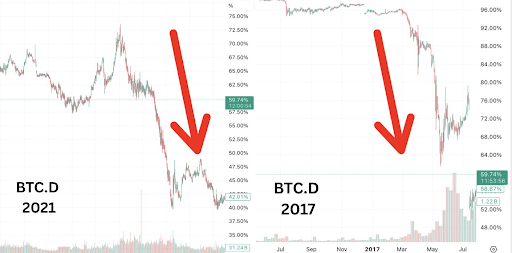
Source: Chart from Waterman on X

A similar pattern played out in 2021, when BTC dominance fell from about 60% in early April to near 40% by mid-May. That move coincided with another powerful altcoin expansion, pushing Ethereum and several other major altcoins to new all-time highs. Many of those peaks, particularly among meme coins such as Dogecoin and Shiba Inu, are unbroken to this day.

The most important takeaway from both cycles, according to the analyst, is the speed of the move. In each case, it took just one to two months for a full-blown altcoin season to unfold once Bitcoin dominance began rolling over decisively.

BTC’s Next Move Could Decide Everything

The analyst notes that many investors underestimate how quickly this transition can happen. After waiting through multiple years of accumulation and consolidation, market participants often grow impatient just before the final stage. Historically, however, altcoin season has tended to play out very quickly once conditions align, not gradually over many months. Therefore, investors waiting for an altcoin season can still hold on for that move and not lose focus.

He also pointed to macro signals supporting a risk-on environment, referencing strength in assets such as small-cap equities, gold, and silver hitting all-time highs. These conditions are lining up for capital flowing into higher-beta assets once confidence returns.

Nonetheless, altcoins cannot sustain a true breakout without BTC first making a convincing move. If Bitcoin fails to push to a new all-time high, altcoins may see only short-lived relief rallies. On the other hand, a new Bitcoin all-time high could act as the deciding factor that brings retail traders back into the market and eventually leads to FOMO plus a breakout altcoin season.

BTC trading at $90,971 on the 1D chart | Source: BTCUSDT on Tradingview.com

Related Questions

QWhat is the main reference point traders use to determine when an altcoin season might occur, according to the article?

ABitcoin's dominance (BTC.D) over the broader crypto market is the main reference point.

QHow long does the analyst say it usually takes for a full-blown altcoin season to unfold once Bitcoin dominance begins to decline?

AIt tends to happen very quickly, often playing out within a tight one-to-two-month timeframe.

QWhat happened to Bitcoin's dominance in 2017 that signaled a major altcoin rally?

AIt fell very quickly from around 96% in early March to about 60% by mid-May.

QAccording to the analyst, what is a prerequisite for altcoins to sustain a true breakout and not just have short-lived rallies?

ABitcoin first needs to make a convincing move, ideally pushing to a new all-time high.

QWhat macro signals does the analyst point to that support a 'risk-on' environment favorable for altcoins?

AStrength in assets such as small-cap equities, and gold and silver hitting all-time highs.

Related Reads

Anthropic's IPO Launch: Commercial Miracle or Valuation Bubble?

Anthropic has confidentially filed for an IPO, led by Morgan Stanley and Goldman Sachs, potentially going public by October. Following its latest $650 billion funding round, its pre-IPO valuation stands at $965 billion, with projections reaching up to $2 trillion at listing, which would make it the highest-valued private company ever. The article, written by Fu Sheng, addresses skepticism that this represents an AI bubble akin to the 2000 dot-com crash. It argues the current situation differs fundamentally. Unlike the internet bubble era, which relied on speculative narratives with little revenue, Anthropic's valuation is backed by unprecedented, measurable financial performance. Key data points include: * **Revenue Growth:** ARR skyrocketed from $10 billion in early 2025 to $470 billion by May 2026, targeting $100 billion by year-end—a growth curve unmatched in business history. * **Profitability:** It achieved operating profitability in Q2 2026 with an estimated $5.6 billion profit. * **Efficiency:** With ~3,000 employees and ~$470 billion ARR, its revenue per employee exceeds $10 million. Products like Claude Code, launched less than a year ago, already generate $25 billion in annualized revenue. * **Enterprise Adoption:** It boasts a strong enterprise client base, with 8 of the Fortune 10 and over 1,000 large firms spending over $1 million annually on Claude. The valuation is framed using a traditional SaaS model (e.g., a 10x Price-to-Sales multiple on $100 billion revenue). The author contends the core question for analysts has shifted from "How big could this be?" to "How much is it earning and will earn next quarter?" The discussion extends beyond Anthropic to a broader paradigm shift: the transition from a "carbon-based" to a "silicon-based" economy. Companies are increasingly prioritizing investment in compute and AI capabilities over human resources, as these directly scale productivity and competitive advantage. Anthropic's IPO is thus positioned not just as a corporate milestone, but as a price anchor for this new economic era.

链捕手2h ago

Anthropic's IPO Launch: Commercial Miracle or Valuation Bubble?

链捕手2h ago

Near Returns to the AI Stage: Transformation into a Public Chain Due to 'Payroll Difficulties,' Agent and Privacy Emerge as New Growth Narratives

NEAR Returns to AI Origins: From Payroll Struggles to Blockchain, Now Focusing on AI Agents and Privacy NEAR Protocol's journey began not with grand blockchain ambitions, but from a practical hurdle: its AI startup founders, including Transformer paper co-author Illia Polosukhin, couldn't efficiently pay international developers in 2017. This led them to pivot and build a high-performance, scalable blockchain. After years navigating various crypto narratives like sharding and cross-chain interoperability, NEAR is now leveraging its AI roots to re-enter the AI arena. A key driver is its "NEAR Intents" layer, which abstracts complex cross-chain transactions. Users simply state their goal (e.g., swap BTC for ETH), and a solver network finds the optimal route. This system has processed over $20B in cross-chain volume, generating significant fee revenue. A major growth area is private transactions via "Confidential Intents/Swaps," which hide trade details until settlement to protect against MEV and front-running. Remarkably, private swaps recently accounted for over 40% of NEAR's transaction volume, highlighting strong demand but also potential regulatory scrutiny. With its AI-founder pedigree, NEAR is positioning itself at the intersection of blockchain, AI agents, and privacy, aiming to become infrastructure for the emerging agent economy while navigating the challenges of its rapid adoption.

marsbit5h ago

Near Returns to the AI Stage: Transformation into a Public Chain Due to 'Payroll Difficulties,' Agent and Privacy Emerge as New Growth Narratives

marsbit5h ago

Trading

Spot
Futures

Hot Articles

Discussions

Welcome to the HTX Community. Here, you can stay informed about the latest platform developments and gain access to professional market insights. Users' opinions on the price of S (S) are presented below.

活动图片











