Binance Receives $347 Million In Bitcoin as Matrixport-Associated Wallets Offload Assets

bitcoinistPublished on 2025-12-18Last updated on 2025-12-18

Abstract

Bitcoin is struggling to reclaim the $90,000 level amid deteriorating market sentiment and growing fears of a broader bear market. Adding to the selling pressure, two wallets linked to digital asset platform Matrixport deposited 4,000 BTC (worth approximately $347.56 million) into Binance. Such large exchange inflows are often seen as bearish, as they can signal potential distribution or hedging activity. While not all inflows lead to immediate selling, the timing intensifies market caution. The ability of current demand to absorb this supply will determine whether Bitcoin enters a deeper correction or a prolonged consolidation phase.

Bitcoin is once again testing investor conviction as it struggles to reclaim the $90,000 level, a price zone that has now become a clear psychological and structural barrier. After weeks of choppy price action and repeated failures to sustain upside momentum, sentiment across the market has shifted sharply.

Fear and apathy are increasingly dominant, with a growing number of analysts and participants beginning to call for a broader bear market. For many investors, the narrative has changed from buying dips to questioning whether the cycle has already peaked.

This deterioration in confidence is occurring alongside renewed selling pressure from large, well-capitalized players. According to data from Arkham, two wallets linked to Matrixport deposited a combined 4,000 BTC, worth approximately $347.56 million, into Binance today.
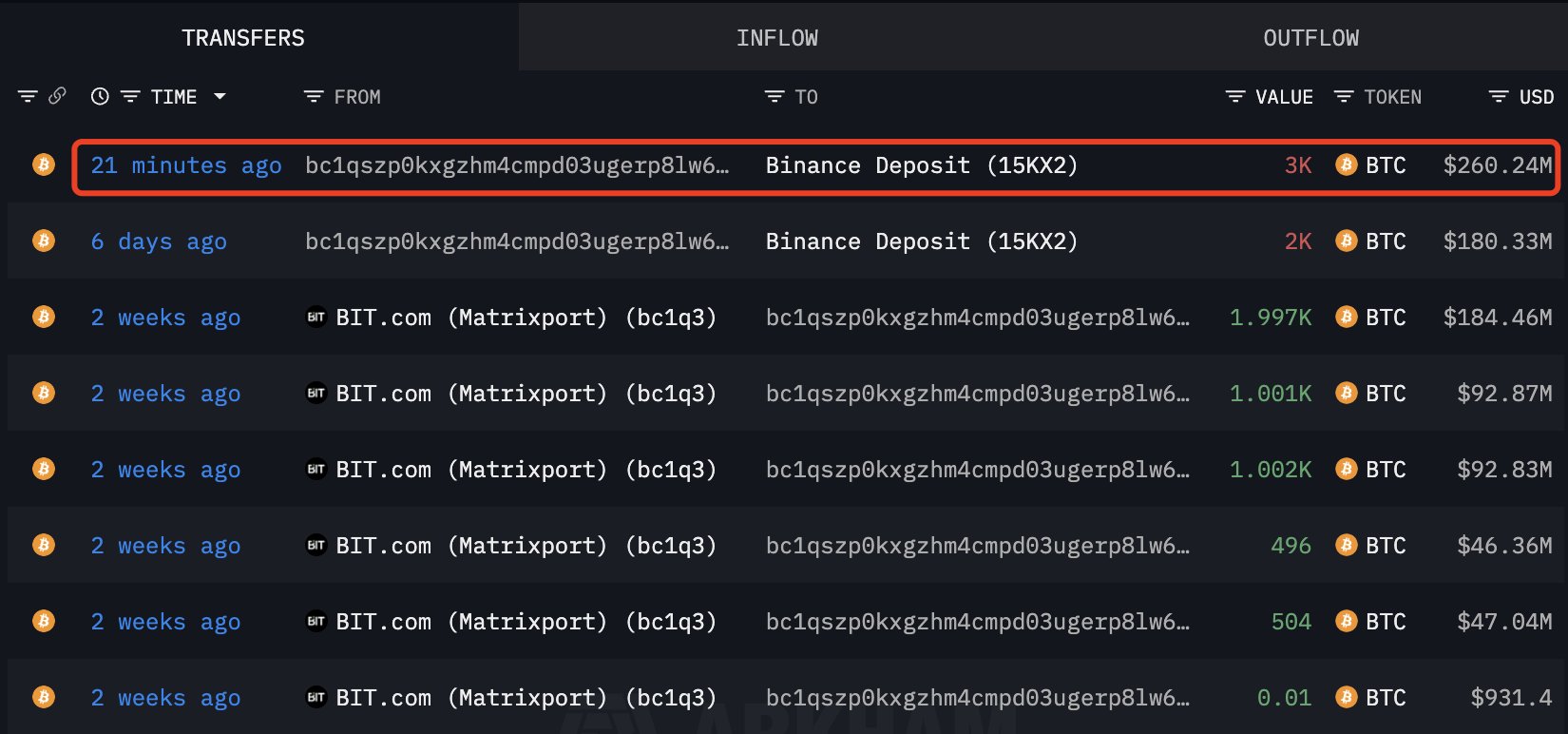
Matrixport-Linked Wallet sends Bitcoin to Binance | Source: Arkham

Matrixport is a large digital-asset financial services platform founded by former Bitmain executives, offering products including crypto lending, structured products, asset management, and custody solutions.

Such large inflows to exchanges are closely watched by the market, as they often precede distribution or hedging activity, particularly during periods of heightened uncertainty. While not every deposit translates directly into spot selling, the timing of these transfers adds to the growing sense of caution.

Whether current demand can absorb this supply and stabilize price will likely determine if this phase becomes a deeper correction—or the start of a more prolonged bearish regime.

Exchange Inflows And What They Mean For Bitcoin

Large Bitcoin deposits to exchanges are almost always interpreted by the market as a bearish signal, since they increase the immediate supply available for sale. In most historical cases, sharp spikes in exchange inflows have preceded periods of downside volatility, reinforcing the perception that whales are preparing to distribute into liquidity. However, some investors urge caution when reading this data in isolation, as not every exchange transfer results in spot selling.

In certain scenarios, large inflows can be linked to internal treasury management, collateral rotation, or the opening of hedged derivatives positions rather than outright liquidation. Institutions may move Bitcoin to centralized venues to post margin for futures or options, allowing them to hedge downside risk without selling their underlying holdings.

In other cases, funds prepare liquidity for over-the-counter settlements or cross-exchange arbitrage, activities that do not necessarily translate into sustained selling pressure on the spot market.

Looking ahead, Bitcoin’s price action over the coming months will likely depend on whether these inflows are followed by a clear increase in realized selling volume. If demand continues to absorb supply near the $85K–$86K zone, the market could transition into a prolonged consolidation phase, allowing sentiment to reset.

However, if exchange balances continue to rise alongside weakening spot demand, downside risks remain elevated. In that scenario, Bitcoin may revisit lower support levels before any durable recovery can begin.


Trending Cryptos

Related Reads

Examining the Open USD Partner Lineup: Follow Who's Joining to See Where the Money Flows

**Title: Deciphering the Open USD Partner Roster: Following the Money** The launch of Open USD is notable less for the stablecoin itself and more for its expansive list of over 140 founding partners, which reads like a "who's who" of global finance and tech. This coalition, including asset managers like BlackRock, card networks Visa and Mastercard, banks (BNY Mellon, Standard Chartered, etc.), tech giants (Google, IBM), merchants (Shopify), and crypto firms (Coinbase, Ripple, Aave, MetaMask), signals a strategic shift. The diverse membership reveals that stablecoins are increasingly viewed not as products to compete over, but as shared infrastructure too critical to be left to any single entity. Each partner category has distinct motives. Asset managers like BlackRock seek to manage the large, sticky cash reserves, a lucrative fee-generating opportunity. Merchants like Shopify aim for lower-cost settlement and potential yield on balances. Banks join defensively to retain custody and settlement roles, fearing deposit outflows to stablecoins. Tech companies bet on programmable money for future machine-to-machine commerce. Crypto firms gain mainstream legitimacy and distribution channels. Remarkably, the consortium includes direct competitors (Visa vs. Mastercard, Coinbase vs. Ripple), indicating that the fear of exclusion from this emerging financial layer outweighs competitive rivalries. However, this shared governance could also lead to slow decision-making. The roster's composition is the real message: it represents a collective bet that a widely accepted, consortium-owned stablecoin is preferable to proprietary versions or having none at all. For incumbents like Circle and Tether, this alliance poses a significant threat, as potential clients have collectively chosen to build their own alternative. The absence of major U.S. retail banks (busy with their own tokenized deposit networks) is equally telling. In essence, the partner list maps where the industry believes value and risk will flow in a tokenized dollar future, marking stablecoin's evolution from a product to a utility.

Foresight News14m ago

Examining the Open USD Partner Lineup: Follow Who's Joining to See Where the Money Flows

Foresight News14m ago

IOSG: Q-Day Countdown, Will Quantum Computing End Cryptocurrency?

IOSG: The Q-Day Countdown – Will Quantum Computing End Cryptocurrency? This analysis explores the looming threat quantum computing poses to blockchain technology. Quantum computers, leveraging Shor's algorithm, could theoretically break the elliptic curve cryptography (ECC) underpinning cryptocurrencies like Bitcoin and Ethereum. The article outlines a hypothetical "Q-Day" scenario where exposed public keys from dormant assets are compromised, leading to fund theft and a deep governance crisis. The core risk is not the complete erasure of blockchains but a systemic reset of public-key cryptography. Bitcoin faces significant challenges due to its "code-is-law" ethos and the immense social consensus required for migration. Its primary vulnerability lies in legacy UTXOs with publicly exposed keys. Ethereum's path involves a more complex, full-stack cryptographic agility upgrade across execution, consensus, and data layers. The industry has a limited "engineering comfort window" of 5-8 years to coordinate a migration to post-quantum cryptography (PQC), such as lattice-based or hash-based signatures. While the existential threat is often overstated, the real bottleneck is the immense coordination required across protocol developers, node operators, wallet providers, exchanges, and custodians. Market repricing of crypto assets may occur well before an actual Q-Day if quantum hardware roadmaps accelerate or regulatory pressure mounts. The article concludes that quantum computing is not a doomsday weapon but a severe stress test for blockchain's foundational security model and governance structures.

marsbit43m ago

IOSG: Q-Day Countdown, Will Quantum Computing End Cryptocurrency?

marsbit43m ago

Why 2026 could redefine Ethereum, Solana, Base and Avalanche

Blockchain infrastructure is undergoing a major coordinated transformation, driven by institutional demand for reliability, compliance, and predictable settlement. Over $30 billion in Real-World Assets (RWA) on-chain has exposed network weaknesses. Major blockchains are responding with foundational upgrades, moving beyond incremental speed improvements. Ethereum's "Glamsterdam" upgrade, planned for H1 2026, will significantly increase gas limits and introduce features like PBS (pre-blocked state) for enhanced settlement and parallel execution. Solana's "Alpenglow," targeting a mainnet launch in H2 2026, focuses on reducing finality time dramatically and freeing network resources to improve reliability. Beyond speed, compliance is critical. Base's "Beryl" upgrade in Q3 2026 will introduce a standardized, regulatory-compliant token framework (B20). Avalanche's "Octane" upgrade aims to boost transaction processing and reduce costs for enterprise applications. Even Bitcoin is evolving with the potential activation of OP_CAT by late 2026/early 2027. The competition is shifting. While technical upgrades are widespread, institutions will ultimately allocate capital based on proven execution, operational resilience, and regulatory compatibility during market stress. Ethereum currently leads in tokenized assets, while networks like Base and Solana are strengthening their institutional offerings. The blockchain that best delivers reliable, compliant, and uninterrupted service is poised to attract the greatest share of future institutional capital.

ambcrypto1h ago

Why 2026 could redefine Ethereum, Solana, Base and Avalanche

ambcrypto1h ago

Trading

Spot

Hot Articles

What is $BITCOIN

DIGITAL GOLD ($BITCOIN): A Comprehensive Analysis Introduction to DIGITAL GOLD ($BITCOIN) DIGITAL GOLD ($BITCOIN) is a blockchain-based project operating on the Solana network, which aims to combine the characteristics of traditional precious metals with the innovation of decentralized technologies. While it shares a name with Bitcoin, often referred to as “digital gold” due to its perception as a store of value, DIGITAL GOLD is a separate token designed to create a unique ecosystem within the Web3 landscape. Its goal is to position itself as a viable alternative digital asset, although specifics regarding its applications and functionalities are still developing. What is DIGITAL GOLD ($BITCOIN)? DIGITAL GOLD ($BITCOIN) is a cryptocurrency token explicitly designed for use on the Solana blockchain. In contrast to Bitcoin, which provides a widely recognized value storage role, this token appears to focus on broader applications and characteristics. Notable aspects include: Blockchain Infrastructure: The token is built on the Solana blockchain, known for its capacity to handle high-speed and low-cost transactions. Supply Dynamics: DIGITAL GOLD has a maximum supply capped at 100 quadrillion tokens (100P $BITCOIN), although details regarding its circulating supply are currently undisclosed. Utility: While precise functionalities are not explicitly outlined, there are indications that the token could be utilized for various applications, potentially involving decentralized applications (dApps) or asset tokenization strategies. Who is the Creator of DIGITAL GOLD ($BITCOIN)? At present, the identity of the creators and development team behind DIGITAL GOLD ($BITCOIN) remains unknown. This situation is typical among many innovative projects within the blockchain space, particularly those aligning with decentralized finance and meme coin phenomena. While such anonymity may foster a community-driven culture, it intensifies concerns about governance and accountability. Who are the Investors of DIGITAL GOLD ($BITCOIN)? The available information indicates that DIGITAL GOLD ($BITCOIN) does not have any known institutional backers or prominent venture capital investments. The project seems to operate on a peer-to-peer model focused on community support and adoption rather than traditional funding routes. Its activity and liquidity are primarily situated on decentralized exchanges (DEXs), such as PumpSwap, rather than established centralized trading platforms, further highlighting its grassroots approach. How DIGITAL GOLD ($BITCOIN) Works The operational mechanics of DIGITAL GOLD ($BITCOIN) can be elaborated on based on its blockchain design and network attributes: Consensus Mechanism: By leveraging Solana’s unique proof-of-history (PoH) combined with a proof-of-stake (PoS) model, the project ensures efficient transaction validation contributing to the network's high performance. Tokenomics: While specific deflationary mechanisms have not been extensively detailed, the vast maximum token supply implies that it may cater to microtransactions or niche use cases that are still to be defined. Interoperability: There exists the potential for integration with Solana’s broader ecosystem, including various decentralized finance (DeFi) platforms. However, the details regarding specific integrations remain unspecified. Timeline of Key Events Here is a timeline that highlights significant milestones concerning DIGITAL GOLD ($BITCOIN): 2023: The initial deployment of the token occurs on the Solana blockchain, marked by its contract address. 2024: DIGITAL GOLD gains visibility as it becomes available for trading on decentralized exchanges like PumpSwap, allowing users to trade it against SOL. 2025: The project witnesses sporadic trading activity and potential interest in community-led engagements, although no noteworthy partnerships or technical advancements have been documented as of yet. Critical Analysis Strengths Scalability: The underlying Solana infrastructure supports high transaction volumes, which could enhance the utility of $BITCOIN in various transaction scenarios. Accessibility: The potential low trading price per token could attract retail investors, facilitating wider participation due to fractional ownership opportunities. Risks Lack of Transparency: The absence of publicly known backers, developers, or an audit process may yield skepticism regarding the project's sustainability and trustworthiness. Market Volatility: The trading activity is heavily reliant on speculative behavior, which can result in significant price volatility and uncertainty for investors. Conclusion DIGITAL GOLD ($BITCOIN) emerges as an intriguing yet ambiguous project within the rapidly evolving Solana ecosystem. While it attempts to leverage the “digital gold” narrative, its departure from Bitcoin's established role as a store of value underscores the need for a clearer differentiation of its intended utility and governance structure. Future acceptance and adoption will likely depend on addressing the current opacity and defining its operational and economic strategies more explicitly. Note: This report encompasses synthesised information available as of October 2023, and developments may have transpired beyond the research period.

656 Total ViewsPublished 2025.05.13Updated 2025.05.13

What is $BITCOIN

Discussions

Welcome to the HTX Community. Here, you can stay informed about the latest platform developments and gain access to professional market insights. Users' opinions on the price of BTC (BTC) are presented below.

活动图片