Binance Bitcoin STH Activity Falls By $8 Billion In December — Here’s Why

bitcoinistPublished on 2026-01-03Last updated on 2026-01-03

Abstract

Bitcoin began December 2025 with bearish momentum but stabilized around the $85,000 support level, leading to a period of consolidation. On-chain analysis from CryptoQuant reveals that Binance experienced a significant $8.16 billion decline in monthly Bitcoin inflows from short-term holders (STHs), dropping from $24.7 billion in November to $16.54 billion in December. This reduction, driven by young UTXOs (coins moved within a day), indicates decreased speculative selling pressure and a shift in market sentiment. The cooling activity suggests STHs are holding rather than selling, possibly due to year-end caution. This transfer of supply control to mid and long-term investors historically leads to consolidation and lower volatility, potentially setting the stage for more sustainable price cycles. Bitcoin was trading at $89,533 at the time of writing.

Initially, Bitcoin began the last month of 2025 with significant bearish momentum, with the price structure taking on a clear bearish direction. However, this downside momentum soon weakened after the flagship cryptocurrency encountered its $85,000 support. Since then, Bitcoin traded mostly within a consolidatory range, struggling to break out of either end of the chart convincingly. Interestingly, an on-chain analysis has been released that examines the dynamics that may have influenced BTC’s December performance.

Binance Inflows See Rapid Monthly Decline From $24.7B To $16.54B

In a QuickTake post on CryptoQuant, market expert CryptoOnchain shares findings on evaluating inflows into Binance in the name of Bitcoin. The indicator involved in this analysis is the Binance Monthly Inflow By UTXO Age metric, which determines how much Bitcoin (in USD or BTC terms) flows into Binance each month, broken down by the age of the UTXOs (Unspent Transaction Outputs) being deposited.

CryptoOnchain highlights that this downturn in money inflows was influenced by young UTXOs (transactions less than a day old). From its November high of approximately $24.7 billion, the metric quickly dropped to $16.54 billion in December, marking an $8.16 billion inflow gap. Typically, young UTXOs are a means through which short-term speculative behavior can be tracked, seeing as they are representative of recently transferred coins. Hence, the significant drop in Binance inflow indicates a growing unwillingness among short-term holders to sell their coins.
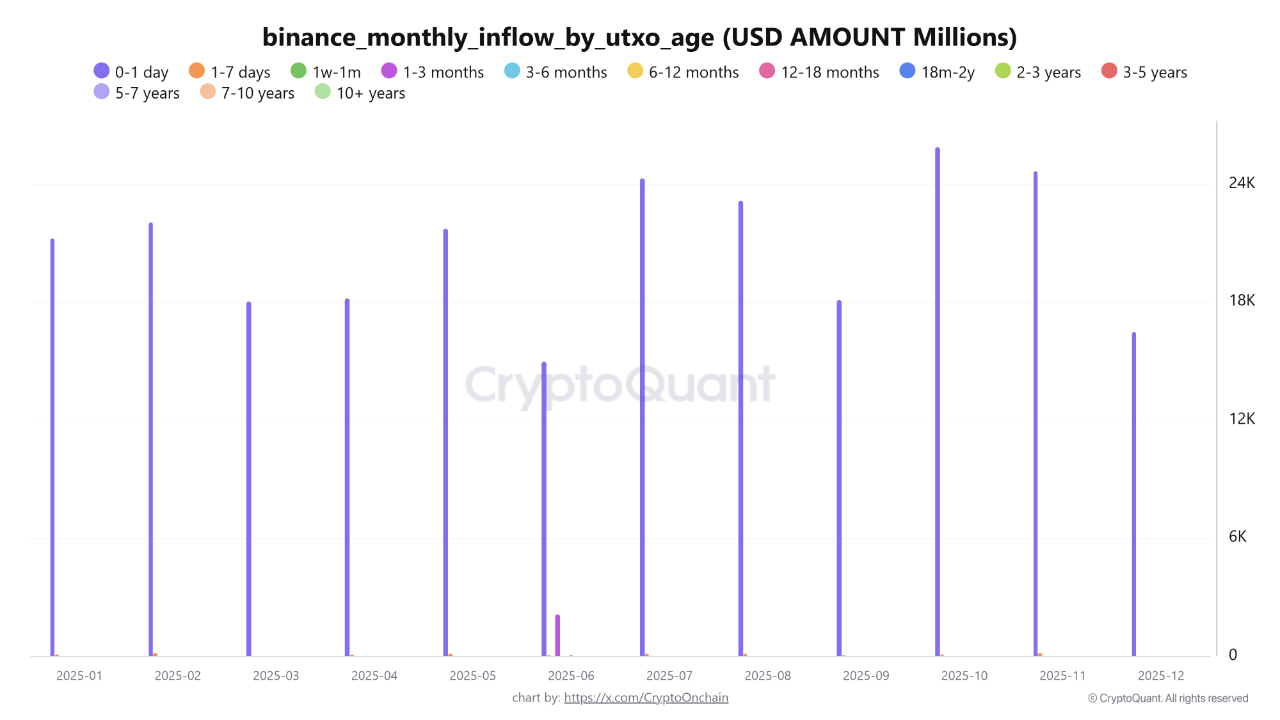
Source: CryptoQuant

It is worth noting that heightened inflows from this investor group point to a growing inclination to sell. This translates to the Bitcoin price as elevated bearish pressure, which leads to short-term price corrections. The inflows decline in December is therefore an inversion. It reveals a “cooling of speculative activity,” which in turn translates on the charts as a significant loss of selling pressure.

The crypto pundit further highlights possible reasons for this exodus of speculative activity. Structurally, the analyst conjectures that the inflow decline could be due to fading price momentum, characteristic of the final days of the year. Short-term holders might have exited the market due to caution, to observe what the new year brings, without getting caught in the mix.

This action then causes a “handover of supply control” to Bitcoin’s mid-term and long-term investors. Historically, such transitions have been associated with consolidation phases and periods of lower volatility, where no significant amount of directional momentum is seen. Hence, if history is anything to go by, the Bitcoin price could be gearing up for sustainable cycles in the coming months.

Bitcoin Price Overview

At press time, Bitcoin holds a valuation of about $89,533, with CoinMarketCap data showing a daily growth of 0.85%.

BTC trading at $89,533 on the daily chart | Source: BTCUSDT chart on Tradingview.com

Related Reads

The Second Half of Macro Influencer Fu Peng's Career

Fu Peng, a prominent Chinese macroeconomist and former chief economist of Northeast Securities, has joined Hong Kong-based digital asset management firm Bitfire Group (formerly New Huo Group) as its chief economist. This move, announced in April 2026, triggered an 11% surge in Bitfire's stock price. Fu, known for his accessible macroeconomic commentary and large social media following, will focus on integrating digital assets into global asset allocation frameworks, particularly combining FICC (fixed income, currencies, and commodities) with cryptocurrencies for institutional clients. His career includes roles at Lehman Brothers and Solomon International, with significant influence gained through public communication. However, in late 2024, Fu faced temporary social media bans after a controversial private speech at HSBC on China's economic challenges, though he denied regulatory sanctions. He later left Northeast Securities citing health reasons. Bitfire, a licensed virtual asset manager serving high-net-worth clients, seeks to build trust and attract traditional capital through Fu’s expertise and credibility. The partnership represents a strategic shift for both: Fu enters the crypto sector after a traditional finance peak, while Bitfire aims to leverage his macro framework for institutional adoption. Outcomes remain uncertain regarding capital inflows and compatibility within corporate structure.

marsbit1h ago

The Second Half of Macro Influencer Fu Peng's Career

marsbit1h ago

Trading

Spot
Futures

Hot Articles

Discussions

Welcome to the HTX Community. Here, you can stay informed about the latest platform developments and gain access to professional market insights. Users' opinions on the price of S (S) are presented below.

活动图片