Author: Michael Burry
Compiled by: Deep Tide TechFlow
The New York Times, Saturday, June 19, 1880
Welcome to the "History Always Rhymes" series. In this series, I illuminate current events from the key perspectives of the distant past.
On a quiet Saturday, as I was perusing old newspapers—a hobby of mine—I came across a report from June 19, 1880, which has a startling relevance to our current anxieties about AI.
This is the story of Melville Ballard. He grew up without language, yet by staring at a tree stump, he asked himself a question: Did the first man grow from here?
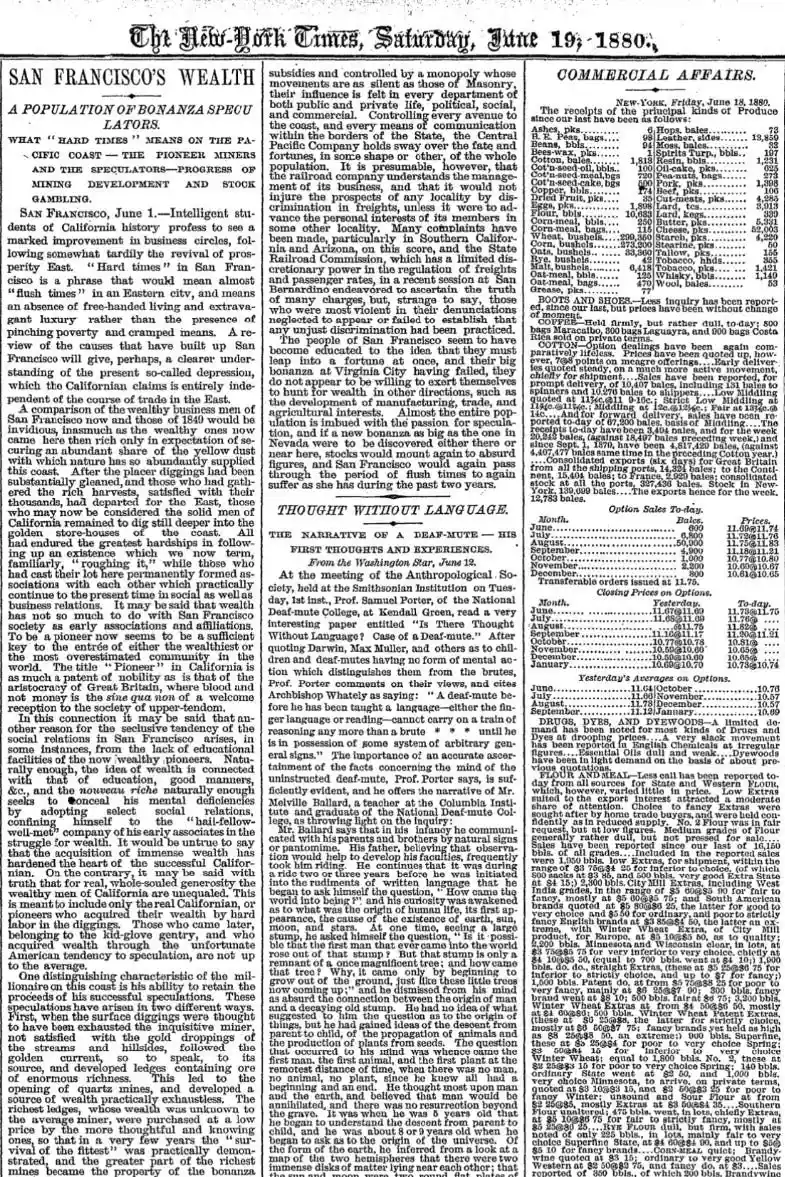
This case from 144 years ago—officially presented at the Smithsonian Institution—poses a potentially fatal challenge to today's large language models and the massive investments behind them. Through the story of an ordinary person, it boldly declares: complex thought is born in the silence that precedes language.
Today, deep in the 21st century, by placing language before rational capacity, we are not building intelligence—we are merely crafting an increasingly refined mirror.
In that old newspaper, two articles are worth noting. Let's start with the one in the middle of the third page, titled: "Thought Without Language."
Of course, large language models, small language models, and reasoning capabilities are the hottest topics right now.
The full title of that article was: "Thought Without Language—A Deaf-Mute's Account of His Earliest Thoughts and Experiences." It was first published in The Washington Star on June 12, 1880.
The subject was Professor Samuel Porter of the Kendall Green National Deaf-Mute College, who presented a paper at the Smithsonian Institution titled, "Can There Be Thought Without Language? A Case of a Deaf-Mute."
The paper began by discussing the mental activities of deaf-mutes and children without linguistic forms, using terminology far behind today's standards, and I was about to skip it.
But the case's subject was a teacher at the Columbia Institution for the Instruction of the Deaf and Dumb—Melville Ballard himself, a deaf-mute and also a graduate of the National Deaf-Mute College.
Ballard said that in his childhood he communicated with his parents and brothers through natural gestures or pantomime. His father believed observation would develop his intellect and often took him out riding.
He continued: Two or three years before he was formally introduced to the basics of written language, during one of these rides, he began to ask himself: "How did the world come to be?" He developed a strong curiosity about the origin of human life, its initial appearance, and the reason for the existence of the earth, sun, moon, and stars.
Once, he saw a large tree stump and a question arose in his mind: "Could the first man to come into the world have grown from that stump?" But then he thought, that stump was just the remnant of a once majestic tree; how did that tree come to be? It grew slowly from the ground, just like the small saplings before him—he then dismissed the idea of linking human origin to a decayed old stump as absurd.
He didn't know what triggered his inquiry into the origin of all things, but he had already established concepts of parental inheritance, animal reproduction, and plants growing from seeds.
The question truly lingering in his mind was: At the most distant beginning, when there were no people, no animals, no plants, where did the first man, the first animal, the first plant actually come from? He thought most about people and the earth, believing that people would eventually perish, with no resurrection after death.
Around the age of 5, he began to understand the concept of parental inheritance; by 8 or 9, he began to question the origin of the universe. Regarding the shape of the earth, he inferred from a map of two hemispheres that they were two huge material disks, adjacent to each other; the sun and moon were two circular luminous plates, and he felt a certain awe towards them, inferring from their rising and setting that there must be something with power governing their paths.
He thought the sun entered a hole in the west and emerged from another hole in the east, traveling through a huge pipe inside the earth along the same arc it traced in the sky. The stars, in his eyes, were tiny points of light embedded in the celestial curtain. He described how he pondered all this in vain until he entered school at age 11.
Before that, his mother had told him about a mysterious being in the sky, but when she couldn't answer his further questions, he could only give up in despair, filled with sadness because he couldn't gain any definite knowledge about that mysterious celestial life.
In his first year at school, he only learned a few sentences each Sunday, and although he studied these simple words, he never truly understood their meaning. He attended services, but due to insufficient mastery of sign language, he understood almost nothing. In the second year, he had a small catechism with a series of questions and answers.
The combination of language and rational capacity thus propelled the development of understanding.
Thereafter, he was able to understand the sign language used by the teachers. One might think his curious nature should have been satisfied. This was not the case—when he learned that the universe was created by that great ruling Spirit, he began to ask: Where did the Creator come from? He continued to pursue the nature and origin of that Ruler. Thinking about this, he asked himself: "After we enter the Lord's kingdom, can we know God's essence and understand His infinity?" Should he, like that patriarch, say: "Can you find out the deep things of God?"
Professor Porter then presented his core argument to the 1880 Smithsonian audience.
He said that animals might understand certain words and distinguish certain objects. But he pointed out:
"Even granting all the possibilities possessed by animals, is it not obvious—that man possesses some faculties which we cannot conceive of as developed from anything held in common with the lower animals, nor as merely an enhancement in degree of those common traits."
"...However similar the mode of impression or the structure of the organs, however dependent on organic activities—that is, however closely connected physiologically—the perception of the eye, as a sensation or perception, is inherently different from that of the ear, head, or tongue, and implies a special gift or faculty not contained in the latter. Rational action and the operation of the lower faculties are not so."
"...That the two share certain elements does not prove they belong to the same order, nor make it possible for one to develop into the other. If the soul's eye—that higher reason which enables us to discern the universe of things—cannot look inward and clearly distinguish its own nature and operations, we should not therefore forget its function, deny its essential superiority, or equate it with those lower, subordinate faculties which we can use it to examine. That which enables us to understand all things must, in its essence, be superior to anything understood by it."
One audience member particularly noted that Ballard's eyes, above all, perfectly conveyed meaning, without any misunderstanding:
"The most interesting part of the meeting was Mr. Ballard's description in gesture of how his mother told him he was going to a faraway school where he would read from books and write letters to fold and send to her; and the pantomime of a hunter who, after shooting a squirrel, accidentally shot himself. Mr. Ballard's gestures and movements, along with his eyes and facial expressions, perfectly conveyed his meaning to the audience. In the words of one member, the expression of the eyes is a language that cannot be misunderstood."
Consider these two sentences:
- "That which enables us to understand all things must, in its essence, be superior to anything understood by it."
- "The expression of the eyes is a language that cannot be misunderstood."
To summarize:
- Language without rational capacity cannot achieve understanding
- Only when rational capacity exists can language unlock understanding
- Fully realized understanding transcends language itself
Large language models place language first, building a primitive form of reason purely through logical inference. But this reason has proven flawed, prone to hallucinations at the many rough edges of knowledge.
Rational capacity never truly exists within them. Therefore, language cannot be sublimated into understanding through reason.
The professor, in his work with deaf-mutes, found: true rational capacity must precede language for language to unlock understanding—understanding is the result produced by true rational capacity and language together.
"The expression of the eyes is a language that cannot be misunderstood."
In other words, the expression of the eyes is the form of perfect understanding—without the need for language.
Large language models, by placing language before true rational capacity, can never reach understanding.
If understanding truly transcends language—as revealed in this Smithsonian presentation 144 years ago—we shouldn't have trouble finding evidence for it today.
I can appreciate this from my own study and practice of medicine. Throughout pre-med courses and most of medical school, deductive logic is the tool students use to organize the vast body of medical knowledge. Entering the clinical phase, the art of medicine—physical signs, emotions, human expertise—develops. Then, at some point during residency or early practice, with the accumulation of much of this experience, understanding finally arrives. All the parts connect with each other in a vast, complex network, allowing experienced physicians to provide complete patient care.
Two surgeons handling a complex head and neck cancer surgery or trauma, or the nurses working with them, can sometimes communicate with just a glance—complete understanding is conveyed, action is triggered, because everyone present has reached an understanding that transcends logical inference and the primitive reasoning forms of memorization and puzzle-solving from early medical education.
The glance thus provides an intuitive grasp of reality, built on shared understanding, which in turn comes from rational capacity in the presence of language.
Large language models—and small language models—are permanently stuck in the middle. They can simulate reasoning, but lack true rational capacity, lack eyes, lack understanding.
The Ballard Test: An entity must demonstrate reason without language to truly possess understanding.
This is a known flaw, a bad starting point. The initial direction of AI research was to generate true rational capacity first, but this was never achieved, so the field turned to language-first—because it was easier.
This "bad starting point" led to a "parameter trap": brute-force language processing powered by countless power-hungry chips has become an extremely ironic bottleneck.
As highlighted in my conversation with Klarna founder Sebastian Siemiatkowski, the way forward lies in compression—prioritizing "System 2" reasoning, digesting information redundancy and the relatively limited set of queries generated by humans, thereby drastically reducing computational demands.
This new path rejects the route of language models talking to each other in an infinite mirror pursuit of the singularity—a directionless waste of resources and, lacking support from economic reality, ultimately impossible.
Cutting-edge research like Google's AlphaGeometry and Meta's Coconut is shifting towards this "reason-first" architecture, but they are essentially rediscovering what was presented at the Smithsonian 144 years ago: Language is the output of understanding, not the engine of reason.
This multi-trillion-dollar "compute myth" might be broken by a return—a return to the silence of pre-linguistic reason. It is the return of the full-bandwidth rational capacity of the deaf-mute, whose silent thoughts reached for the stars in the firmament before finding the words to express them.
Silicon Valley
As mentioned earlier, there was another noteworthy article on the same page. Its relevance to the first is greater than anyone in the 1880s could have imagined.
This article was called: "The Wealth of San Francisco: A City Full of Speculators Who Get Rich Quick."
It was written in San Francisco on June 1, 1880, but not published in The New York Times until June 19.
The French saying comes to mind: "The more things change, the more they stay the same." It feels apt here.
"What San Francisco calls 'hard times' might mean 'quite comfortable days' in Eastern cities, referring to a lack of extravagance and lavish spending, rather than poverty and dire straits."
California at that time was a paradise for small-scale capital players. To satisfy the desire for speculation, a unique open bidding system emerged: for just $50, you could buy a share in a mine, at one dollar per share, or two shares for fifty cents, or any quantity at different prices.
When a certain stock "boomed," it seemed only to fuel the urge to "do it again." It ignited the same speculative fervor in San Francisco, with people vying to chase the lost opportunities of the get-rich-quick groups; the "boom" came with market losses, the "boom" faded, and stock prices returned to normal.
The article's conclusion hits remarkably hard on today's reality:
San Franciscans seem to have grown accustomed to the notion that wealth must be obtained in one fell swoop, and after their big get-rich-quick scheme in Virginia City fell through, they seemed unwilling to rouse themselves to seek wealth in other directions like manufacturing, trade, and agriculture. Almost the entire city is filled with speculative enthusiasm, and if a new bonanza mine as big as Nevada's were discovered here or nearby, stock prices would again soar to absurd heights, San Francisco would again experience those get-rich-quick years, and then again endure everything it has suffered the past two years.
In my article "The Core Sign of a Bubble: Greed on the Supply Side," I traced this astonishing tendency originating from the San Francisco Bay Area: speculation constantly heats up, driving investment far beyond what any anticipated end demand could absorb in any reasonable timeframe.
Reading such old newspapers allows us to interpret today's events from a unique perspective. Whether Silicon Valley will "again experience those get-rich-quick years, and then again endure everything," as it has done time and again, or whether it will break the pattern—no one can say for sure. I hope this article has been beneficial to you.
Finally, I want to recommend Midjourney, a tool for generating images and videos, to the readers.
It's incredibly fun and thought-provoking. Get creative!
Until next time!