"Big Short" Burry: Bitcoin Has Already Crashed 40%, If It Falls Another 10%, It Will Trigger "Disastrous Consequences"

华尔街日报Published on 2026-02-04Last updated on 2026-02-04

Abstract

Famed "Big Short" investor Michael Burry warns that a further 10% drop in Bitcoin, which has already fallen over 40% from its peak, could trigger "disastrous consequences." He argues Bitcoin has failed as a hedge asset and remains purely speculative, noting its inability to respond to typical drivers like dollar weakness or geopolitical risk. Burry highlights that nearly 200 public companies hold Bitcoin, and a continued decline could force corporate treasuries to sell, exacerbating losses. He specifically cautions that a 10% drop would push aggressive corporate holder Strategy Inc. into billions in losses and cut off its access to capital markets. Additionally, Burry warns that Bitcoin sell-off could spill over to broader markets, potentially causing a "collateral death spiral" in tokenized metal futures—which aren’t backed by physical metal—as investors liquidate positions. Despite the warning, the report notes Bitcoin’s relatively small market size may limit wider financial contagion.

Michael Burry, known for successfully predicting the 2008 U.S. housing market crash, warned that Bitcoin has already plummeted 40%, and if it continues to fall, it could cause lasting damage to companies that have heavily accumulated the asset over the past year. He believes Bitcoin has proven to be a purely speculative asset, failing to act as a hedge like precious metals.

In a Substack article published on Monday, Burry pointed out that if Bitcoin falls another 10%, one of the most aggressive Bitcoin-hoarding companies, Strategy Inc., would face billions of dollars in losses and would be largely shut out of capital markets. He warned that a Bitcoin decline could trigger "disastrous consequences," including spillover into broader markets and causing a "collateral death spiral" in tokenized metal futures.

This warning comes as Bitcoin continued its sharp decline on Tuesday, briefly falling below $73,000, erasing all gains since Donald Trump's re-election in November 2024. Since hitting an all-time high in early October, the digital currency has dropped more than 40%.
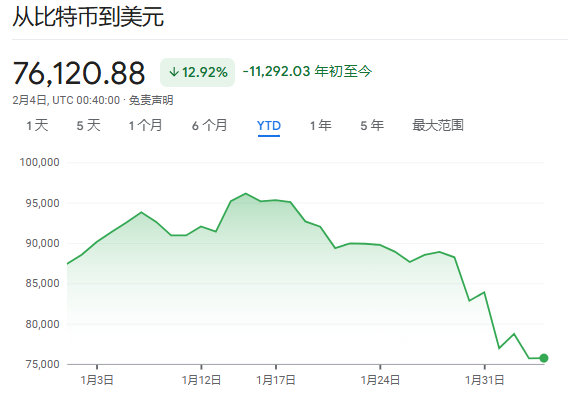
Despite Burry's warning, the cryptocurrency market remains relatively small and is unlikely to cause widespread contagion. With a market capitalization of less than $1.5 trillion, limited household ownership, and narrow corporate adoption, any wealth effects are likely to remain contained.

Bitcoin Exposes Speculative Nature, Fails as Safe-Haven Asset

Burry noted in the article that Bitcoin has failed to respond to typical drivers like a weak U.S. dollar or geopolitical risks, while gold and silver have hit record highs amid global tensions and fears of dollar devaluation. "Bitcoin has no organic use case rationale to slow or stop its decline," Burry said.

According to Bloomberg, analysts attribute Bitcoin's decline to multiple factors, including vanishing inflows, shrinking liquidity, and a broad loss of macro appeal. Many crypto-native traders have also cooled on tokens, shifting to event betting with the rise of prediction markets.

Bitcoin fell over the weekend to its lowest level since last year's tariff-induced turmoil and continued to drop on Tuesday. This performance contrasts sharply with the arguments of its long-term supporters, who believe Bitcoin's fixed supply makes it comparable to gold.

Treasury Companies Face Immense Pressure

Burry warned that the adoption of Bitcoin by corporate treasuries and the launch of new spot cryptocurrency exchange-traded funds (ETFs) are not enough to support its price indefinitely or prevent disastrous consequences in a sharp downturn. He pointed out that nearly 200 publicly traded companies hold Bitcoin.

While this has helped broaden demand, "inventory assets are not permanent," he wrote. Inventory assets must be marked to market and included in financial reports. If Bitcoin's price continues to fall, risk managers will begin advising their companies to sell.

Burry specifically mentioned that if Bitcoin falls another 10%, Strategy Inc., one of the most aggressive Bitcoin-hoarding companies, would be plunged into billions of dollars in losses and find capital markets largely closed to it. He described these "nauseating scenarios as now within reach."

ETFs Amplify Speculation and Increase Market Correlation

Burry added that the emergence of spot ETFs has only intensified Bitcoin's speculative nature while also increasing the token's correlation with the stock market. He wrote that Bitcoin's correlation with the S&P 500 recently approached 0.50. Theoretically, liquidation will kick in aggressively as losing positions start to grow.

Burry noted that since late November, Bitcoin ETFs have been setting some of the largest single-day outflow records, with three occurring in the last 10 days of January.

This trend suggests that institutional investor confidence in Bitcoin is waning, and ETFs, which were originally seen as a tool to broaden Bitcoin adoption, may instead accelerate selling during a market downturn.

Warns of "Collateral Death Spiral" Risk

As Bitcoin continues to fall below certain key levels, Burry believes it is spilling over into broader markets. He noted that the cryptocurrency's decline is partly responsible for the recent crash in gold and silver, as corporate treasurers and speculators need to de-risk by selling profitable positions in tokenized gold and silver futures.

These tokenized metal futures are not backed by actual physical metal and could overwhelm physical metal trading, leading to a "collateral death spiral," he said.

"It appears that at month-end, up to $1 billion in precious metals were liquidated due to falling crypto prices," Burry wrote. If Bitcoin falls to $50,000, miners will go bankrupt, and "tokenized metal futures would collapse into a black hole with no buyers," he stated.

Nevertheless, some market observers point out that past crashes—from Terra to FTX—failed to infect traditional markets. Bulls now point to regulatory clarity and cheap valuations as potential fuel for another rally. But Burry's warning highlights the systemic risks posed by Bitcoin's role as a treasury asset for corporations.


Related Questions

QWhat specific warning did Michael Burry issue regarding Bitcoin's potential further decline?

AMichael Burry warned that if Bitcoin falls another 10%, it could cause 'disastrous consequences,' including billions in losses for aggressive corporate holders like Strategy Inc., inability to access capital markets, and potentially triggering a 'collateral death spiral' in tokenized metal futures.

QAccording to Burry, why has Bitcoin failed to serve as a hedge asset compared to precious metals?

ABurry stated that Bitcoin has failed to react to typical drivers like dollar weakness or geopolitical risks, unlike gold and silver, which hit record highs due to global tensions. He called Bitcoin a purely speculative asset with no organic use case to slow or stop its decline.

QHow have Bitcoin ETFs affected its market behavior, as per Burry's analysis?

ABurry argued that Bitcoin ETFs have intensified its speculative nature and increased its correlation with the stock market, nearing 0.50 with the S&P 500. He noted significant outflows from Bitcoin ETFs, particularly in late January, indicating weakening confidence and potential accelerated selling during downturns.

QWhat risk does Burry associate with tokenized metal futures in the context of Bitcoin's decline?

ABurry warned that tokenized metal futures, not backed by physical metal, could be overwhelmed by Bitcoin's decline, leading to a 'collateral death spiral.' He estimated up to $1 billion in precious metals were liquidated due to crypto price drops, and if Bitcoin falls to $50,000, these futures could collapse into a 'black hole' with no buyers.

QHow does Burry characterize the impact of corporate Bitcoin adoption on market stability?

ABurry highlighted that nearly 200 public companies hold Bitcoin as treasury assets, which must be marked to market. If prices fall, risk managers may force sales, exacerbating declines. He emphasized that treasury assets are not permanent and could lead to systemic risks, as seen with Strategy Inc. facing massive losses and capital market exclusion.

Related Reads

First Batch of Keynote Speakers and Partners Announced! Web2+3 Summit: Defining the Next Generation of Digital Economy

Web2+3 Summit: Defining the Next Generation of Digital Economy The 6th BEYOND International Technology Innovation Expo (BEYOND Expo 2026), Asia's largest tech and ecosystem exhibition, is launching a dedicated Web2+3 stage for the first time. Co-hosted by BEYOND Expo and ChainNeXT Group, the Web3 Summit will take place from May 28–30, 2026. Against the backdrop of accelerating global tech integration, the boundaries between Web2 and Web3 are rapidly blurring. With clearer global regulations for blockchain-driven internet (Web3) and the special issuance of a Hong Kong dollar stable币 license by the Hong Kong SAR government on April 10, 2026, Web3's decentralized principles are quickly merging with traditional industries (Web2) such as e-commerce, finance, and artificial intelligence. Focused on blockchain-driven digital economy elements, the summit will center on three core principles—implementability, commercial viability, and compliance. It will bring together top Web3 experts to discuss key integration areas like stablecoin payment finance (PayFi), real-world asset tokenization (RWA), and decentralized AI (DeAI), unveiling new opportunities for industrial innovation. The first wave of confirmed speakers includes Jack Kong (Director of Hong Kong Cyberport, Chairman of Nano Labs), Yat Siu (Chairman of Animoca Brands), Michael Wu (Co-founder & CEO of Amber Group), Michael Heinrich (Co-founder & CEO of 0G), and Art Abal (Co-founder of Vana). More Web3 ecosystem pioneers, AI, and fintech experts will be announced soon. Core forum topics include: - Web2+DeAI: New AI Paradigms Driven by Decentralized Infrastructure - Web2+RWA: Real-World Asset Tokenization and Global Liquidity - Web2+PayFi: Cross-Border Payments and Financial Innovation Powered by Crypto Infrastructure - Web2+3 AI: Autonomous Agents and the Crypto Economy - Web2+3 Wealth: On-Chain and Off-Chain Integrated Investment Ecosystems - Web2+3 Commerce: A New Landscape for Global Trade Driven by Stablecoins Additional agenda details will be released in the near future.

marsbit2h ago

First Batch of Keynote Speakers and Partners Announced! Web2+3 Summit: Defining the Next Generation of Digital Economy

marsbit2h ago

Trading

Spot
Futures

Hot Articles

What is $BITCOIN

DIGITAL GOLD ($BITCOIN): A Comprehensive Analysis Introduction to DIGITAL GOLD ($BITCOIN) DIGITAL GOLD ($BITCOIN) is a blockchain-based project operating on the Solana network, which aims to combine the characteristics of traditional precious metals with the innovation of decentralized technologies. While it shares a name with Bitcoin, often referred to as “digital gold” due to its perception as a store of value, DIGITAL GOLD is a separate token designed to create a unique ecosystem within the Web3 landscape. Its goal is to position itself as a viable alternative digital asset, although specifics regarding its applications and functionalities are still developing. What is DIGITAL GOLD ($BITCOIN)? DIGITAL GOLD ($BITCOIN) is a cryptocurrency token explicitly designed for use on the Solana blockchain. In contrast to Bitcoin, which provides a widely recognized value storage role, this token appears to focus on broader applications and characteristics. Notable aspects include: Blockchain Infrastructure: The token is built on the Solana blockchain, known for its capacity to handle high-speed and low-cost transactions. Supply Dynamics: DIGITAL GOLD has a maximum supply capped at 100 quadrillion tokens (100P $BITCOIN), although details regarding its circulating supply are currently undisclosed. Utility: While precise functionalities are not explicitly outlined, there are indications that the token could be utilized for various applications, potentially involving decentralized applications (dApps) or asset tokenization strategies. Who is the Creator of DIGITAL GOLD ($BITCOIN)? At present, the identity of the creators and development team behind DIGITAL GOLD ($BITCOIN) remains unknown. This situation is typical among many innovative projects within the blockchain space, particularly those aligning with decentralized finance and meme coin phenomena. While such anonymity may foster a community-driven culture, it intensifies concerns about governance and accountability. Who are the Investors of DIGITAL GOLD ($BITCOIN)? The available information indicates that DIGITAL GOLD ($BITCOIN) does not have any known institutional backers or prominent venture capital investments. The project seems to operate on a peer-to-peer model focused on community support and adoption rather than traditional funding routes. Its activity and liquidity are primarily situated on decentralized exchanges (DEXs), such as PumpSwap, rather than established centralized trading platforms, further highlighting its grassroots approach. How DIGITAL GOLD ($BITCOIN) Works The operational mechanics of DIGITAL GOLD ($BITCOIN) can be elaborated on based on its blockchain design and network attributes: Consensus Mechanism: By leveraging Solana’s unique proof-of-history (PoH) combined with a proof-of-stake (PoS) model, the project ensures efficient transaction validation contributing to the network's high performance. Tokenomics: While specific deflationary mechanisms have not been extensively detailed, the vast maximum token supply implies that it may cater to microtransactions or niche use cases that are still to be defined. Interoperability: There exists the potential for integration with Solana’s broader ecosystem, including various decentralized finance (DeFi) platforms. However, the details regarding specific integrations remain unspecified. Timeline of Key Events Here is a timeline that highlights significant milestones concerning DIGITAL GOLD ($BITCOIN): 2023: The initial deployment of the token occurs on the Solana blockchain, marked by its contract address. 2024: DIGITAL GOLD gains visibility as it becomes available for trading on decentralized exchanges like PumpSwap, allowing users to trade it against SOL. 2025: The project witnesses sporadic trading activity and potential interest in community-led engagements, although no noteworthy partnerships or technical advancements have been documented as of yet. Critical Analysis Strengths Scalability: The underlying Solana infrastructure supports high transaction volumes, which could enhance the utility of $BITCOIN in various transaction scenarios. Accessibility: The potential low trading price per token could attract retail investors, facilitating wider participation due to fractional ownership opportunities. Risks Lack of Transparency: The absence of publicly known backers, developers, or an audit process may yield skepticism regarding the project's sustainability and trustworthiness. Market Volatility: The trading activity is heavily reliant on speculative behavior, which can result in significant price volatility and uncertainty for investors. Conclusion DIGITAL GOLD ($BITCOIN) emerges as an intriguing yet ambiguous project within the rapidly evolving Solana ecosystem. While it attempts to leverage the “digital gold” narrative, its departure from Bitcoin's established role as a store of value underscores the need for a clearer differentiation of its intended utility and governance structure. Future acceptance and adoption will likely depend on addressing the current opacity and defining its operational and economic strategies more explicitly. Note: This report encompasses synthesised information available as of October 2023, and developments may have transpired beyond the research period.

363 Total ViewsPublished 2025.05.13Updated 2025.05.13

What is $BITCOIN

Discussions

Welcome to the HTX Community. Here, you can stay informed about the latest platform developments and gain access to professional market insights. Users' opinions on the price of BTC (BTC) are presented below.

活动图片