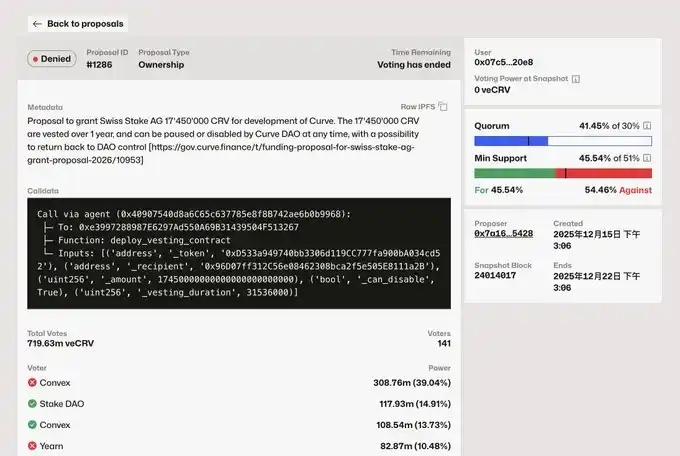
A few days ago, a funding proposal on Curve was rejected, which involved allocating 17M $CRV to the development team (Swiss Stake AG) for development expenses. Both Convex and Yearn voted against it, and their voting power was sufficient to influence the final outcome.
Since the Aave governance issue began to gain attention, governance has started to be scrutinized by the market, and the habit of approving funding requests without question is being broken. This Curve proposal highlights two key points:
1. Some voices in the community are not opposed to funding AG, but they want clarity on how previous funds were used, how future funds will be utilized, whether the approach is sustainable, and whether it has generated returns for the project. At the same time, this overly simplistic grant model lacks accountability once funds are disbursed. In the future, the DAO needs to establish a Treasury, ensure transparency in income and expenditures, or add governance constraints.
2. The major veCRV holders do not want to dilute their value. This is a clear conflict of interest. If the projects supported by CRV grants cannot foreseeably benefit veCRV holders, they are unlikely to gain support. Of course, Convex and Yearn also have their own agendas and influence, but that’s a separate issue.
This proposal was initiated by Curve founder Mich. AG is one of the teams that has been maintaining the core codebase since 2020. The roadmap presented by AG for this funding includes advancing llamalend, supporting PT and LP, as well as expanding the on-chain foreign exchange market and crvUSD. These seem like worthwhile initiatives, but whether they justify a 17M $CRV grant is another calculation. Particularly, Curve’s governance differs significantly from Aave’s, with power distributed among several teams with distinct stances.
Comparing ve with conventional governance models:
First, the conclusion: most conventional governance models, by design, have little to no advantage. Of course, if a DAO is mature enough, traditional structures can function well, but unfortunately, no crypto project has reached that level of maturity yet, as even market-consensus leaders like Aave have encountered issues.
If we focus solely on model design, ve has some advanced aspects. Firstly, it generates cash flow and is backed by liquidity control rights. When there is external demand for liquidity, this power is subject to bribes. So even if you don’t want to lock your tokens long-term, you can delegate them to proxy projects like Convex/Yearn to earn yields.
Thus, ve is a model where voting rights are tied to cash flow. Its future evolution will likely follow the path of “governance capitalism.” Vetoken binds voting rights with “long-term locking,” essentially筛选 those with large capital, ability to bear liquidity loss, and capacity for long-term博弈. Over time, this means governance will shift from ordinary users to “capital groups.”
At the same time, due to the presence of proxy layers like Convex/Yearn, many ordinary users, even loyal ones, who want to retain liquidity and flexibility while earning yields, will gradually choose to delegate their governance to these projects.
This vote also offers some insight: in the future, Mich may not be the key player in Curve’s governance; instead, power lies with these major token holders. When Aave faced governance issues, some proposed the idea of “delegated governance/elite governance,” which is quite similar to Curve’s current structure. As for whether this is good or bad, only time will tell.