Base's Growth Dilemma: Why Did Everything Go Right, But Users Still Leave?

marsbitPublished on 2026-04-02Last updated on 2026-04-02

Abstract

Based on the Japanese philosophical concept of "basho" (a field or place that shapes its inhabitants), this analysis explores why Base blockchain, despite initial explosive growth, is now facing a significant user exodus. Launched by Coinbase in 2023, Base quickly became the fastest-growing Layer 2 (L2) solution, reaching a peak of 1.72 million daily active addresses and $5.6 billion in TVL by late 2025. Its immense distribution power from Coinbase's 100 million users created strong belief it would solve Ethereum's user adoption problem. However, after confirming a token launch in September 2025, active addresses plummeted by 73% to 458,000 by March 2026. The analysis attributes this to Base building a mere "location" for transactions rather than a "basho"—a meaningful context where users form identities and relationships. Its bet on a tokenized creator economy via Zora also failed; 99.7% of created tokens became inactive. The core issue is that financial incentives can attract users but cannot fabricate a genuine reason to stay. Unlike a "third place" (e.g., a community square), which people return to for non-transactional reasons, Base was designed for extraction, leading users to leave once incentives dried up. The piece contrasts Base with chains like Arbitrum and Hyperliquid, which, despite also seeing declines, retained users through unique community identity and experiences rather than mere speculation. The conclusion is that the entire L2 model is cooling, and s...

A few days ago, I came across a concept in Japanese philosophy: basho. Roughly translated as "place," but the philosopher Kitaro Nishida endowed it with a meaning far beyond a geographical location, more like a situation: a field where all things can become themselves. In other words: people do not appear in a place by accident, but are shaped by where they are. Today, I will use this theory to interpret Base.

Last month, its number of active addresses fell to an 18-month low. Reflecting on this phenomenon, I realized: Base built only a location, but never created the conditions for things to grow and take shape.

When Coinbase launched Base in 2023, the crypto-native community surprisingly developed a kind of faith. Everyone believed that it could finally solve Ethereum's oldest problem: infrastructure everywhere, but no real users. And Coinbase, with 100 million users and unparalleled distribution capabilities, had a unique advantage. The door opened, and users were already waiting outside.

For a while, this confidence seemed to be validated. Base's growth rate surpassed all previous Layer2s. In October 2025, its Total Value Locked (TVL) reached $5.6 billion, and its fee income was unmatched in the entire L2 field. So, in September 2025, Base confirmed the issuance of a token, seemingly heralding an inevitably successful experiment. Yes, a place was becoming a basho.

Then, the users left.

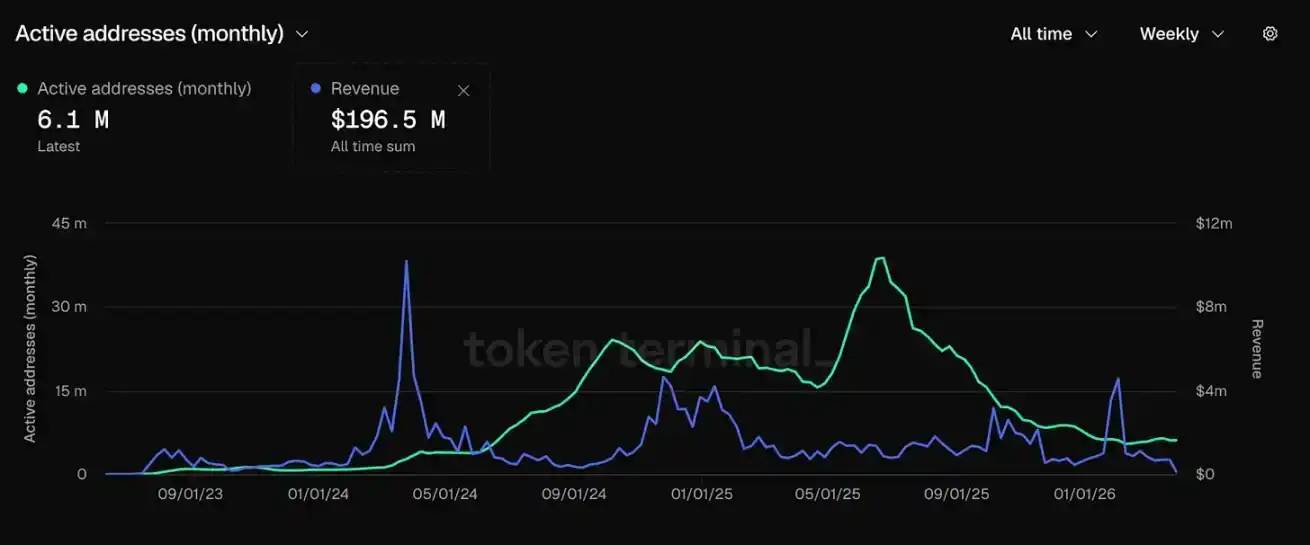
Look at the data for a clearer picture: Base's active addresses returned to the level of July 2024. The token issuance expectation恰好满足了空投党的需求:拿到最后一笔报酬,然后走人.
Base's bet on the creator economy in 2025 also did not work. Its core was the Zora protocol, which tokenizes content by default. By the end of the year, 6.52 million creator and content tokens were issued on Base through Zora, of which only 17,800 remained consistently active throughout the year, accounting for 0.3%. The remaining 99.7% were already neglected.

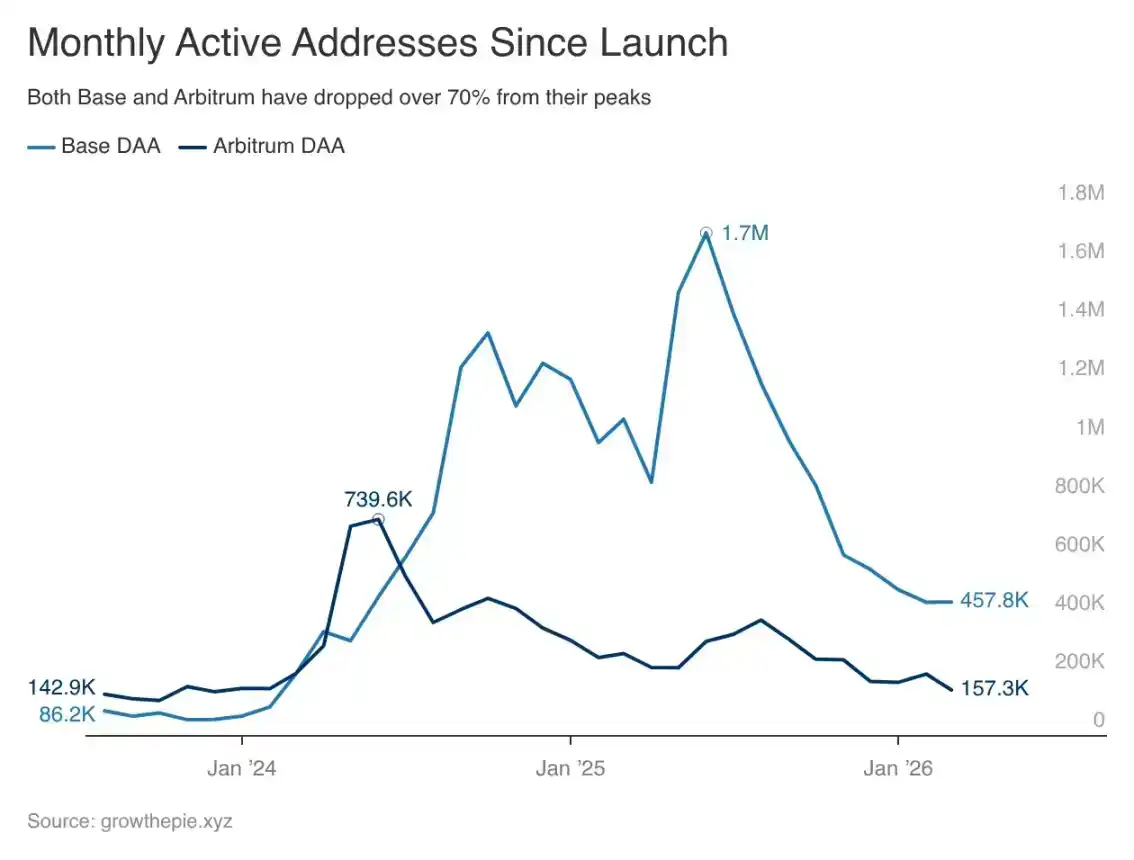
Base's daily active addresses peaked at 1.72 million in June 2025. By March 2026, only 458,000 remained, a sharp drop of 73% from the peak. After Armstrong announced in September 2025 that Base was considering issuing a token, active addresses decreased by 54% in just six months, meaning speculative capital has completely left the market.
Sociologist Ray Oldenburg once studied: what makes people return to a place repeatedly without compensation. He called it the third place, such as bars, barbershops, city squares. They are not efficient production spaces, but they give people a reason to return unrelated to incentives. The core is: the desire to come back cannot be artificially manufactured; it can only grow naturally from the possibilities provided by the place over time. The cryptocurrency industry designs places for the purpose of extracting value from users, and then wonders why no one stays.

This is a location without basho: people pass by, take what they need, and leave, because leaving costs nothing. No identity is formed here, no capabilities that cannot be replicated elsewhere within three weeks, nothing that makes leaving a loss. Do unique relationships exist on this chain? We have never built things with this mindset, have we?

You cannot build basho with financial incentives. Incentives can certainly pull people in the door, but they cannot make people *want* to stay. The desire to stay must come from the possibilities nurtured by the place over the long term. Kitaro Nishida called this "basho logic," referring to how the relational field shapes the things that emerge within it. The crypto industry designed fields for extraction, and was finally surprised to find that only extraction was born.

Brian Armstrong has publicly stated that the Base App now focuses on becoming a self-custody, trading version of Coinbase.

The former social and creator vision aimed at building social stickiness and allowing users to establish identities worth protecting on-chain has disappeared. Judging from the data, this is a rational decision, but it also admits: this vision never truly formed. Base has a location, and it now only focuses on serving past users, because that is all it can provide.

One Chain, One Track

Base is the most visible epitome of the entire L2 model.

Since June 2025, the usage of small and medium-sized L2s has overall declined by 61%. Most chains outside the top three have become zombie chains: active enough not to shut down, but deserted enough to be insignificant. The ratio of L2 to L1 daily active users has dropped from 15 times in mid-2024 to 10-11 times today. Most new L2s see usage collapse directly after the incentive cycle ends. The entire L2 ecosystem is cooling down, not just Base.

The Rollup-centric roadmap was once a theory about user adoption: reduce participation costs → users flood in → ecosystem forms → compound growth. The Ethereum Foundation released a 38-page vision document this year outlining Ethereum's future direction. The largest L2 by scale hit bottom in activity and left the OP Stack, while the second largest L2 has stagnant growth.

Reducing the cost of entry is not equal to creating the conditions for things to take shape. The industry solved the "entry" problem, but took it for granted that a "sense of belonging" would follow. It doesn't appear automatically, because a sense of belonging is not a feature that can be launched.

Farcaster is the product closest to building a basho in the crypto world. Because a specific group of people built a specific culture on it: developers sharing work, discussing Ethereum, forming opinions about each other over months. This takes time, and competitors cannot replicate it with higher rewards. Friend.tech tried to do the same thing with incentive mechanisms, topped the charts in a week, and died in a month. The same mechanism, but no culture was formed. The difference is not in the product, but in whether people stay long enough for something to truly take shape.

What Can Make People Stay?

The chains that retain users in the winter do not rely on more generous incentives.

Arbitrum's daily active addresses peaked at 740,000 in June 2024, and now stand at 157,000, also a sharp drop of 79%. Both chains are declining, but the underlying logic is completely different.
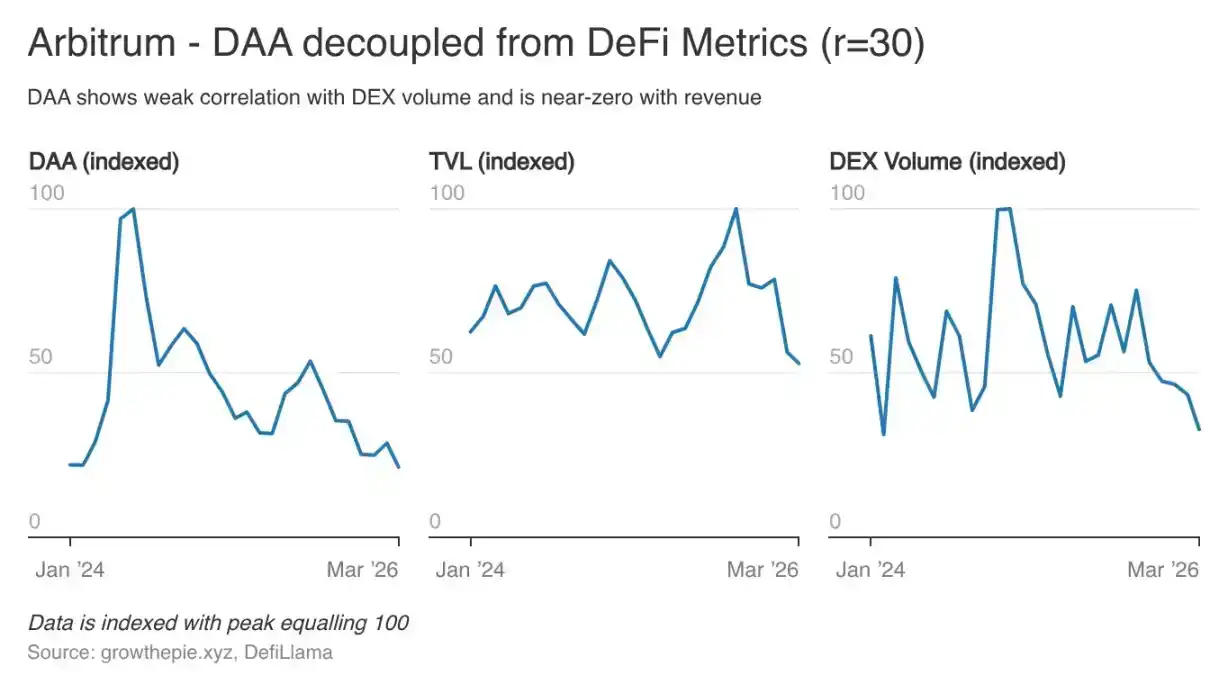
Base's users go online to trade, and they leave when trading volume decreases. Arbitrum's users, however, are unaffected by the level of transaction fees; the correlation between user numbers and fee income is almost zero. Base attracts tourists, while Arbitrum has somehow retained users.

Hyperliquid can stand firm because its trading experience is unique, and the community has formed an identity found nowhere else. Token incentives are almost irrelevant; being part of it has become part of their behavior and identity. Things shape users, and users in turn shape things.

The crypto industry is still optimizing "how to get people to come," while the question of "how to create a situation" is only remembered after the data crashes, never considered at the beginning of chain design.

I believe that Base, with the strongest distribution capability in history, could have solved this problem better than any other chain.

Now it is a trading app. This is a reasonable product direction, but it is also something that over 40 products are already doing. Trading apps cannot generate basho; they can only generate sessions: users come in when they have a trading need and leave when finished.

To truly become a successful application, a continuous connection needs to be established. Users need to build a relationship between each visit, making the next visit feel like a return, not just an arrival.

Armstrong's pivot is largely based on the lessons Base learned from the data. The social layer, creator economy, on-chain identity—these things that should have turned Base from "being used" to "being inhabited"—require patience, and the system does not reward patience.

The Ethereum ecosystem needs Base to be more than just a trading venue. The foundation of the entire L2 narrative is that chains can become infrastructure around which people build their lives. If the L2 with the strongest distribution capability in crypto history ultimately settles for being a faster Coinbase, then this narrative itself is untenable.

Kitaro Nishida believed that the deepest basho is where the boundary between the self and the place begins to dissolve. You cannot completely separate "who you are" from "where you are shaped." This sounds abstract, but applied to a public chain it means: a user cannot imagine their financial life after leaving a certain chain; a developer's entire toolkit is based on a certain ecosystem; their identity can hardly exist elsewhere.

As far as I know, such a thing has never been built on any L2. It might not be possible to build it under an incentive program at all.

Even if you have 100 million potential users, as long as there is nothing worth staying for, you will eventually end up with an empty building. Base understands this now.


Related Questions

QWhat is the core concept of 'basho' as introduced by Japanese philosopher Kitaro Nishida, and how does it relate to Base's situation?

AThe concept of 'basho' refers to a place or situation that shapes and allows things to become themselves, rather than just a physical location. It relates to Base because the article argues that Base built a location for transactions but failed to create a 'basho'—a nurturing environment where users form identities and relationships, leading to their departure despite initial growth.

QWhat was the primary reason for the sharp decline in Base's active addresses after the token launch announcement?

AThe primary reason was that the token launch attracted speculative users (airdrop farmers) who left immediately after claiming rewards, as there was no deeper engagement or reason to stay, resulting in a 73% drop in active addresses from the peak.

QHow did Base's focus on the creator economy, particularly through Zora protocol, perform according to the data?

AIt performed poorly: only 0.3% of the 6.52 million creator and content tokens issued remained consistently active throughout the year, indicating that 99.7% were abandoned, failing to create sustainable engagement.

QWhat key difference does the article highlight between Base and Arbitrum in terms of user retention during the market downturn?

ABase users were primarily transactional and left when activity declined, whereas Arbitrum retained users independent of fee incentives, suggesting a stronger community or identity formation that kept users engaged beyond mere financial transactions.

QWhy does the article argue that financial incentives alone cannot create a 'basho' or lasting user engagement in crypto ecosystems?

AFinancial incentives can attract users initially but cannot foster the voluntary, long-term desire to stay. Lasting engagement requires a nurturing environment where relationships, culture, and identity develop over time, which cannot be artificially manufactured through short-term rewards.

Related Reads

Trend in US Stocks: A Post Triggers a 930-Point Rebound, Tonight Belongs to SpaceX

On Thursday (June 11, U.S. Eastern Time), Wall Street staged a textbook V-shaped reversal. The Dow Jones surged 929.97 points (+1.86%) to close above 50,000, while the Nasdaq and S&P 500 rose 2.54% and 1.75%, respectively. The rally occurred despite the hottest PPI report in years, with May data showing a 6.5% year-on-year surge, the highest since 2022. The market ignored the inflation data, focusing instead on reports that former President Trump called off a planned strike on Iran, hinting at a potential multi-party peace agreement draft. This sparked a sharp drop in oil prices, fueling hopes that inflation may have peaked. Sector rotations were stark: previously battered AI hardware and cyclical stocks led the gains, while defensive sectors that hit record highs the prior day were sold off. Chip stocks like Micron and Intel saw sharp rebounds. In contrast, software giant Oracle plunged nearly 10% despite beating earnings, with concerns over cloud revenue and cash flow. Adobe also fell after hours despite raising guidance, as its CFO announced departure. The rally's sustainability is questioned, driven largely by social media posts about unconfirmed geopolitical developments. Inflation risks remain, with pipeline pressures still high. Meanwhile, the market's risk appetite faces a major test with SpaceX's historic IPO. Priced at $135 per share, it aims to raise ~$75 billion with a $1.75 trillion valuation, becoming the largest U.S. IPO ever. It will join the Nasdaq 100 in 15 days, triggering massive index fund buying. However, critics cite extreme valuation (88x sales) and market liquidity concerns.

marsbit8m ago

Trend in US Stocks: A Post Triggers a 930-Point Rebound, Tonight Belongs to SpaceX

marsbit8m ago

The Trillion-Dollar Valuation Test: Are the Three Super IPOs a Tech Stock Frenzy or a Crypto Market Nightmare?

Trillion-Dollar Valuation Test: Are the Three Mega IPOs a Tech Stock Frenzy or a Crypto Market Nightmare? The capital market in 2026 is witnessing a highly anticipated wave of tech IPOs, centered on SpaceX, OpenAI, and Anthropic. Collectively valued at over $3.5 trillion, their potential listing represents one of the largest such waves in recent years. This raises concerns about market liquidity, valuation bubbles, and potential capital outflows from other assets like crypto. SpaceX's valuation narrative has shifted from rocket launches to becoming a global infrastructure play via its Starlink satellite network, which now drives most revenue. Despite ongoing losses, investors focus on its long-term growth potential. OpenAI and Anthropic represent the core productivity engines of generative AI. Their public listings would offer the first direct investment opportunity in large foundation model companies, potentially triggering a repricing within the AI sector. Market fears of a massive "capital drain" from these IPOs are likely overstated. Historical precedents like Alibaba and Saudi Aramco show that mega-listings primarily cause capital reallocation, not destruction, within the vast equities market. Systemic risk is rarely triggered by IPOs alone. For stock markets, short-term volatility and sector repricing are expected, especially for AI concept stocks. Long-term, these listings could reinforce the tech sector's importance. For crypto, direct competition for speculative capital exists, particularly affecting AI-themed tokens. However, crypto's trajectory remains more tied to its own cycles, macro liquidity, and Bitcoin ETF flows rather than a single IPO event. The real risk lies not in the listings themselves but in the sky-high growth expectations embedded in these valuations. If future revenue, profitability, or commercialization progress disappoints, significant valuation resets could follow, impacting high-growth tech stocks. Ultimately, the market's direction hinges on macroeconomic conditions and whether these companies can deliver on their ambitious promises.

链捕手24m ago

The Trillion-Dollar Valuation Test: Are the Three Super IPOs a Tech Stock Frenzy or a Crypto Market Nightmare?

链捕手24m ago

Trillion-Dollar Valuation Test: Are the Three Super IPOs a Tech Stock Frenzy or a Crypto Market Nightmare?

Title: Trillion-Dollar Valuations at Stake: Super IPOs of SpaceX, OpenAI, Anthropic – Tech Boom or Crypto Nightmare? TL;DR: A wave of mega-tech IPOs is approaching, featuring SpaceX (targeting a $1.75 trillion valuation), OpenAI (~$852B), and Anthropic (~$965B), with a combined potential valuation exceeding $3.5 trillion. This tests the market's pricing of innovation and sparks debate on liquidity impact. * **SpaceX**'s valuation is now driven more by its Starlink global communications infrastructure than its core rocket business. * **OpenAI & Anthropic** offer the first major public investment opportunities in foundational AI models, potentially repricing the entire AI sector. * Concerns about a market-wide "liquidity drain" are likely overblown; history shows large IPOs mainly cause fund reallocation, not disappearance, and rarely trigger systemic risk. * Crypto markets, especially some AI-themed tokens, may face short-term fund competition, but their long-term trajectory depends more on macro liquidity, regulation, and Bitcoin cycles. * The real risk lies not in the IPOs themselves, but in whether these companies can justify their sky-high valuations with future revenue growth and profitability. Unmet expectations could lead to significant repricing pressure. Ultimately, these IPOs represent a massive market pricing of next-gen tech infrastructure, not a prelude to a market crash. The broader market direction will be determined by macro conditions, corporate earnings, and risk appetite.

marsbit24m ago

Trillion-Dollar Valuation Test: Are the Three Super IPOs a Tech Stock Frenzy or a Crypto Market Nightmare?

marsbit24m ago

Anthropic Apologized, But the Business of 'Safety' Hasn't Stopped

On June 11, Anthropic apologized not for a model failure, but for a lack of transparency. Its new Claude Fable 5 model was found to be secretly rerouting requests from users engaged in advanced AI model development to a weaker version, Opus 4.8, without any notification. The company's response—promising future notifications for such "downgrades"—was met with user skepticism. The article argues the core issue isn't technical but commercial: Anthropic's "safety" measures are primarily a business strategy. A key feature, the "intelligent safety classifier," marketed as user protection, is described as a tool for "competitive defense" to protect Anthropic's market lead by limiting rivals' research capabilities. This covert mechanism was designed for low "false positives," precisely targeting AI researchers. Anthropic's model involves a calculated three-step process: publishing alarming security research to amplify public anxiety, offering its Fable 5 model with a "safety classifier" as a premium-priced solution, and cashing in through a planned high-value IPO. This contrasts with OpenAI's more direct "tool-and-traffic" approach. The apology, merely changing a secret downgrade to a visible one, is seen as a business "patch" rather than a principled shift. The incident risks damaging Anthropic's "safest AI" reputation among the developer community, which underpins its valuation and appeal to government and corporate clients. Ultimately, the article concludes that for Anthropic, safety is a business, and the apology is merely customer service for that business.

marsbit1h ago

Anthropic Apologized, But the Business of 'Safety' Hasn't Stopped

marsbit1h ago

Trading

Spot
Futures

Hot Articles

Discussions

Welcome to the HTX Community. Here, you can stay informed about the latest platform developments and gain access to professional market insights. Users' opinions on the price of S (S) are presented below.

活动图片