Axelar Team Acquired, Token Abandoned: Circle's 'Take the Team, Not the Token' Move Sparks Heated Debate in Crypto Community

marsbitPublished on 2025-12-17Last updated on 2025-12-17

Abstract

Circle, the stablecoin giant, has announced the acquisition of the core team and intellectual property of Interop Labs, the initial development team behind the cross-chain protocol Axelar Network. The move aims to advance Circle’s cross-chain infrastructure strategy and improve interoperability for its core products like Arc and CCTP. However, the acquisition explicitly excludes the Axelar Network itself, its foundation, and its native token AXL, which will continue to operate under community governance. Another contributing team, Common Prefix, will take over Interop Labs' former activities. Following the news, the price of AXL dropped sharply, falling 15% to around $0.115. The “acquire-the-team-but-not-the-token” approach has sparked intense debate within the crypto community. Critics, including VCs and industry figures, argue that the move unfairly disadvantages token holders, who supported the project early on but received nothing from the acquisition. Some have called it a “rug pull” and raised ethical and legal concerns, emphasizing the misalignment between team incentives and token holder interests. Supporters counter that this reflects standard market reality where tokens sit at the bottom of the capital structure—below debt and equity—and aren’t inherently entitled to proceeds in acquisitions. They see Circle’s decision as a rational business move that follows conventional corporate finance hierarchies. The incident highlights a recurring conflict in crypto: the ...

Original: Odaily Planet Daily

Author: Azuma

At midnight on December 16, stable币 giant Circle officially announced the completion of a signed agreement to acquire the core talent and technology of Interop Labs, the initial development team behind the cross-chain protocol Axelar Network. This move aims to advance Circle's cross-chain infrastructure strategy and help achieve seamless, scalable interoperability for core Circle products like Arc and CCTP.

This seemed like another classic case of an industry giant acquiring a high-quality team, appearing to be a win-win situation. However, the crucial point is that Circle explicitly stated in the acquisition announcement that the transaction only involves the Interop Labs team and its proprietary intellectual property. The Axelar Network, the Axelar Foundation, and the AXL token will continue to operate independently under community governance. Common Prefix, another contributing team to the original project, will take over the activities previously handled by Interop Labs.

In simple terms, Circle took the original development team of Axelar Network but explicitly discarded the Axelar Network project itself and its AXL token.

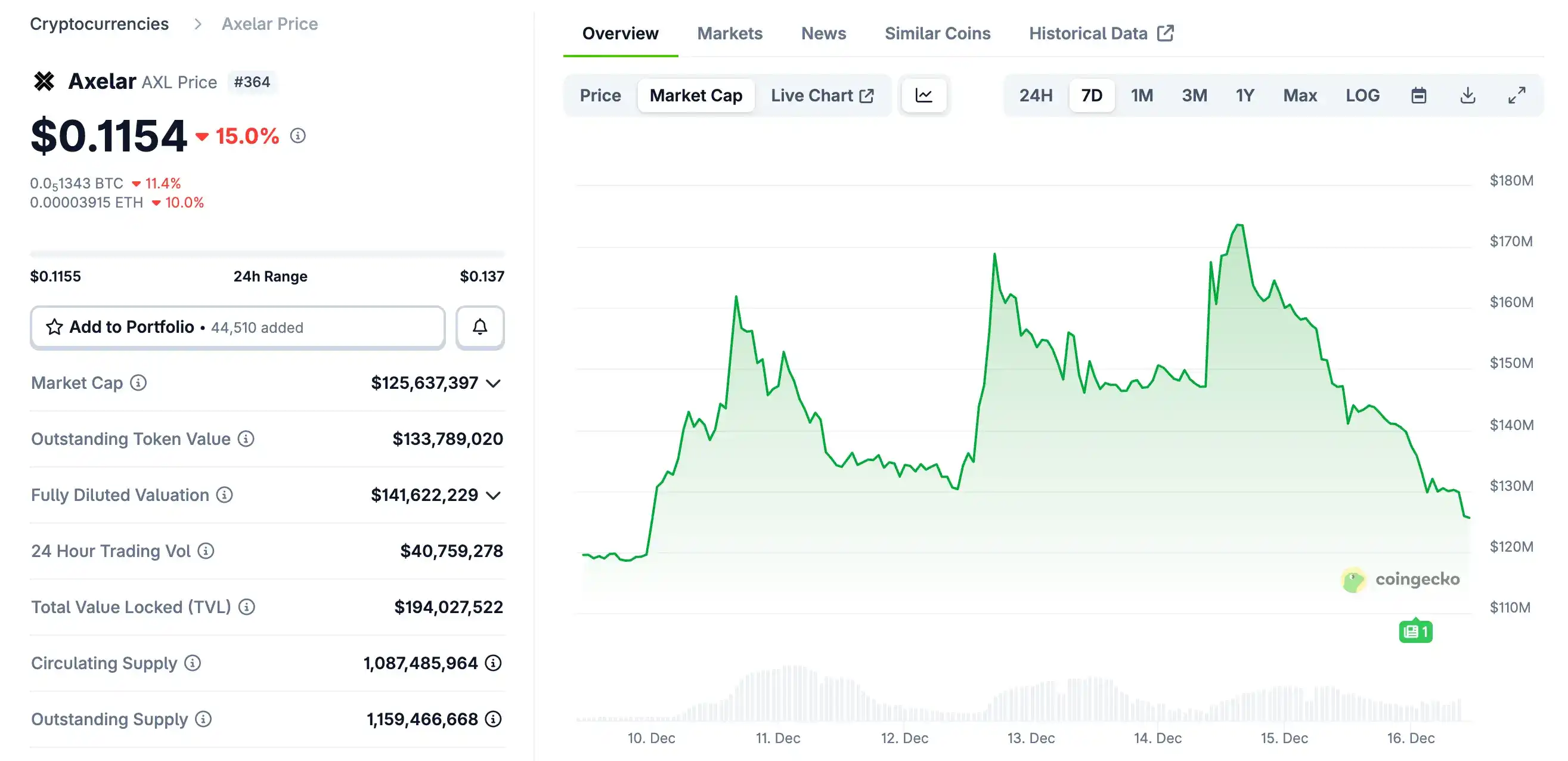
Affected by this sudden news, AXL plummeted sharply. As of around 10:00 AM today, it was temporarily quoted at $0.115, marking a 24-hour drop of 15%.
Simultaneously, the unique "take the team, not the token" nature of the acquisition and the衍生出的 "equity vs. token" issue have sparked extensive discussion within the community. Supporters and opponents of this acquisition model are locked in a fierce debate, each holding their own views.

Opposing Views: A De Facto Rug Pull, Circle's Misstep, Only Token Holders Get Hurt......

The core strength of the opposition consists of some VCs, which is understandable — "I invested real money in the project's token rights, holding a bunch of tokens. Now you've taken the working team away, what use are these tokens to me?"

Moonrock Capital founder Simon Dedic commented on this: "Another acquisition, another rug pull. Circle acquiring Axelar but explicitly excluding the foundation and the AXL token is practically criminal. Even if not illegal, it's immoral. If you are a founder wanting to issue a token: either treat it like equity, or get lost."

The Block co-founder and 6MV founder Mike Dudas commented: "For everyone thinking this is a token vs. equity problem, I can tell you clearly, this is entirely Circle's doing. Rumors suggest that Circle's VP of Corporate Development once told an Axelar co-founder 'I don't care about your investors,' and 'bought' the CEO and IP right from under the investors' noses without paying them any consideration, even though this IP and team were crucial for Arc's launch."

Lombard Finance founder posted AXL's price chart and predicted: "Axelar's core team was bought by Circle, AXL might be worthless now. It's been over three years since the token issuance, the team's equity has long been fully vested. But this outcome feels very uncomfortable: the team and/or investors sell tokens for profit, while token holders can only pin their hopes on a distant dream."

ChainLink community figure Zach Rynes stated: "This once again exposes the token vs. equity利益冲突 problem plaguing the crypto industry. The development team behind the protocol gets successfully acquired, while the token holders who funded this team get nothing. The so-called continued independent operation under community governance is no different than the development team abandoning its users for better prospects. If we want to attract real capital, this is the primary issue the industry urgently needs to solve."

SOAR Ecosystem Lead Nicholas Wenzel stated: "Axelar token is heading to zero, thanks for playing. Another acquisition where token holders get nothing, and equity holders make a fortune."

Supporting Views: Normal Market Behavior, Tokens Are Naturally at the Bottom of the Capital Stack

If the opposition focuses more on the unfair treatment of token holders, the supporters focus more on the rules of financing and mergers and acquisitions.

Arca Chief Investment Officer Jeff Dorman believes Circle's approach is not problematic and explained at length the capital structure of corporate financing and the天然 disadvantaged position of tokens.

Companies raise capital through different tiers of the capital structure, and these tiers inherently have a clear order of priority—some tiers are naturally senior to others — Secured Debt > Unsecured Senior Debt > Subordinated Debt > Preferred Stock > Common Stock > Tokens.

History is filled with cases where one class of investors benefits at the expense of another.

  • In bankruptcies, creditors win at the expense of equity investors;
  • In leveraged buyouts (LBOs), equity holders often profit at the expense of creditors;
  • In take-unders, creditors are usually prioritized over equity holders;
  • In strategic acquisitions, usually both creditors and equity holders benefit (but not always);
  • And tokens are often at the very bottom of the capital stack......

This doesn't mean tokens have no value, nor does it mean tokens necessarily need some kind of "protection mechanism," but the market needs to recognize the reality: when someone acquires a company whose value is already low, and the token issued by that company is also nearly worthless, token holders don't magically receive a dividend. In this scenario, gains for equity often come at the expense of losses for the token.

Electric Capital co-founder Avichal Garg also commented: "This is normal. If all future value is created by the team, then no company will want to pay returns to investors."

Core Contradiction: What Exactly Is a Token?

Surrounding the "take the team, not the token" acquisition storm involving Axelar and Circle, both sides of the debate seem to have their points.

The anger of the opponents is real: Token holders bore the risk during the project's most difficult times, when it needed liquidity and narrative support the most, yet were completely excluded at the critical juncture of value realization. From the result, the core team and intellectual property achieved value monetization, while the token was left in the vacuum narrative of "community governance." The market voted most directly with the price, which is indeed deeply discouraging for all who believed in the token's value.

The judgment of the supporters is also reasonable in a practical sense: From a strict capital structure perspective, tokens are neither debt nor equity and naturally lack priority in the context of M&A and liquidation. Circle did not violate existing commercial rules; it just冷静ly chose the assets most valuable to itself.

The true core of the矛盾 is not whether Circle was moral, but a question the industry has long刻意回避d: What exactly is a token in the legal and economic structure?

When prospects are bright, tokens are默认为 "quasi-equity," imbued with the imagination of a claim on future success; but in practical scenarios like acquisitions, bankruptcies, and liquidations, they are quickly reduced to their original form of a "rights-less instrument." This narrative equity-ization coupled with structural subordination is the root cause of recurring conflicts.

The Axelar acquisition might not be the last similar controversy, but hopefully, it can serve as an opportunity for the industry to further contemplate the positioning and meaning of tokens — Tokens do not inherently possess rights; only institutionalized, structured rights are acknowledged at critical moments. The specific form of implementation still requires all practitioners to explore and practice together.


Related Questions

QWhat was the main reason behind the crypto community's debate regarding Circle's acquisition of Axelar's team?

AThe debate centered around Circle's 'acquire the team, discard the token' approach, which saw the acquisition of Interop Labs' core talent and intellectual property while explicitly leaving the Axelar Network, its foundation, and the AXL token to operate independently under community governance, causing the token's value to drop and raising questions about the rights of token holders.

QHow did the price of AXL token react to the news of Circle's acquisition?

AFollowing the announcement, the AXL token experienced a significant short-term decline, dropping to approximately $0.115 with a 24-hour decrease of 15%.

QWhat was a key argument from opponents of the acquisition, such as Moonrock Capital's founder?

AOpponents, including Moonrock Capital's founder Simon Dedic, argued that the acquisition was effectively a 'rug pull,' morally wrong, and detrimental to token holders, as it separated the valuable team and IP from the token, leaving investors with assets of questionable value without proper compensation.

QWhat perspective did supporters like Arca's CIO Jeff Dorman offer regarding the acquisition?

ASupporters like Jeff Dorman argued that the acquisition was a normal market behavior, highlighting that tokens naturally reside at the bottom of the capital structure in corporate finance, meaning they lack priority in scenarios like acquisitions and thus do not inherently entitle holders to benefits when equity or other higher-tier assets are transacted.

QWhat core issue does the Axelar-Circle acquisition controversy highlight about tokens in the crypto industry?

AThe controversy underscores the unresolved question of what tokens legally and economically represent—often treated as 'quasi-equity' during prosperous times but relegated to having no rights in practical scenarios like acquisitions, revealing a conflict between narrative expectations and structural reality that requires clearer institutional definitions and rights for token holders.

Related Reads

Gensyn AI: Don't Let AI Repeat the Mistakes of the Internet

In recent months, the rapid growth of the AI industry has attracted significant talent from the crypto sector. A persistent question among researchers intersecting both fields is whether blockchain can become a foundational part of AI infrastructure. While many previous AI and Crypto projects focused on application layers (like AI Agents, on-chain reasoning, data markets, and compute rentals), few achieved viable commercial models. Gensyn differentiates itself by targeting the most critical and expensive layer of AI: model training. Gensyn aims to organize globally distributed GPU resources into an open AI training network. Developers can submit training tasks, nodes provide computational power, and the network verifies results while distributing incentives. The core issue addressed is not decentralization for its own sake, but the increasing centralization of compute power among tech giants. In the era of large models, access to GPUs (like the H100) has become a decisive bottleneck, dictating the pace of AI development. Major AI companies are heavily dependent on large cloud providers for compute resources. Gensyn's approach is significant for several reasons: 1) It operates at the core infrastructure layer (model training), the most resource-intensive and technically demanding part of the AI value chain. 2) It proposes a more open, collaborative model for compute, potentially increasing resource utilization by dynamically pooling idle GPUs, similar to early cloud computing logic. 3) Its technical moat lies in solving complex challenges like verifying training results, ensuring node honesty, and maintaining reliability in a distributed environment—making it more of a deep-tech infrastructure company. 4) It targets a validated, high-growth market with genuine demand, rather than pursuing blockchain integration without purpose. Ultimately, the boundaries between Crypto and AI are blurring. AI requires global resource coordination, incentive mechanisms, and collaborative systems—areas where crypto-native solutions excel. Gensyn represents a step toward making advanced training capabilities more accessible and collaborative, moving beyond a niche controlled by a few giants. If successful, it could evolve into a fundamental piece of AI infrastructure, where the most enduring value in the AI era is often created.

marsbit5h ago

Gensyn AI: Don't Let AI Repeat the Mistakes of the Internet

marsbit5h ago

Why is China's AI Developing So Fast? The Answer Lies Inside the Labs

A US researcher's visit to China's top AI labs reveals distinct cultural and organizational factors driving China's rapid AI development. While talent, data, and compute are similar to the West, Chinese labs excel through a pragmatic, execution-focused culture: less emphasis on individual stardom and conceptual debate, and more on teamwork, engineering optimization, and mastering the full tech stack. A key advantage is the integration of young students and researchers who approach model-building with fresh perspectives and low ego, prioritizing collective progress over personal credit. This contrasts with the US culture of self-promotion and "star scientist" narratives. Chinese labs also exhibit a strong "build, don't buy" mentality, preferring to develop core capabilities—like data pipelines and environments—in-house rather than relying on external services. The ecosystem feels more collaborative than tribal, with mutual respect among labs. While government support exists, its scale is unclear, and technical decisions appear driven by labs, not state mandates. Chinese companies across sectors, from platforms to consumer tech, are building their own foundational models to control their tech destiny, reflecting a broader cultural drive for technological sovereignty. Demand for AI is emerging, with spending patterns potentially mirroring cloud infrastructure more than traditional SaaS. Despite challenges like a less mature data industry and GPU shortages, Chinese labs are propelled by vast talent, rapid iteration, and deep integration with the open-source community. The competition is evolving beyond a pure model race into a contest of organizational execution, developer ecosystems, and industrial pragmatism.

marsbit6h ago

Why is China's AI Developing So Fast? The Answer Lies Inside the Labs

marsbit6h ago

3 Years, 5 Times: The Rebirth of a Century-Old Glass Factory

Corning, a 175-year-old glass company, is experiencing a dramatic revival as a key player in AI infrastructure, driven by surging demand for high-performance optical fiber in data centers. AI data centers require vastly more fiber than traditional ones—5 to 10 times as much per rack—to handle high-speed data transmission between GPUs. This structural demand shift, coupled with supply constraints from the lengthy expansion cycle for fiber preforms, has created a significant supply-demand gap. Nvidia has invested in Corning, along with Lumentum and Coherent, in a $4.5 billion total commitment to secure the optical supply chain for AI. Corning's competitive edge lies in its expertise in producing ultra-low-loss, high-density, and bend-resistant specialty fiber, which is critical for 800G+ and future 1.6T data rates. Its deep involvement in co-packaged optics (CPO) with partners like Nvidia further solidifies its position. While not the largest fiber manufacturer globally, Corning's revenue from enterprise/data center clients now exceeds 40% of its optical communications sales, and it has secured multi-year supply agreements with major hyperscalers including Meta and Nvidia. Financially, Corning's optical communications revenue has surged, doubling from $1.3 billion in 2023 to over $3 billion in 2025. Its stock price has risen nearly 6-fold since late 2023. Key future catalysts include the rollout of Nvidia's CPO products and the scale of undisclosed customer agreements. However, risks include high current valuations and potential disruption from next-generation technologies like hollow-core fiber. The company's long-term bet on light over electricity, maintained even through the telecom bubble crash, is now being validated by the AI boom.

marsbit7h ago

3 Years, 5 Times: The Rebirth of a Century-Old Glass Factory

marsbit7h ago

Trading

Spot
Futures

Hot Articles

Discussions

Welcome to the HTX Community. Here, you can stay informed about the latest platform developments and gain access to professional market insights. Users' opinions on the price of S (S) are presented below.

活动图片