Are altcoins coming back? Why 'Bitcoin season' has staying power in 2026

cointelegraphPublished on 2025-12-23Last updated on 2025-12-23

Abstract

Analysts indicate that altcoins are not poised for a comeback, with bearish patterns suggesting "altcoin season" is unlikely in the near term. The total market cap of altcoins (TOTAL2) has declined 32% since its October peak, breaking key support levels. Technical indicators like the SuperTrend have flashed sell signals, historically preceding significant downturns. Bitcoin dominance remains strong at 59.27%, driven by institutional adoption and ETF inflows, which continue to favor BTC over riskier altcoins. Key metrics, including the Altcoin Season Index reading of 18/100, confirm the market is still in "Bitcoin season," with no signs of a broad altcoin rally ahead.

Most altcoins are currently displaying bearish patterns that suggest “altcoin season” is not coming, according to numerous analysts, as Bitcoin dominance begins to rise again.

Key takeaways:

  • The Supertrend indicator flashes “sell,” which previously led to a 66% drop in the altcoin total market cap.

  • Rising BTC dominance and a low altcoin season index show no signs of reversal.

Altcoin total market cap turns bearish

The ongoing sell-off in altcoins is reflected by the correction in TOTAL2 — the total market cap of all cryptocurrencies excluding Bitcoin (BTC) — that began on Oct. 10.

Data from TradingView shows that TOTAL2 has decreased by 32% to $1.19 trillion in December from its all-time high of $1.77 trillion reached on Oct. 10.

This drop has seen TOTAL2 lose above key support levels, including the 50-week exponential moving average (EMA) currently at $1.3 trillion, as shown in the chart below.

Related: Crypto altseason unlikely in 2026 as ‘blue-chip survivors’ to win out: Analyst

The SuperTrend indicator also flashed a bearish signal when it reversed from red to green and moved above the price in mid-November.

This indicator overlays the chart while tracking TOTAL2’s trend, like the moving averages. It incorporates the average true range in its calculations, which helps traders identify market trends.

Previous confirmations from these two indicators were followed by 85.5% and 66% drawdowns during the 2018 and 2022 bear markets, as shown in the chart below.
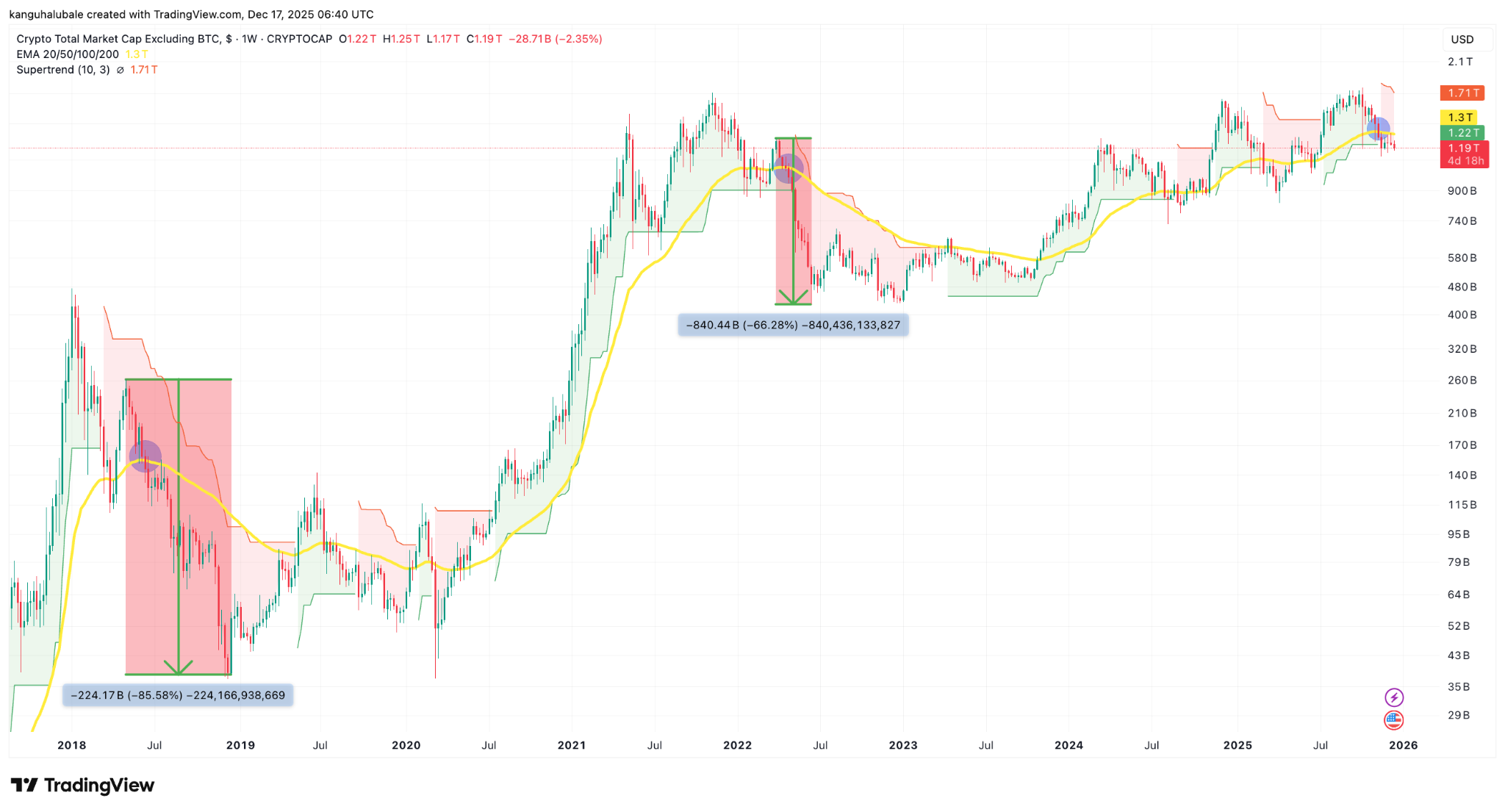
Total crypto market cap excluding BTC. Source: TradingView

Altcoins are still stuck in the downtrend as TOTAL2 consolidates within an ascending triangle.

“Altcoin market cap is coiling into a brutal downtrend,” Merlijn The Trader said in an X post analysis.

Support at $1.15 trillion is holding for now, but “if this triangle breaks, we could see a -30% flush” to $830 billion, the analyst said, adding that the “altseason is not coming” until the resistance at $1.68 trillion is broken.
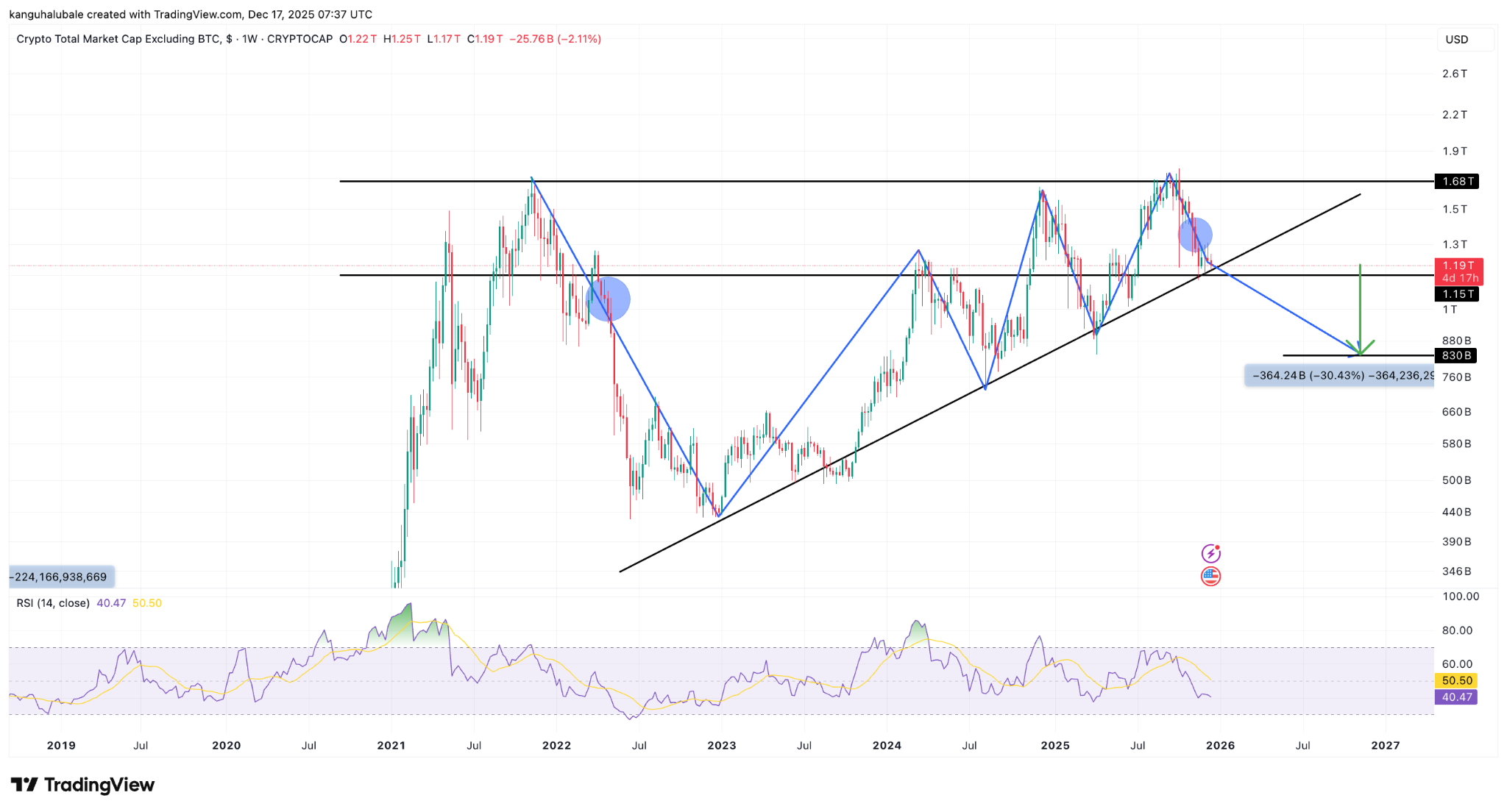
TOTAL2 weekly chart. Source: Cointelegraph/TradingView

“Alt season will never occur again,” said CryptoDaddi in a recent post on X, adding that going forward, money will be concentrated into a select few altcoins.

“There will NEVER be another Rising Tides rally where everything pumps. Ever.”

Bitcoin’s unshakable dominance

Bitcoin's (BTC) grip on the cryptocurrency market has tightened in 2025, leaving little room for altcoins to outperform.

After pushing past 65% in June, Bitcoin dominance — a metric measuring Bitcoin’s market share relative to the overall crypto market — dropped to 57% in September.

Since then, the metric has been on an upward trend, recording higher highs and higher lows, as shown in the chart below.

At the time of publication, BTC dominance is at 59.27%, indicating that it is still Bitcoin season.
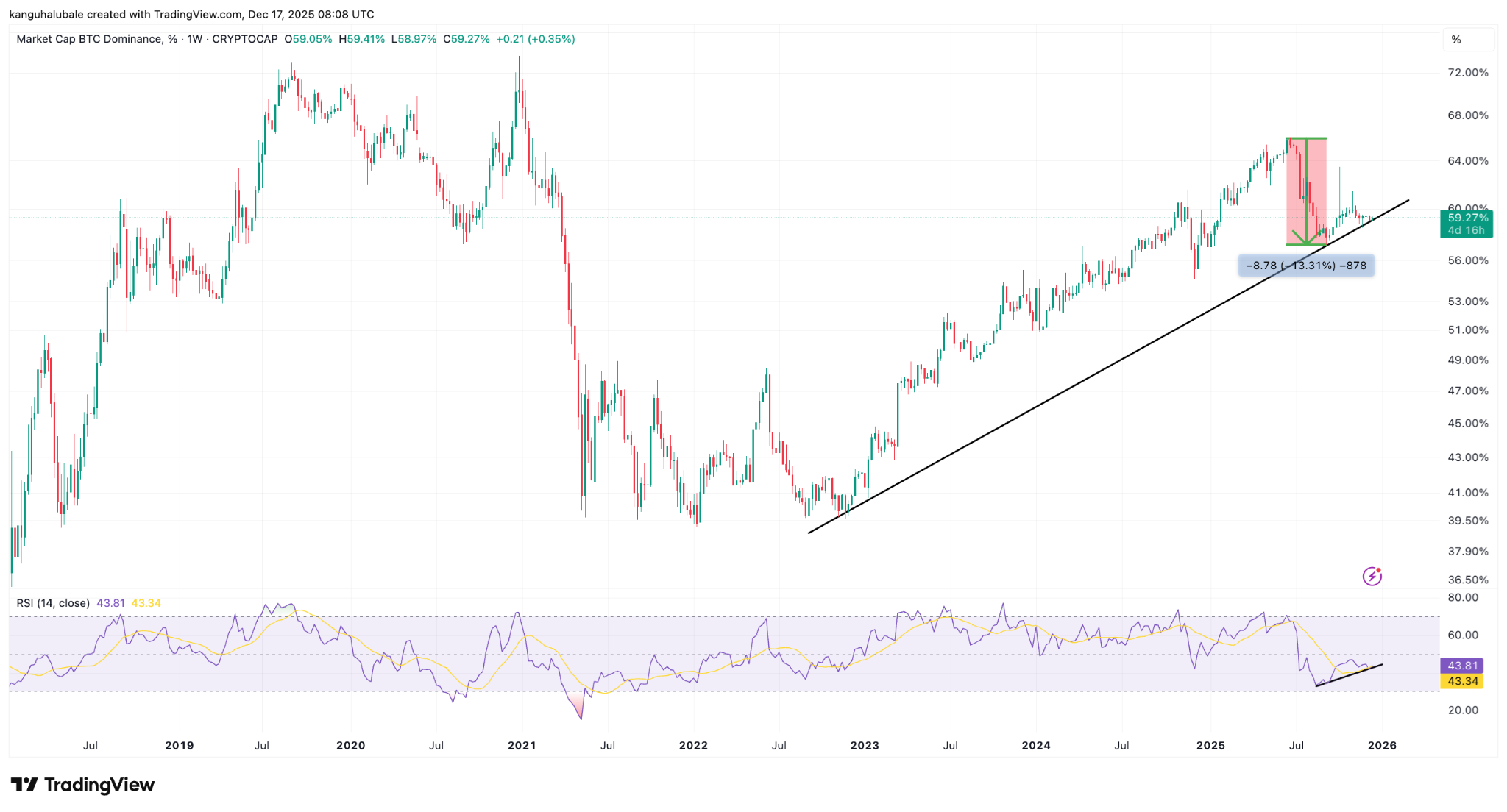
Bitcoin dominance, %. Source: Cointelegraph/TradingView

This metric has not dropped below 50% since September 2023, which has previously marked the start of the altseason.

This is a structural shift driven by institutional adoption that came after the approval and success of Bitcoin ETFs, which have attracted billions from traditional finance.

Institutions like BlackRock and Fidelity prioritize Bitcoin for its adoption, relative stability and regulatory clarity, viewing altcoins as riskier and less liquid.

It’s not just aggressive buying by Strategy either. BlackRock’s IBIT Bitcoin ETF attracted over $25 billion in inflows in 2025, reinforcing the preference corporate buyers have for BTC over altcoins.

Bitcoin dominance is printing a higher low, and money is rotating back into BTC, not alts,” said CyrilXBT in an X post, adding:

“Right now, BTC is still absorbing the room.”

It’s still Bitcoin season

Meanwhile, key indicators the crypto industry uses to determine an incoming altcoin season suggest it’s still nowhere in sight.

According to Capriole Investments’ Altcoin Speculation Index, only 21% of the top altcoins have outperformed BTC during the last three-month period, suggesting capitulation among altcoin holders.

Additionally, the Crypto Market Breadth — a measure of market strength — reveals that only 8% of all altcoins are trading above their 50-day moving average, suggesting that the altcoin market is extremely weak.
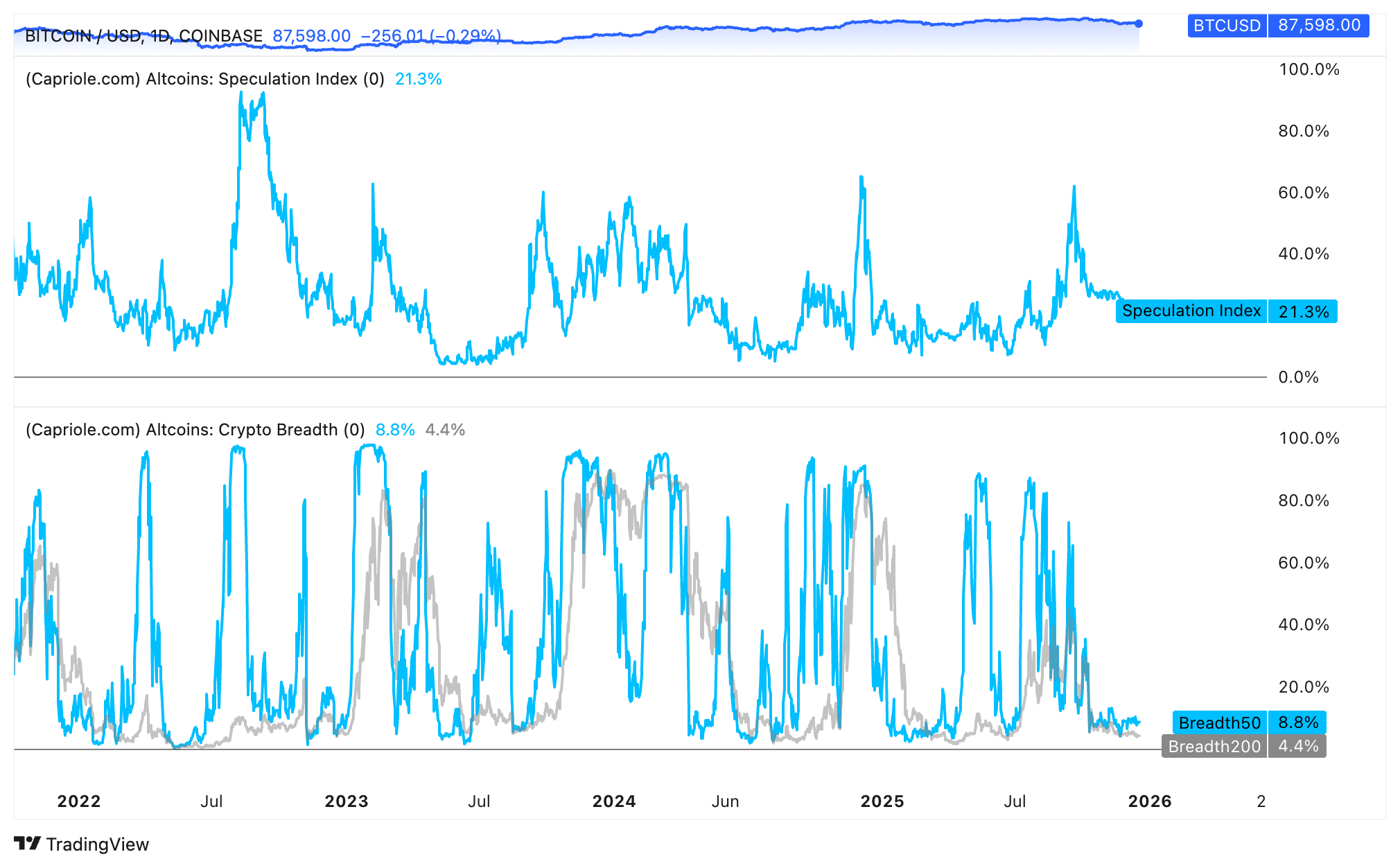
Altcoin speculation index. Source: Capriole Investments

Similarly, CoinMarketCap’s Altcoin Season Index, which measures the top 100 cryptocurrencies against Bitcoin’s performance over the past 90 days, is reading a score of 18 out of 100, leaning toward a more Bitcoin-dominated market, referring to it as “Bitcoin Season.” Altcoin season is when the percentage is above 75%.

“CMC Altcoin Season Index is at a record low,” said altcoin trader Money Ape in an analysis on X, adding:

“They call this a ‘Bitcoin season.”

As Cointelegraph reported, Bitcoin has outperformed most other cryptocurrency sectors in recent months, indicating that capital and investment continue to favor Bitcoin.

This article does not contain investment advice or recommendations. Every investment and trading move involves risk, and readers should conduct their own research when making a decision. While we strive to provide accurate and timely information, Cointelegraph does not guarantee the accuracy, completeness, or reliability of any information in this article. This article may contain forward-looking statements that are subject to risks and uncertainties. Cointelegraph will not be liable for any loss or damage arising from your reliance on this information.

Related Questions

QWhat does the Supertrend indicator currently signal for the altcoin market, and what was the historical impact of this signal?

AThe Supertrend indicator is currently flashing a 'sell' signal for the altcoin market. Historically, this signal was followed by a 66% drop in the altcoin total market cap during the 2022 bear market and an 85.5% drawdown in 2018.

QWhat is the current level of Bitcoin dominance, and what does this indicate about the market?

ABitcoin dominance is currently at 59.27%. This indicates that it is still 'Bitcoin season,' meaning Bitcoin is outperforming altcoins and holding a dominant share of the total cryptocurrency market cap.

QAccording to the Altcoin Season Index, is an altcoin season likely to occur soon?

ANo, an altcoin season is not likely soon. The Altcoin Season Index is reading a score of 18 out of 100, which is far below the 75% threshold required to be considered an altcoin season. This indicates a strongly Bitcoin-dominated market.

QWhat key support level has the TOTAL2 (altcoin market cap) lost, and what is a potential downside target if its current triangle pattern breaks?

ATOTAL2 has lost key support at the 50-week exponential moving average (EMA), which is at $1.3 trillion. If the current ascending triangle pattern breaks to the downside, the analysis suggests a potential 'flush' of -30% down to $830 billion.

QWhat is cited as a major structural reason for Bitcoin's sustained dominance over altcoins?

AA major structural reason is institutional adoption driven by the approval and success of Bitcoin ETFs. Institutions like BlackRock and Fidelity prioritize Bitcoin for its adoption, relative stability, and regulatory clarity, viewing altcoins as riskier and less liquid. This has attracted billions of dollars from traditional finance into Bitcoin.

Related Reads

Bitroot Public Chain Invited to Attend Tencent Cloud Singapore AI Conference, Discussing the Future Alongside Solana

On May 19, Bitroot, an emerging Layer 1 blockchain, participated in the Tencent Cloud AI Summit in Singapore alongside key industry players like Solana Foundation. The event explored the intersection of AI infrastructure, enterprise applications, AI Agents, and Web3. Bitroot's invitation, despite being pre-mainnet, highlights industry interest in its focus on high-performance, AI-native architecture tailored for future AI Agent execution and verifiable on-chain automation. Bitroot CEO Juan Jose emphasized that AI competition is shifting from model performance to data, real-world application scenarios, and trust infrastructure. He argued that for AI Agents to evolve from assistants to autonomous executors managing transactions and assets, they require low-latency, low-cost, and high-throughput blockchain environments. Bitroot aims to address this through its EVM-compatible design, optimistic parallel execution, and a consensus mechanism targeting high scalability. Currently in its Testnet 5.0 phase, Bitroot reports metrics like over 50,000 peak TPS and sub-0.3 second average block time. Its narrative positions it within a growing landscape where next-generation Layer 1s like Monad and Aptos also compete on performance, while Bitroot differentiates by integrating AI computational capabilities natively across its stack. The summit underscored that the fusion of AI and Web3 is moving from concept to infrastructure competition, where networks balancing performance, security, and verifiability will be crucial for enabling scalable AI-driven applications.

marsbit7m ago

Bitroot Public Chain Invited to Attend Tencent Cloud Singapore AI Conference, Discussing the Future Alongside Solana

marsbit7m ago

Hedge Fund Q1 Interpretation: Everyone Is Selling Software, Buying Chips

Hedge Funds and Mutual Funds Aligned in Q1: Dumping Software, Buying Chips A clear consensus emerged among major U.S. hedge funds and mutual funds in Q1: they were simultaneously selling software stocks and pouring capital into the semiconductor sector. This aggressive rotation pushed semiconductor exposure in hedge fund long portfolios to a record high. Hedge funds delivered a 7% return year-to-date, while only 30% of large-cap active mutual funds outperformed their benchmarks. The average short interest for S&P 500 constituents rose to 3% of market cap, the highest since 2011. Within technology, the structural shift was stark. Hedge funds' semiconductor weighting hit an all-time high, while software fell to its lowest since 2019. Excluding Microsoft, mutual funds' relative overexposure to semis vs. software was the largest since 2012. Microsoft was among the most net-sold stocks by both groups. Hedge funds net purchased semiconductor names like LRCX and AMAT. Strategies diverged on leverage and cash. Hedge funds increased their net exposure to near a one-year high after an initial cut. Mutual funds raised their cash allocation, though it remains historically low at 1.4%. Sector alignment was high in Industrials (both overweight) but divergent in Tech: hedge funds increased their Tech net tilt by a record 853 basis points, while mutual funds reduced theirs. Clear splits also appeared in Financials and Consumer Discretionary. Four stocks appeared on both Goldman's hedge fund VIP and mutual fund overweight lists: BA, MA, MRVL, and V. This "shared favorites" basket has returned 10% YTD, outperforming the equal-weight S&P 500. Notably, all "Magnificent Seven" stocks are on the hedge fund VIP list but are uniformly underweighted by mutual funds.

marsbit17m ago

Hedge Fund Q1 Interpretation: Everyone Is Selling Software, Buying Chips

marsbit17m ago

The Evolution Path of Physical Bitcoin

The Evolution of Physical Bitcoin Bitcoin's digital nature is its core strength, enabling self-custody and rapid global transfers. However, its intangibility also hinders mainstream adoption. For over a decade, creators have attempted to materialize Bitcoin while preserving its cash-like properties, yielding notable results. Casascius Coins, launched in 2011, were the first and most iconic physical Bitcoin. Creator Mike Caldwell generated private keys offline, printed them on coins, and sealed them with tamper-evident holograms. This model relied on user trust in the centralized issuer. Production ceased in 2013 due to regulatory pressure from FinCEN. RavenBit Coins emerged in 2014 aiming to decentralize minting by letting users generate and apply their own keys. However, this led to trust issues with numerous untrusted minters and insecure key generation methods. In 2016, Coinkite introduced Opendimes—a breakthrough in bearer asset technology. These USB-shaped devices generate and store keys internally. Funds can be received by checking the public key, but spending requires physically breaking the device to extract the private key. While innovative and open-source, its cost (~$20) and form factor limit its use for small, everyday transactions. Satochip's Satodime, a card-shaped device using similar secure chip technology, followed. It supports NFC interaction and comes in various forms. While potentially cheaper in bulk (~13€), it remains a high-security hardware wallet, not a low-cost cash substitute. A fundamental cost barrier exists. For physical Bitcoin to achieve widespread commercial use, hardware costs must drop below $1 to match the production cost of fiat banknotes. Current secure chips capable of running Bitcoin's cryptographic algorithms (like secp256k1) are too expensive. Chips like NXP's NTAG X DNA (~$3) show cost-reduction potential but lack native Bitcoin curve support. Projects like OfflineCash embed chips in banknote-like paper, but face challenges with durability, the need for custom Bitcoin-enabled chips, and the inherent requirement for users to verify balances online—which conflicts with Bitcoin's trustless ideal. Coinkite's Tapsigner, a ~$20 card with a proprietary Bitcoin NFC chip, is seen as a more practical step forward. It functions as a reloadable hardware wallet for contactless payments, solving the "change" problem and focusing on real-world retail integration, a direction also pursued by companies like Cash App and Square. In summary, the journey to physical Bitcoin has progressed from trusted centralized mints (Casascius) to user-generated keys (RavenBit) and finally to self-contained secure hardware (Opendimes, Satodime, Tapsigner). The core challenge remains developing a sufficiently low-cost, durable, and truly trustless physical bearer asset that can function like cash in daily transactions. Current solutions are either too expensive or introduce new trust assumptions, keeping the ideal of ubiquitous physical Bitcoin just out of reach for now.

marsbit1h ago

The Evolution Path of Physical Bitcoin

marsbit1h ago

Trading

Spot
Futures

Hot Articles

What is $BITCOIN

DIGITAL GOLD ($BITCOIN): A Comprehensive Analysis Introduction to DIGITAL GOLD ($BITCOIN) DIGITAL GOLD ($BITCOIN) is a blockchain-based project operating on the Solana network, which aims to combine the characteristics of traditional precious metals with the innovation of decentralized technologies. While it shares a name with Bitcoin, often referred to as “digital gold” due to its perception as a store of value, DIGITAL GOLD is a separate token designed to create a unique ecosystem within the Web3 landscape. Its goal is to position itself as a viable alternative digital asset, although specifics regarding its applications and functionalities are still developing. What is DIGITAL GOLD ($BITCOIN)? DIGITAL GOLD ($BITCOIN) is a cryptocurrency token explicitly designed for use on the Solana blockchain. In contrast to Bitcoin, which provides a widely recognized value storage role, this token appears to focus on broader applications and characteristics. Notable aspects include: Blockchain Infrastructure: The token is built on the Solana blockchain, known for its capacity to handle high-speed and low-cost transactions. Supply Dynamics: DIGITAL GOLD has a maximum supply capped at 100 quadrillion tokens (100P $BITCOIN), although details regarding its circulating supply are currently undisclosed. Utility: While precise functionalities are not explicitly outlined, there are indications that the token could be utilized for various applications, potentially involving decentralized applications (dApps) or asset tokenization strategies. Who is the Creator of DIGITAL GOLD ($BITCOIN)? At present, the identity of the creators and development team behind DIGITAL GOLD ($BITCOIN) remains unknown. This situation is typical among many innovative projects within the blockchain space, particularly those aligning with decentralized finance and meme coin phenomena. While such anonymity may foster a community-driven culture, it intensifies concerns about governance and accountability. Who are the Investors of DIGITAL GOLD ($BITCOIN)? The available information indicates that DIGITAL GOLD ($BITCOIN) does not have any known institutional backers or prominent venture capital investments. The project seems to operate on a peer-to-peer model focused on community support and adoption rather than traditional funding routes. Its activity and liquidity are primarily situated on decentralized exchanges (DEXs), such as PumpSwap, rather than established centralized trading platforms, further highlighting its grassroots approach. How DIGITAL GOLD ($BITCOIN) Works The operational mechanics of DIGITAL GOLD ($BITCOIN) can be elaborated on based on its blockchain design and network attributes: Consensus Mechanism: By leveraging Solana’s unique proof-of-history (PoH) combined with a proof-of-stake (PoS) model, the project ensures efficient transaction validation contributing to the network's high performance. Tokenomics: While specific deflationary mechanisms have not been extensively detailed, the vast maximum token supply implies that it may cater to microtransactions or niche use cases that are still to be defined. Interoperability: There exists the potential for integration with Solana’s broader ecosystem, including various decentralized finance (DeFi) platforms. However, the details regarding specific integrations remain unspecified. Timeline of Key Events Here is a timeline that highlights significant milestones concerning DIGITAL GOLD ($BITCOIN): 2023: The initial deployment of the token occurs on the Solana blockchain, marked by its contract address. 2024: DIGITAL GOLD gains visibility as it becomes available for trading on decentralized exchanges like PumpSwap, allowing users to trade it against SOL. 2025: The project witnesses sporadic trading activity and potential interest in community-led engagements, although no noteworthy partnerships or technical advancements have been documented as of yet. Critical Analysis Strengths Scalability: The underlying Solana infrastructure supports high transaction volumes, which could enhance the utility of $BITCOIN in various transaction scenarios. Accessibility: The potential low trading price per token could attract retail investors, facilitating wider participation due to fractional ownership opportunities. Risks Lack of Transparency: The absence of publicly known backers, developers, or an audit process may yield skepticism regarding the project's sustainability and trustworthiness. Market Volatility: The trading activity is heavily reliant on speculative behavior, which can result in significant price volatility and uncertainty for investors. Conclusion DIGITAL GOLD ($BITCOIN) emerges as an intriguing yet ambiguous project within the rapidly evolving Solana ecosystem. While it attempts to leverage the “digital gold” narrative, its departure from Bitcoin's established role as a store of value underscores the need for a clearer differentiation of its intended utility and governance structure. Future acceptance and adoption will likely depend on addressing the current opacity and defining its operational and economic strategies more explicitly. Note: This report encompasses synthesised information available as of October 2023, and developments may have transpired beyond the research period.

363 Total ViewsPublished 2025.05.13Updated 2025.05.13

What is $BITCOIN

Discussions

Welcome to the HTX Community. Here, you can stay informed about the latest platform developments and gain access to professional market insights. Users' opinions on the price of BTC (BTC) are presented below.

活动图片