Anthropic Data: Nearly Half of AI Agent Calls Concentrated in Software Engineering, These 16 Vertical Domains Remain Blue Oceans

marsbitPublished on 2026-02-24Last updated on 2026-02-24

Abstract

According to Anthropic's comprehensive study on real-world AI Agent usage, nearly 50% of all tool usage by AI agents is concentrated in software engineering. In contrast, 16 other sectors—including healthcare, legal, finance, and education—each account for less than 5% of total usage, representing significant untapped opportunities. A key insight is the "trust deficit": while models like Claude are capable of working autonomously for nearly five hours, the 99.9th percentile of user sessions lasts only about 42 minutes. This gap highlights a major product opportunity. Over time, user trust grows—experienced users shifting from pre-approval to proactive monitoring—but overall adoption still lags behind technical capability. The report suggests that vertical AI applications in underserved domains could spawn hundreds of unicorns, mirroring the rise of SaaS. Success requires deep domain expertise, proprietary data integration, context-aware engineering, and effective change management. Regulatory approaches should enable—not hinder—human-AI collaboration by focusing on monitoring and intervention rather than mandatory step-by-step approvals. In summary, the AI agent landscape remains early-stage, with vast potential in verticals where domain-specific agents can automate complex, high-value workflows.

Author: Garry's List

Compiled by: Deep Tide TechFlow

Deep Tide Introduction: Anthropic has released the most comprehensive study to date on the real-world usage of AI Agents. The core data shows: software engineering accounts for nearly 50% of AI Agent tool calls, while 16 vertical domains including healthcare, legal, and education combined account for less than half of the remainder, with each domain's share below 5%.

This is not a sign of market saturation, but a map of 300 vertical AI unicorns—more valuable is a counterintuitive finding cited in the article: models can already work independently for nearly 5 hours, but users only let them work for 42 minutes. This "trust deficit" itself is the next product opportunity.

Full Text Below:

Software engineering accounts for nearly 50% of all AI Agent tool calls. Sixteen domains including healthcare, legal, and finance are almost untouched, each below 5%. This means there are 300 vertical AI unicorns waiting to be built.

If I were to start a business today, I would stare at the red area in the bar chart above until I saw my future.

Box founder Aaron Levie said:

This chart is a great reminder of how much opportunity there is in the AI Agent space right now.

There will certainly be a lot of horizontal Agent opportunities, but there is also a lot of workflow that requires deep domain expertise to truly help users automate the unique processes in their vertical.

The template is: build Agent software that integrates proprietary data to effectively bridge users and Agent collaboration in handling workflows, while possessing deep domain-specific contextual engineering capabilities and the ability to drive change management on the client side.

Many domains still have huge gaps.

Software engineering occupies half of all AI Agent activity. The other half is scattered across 16 vertical domains, none exceeding 9%. Healthcare accounts for 1%, legal for 0.9%, and education for 1.8%. These are not saturated markets; they are markets that barely exist.

Anthropic just released the most comprehensive study to date on real AI Agent usage. The core finding: software engineering accounts for 49.7% of Agent tool calls on its API. The core conclusion buried deeper: everything else is a blue ocean.

Deployment Lag

One data point should excite entrepreneurs: the model's capabilities far exceed the boundaries of what users are willing to trust it with.

METR's capability assessment shows that Claude can solve tasks that would take a human nearly five hours to complete. But in actual use, the 99.9th percentile session duration is only about 42 minutes. This gap—between what AI can do and what we allow it to do—is a huge opportunity.
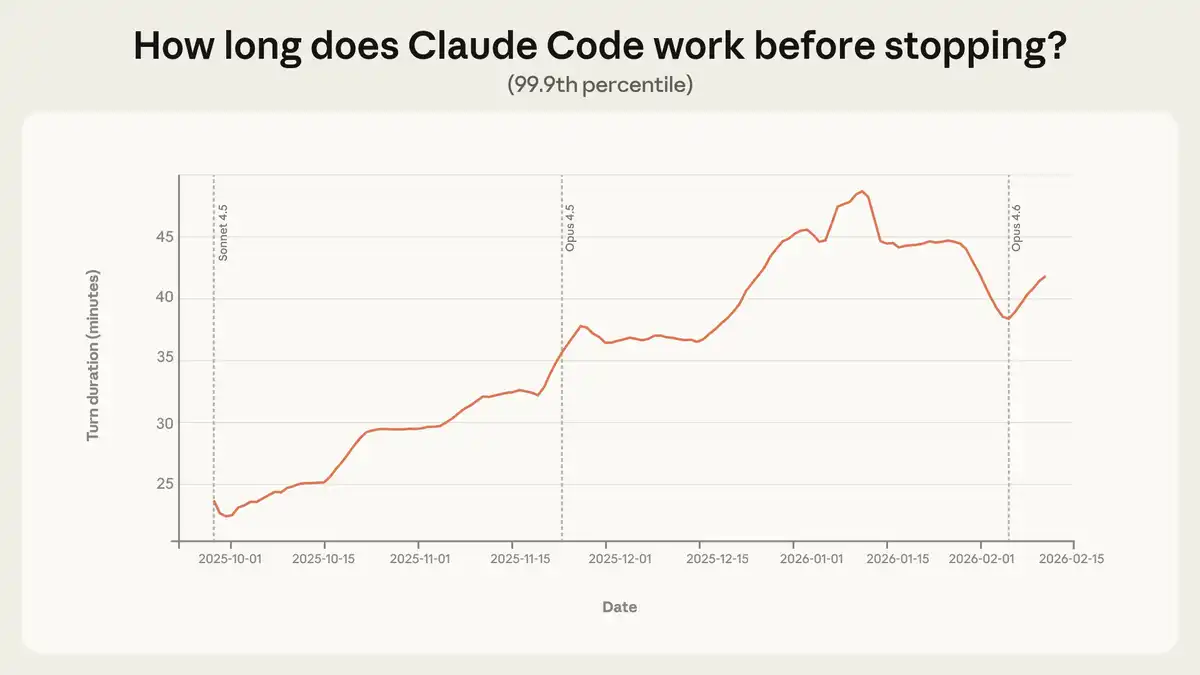
Figure: The maximum duration Claude Code was trained on nearly doubled in three months. This not only improved capabilities but also enhanced trust.

Source:x.com

From October 2025 to January 2026, the 99.9th percentile single-session duration almost doubled, growing from less than 25 minutes to over 45 minutes. Growth was steady across model versions. This isn't just the model getting stronger; it's users learning through repeated use, gradually extending their trust in the Agent.

"From August to December, Claude Code's success rate on internal users' most challenging tasks doubled, while the number of human interventions per session decreased from 5.4 to 3.3."

The capability is already there; deployment hasn't caught up. This isn't a problem; it's a product opportunity.

How Trust Evolves

20% of new users automatically approve Claude Code's actions. By 750 sessions, over 40% of sessions run in full auto-approval mode. But there's a counterintuitive finding: experienced users intervene more, not less. New users intervene in 5% of turns, while experienced users intervene in 9%.
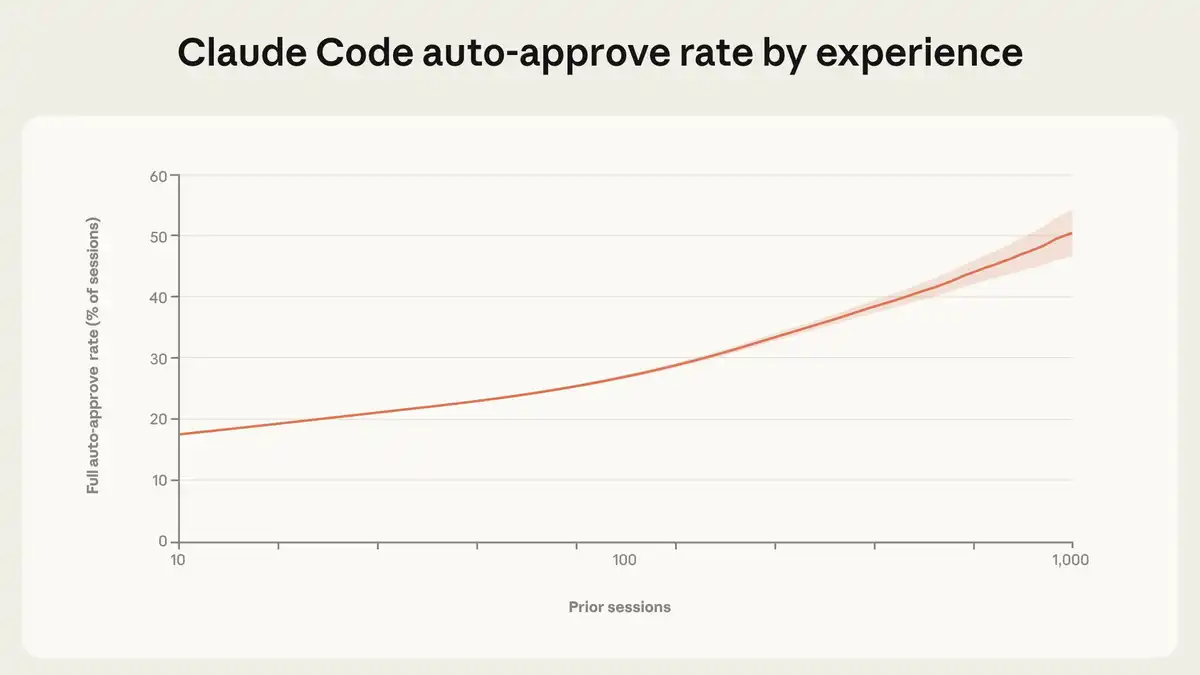
Figure: Trust is a skill that accumulates. New users automatically approve 20% of sessions. By 750 sessions, this exceeds 40%.

Image: Anthropic

Source: x.com

This isn't a contradiction but a shift in supervision strategy. Beginners approve step-by-step before actions occur; experienced users authorize first and intervene only if problems arise—they've moved from pre-approval to active monitoring.

Here's a safety-relevant finding: on complex tasks, Claude Code proactively requests clarification more than twice as often as humans proactively intervene. The Agent pauses to confirm rather than charging ahead. This is a feature, not a bug.

"The core insight of this study is: the autonomy Agents exercise in practice is co-constructed by the model, the user, and the product. Claude pauses to ask questions when uncertain, thereby limiting its own independence. Users build trust through collaboration with the model and adjust their supervision strategies accordingly."

Levie's Vertical AI Playbook

Aaron Levie points to the immense wealth and value waiting to be unlocked: build Agent software that integrates proprietary data, make it truly solve real people and problems, pack it with context to maximize intelligent output, and—this is the part most entrepreneurs miss—drive change management on the client side.

This last point is why vertical AI is so hard to replicate. Anyone can build an API wrapper, but few can truly navigate the workflows, regulatory constraints, and organizational resistance unique to medical billing, legal discovery, or building permit approvals.

SaaS grew tenfold every decade over the past few decades. Over 40% of venture capital in the past 20 years flowed to SaaS companies. This industry spawned over 170 SaaS unicorns. The logic is simple: each of these unicorns has a vertical AI version waiting to emerge. And the AI version could be ten times larger because it replaces not just software but also operators.

The Nature of Co-Construction

Anthropic's core finding deserves serious attention from anyone involved in AI policy making. Autonomy is not an inherent property of the model but is co-constructed by the model, the user, and the product. Pre-deployment evaluations cannot capture this; you must measure it in real use.

Anthropic stated officially:

Software engineering accounts for about 50% of Agent tool calls on our API, but we are also seeing emergence in other industries. As the boundaries of risk and autonomy continue to expand, post-deployment monitoring becomes critical. We encourage other model developers to expand on this research.

The safety numbers are reassuring: 73% of tool calls have a human in the loop, and only 0.8% of operations are irreversible. The highest-risk deployment scenarios—such as API key exposure or autonomous crypto trading—are mostly security assessments, not real production environments.

"Regulatory requirements that mandate specific interaction patterns—for example, requiring human approval for every action—will only create friction without necessarily delivering safety benefits."

Policies mandating "approve every action" kill productivity gains without increasing safety. A better goal is to ensure humans can monitor and intervene, not to mandate specific approval workflows.

Where the Unicorns Are Hidden

The map is drawn. Software engineering is already being done. Healthcare, legal, finance, education, customer service, logistics—16 vertical domains, each with single-digit market share—are waiting for someone to truly embed domain expertise into Agents.

300 SaaS unicorns were born before; the next 300 vertical AI unicorns are about to emerge. The founders who pick a vertical, embed domain expertise into Agents, and figure out how to drive change management will own the enterprise software market for the next decade.

The model can work for five hours; users only let it work for 42 minutes. That's the signal: we are still in the very early stages, there is so much left to build, and in countless places that haven't seen even a minute of intelligence at work.


Related Questions

QWhat percentage of AI Agent tool usage is concentrated in software engineering according to Anthropic's data?

ASoftware engineering accounts for nearly 50% (49.7%) of all AI Agent tool usage.

QWhat is the key opportunity identified in the gap between AI's capabilities and user trust?

AThe gap between AI's ability to work for nearly 5 hours and users only allowing it to work for about 42 minutes represents a major product opportunity to build trust and increase deployment.

QHow did user intervention behavior change as they gained more experience with Claude Code?

AWhile more experienced users (after 750 sessions) ran over 40% of sessions in auto-approval mode, they actually intervened more frequently (9% of turns) compared to new users (5% of turns), shifting their strategy from pre-approval to active monitoring.

QAccording to Aaron Levie, what are the key components for building a successful vertical AI agent?

AThe key components are: building agent software that integrates proprietary data, effectively bridging user and agent collaboration, possessing deep domain-specific contextual engineering capabilities, and driving change management on the customer side.

QWhat does the article suggest is the future market potential for vertical AI compared to SaaS?

AThe article suggests that while the SaaS industry produced over 170 unicorns, there are potentially 300 vertical AI unicorns waiting to be built, and the AI versions could be ten times larger because they replace not just software but also the operators.

Related Reads

20 Billion Valuation, Alibaba and Tencent Competing to Invest, Whose Money Will Liang Wenfeng Take?

DeepSeek, an AI startup founded by Liang Wenfeng, is reportedly in talks with Alibaba and Tencent for an external funding round that could value the company at over $20 billion. This marks a significant shift, as DeepSeek had previously relied solely on funding from its parent company,幻方量化 (Huanfang Quantitative), and had resisted external investment. The potential valuation would place DeepSeek among the top-tier AI model companies in China, comparable to competitors like MoonDark (valued at ~$18 billion) and ahead of recently listed firms like MiniMax and Zhipu. The funding—which could range from $600 million (for a 3% stake) to $2 billion (for 10%)—is seen as a move to secure resources for model development, retain talent, and support infrastructure needs, particularly as competition in inference models and AI agents intensifies. Both Alibaba and Tencent are eager to invest, not only for financial returns but also to integrate DeepSeek into their broader AI ecosystems. However, DeepSeek’s leadership is cautious about maintaining independence and may prefer financial investors over strategic ones to avoid being locked into a specific tech ecosystem. Alternative options, such as state-backed funds, offer longer-term capital and policy support but may come with slower decision-making and potential constraints on global expansion. With competing AI firms accelerating their IPO plans, DeepSeek’s window for securing optimal terms may be narrowing. The final decision will reflect a trade-off between capital, resources, and strategic independence.

marsbit42m ago

20 Billion Valuation, Alibaba and Tencent Competing to Invest, Whose Money Will Liang Wenfeng Take?

marsbit42m ago

After Losing 97% of Its Market Value, iQiyi Attempts to Use AI to Forcefully Extend Its Lifespan

After losing 97% of its market value since its 2018 peak, iQiyi is aggressively pivoting to AI in a desperate attempt to survive. At its 2026 World Conference, CEO Gong Yu announced an "AI Artist Library" with over 100 virtual performers and a new AIGC platform, "NaDou Pro," promising faster production and lower costs. This shift comes as the company faces severe financial distress: its market cap sits near delisting thresholds at $1.36 billion, with significant losses, declining membership revenue, and depleted cash flow. The AI strategy has sparked controversy. Top actors have issued legal threats against unauthorized digital replicas, while in Hengdian, over 134,000 background actors are seeing their already scarce job opportunities vanish as AI replaces them for background roles. iQiyi's move represents a fundamental shift from being a high-cost content buyer to a landlord" to becoming a "platform capitalist" that transfers production risk to creators. This contrasts with competitors like Douyin (TikTok's Chinese counterpart), which is investing heavily in *real* actor-led short dramas, betting that authentic human connection retains users better than AI-generated content. The article draws a parallel to the 1920s transition to "talkies," which made cinema musicians obsolete but ultimately enriched the art form. In contrast, iQiyi's AI drive is framed not as an artistic evolution but as a cost-cutting measure that could degrade storytelling, replacing genuine human emotion with algorithmically calculated stimulation and potentially numbing audiences' capacity for empathy. The core question remains: can a company focused solely on financial survival preserve the art of storytelling?

marsbit45m ago

After Losing 97% of Its Market Value, iQiyi Attempts to Use AI to Forcefully Extend Its Lifespan

marsbit45m ago

Only a 50% Chance of Passing This Year, Can the CLARITY Bill Succeed Before the Midterm Elections?

The CLARITY Act, which passed the House in July 2025 with strong bipartisan support (294-134), faces a critical juncture in the Senate. The Senate Banking Committee is expected to hold a markup soon, but key issues remain unresolved, including stablecoin yield provisions, DeFi regulations, and securing full Republican committee support. Other contentious points involve the Blockchain Regulatory Certainty Act (BRCA), ethics amendments for government officials, and SEC-related matters. The legislative calendar is tight, with limited time before the midterm elections. If the committee markup is delayed beyond mid-May, the chances of passage in 2026 drop significantly. Senator Cynthia Lummis has warned that failure this year could delay comprehensive crypto market structure legislation until 2030 or later. Galaxy estimates the probability of the CLARITY Act becoming law in 2026 is only about 50%. The bill provides crucial regulatory clarity by defining jurisdictional boundaries between the SEC and CFTC, establishing a path for decentralization, and bringing digital commodity intermediaries under federal regulation. Its passage is seen as vital before potential power shifts in the next Congress, which could bring less favorable leadership to key committees. The timeline is compressed, and the bill must compete for floor time with other priorities like Iran authorization and DHS appropriations. Key hurdles include finalizing the stablecoin yield compromise text, addressing law enforcement concerns about BRCA, and navigating political dynamics around SEC nominations. The outcome of the Banking Committee markup and the level of bipartisan support will be critical indicators of its future success.

marsbit1h ago

Only a 50% Chance of Passing This Year, Can the CLARITY Bill Succeed Before the Midterm Elections?

marsbit1h ago

Trading

Spot
Futures
活动图片