American banks are actively exploring tokenized deposits as an alternative to stablecoins, but their widespread adoption could alter the structure of bank funding and reduce the ability of credit institutions to transform short-term liabilities into long-term loans. This is according to an analysis by the Federal Reserve Bank of Dallas.
The authors noted that tokenization could increase the interest rate sensitivity of deposits, boost fund outflows, and force banks to hold more liquid assets.
Tokenized deposits differ from stablecoins in that they exist within the existing banking system and can generate interest income for their owners. At the same time, they are currently less convenient for transfers between different banks. For widespread adoption, deposit tokens need to begin circulating outside the issuing institution, which is why banks are already considering models based on consortia and shared networks.
It is worth recalling that major US banks, including JPMorgan, Citigroup, Bank of America, and Wells Fargo, have planned to launch a network of tokenized deposits in the first half of 2027.
Tokenization Could Transform Bank Lending
Traditionally, banks use relatively stable deposits to fund long-term loans. However, instant transfers of tokenized deposits could significantly simplify the process for customers to switch between banks in search of higher yields.
An additional factor could be the development of agent-based AI and smart contracts. Theoretically, they could automate the movement of funds between banks without the direct involvement of the deposit holder.
According to the authors' estimates, about 80% of the duration of the banking sector's assets, equivalent to approximately $5.8 trillion on a 10-year basis, is supported by the characteristics of deposits. Therefore, changes in depositor behavior could directly impact banks' ability to fund long-term assets.
Specifically:
- A 10% reduction in the average deposit duration could decrease maturity transformation potential by approximately $580 billion;
- A 10% increase in deposit interest rate sensitivity could reduce banks' willingness to take on interest rate risk by approximately $700 billion on a 10-year equivalent basis;
- To maintain lending volumes, banks might be forced to rely more on term debt, potentially raising the cost of loans for households and businesses.
Banks May Need More Liquidity
Tokenized deposits could also force banks to increase their holdings of high-quality liquid assets. The instant movement of funds increases the volatility of deposit balances and complicates outflow forecasting.
Under such conditions, banks may increase the share of reserves and government bonds in their liquidity portfolios to respond more quickly to potential outflows.
Some conclusions can be drawn from Brazil's experience, where the Pix instant payment system has been operational since 2020. By Q1 2026, it had about 200 million active users, with a monthly transaction volume reaching approximately $650 billion.
Research based on regulatory data showed that more active use of Pix increased banks' demand for liquid assets, particularly government bonds, while simultaneously reducing credit intermediation. In the portion of the loan portfolio that remained, banks increased the share of high-risk loans, attempting to boost returns and utilize capital more efficiently.
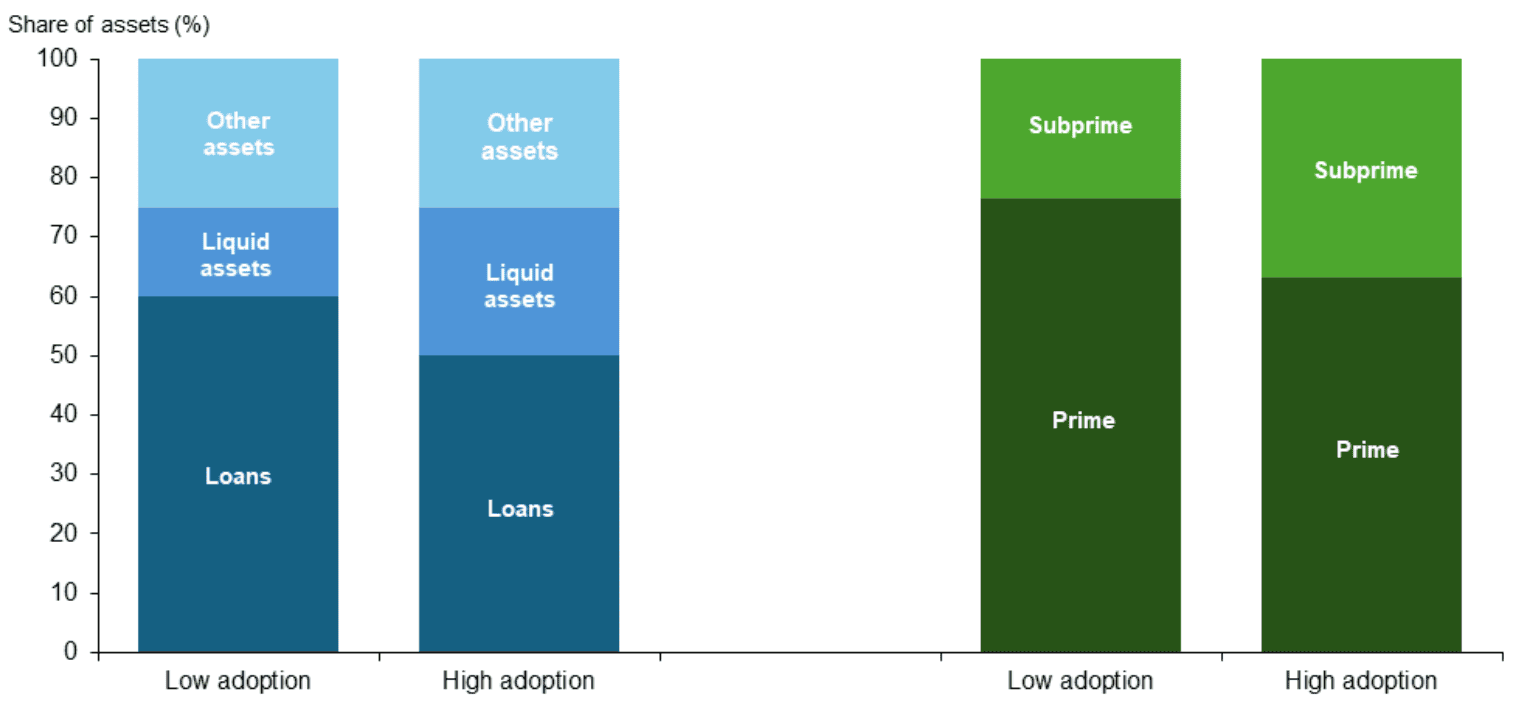
Structure of bank assets and loans based on data from Brazil's Central Bank with low and high use of instant payments. Source: Federal Reserve Bank of Dallas.
The authors emphasize that tokenized deposits in the US are still in the early stages of development, so the scale of future consequences remains uncertain. At the same time, the further spread of tokenization, stablecoins, tokenized securities, and money market funds could significantly change the payment system and bank operating mechanisms.
Separately, regulators will have to assess the impact of such changes on monetary policy, different types of banks, and the role of the central bank as a lender of last resort in a financial system where a significant portion of deposits become digital and instantly transferable.