An AI-Generated 'Whistleblower Post': How Did It Make Two CEOs Write Self-Defense Essays at Midnight?

比推Published on 2026-01-07Last updated on 2026-01-07

Abstract

An anonymous post on Reddit, allegedly written by a drunken backend engineer from a major food delivery platform, went viral with 87,000 upvotes and 36 million views on X. The post accused the company of using algorithms to exploit drivers—assigning “desperation scores” to prioritize orders for more financially vulnerable drivers, delaying regular orders despite promised priority delivery, and misusing driver welfare funds for lobbying against unions. The viral allegations prompted immediate public denials from the CEOs of DoorDash and Uber, who issued statements and social media posts in the middle of the night to refute the claims. DoorDash published a detailed rebuttal on its website. The post was later exposed as an AI-generated hoax by a Platformer reporter. The “whistleblower” provided a fake 18-page technical document and an AI-generated employee ID, which was detected using Google’s SynthID watermarking tool. The account was deleted when further verification was requested. The incident highlights how AI can cheaply and convincingly fabricate content that aligns with public skepticism toward tech platforms. Past real controversies, such as DoorDash’s tip policy and Uber’s Greyball tool, made the false narrative feel plausible. The case underscores growing public anxiety over the difficulty of distinguishing real from AI-generated content and the power of emotionally resonant misinformation—even when debunked—to shape perception.

Written by: Curry, Deep Tide TechFlow

Original Title: The People Need a Bad Capitalist, AI Created a Food Delivery Rumor


Last week, something quite surreal happened.

The CEOs of two major American food delivery giants, one worth $2.7 billion and the other running the world's largest ride-hailing platform, were both awake at midnight on Saturday, writing self-defense essays online.

The cause was an anonymous post on Reddit.

The poster claimed to be a backend engineer at a major food delivery platform, who got drunk and went to a library to use public WiFi to leak information.

The content roughly was:

The company analyzes ride-hailing drivers' situations and assigns them a "desperation score." The more financially strained the driver, the fewer good orders they receive; the so-called priority delivery for food orders is fake, as regular orders are deliberately delayed; various "driver welfare fees" are not given to drivers at all but are used to lobby Congress against unions...

The post ended in a very convincing manner: I'm drunk, I'm angry, so I'm leaking this.

It perfectly portrayed itself as a whistleblower role of "big companies using algorithms to exploit drivers."
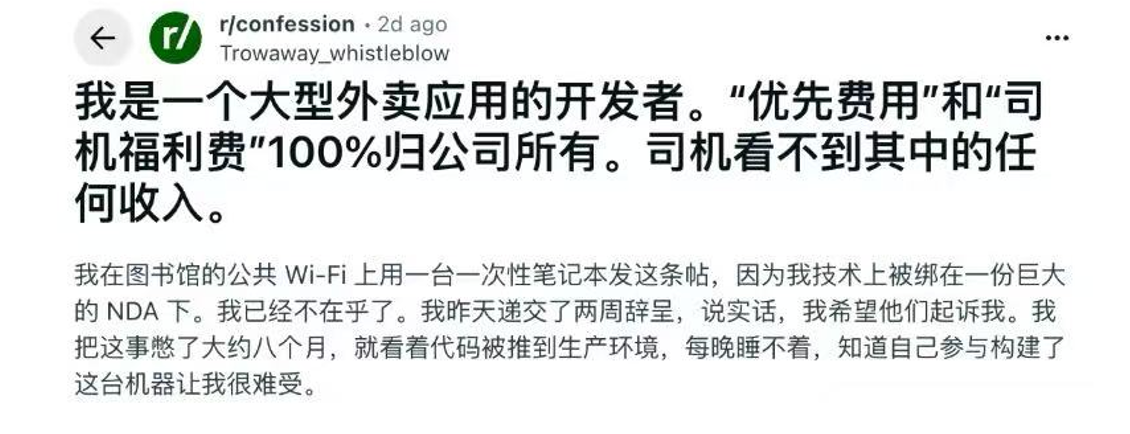
The post received 87,000 upvotes in three days, reaching the front page of Reddit. Some also screenshotted and posted it on X, where it gained 36 million exposures.

Keep in mind, the American food delivery market has only a few major players. The post didn’t name names, but everyone was guessing who it was.

DoorDash's CEO Tony Xu was the first to react, tweeting that this wasn’t them and that he would fire anyone who did such a thing. Uber’s COO also jumped in to respond, "Don’t believe everything you see online."
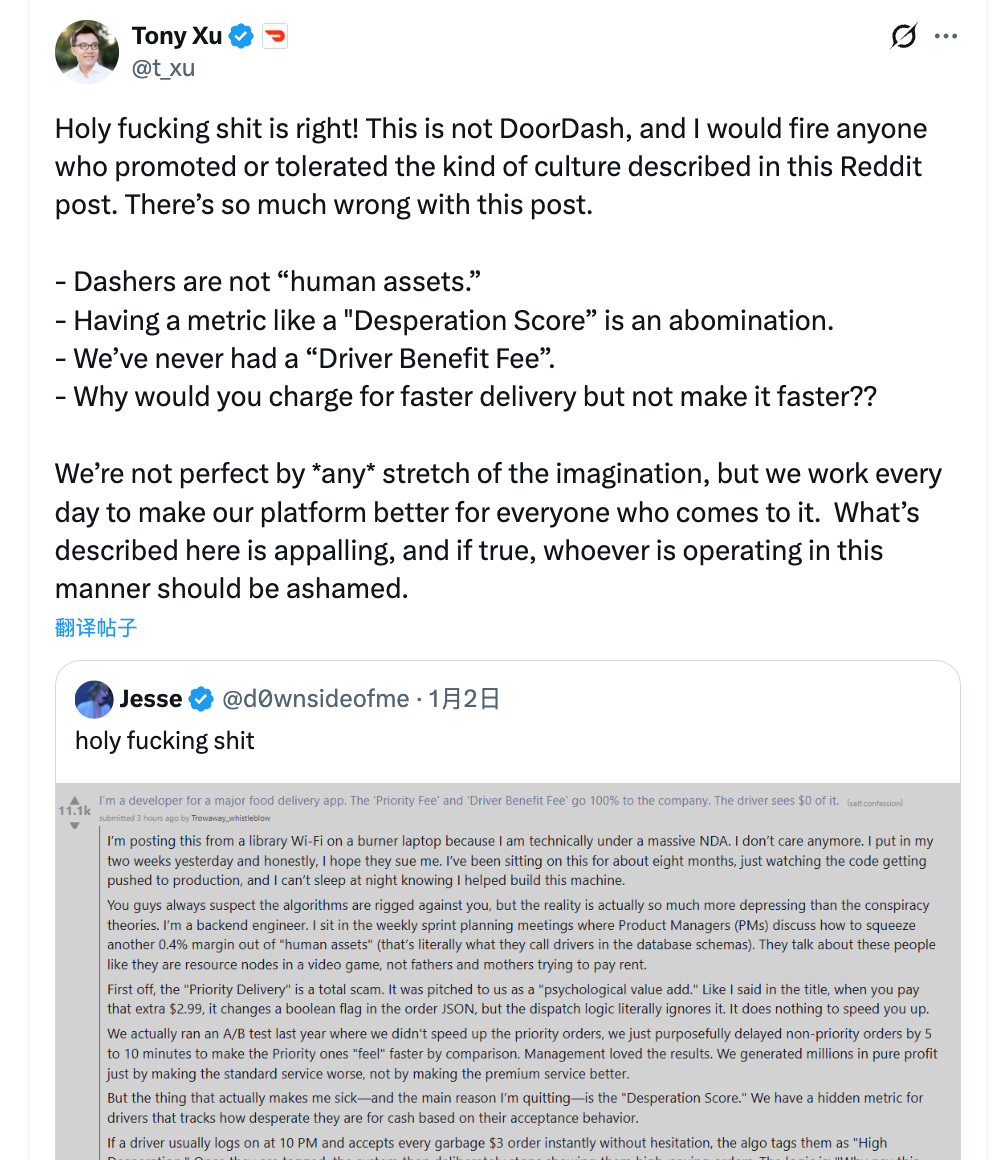
DoorDash even published a five-point statement on its official website, refuting each point in the leak. These two companies, with a combined market cap of over $80 billion, were forced into overnight PR clarifications by an anonymous post.

Then, the post was proven to be fabricated.

It was debunked by Platformer reporter Casey Newton.

He contacted the poster, who immediately sent over an 18-page "internal technical document" titled "AllocNet-T: High-Dimensional Temporal Supply State Modeling."

Every page was watermarked "Confidential," attributed to Uber’s "Market Dynamics Group · Behavioral Economics Department."

The content explained the model mentioned in the Reddit post that calculates the "desperation score" for drivers. It included architecture diagrams, mathematical formulas, data flow charts...
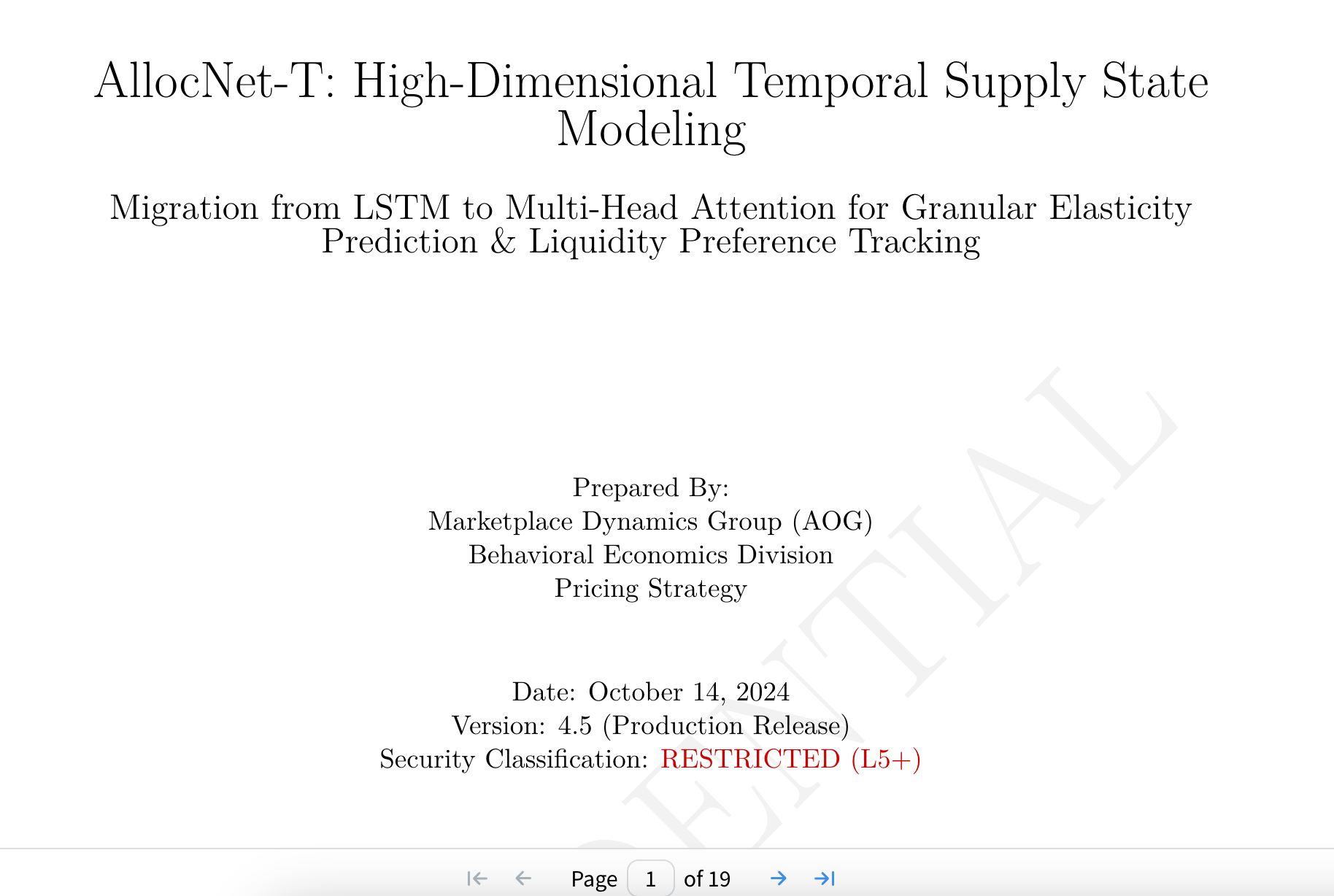
(Fake paper screenshot, at first glance, it looked very real)

Newton said the document initially fooled him. Who would go to the trouble of forging an 18-page technical document to bait a journalist?

But now it’s different.

An 18-page document like this can be generated by AI in minutes.

Additionally, the leaker sent the reporter a blurred photo of their Uber employee ID to prove they worked there.

Out of curiosity, Newton ran the ID photo through Google Gemini for verification. Gemini said the image was AI-generated.

It could be identified because Google embeds an invisible watermark called SynthID in its AI-generated content, undetectable to the human eye but recognizable by machines.

Even more absurdly, the employee ID featured the "Uber Eats" logo.

An Uber spokesperson confirmed: They do not have Uber Eats-branded employee IDs; all badges only say Uber.

Clearly, this fake "whistleblower" didn’t even know who they were trying to target. When the reporter requested LinkedIn or other social media accounts for further verification,

The leaker deleted their account and vanished.

Actually, we don’t want to talk about AI’s ability to fake things; that’s not new.

We’d rather discuss: Why were tens of millions of people willing to believe an anonymous leak post?

In 2020, DoorDash was sued for using tips to offset drivers' base pay and settled for $16.75 million. Uber had a tool called Greyball to evade regulators. These are real events.

It’s easy to find a subconscious agreement: Platforms are not good guys, and this judgment is definitely correct.

So when someone says "food delivery platforms use algorithms to exploit drivers," the first reaction isn’t "Is this true?" but "I knew it."

Fake news spreads because it resembles what people already believe in their hearts.

What AI does is reduce the cost of creating this "resemblance" to almost zero.

There’s another detail in this story.

The deception was uncovered using Google’s watermark detection. Google develops AI, and Google also creates AI detection tools.

But SynthID can only detect Google’s own AI. This time, they caught it because the forger happened to use Gemini. With another model, they might not have been so lucky.

So solving this case was less a technical victory and more about:

The other party made a rookie mistake.

Previously, a Reuters survey found that 59% of people worry they can’t distinguish truth from falsehood online.

The food delivery CEOs’ clarification tweets were seen by hundreds of thousands, but how many firmly believe it’s just PR, just lies? Even though the fake leak post has been deleted, people are still criticizing the platforms in the comments.

The lie has run halfway around the world while the truth is still tying its shoes.

Now think, what if this post wasn’t about Uber but Meituan or Ele.me?

Things like "desperation score," "using algorithms to exploit riders," "welfare fees not given to riders at all." When you see these accusations, is your first reaction emotional agreement?

"Delivery Riders, Trapped in the System"—do you remember that article?

So the issue isn’t whether AI can fake things. The issue is, when a lie looks like what everyone already believes, does truth even matter?

What that account-deleting fugitive wanted, we don’t know.

We only know they found an emotional outlet and poured a bucket of AI-generated fuel into it.

The fire started. As for whether it’s real or fake firewood, who cares?

In fairy tales, Pinocchio’s nose grows when he lies.

AI has no nose.

Original link:https://www.bitpush.news/articles/7600729

Trending Cryptos

Related Questions

QWhat was the main reason the anonymous Reddit post about food delivery platforms gained so much traction and led to CEOs responding?

AThe post gained traction because it tapped into pre-existing public skepticism and negative sentiment towards large food delivery platforms, with many people already believing that such companies exploit drivers through algorithms. The allegations, though fabricated, aligned with common perceptions, making them easily believable.

QHow was the anonymous Reddit post eventually exposed as being AI-generated?

AThe post was exposed as AI-generated when a journalist, Casey Newton, investigated and found that the 'internal technical document' provided by the whistleblower was likely created by AI in minutes. Additionally, a fake employee ID photo included in the evidence was identified as AI-generated by Google's SynthID watermark detection tool, and Uber confirmed they do not issue Uber Eats-branded employee cards.

QWhat specific allegations did the AI-generated Reddit post make against the food delivery companies?

AThe post alleged that the company analyzed ride-hailing drivers' situations and assigned them a 'desperation score,' where drivers in greater financial need received worse orders; that priority delivery for food orders was fake and regular orders were delayed; and that various 'driver welfare fees' were not given to drivers but used to lobby Congress against unions.

QWhy did the CEOs of DoorDash and Uber feel compelled to respond to the anonymous post?

AThe CEOs felt compelled to respond because the post went viral with 87,000 likes on Reddit and 36 million views on X, creating significant public pressure and potential damage to their reputations. They issued denials and clarifications to protect their companies' images and reassure the public and stakeholders.

QWhat broader concern does this incident raise about AI and misinformation?

AThe incident highlights how AI can easily generate convincing misinformation that aligns with existing public biases, making it difficult to distinguish truth from falsehood. It underscores the challenge of combating AI-generated content, especially when it reinforces preconceived notions, and raises concerns about the potential for widespread deception in the digital age.

Related Reads

This Strategy Earned Hefei One Trillion Yuan

This article analyzes the "Hefei Model" that enabled a municipal state-owned investment to generate paper profits exceeding one trillion yuan through the 2026 IPO of ChangXin Memory Technologies (CXMT). It argues against framing this success as a "lucky gamble," instead presenting it as the result of a deliberate institutional system designed to enable long-term industrial investment. The system comprises three core components. First, a **quantified risk-tolerance mechanism**, including a 40% loss allowance for venture funds and a clear "duty-fulfilled exemption" list, decouples project failure from personal career risk for decision-makers, allowing them to focus on industrial potential rather than personal liability. Second, **strategic investment in critical supply chain gaps**: Hefei doesn't just invest in "good" projects, but targets "missing" links essential for its key industries (appliances, displays, cars). The investment in CXMT aimed to fill the critical DRAM memory chip gap, subsequently attracting over 450 upstream and downstream firms and creating a full semiconductor cluster. Third, **institutional authorization for counter-cyclical investment**: Protected by the risk-tolerance framework, Hefei supported CXMT with increased investment during the 2023 global memory industry downturn, enabling it to scale production and capitalize on the 2025 AI-driven demand surge. The article concludes that the true lesson is not the specific investment but building the institutional infrastructure—quantified risk tolerance, deep industry chain analysis, and counter-cyclical mandates—that makes such long-term, strategic bets possible. It notes the final challenge is perfecting the exit mechanism to complete the investment cycle and transform paper gains into sustainable fiscal returns and reinvestment capacity.

marsbit12m ago

This Strategy Earned Hefei One Trillion Yuan

marsbit12m ago

Silicon Valley VC's On-the-Ground Observations of Chinese Entrepreneurship: A Harsher Capital Environment Breeding Fiercer Companies

A Silicon Valley VC's on-the-ground observations of China's startup ecosystem reveal a harsher capital environment forging more aggressive and execution-driven companies. Unlike Silicon Valley's patient capital focused on long-term growth, China's venture landscape is characterized by intense pressure for exits. Startups often face "equity in name, debt in reality" terms with strict timelines and personal founder liability, pushing IPO as the nearly mandatory exit path due to a virtually non-existent M&A market. This high-stakes system, while potentially fostering short-termism, cultivates extreme cost discipline, rapid execution, and formidable commercialization skills—traits evident as these companies expand overseas. The funding ecosystem comprises three main pools: local RMB funds (often government-backed with economic development mandates), domestic USD funds (more founder-friendly, like Sequoia China), and dwindling direct foreign capital. Financial Advisors (FAs) play a crucial intermediary role, packaging deals and navigating China's opaque, relationship-based business networks where platforms like LinkedIn haven't taken root. Underpinning it all is significant state influence through industrial policy, directing capital and incentives toward strategic sectors like semiconductors and AI. The result is a distinct, parallel innovation model—less forgiving than Silicon Valley's, but capable of concentrating resources, accelerating iteration, and producing fiercely competitive companies in targeted industries.

marsbit17m ago

Silicon Valley VC's On-the-Ground Observations of Chinese Entrepreneurship: A Harsher Capital Environment Breeding Fiercer Companies

marsbit17m ago

SharpLink's Helm: Buying Only, Never Selling, Making ETH Generate Profits Through the Cold Winter

SharpLink co-CEO Joseph Chalom shares his bullish outlook on Ethereum during the recent "Injective Summit 2026." Despite prevailing negative market sentiment, Chalom argues that fundamentals and data tell a different story: Ethereum dominates with over 50% of stablecoin transaction volume, nearly 60% of tokenized real-world assets (RWA), and remains the uncontested leader in DeFi. He attributes the communication gap and lack of confidence partly to the Ethereum Foundation's restructuring. In response, SharpLink, alongside ConsenSys and Bitmain, is funding three key spin-off teams from the Foundation: ETH Labs (for institutional-scale scalability), Ethereum Institutional (for business development and marketing), and EthSystems (for next-gen privacy and compliance solutions). Chalom emphasizes these are critical for accelerating institutional adoption. Regarding SharpLink's strategy, Chalom details a conservative, yield-focused approach. The firm holds 886,725 ETH, acquired with zero leverage or debt. They generate revenue by staking ETH and strategically deploying capital into DeFi protocols via a dedicated fund, aiming for returns above the native staking yield. This contrasts with some Bitcoin-focused firms that have become net sellers. On the broader institutional adoption of tokenization, Chalom sees current progress as just the beginning. He breaks it down into layers: stablecoins as the currency/value layer, tokenized assets as the exposure layer, and DeFi as the execution layer. He predicts regulatory clarity, like the potential Clarity Act, will be a major catalyst. A key future inflection point will be when fiduciary managers prefer tokenized, 24/7 tradable digital assets over traditional "analog" versions due to their programmability and instant settlement. In conclusion, Chalom positions SharpLink not just as an ETH accumulator and yield generator, but as an active "ecosystem steward," funding essential development and marketing initiatives to support Ethereum's long-term growth, which he believes is directly aligned with shareholder interests.

Odaily星球日报18m ago

SharpLink's Helm: Buying Only, Never Selling, Making ETH Generate Profits Through the Cold Winter

Odaily星球日报18m ago

Ten European Banks Launch Blockchain Initiative RL1

On July 28, 2026, ten European financial institutions launched the Regulated Layer One (RL1) initiative. This open, neutral, and compliance-focused blockchain network is specialized for institutional digital asset operations. The founding members include ABN AMRO, Cecabank, Chartered Investment, Crédit Mutuel Alliance Fédérale, DekaBank, DZ BANK, LBBW, Natixis CIB, SC Ventures, and Seturion, formed as a European cooperative society (SCE) and led by Henning Voelkel, former head of SWIAT. The network is open to new participants, with NatWest currently in discussions to join. RL1 is built on the SWIAT blockchain, which will remain its software and services provider. The underlying SWIAT network, operational for three years, has processed 50 transactions totaling €700 million. The initiative is described as a collective European effort to create a foundation for a shared, openly and trustworthily managed distributed ledger. Its primary goal is to overcome fragmentation in the regulated financial sector by establishing a neutral, participant-owned, pan-European DLT infrastructure for tokenized assets, digital money, and next-generation financial services. The move responds to growing EU demand for scalable real-world asset (RWA) infrastructure, evidenced by projects like Pontes and Appia. This launch aligns with broader sector growth expectations, including Standard Chartered's forecast for DeFi and RWA market capitalization to reach $2 trillion.

cryptonews.ru23m ago

Ten European Banks Launch Blockchain Initiative RL1

cryptonews.ru23m ago

Trading

Spot

Hot Articles

Discussions

Welcome to the HTX Community. Here, you can stay informed about the latest platform developments and gain access to professional market insights. Users' opinions on the price of AI (AI) are presented below.

活动图片