Altman Returns to Stanford and Admits Mistake: Outsourcing Thinking to AI, a Generation's Brains Are Atrophying

marsbitPublished on 2026-07-16Last updated on 2026-07-16

Abstract

Sam Altman returned to Stanford University and admitted he was wrong about AI's impact on education. He predicted that after an initial phase of student cheating with ChatGPT, the education system would rapidly reform itself to teach more critical thinking. However, three and a half years later, while AI has advanced dramatically, teaching and assessment methods remain largely unchanged—still focused on memorization, standardized answers, and closed-book exams. Altman expressed deep concern that this disconnect is causing a "cognitive atrophy," where outsourcing thinking to AI erodes students' critical reasoning skills. Research supports this: grades have dropped in high-stakes exams after ChatGPT's introduction, and while assignment scores in writing and coding have inflated due to AI use, exam performance hasn't improved, indicating "outsourcing" rather than learning. He argues the problem lies in institutional inertia. The education system, built on the premise that tasks are time-consuming, hasn't adapted to a world where AI makes shortcuts effortless. Students are being evaluated by outdated standards, risking a generational gap in essential cognitive skills. Altman proposes a shift: education should move from testing memorization to fostering judgment, creativity, and the ability to ask better questions. Core practices like writing and programming remain vital not for their outputs, which AI can generate, but for the thinking process they train. The urgent need is to...

Everyone thought schools would be forced to drastically transform by AI.

But three and a half years after ChatGPT's debut, education has barely changed.

In May of this year, Sam Altman returned to his alma mater, Stanford University, took the stage in the CS153 class, and admitted his mistake:

This was one of my prediction errors.

He also issued a stern warning: if we don't change, human thinking capacity will atrophy.

Not long ago, on the CS153 stage at Stanford, OpenAI CEO Sam Altman was asked: What do you think about education?

He paused: "I'm very worried. I thought it would have changed by now."
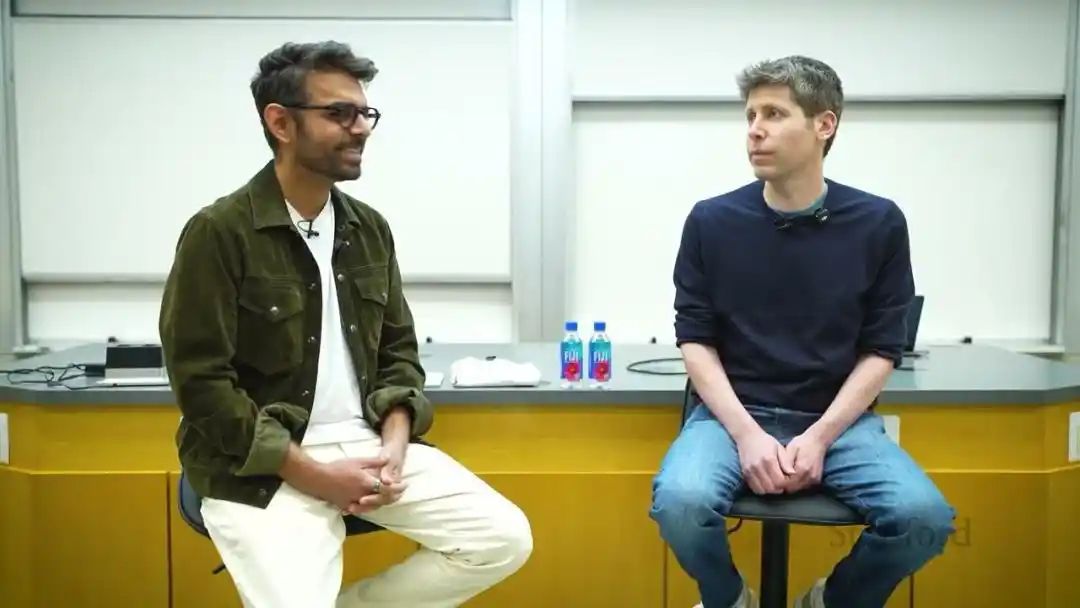
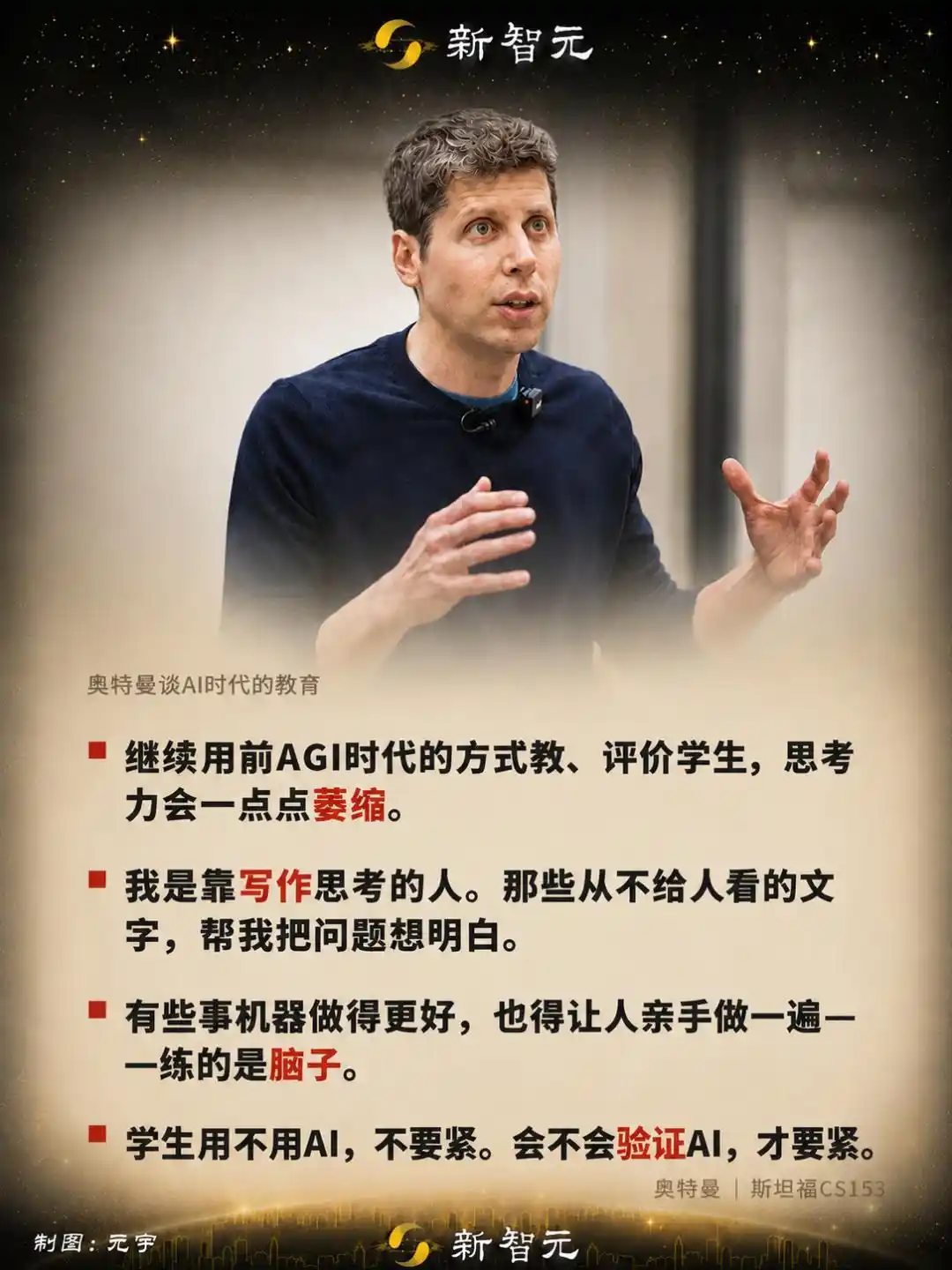
Altman appears at Stanford CS153 class discussing education in the AI era, admitting he underestimated the speed of the education system's transformation. (Source: Stanford Online)

Three and a half years ago, right after ChatGPT launched, Altman predicted that students would cheat for a year, then the entire education system would be forced to restructure itself, teaching people to think better than before.

However, three and a half years later, the script didn't unfold as Altman imagined.

On the AI side, it evolved from GPT-3.5, which could only write copy, to models that can disprove mathematical conjectures that stumped mathematicians for decades.

On the school side, they're still testing students with the same old things: rote memorization, standard answers, closed-book exams.

Homework, exams, theses... everything remains the same. Scouring the entire education system, he couldn't find a single significant structural change.

A man who bet correctly on the "Scaling Law" turned out to be mistaken about education.

He said this was one of his biggest prediction mistakes in recent years.

A person who constantly talks about Artificial General Intelligence (AGI) is actually anxious about the classroom.

What exactly is he afraid of?

He Thought Schools Should Have Changed Already

Rewind to November 2022, just after ChatGPT's release.

Back then, Altman's assessment was still optimistic:

The first year, students would use it to cheat and learn little; then the education system would reinvent itself, teaching courses much better than before.

According to his vision, teachers would assign projects that necessitated using AI, forcing students to use their brains more and come up with new ideas.

In 2024, he publicly expressed optimism: superintelligence would bring a personal tutor for everyone, education would shift from rote memorization to problem-solving, to critical thinking.

The result? AI advanced by leaps and bounds year after year, while education remained stagnant.

AI Outsourcing Is Hollowing Out Critical Thinking

This disconnect is what Altman is truly worried about.

He says if we continue to teach and evaluate students using the methods of the "pre-AGI world," it will not only render these methods ineffective but also cause people to "fail to learn how to think," leading to the gradual atrophy of critical thinking.

Outsourcing thinking to AI starts as just a shortcut.

But use it or lose it—the mental muscle responsible for independent thinking, like an unused arm, will subtly shrink and weaken, or as Altman puts it—muscle atrophy.

Is this just Altman's concern, or is it already a reality?

Some research shows that after ChatGPT entered the classroom, monthly test scores dropped by about 20% within six months; for high-stakes entrance exams that truly determine one's future, scores fell by 18% and 24% respectively, and this deficit takes up to two years to gradually become apparent.

More telling is an analysis from the University of California, Berkeley (UC Berkeley).

Among over 500,000 grade samples, grades in subjects like writing and programming noticeably shifted upward after ChatGPT, but the increase was entirely in homework scores, while exam scores remained unchanged.
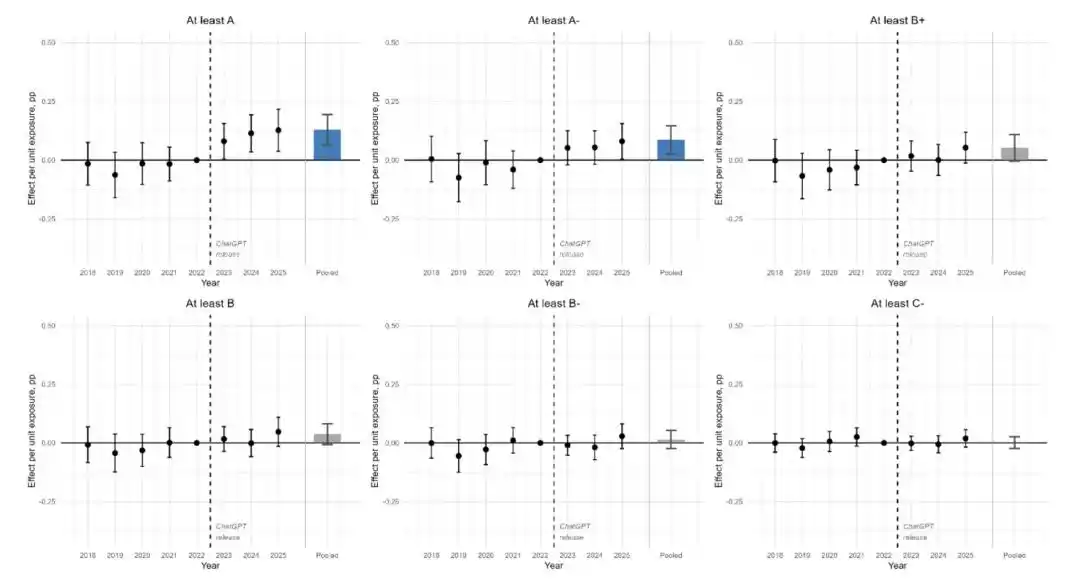
UC Berkeley analysis of over 500,000 grades: After ChatGPT's release, the proportion of A and A- grades in writing and programming courses significantly increased (blue significantly positive), while B+ and below barely moved. (Source: Chirikov/CSHE)

Why? This is "outsourcing," not "learning."

Another study spanning ten years and covering millions of US math interactions points to the same conclusion: with the arrival of chatbots, problems are solved faster, but less is learned.

Homework submissions are getting more polished, but minds are getting emptier.

Where Is the Promised Renaissance in Education?

Altman isn't the only one puzzled.
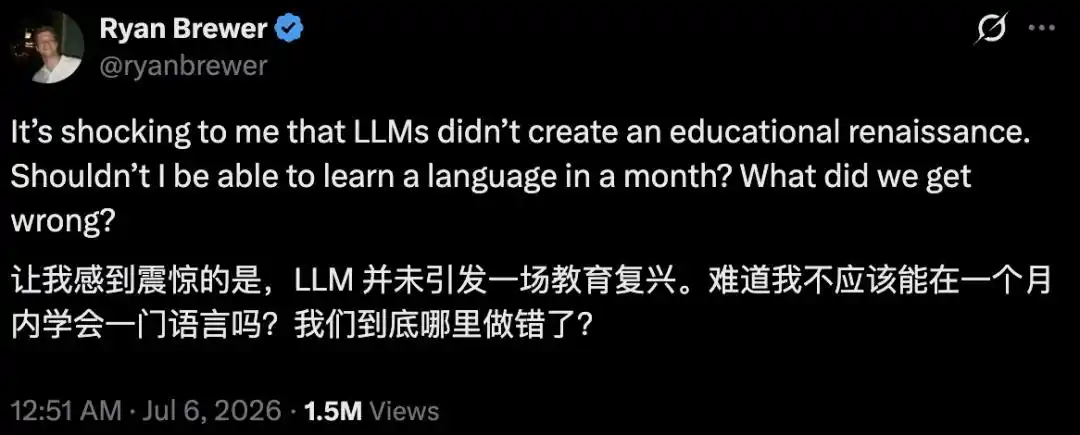
OpenAI technical team member Ryan Brewer posted, saying it's shocking that large language models haven't sparked an educational renaissance:

Shouldn't I be able to learn a language in a month? Where did we go wrong?

Similar doubts spread rapidly on X: With the most powerful learning tool in history in hand, why haven't AI tutors entered every household? Why is the education revolution so delayed?

The answer lies not in technology, but in institutional inertia.

The university's evaluation system—exams, theses, homework—has been built over centuries on an implicit premise: these tasks are too time-consuming for anyone to take shortcuts.

AI has changed that premise.

But schools are still using pre-AGI standards to measure a new generation raised with AI, even as the first generation of ChatGPT natives have already graduated.

Tools update with a version number; systems update over a generation: the technology is already here, but the rules remain in the previous era.

A 24/7, tireless, personalized, almost-free AI tutor could theoretically be given to every child today.

But it hasn't arrived, and the real reason is the pace at which the education system restructures itself.

In the same speech, Altman offered another prediction:

It's been three and a half years since ChatGPT appeared. Even if AI merely progresses along the same curve for another three and a half years, what human society can do will be on a completely different scale than today.

As technology races ahead exponentially, the gap between it and education will only widen, ultimately to be filled by the students currently sitting in old exams, old homework, and old evaluation systems.

The skills they learn may be taken over by AI the moment they leave school; the judgment they fail to develop may be difficult to recover in a lifetime.

The debt incurred is a generation's "cognitive deficit."

If Machines Can Write, Why Must Humans Still Learn?

So what should we still teach?

Altman's answer is somewhat counterintuitive: Some things, even though machines can do them better, humans must still do them by hand.

He gave his own example.

He said he's the kind of person who "thinks by writing," producing a lot of text never meant for anyone else, just to clarify a problem, and he's grateful he learned to write.

Programming is the same; AI can generate code in a second, but the process of building logic by hand trains the brain.

In essence, writing and programming are like math proofs in the calculator era: the machine already knows the answer, but we still have students derive it themselves. The goal isn't the answer behind the problem, but the meta-skills of "thinking" and "learning," and writing and programming are the tools to train them.

Following this logic, Altman advocates shifting the goal of education from "remembering more knowledge" to "asking better questions"; from testing memory to testing judgment, creativity, and genuine interdisciplinary skills.
And the root of the problem lies precisely in the evaluation system.

What do today's exams still test?

Memory, standard answers, completing tasks alone and closed-book. These three things are exactly what AI is best at and can most easily do for you.

When schools still evaluate students by "who remembers more, who answers more accurately," AI has turned "remembering more, answering accurately" into a zero-cost commodity.

How much meaning remains in numbers measured by a ruler that AI can easily pass, when used to gauge the abilities of the next generation?

This is what truly worries Altman: It's not most crucial whether students use AI; what's crucial is whether they can *verify* AI.

More concerning than over-reliance on AI is using AI without knowing how to verify it, accepting the machine's output at face value.

If this inertia persists for another three and a half years, a generation will gradually lose the training ground for independent thought, only to realize too late: they've almost forgotten how to think for themselves.

References:

https://www.youtube.com/watch?v=F_7M4Hc-usM

https://x.com/hesamation/status/2073884828861071557

https://x.com/ryanbrewer/status/2073812031988535760

This article is from the WeChat public account "Xin Zhi Yuan", author: ASI Revelations

Trending Cryptos

Related Questions

QWhat was Sam Altman's original prediction about the impact of ChatGPT on education, and how did reality differ from his expectation?

ASam Altman initially predicted that after a year of students using ChatGPT to cheat, the education system would be forced to fundamentally restructure itself to teach people how to think better. However, three and a half years later, he admitted this was a major prediction error, as education has seen almost no significant structural change while AI has advanced rapidly.

QAccording to Sam Altman, what is the primary danger of continuing to use pre-AGI teaching and assessment methods in an AI era?

AThe primary danger is the atrophy of critical thinking skills. If students outsource their thinking to AI and education systems continue to rely on methods that value memorization and standardized answers over genuine understanding, the 'muscle' for independent thought will weaken and shrink due to lack of use.

QWhat evidence from UC Berkeley's grade analysis suggests students are 'outsourcing' rather than 'learning' with AI?

AAn analysis of over 500,000 grades at UC Berkeley showed that in courses like writing and programming, the proportion of students receiving A and A- grades increased significantly after ChatGPT's release, but grades for exams (B+ and below) remained virtually unchanged. This indicates AI is helping improve homework scores without corresponding gains in exam performance, pointing to outsourcing of work rather than deeper learning.

QWhy does Sam Altman believe that activities like writing and programming remain essential to learn, even though AI can do them well?

AHe believes the process of doing these activities trains the 'meta-skills' of thinking and learning. Just as students still work through math proofs in the calculator era, writing and programming are tools to structure logic and clarify thought. The value is not in the final product but in the cognitive exercise the process provides for the brain.

QWhat does Sam Altman suggest should be the new focus of education in the age of AI, and what is the main obstacle to achieving this shift?

AHe suggests shifting the focus from memorizing knowledge to asking better questions, and from testing memory to assessing judgment, creativity, and interdisciplinary skills. The main obstacle is the inertia of the current evaluation system, which still relies on assessing memorization, standardized answers, and closed-book tasks—precisely the areas where AI excels, making such assessments increasingly meaningless.

Related Reads

Gold Rush Handbook | Rialto Teams Up with Robinhood Crypto, Targeting Order Routing Rights

**Summary** Rialto is positioning itself as an on-chain spot exchange focused on order routing and execution quality for a range of assets, including cryptocurrencies and tokenized stocks/ETFs. It operates primarily on the Robinhood Chain network. Its core mechanism revolves around **propAMMs** – on-chain market makers that use proprietary inventory and pricing logic, referencing external markets (like underlying stock exchanges for tokenized equities) rather than relying solely on automated market maker (AMM) formulas. For each user order, Rialto's aggregator solicits real-time quotes from multiple liquidity sources, including its own propAMM (Rivo Altus) and traditional DEX pools. It then selects and atomically executes the path offering the best net output after costs, potentially splitting orders across sources. Rialto's key competitive claim is turning **order routing control into a service for better execution**. Instead of users manually finding the best liquidity, the system automatically compares and routes to the optimal source(s) for each trade. It has launched a partner program for integrations and its swap API is already used by several protocols. Challenges ahead include expanding the asset base on Robinhood Chain, ensuring Rivo Altus's price competitiveness, attracting diverse external liquidity, and consistently delivering superior net execution compared to manual routing. Success in these areas would see Rialto competing for the crucial "order routing right" in the emerging on-chain market for tokenized real-world assets.

Foresight News33m ago

Gold Rush Handbook | Rialto Teams Up with Robinhood Crypto, Targeting Order Routing Rights

Foresight News33m ago

Bitwise: RWA and Prediction Markets Continue to Gain Momentum, Crypto is Bottoming Out

Bitwise's Q2 2026 report highlights a challenging crypto market. The Bitwise 10 Crypto Index fell 15.4%, and spot Bitcoin ETFs saw a record $4.9 billion in quarterly outflows as Bitcoin dropped below $60,000. Overall sentiment is described as one of the worst in eight years. Despite the downturn, key sectors show resilience and growth. Real-World Asset (RWA) tokenization reached a record $33 billion, up 45% year-to-date. Prediction markets also hit new highs, with open interest at $1.8 billion and quarterly volume hitting $43 billion, driven partly by political events. Crypto equities outperformed, with the Bitwise Crypto Innovators 30 Index rising 30.6%, largely fueled by AI-related Bitcoin miners. These stocks exhibited low correlation with other major asset classes. Major DeFi protocols like Aave demonstrated strong revenue generation, with the top ten crypto applications collectively earning $5.9 billion over the past year. The report notes that while prices and on-chain activity are down from peaks, fundamental metrics like stablecoin supply (~$300B) and Ethereum transaction activity are significantly higher than at the 2022 bear market bottom. Key Q3 factors include the fate of the CLARITY Act, final rules for the GENIUS stablecoin act, and policy signals from the new Fed Chair. The conclusion is that the industry is building a stronger foundation—with greater adoption, institutional involvement, and real utility—even at depressed prices, setting the stage for the next cycle.

Odaily星球日报59m ago

Bitwise: RWA and Prediction Markets Continue to Gain Momentum, Crypto is Bottoming Out

Odaily星球日报59m ago

Bitcoin Shifts to Building a Bottom, with Selling Pressure from Long-Term Holders Significantly Easing

Bitcoin is transitioning into a basing phase, with significant selling pressure from long-term holders showing signs of easing. The market is testing overhead resistance, with Bitcoin responding more positively to favorable macro data like soft inflation reports than major equity indices. Its correlation with stocks is weakening while its inverse relationship with the US dollar strengthens, indicating a shift in primary drivers towards liquidity factors rather than risk sentiment. On-chain analysis reveals that long-term holder profit-taking has largely dried up, and the wave of capitulation selling from this cohort has peaked and begun to recede. Buyers successfully absorbed selling pressure at the June lows. Bitcoin currently trades between the network's average realized price (a support floor) and the short-term holder cost basis near $69k, which will be a key resistance level. A breakout above this level is needed to signal a more sustained recovery. In derivatives markets, traders are unwinding bearish bets, with put/call ratios falling and crash protection premiums declining. However, this futures and options positioning adjustment has not been accompanied by significant spot buying. US spot ETF outflows have slowed but not reversed. Volatility has compressed to low levels. In summary, the foundations for a bottom are forming: long-term holder selling is subsiding, demand absorbed the recent low, and the market is reacting to positive catalysts. However, confirmation is still lacking, requiring a spot-driven breakout and hold above the short-term holder cost basis around $69k.

Foresight News1h ago

Bitcoin Shifts to Building a Bottom, with Selling Pressure from Long-Term Holders Significantly Easing

Foresight News1h ago

Trading

Spot

Hot Articles

Discussions

Welcome to the HTX Community. Here, you can stay informed about the latest platform developments and gain access to professional market insights. Users' opinions on the price of S (S) are presented below.

活动图片