All about Solana’s 4.7M milestone and SOL’s attempt to clear $75-level

ambcryptoPublished on 2026-07-02Last updated on 2026-07-02

Abstract

Solana recently reached a significant milestone with active addresses surging to 4.7 million, indicating a substantial increase in network activity and user engagement. This growth in on-chain interactions could boost market confidence and demand for SOL. The token's price is currently testing a critical technical resistance level near the $75 mark, represented by a key Exponential Moving Average. A successful breakout above this level could signal a shift in market structure and potentially lead to a broader recovery, with the next target around $83. On-chain data reveals ongoing token accumulation by holders and a reduction in circulating supply, suggesting a potential supply-demand imbalance that could drive prices higher in the near term. Fundamental analysis adds to the bullish case, as Solana's Price-to-Sales ratio stands around 2, which some investors interpret as a sign the token may be undervalued at its current trading price. While this metric is not a short-term trading signal, it provides supportive context for ongoing accumulation. Together, the improving network fundamentals, holder behavior, and valuation metrics appear to be aligning to support a potential price breakout for SOL.

Solana is in the news after its active addresses surged significantly to 4.7 million over the past week. The hike in user interactions across the Solana network could translate into greater demand and eventually feed into investors’ market confidence.

However, will other on-chain and technical developments help sustain the improving market activity?
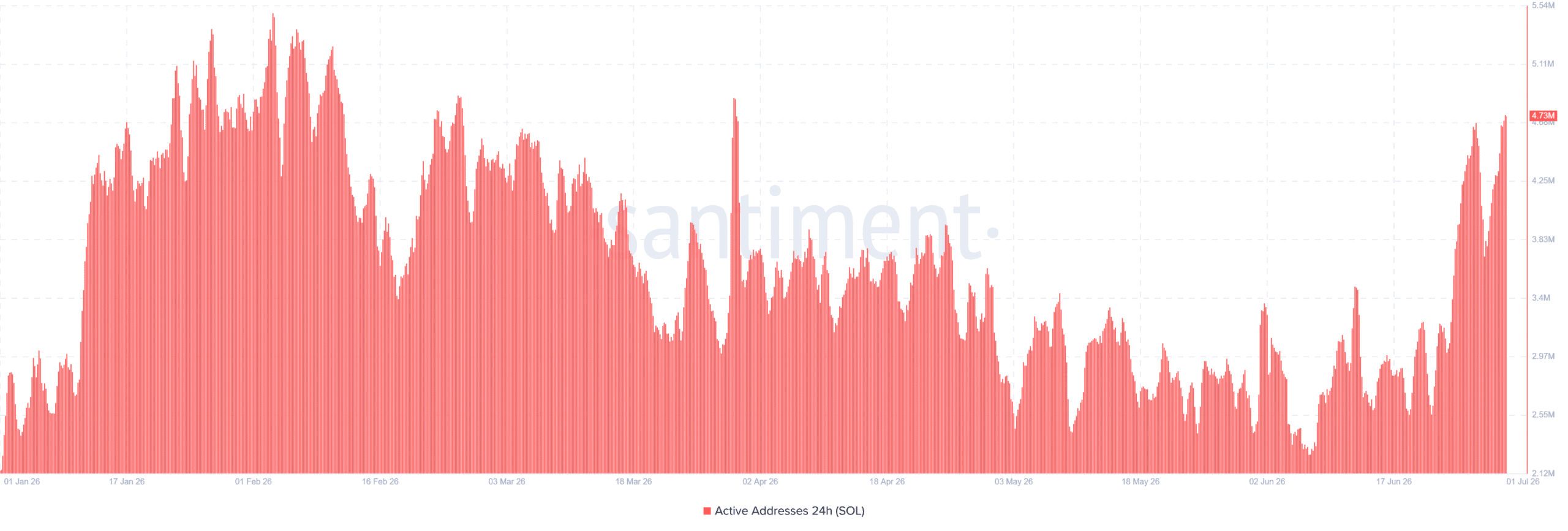
Source: Santiment

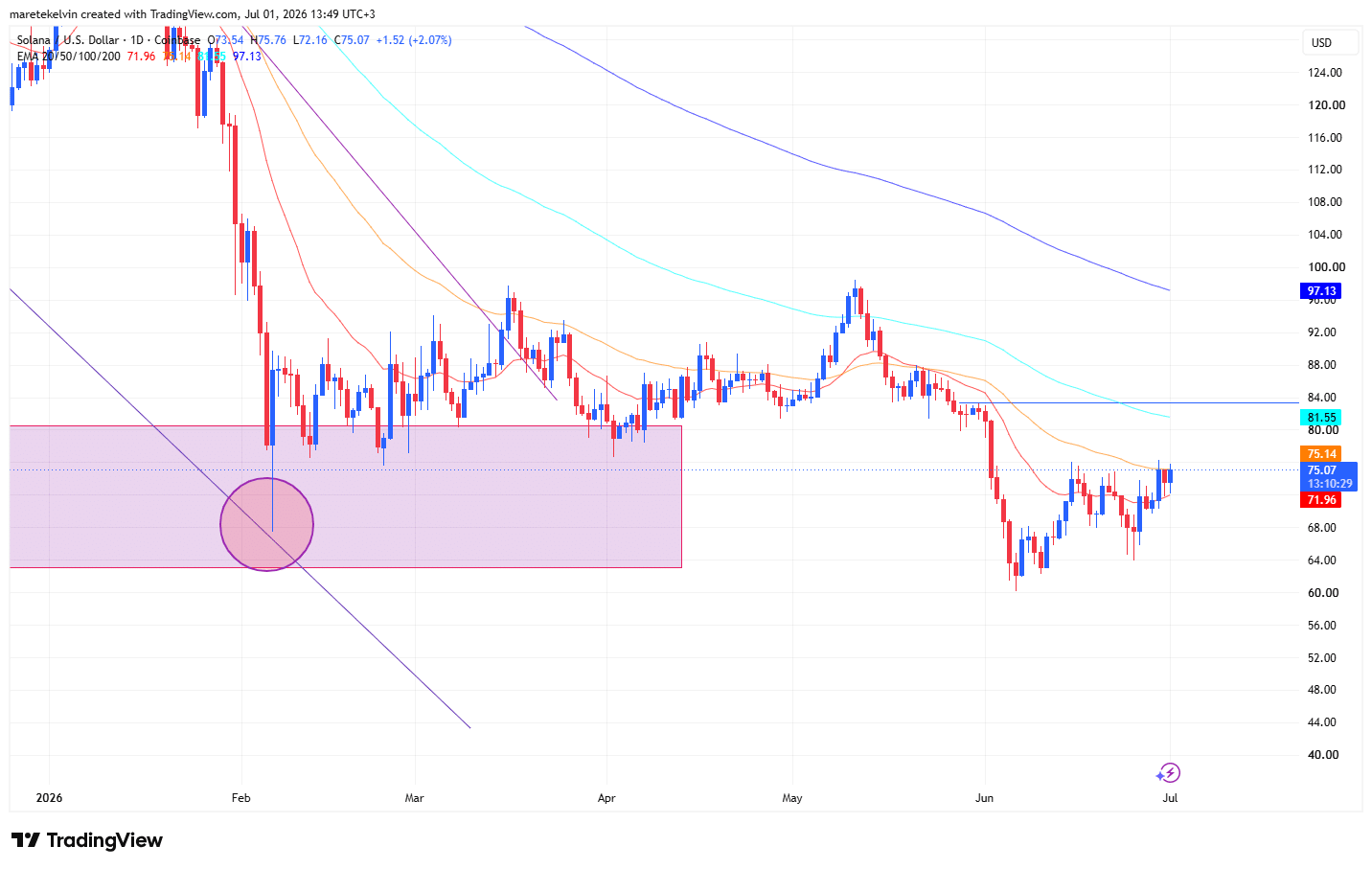
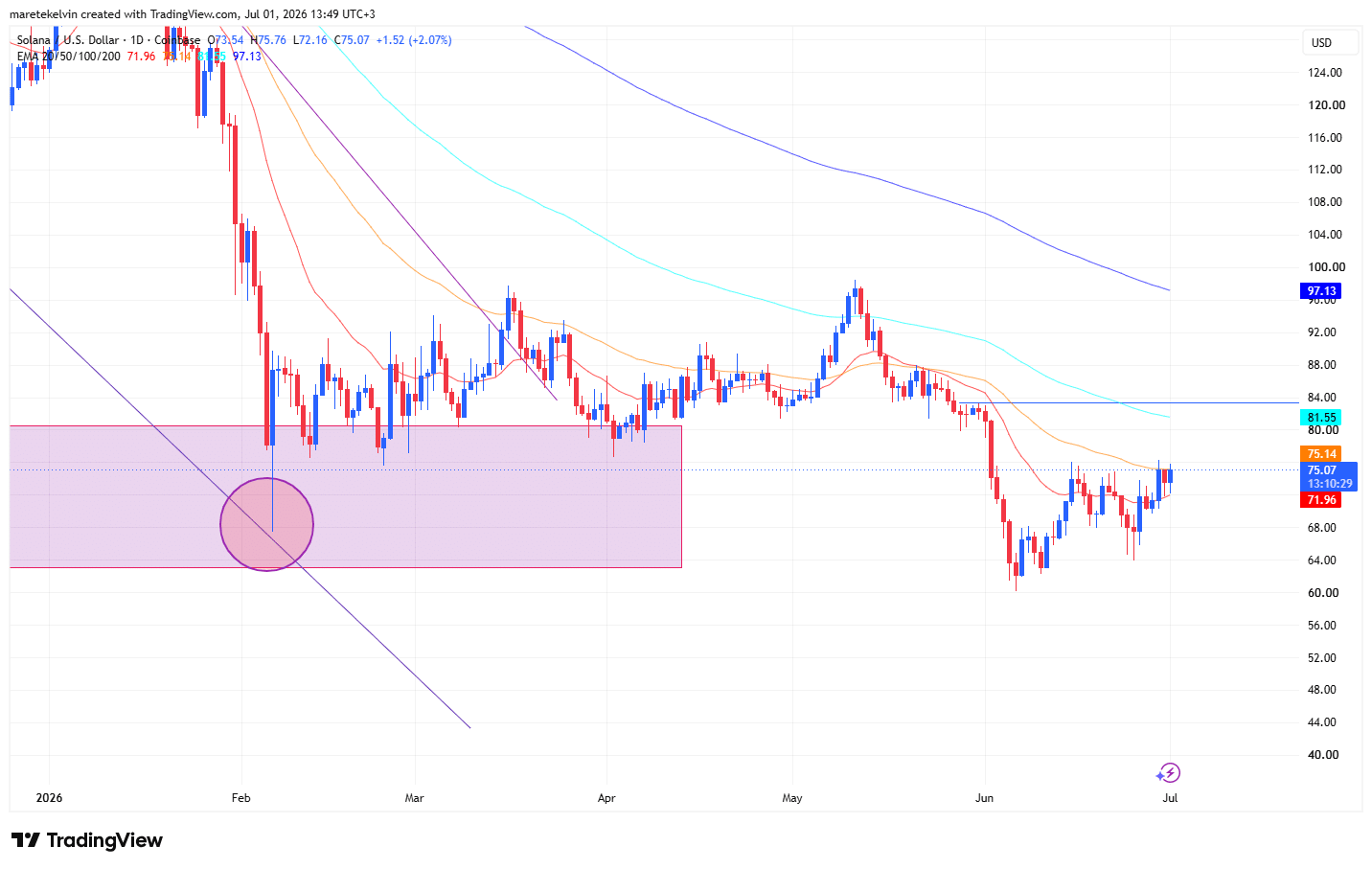
On the daily chart, Solana seemeed to be approaching a key turning point at press time.

Its price action struggled for weeks below key resistance levels since it bounced back from its trading price of $59. Lately though, the token has been testing a major Exponential Moving Average(EMA) resistance at $75.

A successful move above that level could mark a shift in market structure and strengthen the case for a broader recovery. Here, the timing matters too. Especially since the altcoin’s improving fundamentals could add to and accelerate its improving network activity.
Source: TradingView

Are long-term holders playing along?

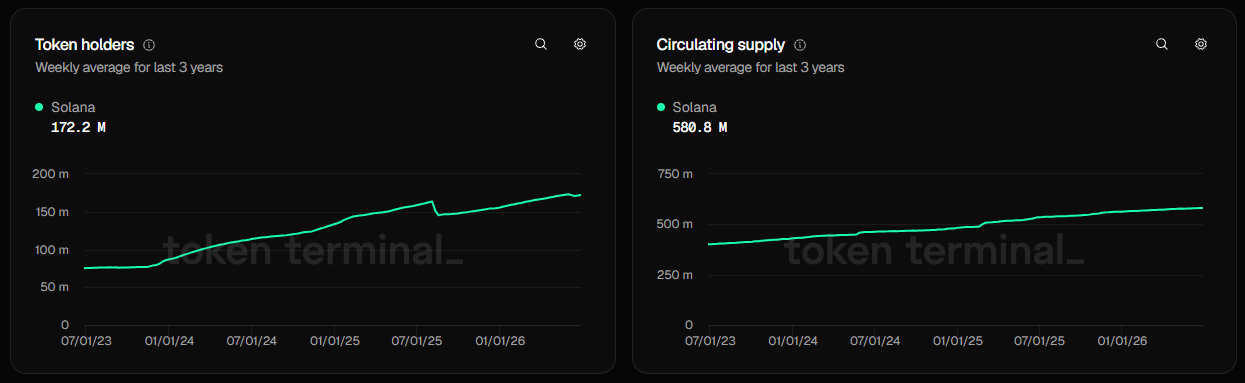
Accumulation of tokens on the network has been on the surge as well. In fact, holder balances have increased as a result of more investments being made on the platform in this period of consolidation.

However, there has been a drop in the supply too – Meaning that there are fewer tokens being returned to circulation.

The divergence could cause a demand shoot as not enough tokens may be available for circulation. As a result, the token’s price could push higher in the near future.
Source: Token Terminal

Is it undervalued?

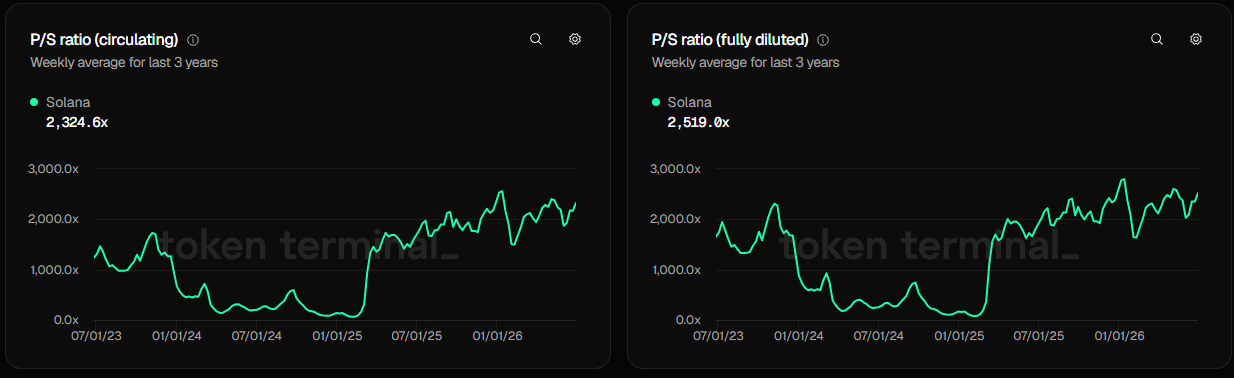
Fundamental metrics seemed to be relaying a similar story. At the time of writing, Solana’s Price-to-Sales ratio was around 2 – A level that suggested the token may be undervalued at its trading price.

While valuation metrics are rarely used as short-term trading signals, they can provide useful context when assessing whether an asset is becoming stretched or remains relatively undervalued.

For some investors, the current ratio may strengthen the case for ongoing accumulation, which will turn out as another positive gain for SOL.
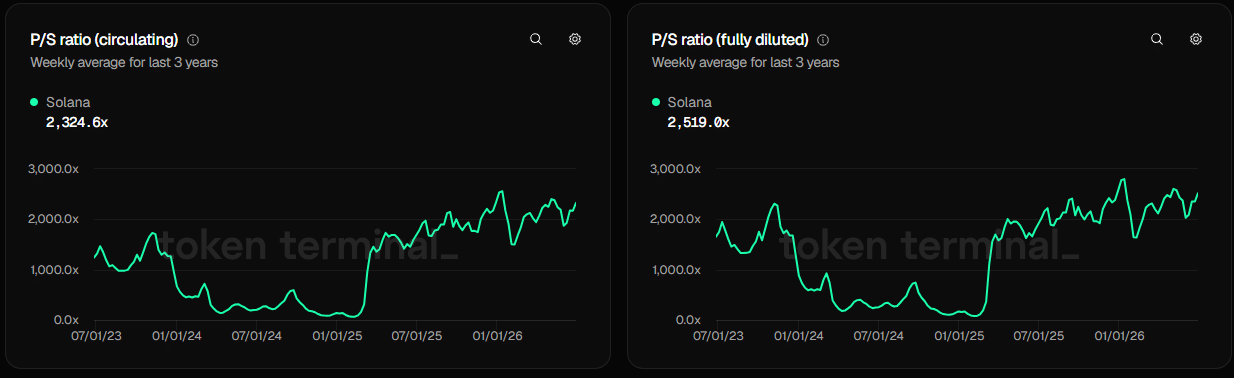
Source: Token Terminal

Can buyers clear the next hurdle?

The market now faces a clear test. A decisive move above the EMA resistance near $75 would strengthen the bullish structure that has been developing over recent sessions.

Beyond that level, the next major area of interest sits around $83, where previous selling pressure emerged.

At press time, the altcoin’s price action was catching up with its fundamentals. Especially since network activity has been growing and holders have continued to accumulate on the back of supportive valuation metrics. Together, they all appeared to be in support of the anticipated breakout.


Final Summary

  • Solana’s active addresses surged to 4.7 million, signaling renewed activity across the network.
  • Holder accumulation and a P/S ratio of 2 seemed to support SOL’s attempts to truly reclaim the key $75-resistance level.


Trending Cryptos

Related Questions

QWhat is the significant milestone reached by Solana's network activity mentioned in the article?

ASolana's active addresses surged significantly to 4.7 million over the past week.

QAccording to the article, what key price level is Solana (SOL) attempting to break through?

ASolana is testing a major Exponential Moving Average (EMA) resistance at the $75 level.

QWhat does the article suggest about Solana's token supply and its potential impact on price?

AThere has been a drop in the token supply, meaning fewer tokens are being returned to circulation. This divergence could cause a demand surge and potentially push the price higher.

QWhat valuation metric is mentioned as a potential indicator that Solana (SOL) may be undervalued?

ASolana's Price-to-Sales (P/S) ratio was around 2, which the article suggests may indicate the token is undervalued at its current trading price.

QWhat is identified as the next major area of interest for SOL's price if it successfully breaks above $75?

ABeyond the $75 level, the next major area of interest sits around $83, where previous selling pressure emerged.

Related Reads

Solana Expands Validator Power With Launch of On-Chain Governance

Solana has formally launched its on-chain governance system, empowering token holders and validators with a more open and decentralized way to influence major protocol decisions. Governance debates and voting are now conducted entirely on-chain using the new Solana Governance Proposals (SGP) framework, supported by stake-weighted voting and cryptographic verification. Validators with at least 100,000 SOL in delegated stake can submit an SGP. To proceed to a formal vote, a proposal must first gain support from at least 15% of the network's total staked SOL, ensuring only ideas with significant backing move forward. SGPs serve a distinct purpose from the technical Solana Improvement Documents (SIMDs). While SIMDs focus on *how* to implement protocol upgrades, SGPs determine *whether* the broader ecosystem believes a proposal should proceed, via an on-chain, stake-weighted vote. This separation allows core developers to continue building effectively while reserving community-wide votes for impactful decisions. A key feature grants delegators greater control: they can now override their validator's governance vote. If a validator votes against a delegator's preference or abstains, the delegator can cast a vote directly using their own stake weight through Solana's governance portal. The voting process is secured using Merkle proofs to verify participant stakes against an on-chain consensus snapshot. With this implementation, Solana aims to broaden community participation in governance without hindering development, combining decentralized decision-making with efficient protocol evolution.

TheNewsCrypto7m ago

Solana Expands Validator Power With Launch of On-Chain Governance

TheNewsCrypto7m ago

Trillion-Won Bet on Semiconductors: Is South Korea Really Panicking This Time?

**Summary:** South Korea, traditionally adept at "counter-cyclical" investments during industry downturns, has launched an unprecedented trillion-dollar (approximately 6.4 trillion RMB) semiconductor investment plan during a current AI-driven boom. This shift signals deep strategic anxiety, driven by the rapid rise of China's memory chip challengers. The article traces this dynamic through the history of East Asian semiconductor competition. In the 1980s, Japan used a "national system + industrial capital" model to surpass the US in DRAM, only to be overtaken in the 1990s by South Korea employing the same aggressive, efficiency-focused tactics—most notably massive, loss-tolerant investments during downturns to crush competitors like Japan's Elpida. Now, China's memory giants, Yangtze Memory (YMTC) and ChangXin Memory Technologies (CXMT), are employing a strikingly similar playbook. Starting from near-zero a decade ago, they've used a combination of government-backed capital, strategic technology acquisition (e.g., CXMT leveraging Qimonda's legacy), and innovative architectural leaps (e.g., YMTC's Xtacking) to achieve rapid technological catch-up. Crucially, during the severe industry downturn of 2023, while Korean and US giants cut production, the Chinese firms expanded capacity and competed on price, rapidly gaining global market share (reaching ~11% in NAND and ~7.67% in DRAM by 2025). South Korea's current massive investment, therefore, is a defensive move born of fear. The historical pattern suggests that once a technological gap closes, scale and integrated supply chain advantages—areas where China holds significant potential—can determine the leader. Having used counter-cyclical strategies to become the incumbent, South Korea now faces the prospect of a formidable challenger using those very same tactics. This investment marks not just a bet on the AI cycle, but the opening chapter in a new battle for dominance in the memory industry.

marsbit16m ago

Trillion-Won Bet on Semiconductors: Is South Korea Really Panicking This Time?

marsbit16m ago

Trading

Spot

Hot Articles

Discussions

Welcome to the HTX Community. Here, you can stay informed about the latest platform developments and gain access to professional market insights. Users' opinions on the price of S (S) are presented below.

活动图片