After Institutional Support and Price Surge, Revisiting the True Value of Bittensor's 128 Subnets

marsbitPublished on 2026-03-17Last updated on 2026-03-17

Abstract

After removing institutional support and price increases, this article re-evaluates the real value of Bittensor's 128 subnets. Bittensor operates as a decentralized AI ecosystem where each subnet functions like an independent startup with its own token (Alpha), revenue model, and team. There are two primary ways to earn: TAO emissions (protocol subsidies based on staking inflows) and Alpha token PnL (capital gains from subnet performance). Since the Taoflow update in November 2025, subnets with negative net staking flow receive zero emissions, creating a competitive environment. Approximately 3,600 TAO (around $960k daily) is distributed, with the top 10 subnets controlling 56% of emissions. Key case studies include Chutes (SN64), which demonstrates product-market fit with 400k users and 9.1 trillion tokens processed at 85% lower cost than AWS, and Templar (SN3), which offers asymmetric upside by training frontier LLMs in a fully decentralized manner. The investment framework positions TAO as an index fund for the entire network, while Alpha staking represents concentrated bets on specific subnets. The ecosystem is attracting institutional interest, with significant holdings from DCG and Polychain Capital. The conclusion emphasizes evaluating subnets based on product utility, staking flow, team execution, organic demand, and liquidity conditions.

Author: Kaff

Compiled by: Yuliya, PANews

TL;DR

  • Bittensor consists of 128 independent subnets, each operating like a startup with its own token (Alpha), revenue model, and team.

  • There are two ways to make money: TAO emissions (protocol subsidies from staking inflows) and Alpha token PnL (capital gains from subnet performance).

  • Since Taoflow in November 2025, subnets with negative net staking inflows receive zero emissions—forcing them to either succeed or die.

  • Approximately 3,600 TAO (~$960k) is distributed daily across all subnets, with the top ten controlling ~56% of the share.

  • Chutes (SN64) is the clearest example of product-market fit: 400k+ users, 9.1T tokens processed, 85% cheaper than AWS.

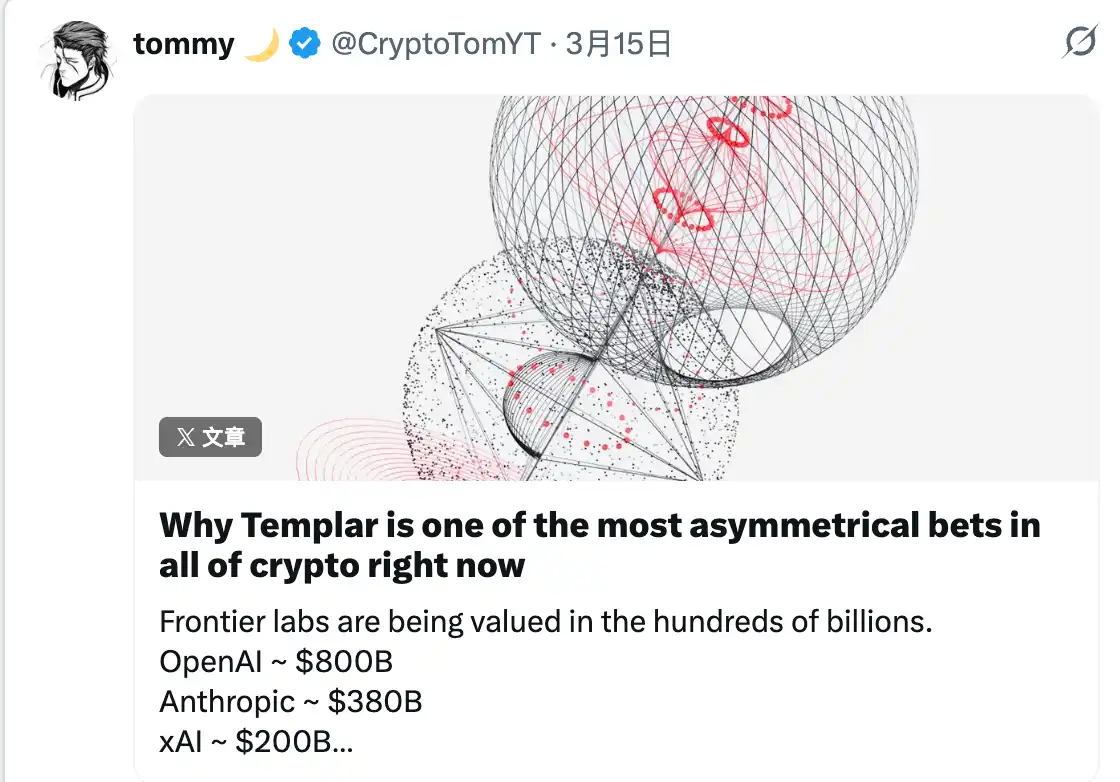
  • Templar (SN3) is the most asymmetric bet: fully decentralized training of frontier LLMs with a ~$60M market cap vs. OpenAI’s $800B.

  • TAO = broad index fund to the entire network, while Alpha staking = concentrated investment in specific startups—with 100%+ APY potential but real risk.

  • Alpha tokens carry no formal yield promise; their value depends entirely on market dynamics and team execution.

1. Subnet Structure: Who Does What?

When people think of Bittensor, the most common mental model is: this is a decentralized AI project. While true, it’s incomplete.

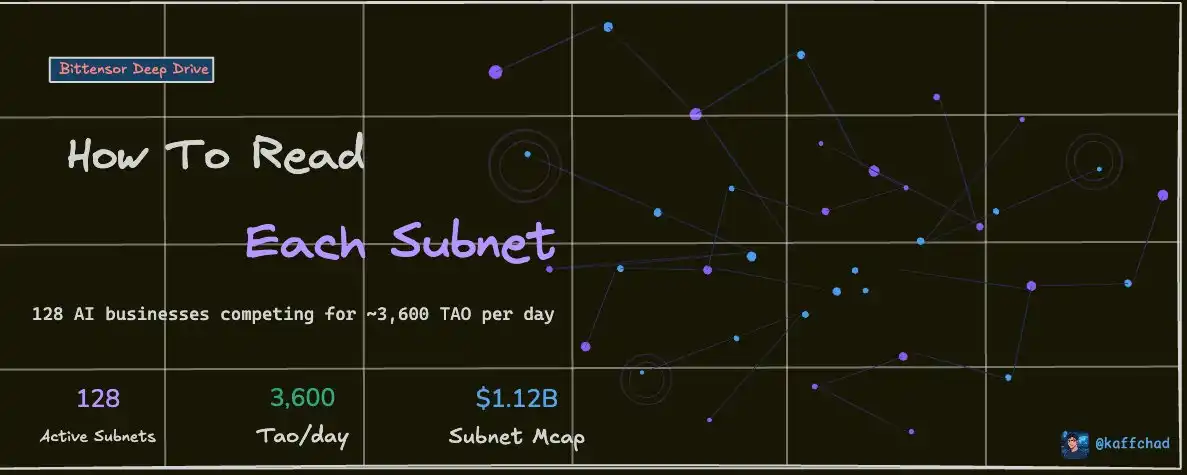
In reality, Bittensor is 128 independent AI startups competing in a brutal economic system, each with its own token, revenue model, and struggle for survival. By March 2026, the total market cap of all subnet tokens was ~$1.12B, equivalent to 27% of TAO’s own market cap. Grayscale calls it “Y Combinator for decentralized AI.” Except instead of a committee deciding who gets funded, the market decides.

Understanding this mechanism allows you to evaluate which subnets are creating real value and which are dying.

Each subnet is an incentive-based competitive market producing specific digital goods—AI inference, GPU compute, model training, financial data analysis, and more.

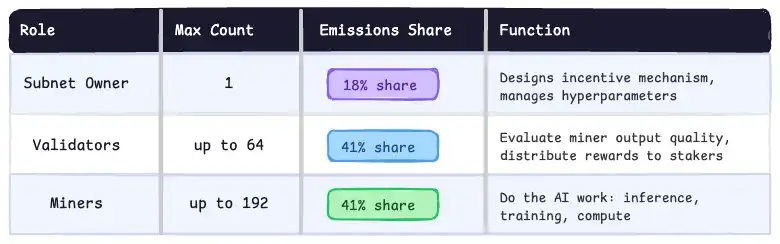
Each subnet is driven by three roles: subnet owner, validators, and miners:
Alpha Tokens: Equity in the Subnet

When you stake TAO to a subnet, your TAO enters an on-chain AMM pool (similar to Uniswap V2 mechanics). In return, you receive Alpha tokens. The price formula is:

Alpha Price = TAO in Pool ÷ Alpha in Pool

Alpha tokens have a hard cap of 21M (echoing TAO’s supply), and they auto-compound every ~72 minutes (one “tempo” = 360 blocks).

2. Two Revenue Streams and Why They’re Overlooked

In Bittensor, there are two completely separate ways to make money:

Revenue Stream 1: TAO Emissions via Taoflow

Since November 2025, Bittensor adopted the Taoflow model, a fundamental shift in how emissions are allocated.

Previously, emissions were calculated based on token price. This created a loophole: projects could artificially inflate their token price to capture emissions, build a “TAO treasury,” and slowly dump while still collecting rewards.

Taoflow fixed this by tracking net staking flow of TAO: staking inflows minus unstaking outflows. The mechanism runs in four steps:
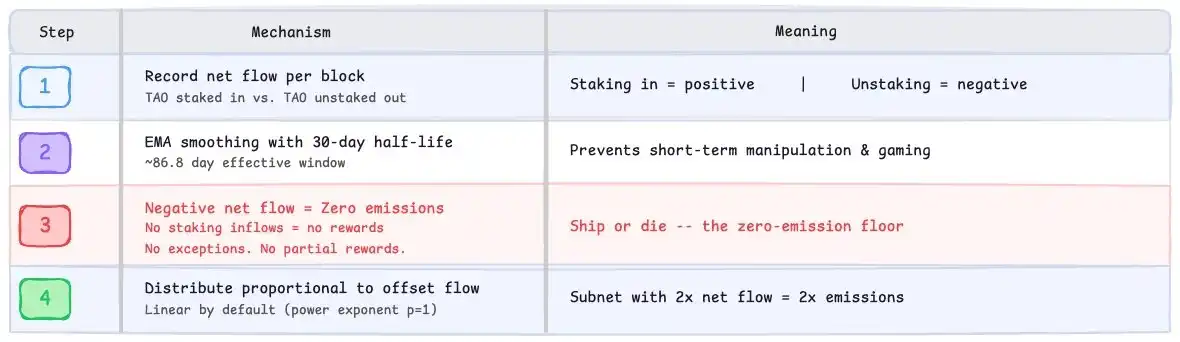
After TAO’s first halving on Dec 14, 2025, block rewards dropped from 1 TAO to 0.5 TAO/block. Currently, ~3,600 TAO (~$960k at current prices) is distributed daily across 128 subnets. DCG estimates over $100M flows into the ecosystem annually.

Revenue Stream 2: Alpha Token PnL

This is the part most TAO holders aren’t tracking.

If a subnet performs well, Alpha’s price (denominated in TAO) rises. When you unstake, you receive more TAO than you initially put in. This is Alpha PnL = capital gains from holding a specific subnet’s token.

Taoflow creates a powerful flywheel effect:

  • Great product → more people stake TAO → positive net flow

  • Positive flow → more emissions → deeper liquidity pool

  • Deeper liquidity → lower slippage → attracts more capital

  • More capital → Alpha price rises → Alpha PnL increases for existing holders

The reverse is also true, and equally brutal. Sustained negative flow subnets → zero emissions → stakers continuously withdraw → death spiral.

3. Which Subnets Are Winning and Why?

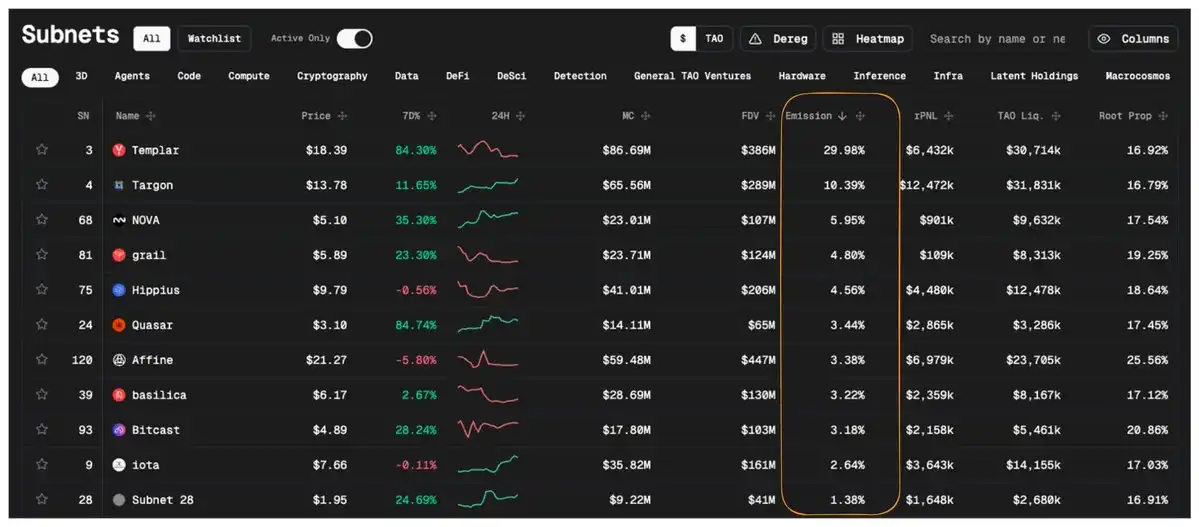
Here’s a snapshot of leading subnets ranked by emission dominance and realized PnL (rPnL):

  • SN3| templar: Large-scale LLM pre-training | Emission Share: 30.39% | rPnL: $6.43M

  • SN4| Targon: AI inference market—hosting and serving AI models for real-time predictions | Emission Share: 10.39% | rPnL: $12.47M

  • SN68| METANOVA: AI drug discovery company developing therapies to reprogram body and mind | Emission Share: 5.95% | rPnL: $900k

  • SN81| grail: Verifiable LLM post-training processing | Emission Share: 4.8% | rPnL: $109k

  • SN75| Hippius: Decentralized storage and web infrastructure with IP management | Emission Share: 4.56% | rPnL: $4.48M

The top 10 subnets control ~56% of the total daily emissions.
Case Study: Chutes, The Textbook Example of Product-Market Fit (PMF)

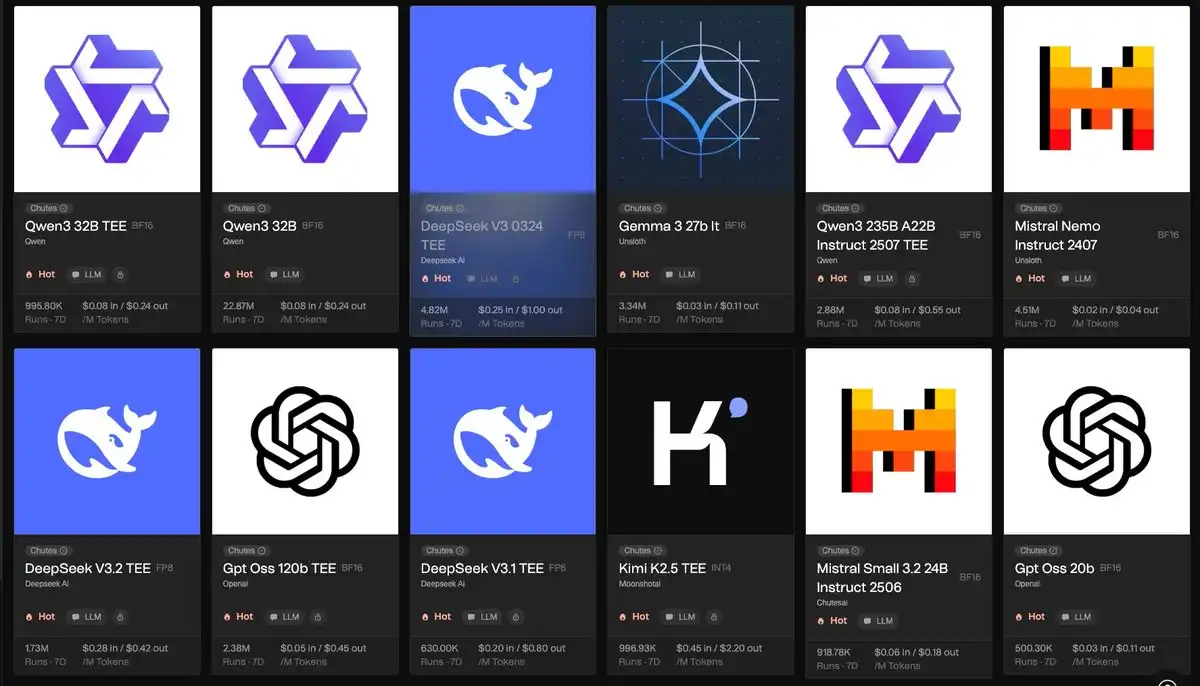
Built by Rayon Labs, Chutes is a decentralized serverless AI inference market, a Web3 alternative to OpenAI API and AWS for model deployment.

What stands out about Chutes:

  • Processed 9.1T tokens since late 2024

  • 400k+ users (100k+ via API)

  • 85% cheaper AI model deployment costs vs. AWS

  • Models supported: DeepSeek, Mistral, LLaMA, and dozens more

  • Platform revenue auto-staked → buys back Alpha tokens → organic demand flywheel

During a spike in February 2026, Chutes attracted over 2,740 TAO in just 9 hours. Alpha tokens peaked at $99.94 (0.225 TAO), with an FDV of 2.05M TAO (~$518M at TAO’s peak).

Rayon Labs also operates SN56 (Gradients—model training) and SN19 (Nineteen—high-frequency inference), collectively commanding over 23% of total emissions at their peak.
Case Study: Templar (SN3), The Most Asymmetric Bet in the Subnet Ecosystem

On March 10, 2026, Templar (SN3) completed Covenant-72B, a 72B parameter model hailed as the largest decentralized pre-training run in history.
4. The Mechanics Behind It: Registration, Yuma Consensus, and Competitive Pressure

Registration, A Competitive Arena

Not everyone can open a subnet. Registration uses a dynamic burn pricing mechanism: the cost doubles with each new subnet registration and halves linearly over 28,800 blocks (~4 days) with no new registrations.

When all 128 slots are full, new subnets must replace the worst-performing existing subnet (measured by lowest EMA price). Newly registered subnets get a 4-month grace period before being eligible for deregistration. The network is expected to expand to 256 subnets in 2026.

Yuma Consensus, Automated Independent Auditing

Within each subnet, Yuma consensus transforms validators' subjective assessments into objective reward distribution:

  • Validators submit weight vectors, scoring each miner they evaluate

  • The blockchain calculates the stake-weighted median for each miner (kappa=0.5)

  • Weights above the median are clipped—to prevent collusion and over-evaluation

  • Validators use a commit-reveal mechanism—submitting sealed weights, revealed only after a set number of blocks—to prevent weight copying

  • Validators who identify good miners early and evaluate consistently build stronger bonded positions and earn larger dividend shares

The result: No subnet owner can unilaterally change who gets rewards. This is the fundamental difference between Bittensor and typical crypto “AI projects.”

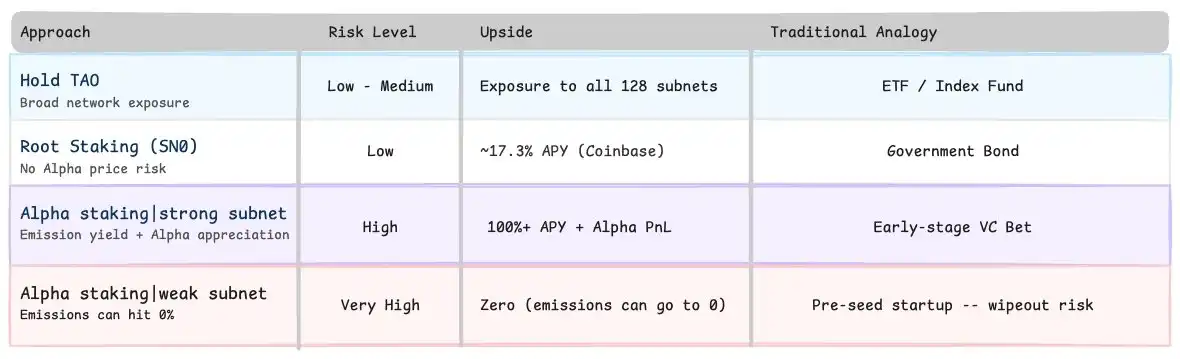
5. Investment Framework: TAO = Index Fund, Alpha Staking = Startup Bet

Auditless Research summarized it perfectly: “TAO is effectively more of an options token—a call option that can be pointed at the emissions of whatever Alpha token looks undervalued.”
How to Read a Subnet Like a Balance Sheet

  • Emissions = Protocol subsidies - network revenue, similar to government grants or accelerator funding

  • Alpha PnL = Market cap signal - the market is pricing the subnet’s true value

  • Net staking flow = Revenue growth indicator - positive flow = “product sells,” negative flow = churning customers

  • Subnet owner = Founder quality - communication frequency, delivery speed, and product roadmap are things to track

  • Number of validators = Board quality - more independent validators = less chance of manipulated scoring

Institutional Signals Are Growing

This is no longer just a retail story:

  • DCG holds over 500k TAO (~2.4% of total supply)

  • Polychain Capital holds ~$200M worth of TAO

  • Grayscale GTAO Trust listed on NYSE on January 6, 2026

  • Stillcore Capital (co-founded by Jason Calacanis) launched a fund dedicated to subnet tokens

6. Conclusion: A Starter Framework

Bittensor has created a structure unique in crypto: 128 AI businesses competing for a shared ~3,600 TAO (~$960k) daily, where capital allocation is determined solely by staker behavior.

When evaluating a subnet, ask these five questions:

  • Product: What does this subnet offer? Is there real demand for it?

  • Flow: Is net staking flow positive or negative? What’s the 30-day trend?

  • Team: Is the subnet owner communicating and delivering consistently?

  • Flywheel: Does revenue create organic demand for Alpha, or is it pure speculation?

  • Exit: Is the liquidity pool deep enough to exit without significant slippage?

TAO gives you broad exposure to the entire ecosystem. Alpha staking gives you a concentrated bet on a specific “startup”—with all the accompanying upside potential and downside risk.

Related Questions

QWhat are the two primary ways to generate income within the Bittensor subnet ecosystem?

AThe two primary ways to generate income are: 1) TAO emissions (protocol subsidies based on staking inflow) and 2) Alpha token PnL (capital gains from the performance of the specific subnet).

QWhat is the Taoflow model and what fundamental change did it introduce in November 2025?

AThe Taoflow model is a fundamental shift in how emissions are distributed. It tracks the net staking flow of TAO (staking inflow minus unstaking outflow) into a subnet. Subnets with negative net flow receive zero emissions, forcing them to either perform or be eliminated.

QWhich subnet is highlighted as the clearest example of product-market fit (PMF) and what are its key metrics?

AChutes (SN64) is highlighted as the clearest example of PMF. Its key metrics include processing over 9.1 trillion tokens, having over 400,000 users (100,000+ via API), and offering AI model deployment at an 85% lower cost than AWS.

QHow does the investment exposure of holding TAO differ from staking for an Alpha token?

AHolding TAO provides broad, index fund-like exposure to the entire Bittensor network. Staking for an Alpha token is a concentrated investment in a specific 'startup' subnet, offering higher potential returns (100%+ APY) but also carrying significant risk.

QWhat mechanism ensures that no single subnet owner can unilaterally change who gets rewards, and how does it work?

AThe Yuma Consensus ensures this. Validators submit weight vectors rating miners, the blockchain calculates a median score, and weights above the median are clipped to prevent collusion and over-evaluation. A commit-reveal mechanism prevents copying weights, making the system an automated, independent audit.

Related Reads

Sequoia Dialogue with Jensen Huang: Computing Model Undergoes a 60-Year Transformation; You Won't Be Replaced by AI, But You Will Be Dimensionality-Reduced by 'Those Who Master AI'

NVIDIA founder and CEO Jensen Huang, in a conversation with Sequoia Capital's Konstantine Buhler, argues that we are witnessing the most significant computing shift in 60 years—from retrieval-based to generative computing. Instead of just storing and retrieving data, future systems will generate highly personalized content (text, images, video) on demand, powered by massive "AI factories." Huang envisions a global "intelligence network" that will envelop the planet, following the historical patterns of energy and communication grids. He outlines a five-layer investment framework: 1) Energy, 2) Chips/Computers, 3) Infrastructure (data centers), 4) AI Models, and 5) Applications. He predicts this ecosystem will reach a scale of $20 trillion annually. Crucially, Huang pushes back against fears of AI-driven job loss. He distinguishes between specific "tasks" (e.g., typing, analyzing images) and overall "jobs" (e.g., CEO, radiologist). While AI automates tasks, it increases efficiency and demand for the higher-value problem-solving aspects of professions, thus creating more jobs and "up-leveling" careers. The real risk, he asserts, is not being replaced by AI, but being outperformed by someone who effectively leverages it. He urges everyone to embrace AI as a tool for augmented capability and innovation.

marsbit20m ago

Sequoia Dialogue with Jensen Huang: Computing Model Undergoes a 60-Year Transformation; You Won't Be Replaced by AI, But You Will Be Dimensionality-Reduced by 'Those Who Master AI'

marsbit20m ago

"I Don't Need a Better Model Anymore": A Panorama of AI Users Under a Reddit Hot Post

Titled "I Don't Need a Better Model Anymore": AI User Reactions on Reddit Anthropic recently released Claude Fable 5, its first publicly available 'Mythos'-tier model, achieving 80.3% on the SWE-Bench Pro benchmark and significantly outperforming its predecessor and competitors. However, a viral Reddit post titled "Claude Fable made me realize I don't need better models anymore" highlighted a growing user sentiment of "good enough." Top comments expressed "model fatigue," with users stating that earlier models like Opus 4.5/4.8 already sufficed for their workflows. High cost was a key concern, as Fable 5's API is nearly twice the price of Opus 4.8, with users questioning the return on investment and suggesting the field has hit a plateau. The most frequent complaint targeted Fable 5's stringent safety filters. Designed to intercept high-risk requests (e.g., cybersecurity), the system was perceived as overly conservative. Users reported frequent rejections for routine security-related tasks, leading to automatic fallbacks to the older Opus model. Paying users were particularly frustrated, feeling they paid a premium for a less usable product. Dissenting voices came from users with heavy, complex tasks. For workloads like high-energy physics simulations with thousands of code lines, Fable 5's improved long-context understanding and error detection represented a significant, worthwhile leap—described as moving from a "college player to an NBA starter." The debate underscores a divergence between benchmark performance and practical utility. For most users, current models meet their needs, making further advances relevant only for extreme use-cases. The discussion also raised concerns about a potential "Public AI Freeze," where the most powerful models (like the restricted Mythos 5) remain exclusive to enterprises and governments, while public offerings stagnate. The launch presents two report cards: one of technical excellence and another of user skepticism. Fable 5's ultimate reception may depend on Anthropic's ability to refine its safety filters and justify its cost for specialized, high-demand users.

marsbit28m ago

"I Don't Need a Better Model Anymore": A Panorama of AI Users Under a Reddit Hot Post

marsbit28m ago

When AI Traffic Surpasses Humans, How Do You Prove You're Human?

With AI-generated web traffic surpassing human activity, websites face a crisis as AI agents bypass ads, avoid clicks, and scrape data without generating revenue. This disrupts the ad-based internet economy, diverting traffic and reducing site visits. In response, sites are blocking AI crawlers and deploying traps like Cloudflare's "honeypot" pages. Traditional CAPTCHAs are now ineffective against advanced AI. The focus has shifted to behavioral biometrics—analyzing unique human patterns such as cursor movement, typing rhythm, and keystroke dynamics. Companies like IBM and BioCatch use this data to distinguish humans from bots, even detecting fraud through behavioral inconsistencies. Two competing approaches aim to verify human identity centrally. Sam Altman’s World (formerly Worldcoin) uses iris scanning to create unique credentials, though it faces privacy concerns and regulatory bans. Alternatively, cryptographic zero-knowledge proofs offer anonymous verification without revealing personal data, championed by Vitalik Buterin to avoid centralized surveillance. However, both systems have flaws. Centralized solutions risk biometric data misuse, while decentralized models may be exploited through identity rental markets in economically unequal regions. Despite challenges, the author favors cryptographic methods for preserving privacy over pervasive behavioral monitoring that permanently captures and controls personal biometric data.

marsbit36m ago

When AI Traffic Surpasses Humans, How Do You Prove You're Human?

marsbit36m ago

2026 Landscape of Decentralized AI: Why is Blockchain the Inevitable "Antidote" for AI?

**The 2026 Landscape of Decentralized AI: Why Blockchain is the "Cure" AI Cannot Ignore** Decentralized AI addresses fundamental bottlenecks of centralized AI: scarce and expensive computational resources, excessive control concentration, unverifiable model outputs, and increasing difficulty in acquiring training data due to privacy and regulation. Blockchain offers a path to make intelligence open, verifiable, and economically accessible. The technical stack comprises three layers: 1. **Applications & Services**: The main crypto use cases are "Agentic Finance" (converting natural language into on-chain actions) and "Agentic Payments" for machine-to-machine commerce. Projects like Giza, Infinity Labs, Coinvest AI, and x402 (handling 173M+ transactions) are key players. 2. **Middleware**: This coordination layer enables agents to discover, identify, and transact. Notable projects include Gokite AI (specialized L1), Virtuals (an OS for the agent economy), and especially Bittensor—a network of specialized subnets forming competitive AI micro-economies. 3. **Infrastructure**: The capital-intensive layer providing raw resources. It includes decentralized compute (Akash, Render, Aethir), verifiable inference (Venice AI, OpenGradient), distributed training (Prime Intellect, Templar AI), decentralized storage (Filecoin, Walrus), and privacy/verification layers (Nillion, Arcium, Phala Network) using technologies like ZKPs, MPC, and TEEs. The outlook for 2026-2027 indicates AI demand outpacing infrastructure, with AI agents as a primary growth engine. Computation is becoming an asset class, with on-chain markets as its financial layer. Tokenomics is emerging as a structural advantage for coordinating capital, compute, and data in decentralized AI networks. While still early—with adoption uneven and revenue often trailing token incentives—projects like Bittensor, NEAR, and Virtuals demonstrate a shift from speculative narrative to a new model for coordinating intelligence.

marsbit39m ago

2026 Landscape of Decentralized AI: Why is Blockchain the Inevitable "Antidote" for AI?

marsbit39m ago

a16z Crypto Partner: Cash Flow is the Moat

Cash Flow as the Moat: A Playbook for Crypto Founders Historically, the most enduring businesses have been built by positioning themselves within the "flow of funds"—facilitating the creation and transfer of value in a network and extracting a portion of it. Cryptocurrency is the first modern technology natively built for this purpose. For startups, failing to architect products and businesses to leverage these principles means missing a major opportunity. Blockchains are inherently network businesses. Each transaction settles on a shared ledger, and every new participant strengthens the underlying network for all. Well-designed network tokens amplify this by aligning users, developers, and validators around growing the network, with value flowing back to contributors in a transparent feedback loop. This model is not new; companies from railroads and Standard Oil to Google, Meta, and AWS have thrived by inserting themselves into critical flows of value (goods, attention, compute). Financial markets make it even clearer: firms like Visa and major market makers generate immense revenue not by predicting markets but by being in the path of transactions. The combination of fund flow and network effects creates one of the most durable business structures. The high margins in traditional finance (payments, custody, lending, FX) represent prime targets. Crypto founders have the opportunity to build the next version—programmable, instant, global, and natively in the flow of funds. The frontier extends beyond finance to areas like computing/GPUs, AI training data, energy, robotics, and space—markets without entrenched intermediaries, ripe for building new, efficient value rails on programmable infrastructure. Founders should ask: Are you in the flow of funds today? Does your revenue scale 10x with the value of activity on your platform? Where in your target market are profit margins highest relative to value created? The opportunity is clear: embed your startup into the new flows of value and let the network effects accumulate.

marsbit42m ago

a16z Crypto Partner: Cash Flow is the Moat

marsbit42m ago

Trading

Spot
Futures

Hot Articles

Discussions

Welcome to the HTX Community. Here, you can stay informed about the latest platform developments and gain access to professional market insights. Users' opinions on the price of S (S) are presented below.

活动图片