ADA Falls Out of Top 10 Ranking While Hyperliquid Surges, Is Cardano Losing Its Edge?

bitcoinistPublished on 2026-02-04Last updated on 2026-02-04

Abstract

Cardano's ADA has fallen out of the top 10 cryptocurrencies by market cap, facing price declines and political headwinds after founder Charles Hoskinson criticized proposed U.S. crypto regulation. Meanwhile, Hyperliquid's HYPE token surged over 20% following a new proposal to introduce event-based contracts, pushing trading volume to around $1 billion. This shift highlights a market increasingly prioritizing fast-growing use cases and product innovation over legacy status, underscoring the rapid change in investor focus and crypto leadership.

Cardano’s ADA token has slipped out of the crypto top 10 by market capitalization, a symbolic shift as newer platforms attract attention and capital.

Related Reading: Hong Kong Prepares To Grant Limited Batch Of Stablecoin Licenses In March – Report

While ADA struggles with price pressure and political controversy around crypto regulation, Hyperliquid’s HYPE token has surged sharply, underscoring how quickly market leadership can change in the current cycle.

The contrast accentuates diverging narratives, one centered on governance and ideology, the other on rapid product expansion and trader demand.
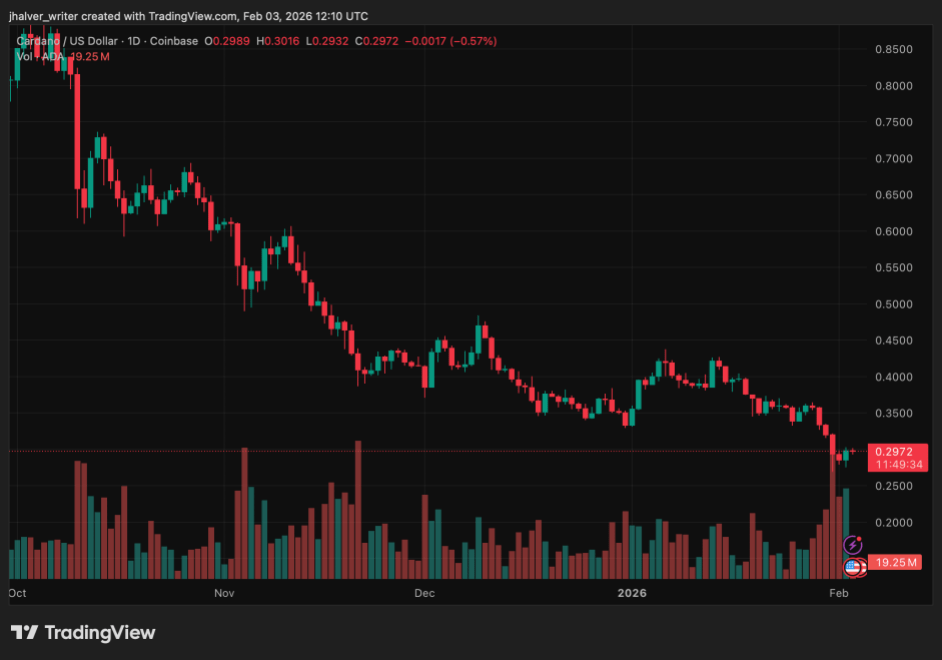
ADA's price trends to the downside on the daily chart. Source: ADAUSD on Tradingview

Hyperliquid Rally Fueled by New Market Design

HYPE jumped more than 20% after the HyperCore team backed HIP-4, a proposal that introduces “outcome trading” to the protocol. The move pushes Hyperliquid beyond its core perpetual futures offering into event-based contracts, a category that includes prediction markets and bounded outcome instruments.

Following the announcement, HYPE reached its highest price since late November 2025, with trading volume climbing to around $1 billion. Open interest on the platform has also expanded, reflecting rising participation.

The proposal is currently live on testnet and is expected to launch with fully collateralized contracts that avoid leverage and liquidations, differentiating them from traditional derivatives.

The timing aligns with broader growth in prediction markets. Industry data shows monthly trading volume in the sector hit a record in January, driven by platforms such as Kalshi and Polymarket.

Cardano (ADA) Faces Price Pressure and Political Headwinds

While Hyperliquid gains momentum, Cardano has faced a different set of challenges. ADA dropped around 7% following public comments from founder Charles Hoskinson criticizing the proposed US “Clarity Act,” which aims to define regulatory oversight between the SEC and CFTC.

Hoskinson argued the bill favors banks and centralized custodians, warning it could undermine decentralized finance. These remarks reignited debate over Cardano’s positioning as a values-driven project at a time when parts of the industry are moving closer to traditional finance.

Although Cardano continues to emphasize research-led development, decentralized governance, and long-term infrastructure upgrades, market sentiment has been less forgiving in the short term.

Shifting Rankings Reflect Changing Priorities

ADA’s exit from the top 10 does not signal the end of the project, but it does reflect changing investor priorities. Tokens tied to fast-growing use cases and near-term trading activity are gaining ground, while slower-moving platforms face tougher scrutiny.

Related Reading: Strategy Announces New Buy Even As Crash Threatens Cost Basis: 855 Bitcoin Added

Currently, Hyperliquid’s rise and Cardano’s slide illustrate a market increasingly driven by execution speed and product relevance rather than legacy status alone.

Cover image from ChatGPT, ADAUSD chart on Tradingview

Related Questions

QWhat is the main reason for ADA's drop out of the top 10 cryptocurrencies by market cap?

AADA has slipped out of the top 10 due to a combination of price pressure and political controversy, particularly surrounding founder Charles Hoskinson's criticism of the proposed US 'Clarity Act', which has shifted investor focus towards newer platforms with faster growth and product relevance.

QWhat specific proposal caused the Hyperliquid (HYPE) token to surge over 20%?

AThe Hyperliquid token surged following the HyperCore team's backing of HIP-4, a proposal that introduces 'outcome trading' to the protocol, expanding its offerings into event-based contracts like prediction markets.

QHow does the new 'outcome trading' on Hyperliquid differ from traditional derivatives?

AThe new outcome trading on Hyperliquid is expected to launch with fully collateralized contracts that avoid leverage and liquidations, differentiating them from traditional derivatives.

QWhat was a key criticism from Cardano's founder, Charles Hoskinson, regarding US regulation?

ACharles Hoskinson criticized the proposed US 'Clarity Act', arguing that it favors banks and centralized custodians and could potentially undermine decentralized finance (DeFi).

QWhat broader market trend does the contrast between Cardano's decline and Hyperliquid's rise illustrate?

AThe contrast illustrates a market that is increasingly driven by execution speed, rapid product expansion, and immediate use cases rather than a project's legacy status or long-term ideological positioning.

Related Reads

Agents Take Over Traffic Distribution Power: What Are Tencent, ByteDance, and Alibaba Competing For?

In the race to dominate the AI era's entry point, China's tech giants—Tencent, ByteDance, and Alibaba—are aggressively deploying AI Agents to control the future of traffic distribution. Alibaba is pursuing a dual-track "closed loop + openness" strategy. Its Qianwen app is evolving into a super-Agent integrated across its ecosystem (Taobao, Alipay, etc.) to handle complex tasks like travel planning. Concurrently, it is opening its platform to external brands (Luckin Coffee, KFC) and has launched a B2B Agent platform, "Wukong," targeting enterprise automation. Its other flagship, Quark, aims to be an "AI super search box" for information and tasks. ByteDance is executing an omnipresent "sprawl strategy." Its Doubao app boasts over 300 million monthly active users and is evolving into a default AI entry point for daily life, with plans for paid versions and e-commerce integration. Its core weapon is the Kouzi platform, a visual "AI assembly factory" for developers to build custom Agents. ByteDance is also pushing hardware integration, collaborating on AI phones and developing smart glasses to embed Doubao everywhere. Tencent is playing its long-held "ultimate card" by quietly embedding an AI Agent directly into WeChat. This Agent, accessible via a swipe, can understand user commands and automatically execute tasks by calling upon WeChat's millions of mini-programs (e.g., finding and ordering coffee). This leverages WeChat's unparalleled 1.4-billion-user ecosystem to position the app as an AI-powered "service operating system," a move that could dramatically reshape the competitive landscape. The core battleground is shifting from competing for "user screen time" to competing to be the "default execution layer" for user intent. The business model is evolving from an "attention economy" to an "intent economy," where the Agent that can most efficiently fulfill a user's need gains control over service access and token flow. This represents a fundamental change in how users connect with digital services, making the fight for the Agent入口 (entry point) a pivotal moment for redefining industry leadership in the AI age.

marsbit57m ago

Agents Take Over Traffic Distribution Power: What Are Tencent, ByteDance, and Alibaba Competing For?

marsbit57m ago

From Banning Doubao to Embracing Honor: Why Did WeChat Suddenly 'Change Its Face'?

The article explores the sudden shift in WeChat's strategy towards AI assistants from mobile phone manufacturers, transitioning from strict opposition to active collaboration. For over a year, WeChat fiercely resisted attempts by phone AI assistants (like ByteDance's Doubao in late 2025) to control its features via GUI automation ("simulated clicking"), citing security and data control concerns. This stance created a significant barrier for system-level AI integration. Now, Tencent has initiated A2A (Agent-to-Agent) partnerships with major phone brands like Honor, Xiaomi, OPPO, and vivo. This model allows a phone's system AI (e.g., Honor's YOYO) to parse a user's voice command and send a structured request directly to WeChat's own internal AI agent via secure APIs. WeChat then executes the action (e.g., sending a message) and returns the result. The article attributes Tencent's "change of face" to strategic pressure. While leading in social app usage, Tencent trails rivals like ByteDance and Alibaba in standalone AI app popularity. WeChat, with its vast mini-program ecosystem, is Tencent's key asset for an AI comeback. The upcoming WeChat AI agent aims to handle tasks like booking and payments within the app. However, phone system assistants remain the primary AI entry point for most users. The A2A collaboration allows Tencent to extend WeChat's AI reach to this crucial system layer while maintaining control over its core functions and data. For phone manufacturers, embracing A2A is a pragmatic move. The GUI route proved unviable due to WeChat's blocks. A2A offers a compliant path to integrate a vital service, enhancing their AI assistants' usefulness. It allows them to focus on developing their own AI ecosystems for other services while cooperating on WeChat access. The collaboration is framed as a mutual, strategic necessity: Tencent gains a distribution channel, and manufacturers gain a key functionality. The partnership relies on a "dual authorization" mechanism for security, requiring both user and app consent for each action. While questions about long-term data privacy practices remain, experts note A2A is more secure and compliant than GUI automation. Ultimately, this cooperation is seen as a tentative, calculated truce. Tencent's long-term goal is to make WeChat an AI-powered "service OS." Phone manufacturers aim to make their system AI the central user interface. Their paths may converge or clash in the future, but for now, the A2A deal represents the opening chapter in the battle for the AI-era user入口, driven by necessity and strategic calculus on both sides.

marsbit2h ago

From Banning Doubao to Embracing Honor: Why Did WeChat Suddenly 'Change Its Face'?

marsbit2h ago

Trading

Spot
Futures

Hot Articles

Discussions

Welcome to the HTX Community. Here, you can stay informed about the latest platform developments and gain access to professional market insights. Users' opinions on the price of ADA (ADA) are presented below.

活动图片