A New Crypto Era: SEC-CFTC To Host Joint Regulatory Harmonization Event Next Week

bitcoinistPublished on 2026-01-24Last updated on 2026-01-24

Abstract

The U.S. Securities and Exchange Commission (SEC) and the Commodity Futures Trading Commission (CFTC) will host a joint public event on January 27 to discuss harmonizing crypto regulations. The event, part of the Trump administration's push to make the U.S. the global crypto leader, aims to clarify jurisdictional boundaries and foster innovation under American law. This follows ongoing efforts between the agencies to improve regulatory coordination, as emphasized in a September roundtable where SEC Chair Atkins declared an end to "regulatory fragmentation." Meanwhile, congressional efforts to pass crypto legislation have stalled, with the Senate Banking Committee delaying its bill after industry criticism, and Coinbase withdrawing support for what it called a "bad bill." The Senate Agriculture Committee has advanced its version of the Clarity Act, focusing on the CFTC's role.

The Securities and Exchange Commission (SEC) and the Commodity Futures Trading Commission (CFTC) have announced a joint event on the future of crypto oversight amid the Trump administration’s push to welcome the sector.

SEC-CFTC Push Joint Crypto Oversight

On Thursday, SEC Chairman Paul Atking and CFTC Chairman Michael Selig announced they will hold an event next week to discuss regulatory harmonization between the two sister agencies.

According to the announcement, the pro-industry chairmen will outline the efforts to work together and cooperate to “deliver on President Trump’s promise to make the United States the crypto capital of the world.”

The event will be hosted on January 27 at the CFTC headquarters and moderated by crypto journalist Eleanor Terret. Additionally, it will be open to the public and livestreamed on both agencies’ websites.

“For too long, market participants have been forced to navigate regulatory boundaries that are unclear in application and misaligned in design, based solely on legacy jurisdictional silos,” said SEC Chair Atkins and CFTC Chair Selig in a joint statement.

“This event will build on our broader harmonization efforts to ensure that innovation takes root on American soil, under American law, and in service of American investors, consumers, and economic leadership,” they added.

Last year, the SEC and CFTC began discussing their options for effectively collaborating on crypto regulations, as a clear framework for digital assets became a top priority for the agencies

As reported by Bitcoinist, the agencies explored reinstating the CFTC-SEC joint advisory committee to develop recommendations on ongoing issues, including efforts in regulatory coordination.

During a September joint roundtable between the two agencies, Atking declared that the era of regulatory fragmentation was ending and the age of harmonized, innovation-friendly crypto oversight was here:

We are at a crossroads. If we follow the path of our predecessors, America risks ceding leadership in the next chapter of financial history. (...) This ends now (...) our two agencies must work in lockstep to transform dual regulation from a source of confusion into a source of strength. Together, we can offer the best of both worlds: the investor protections that have defined U.S. markets, combined with the innovation-friendly approach that will keep us at the frontier of financial technology throughout the 21st century.

The SEC’s Director of the Division of Trading and Markets, Jamie Selway, highlighted the SEC’s efforts to “further harmonize its rules with our sister regulator, the CFTC. In a January 22 speech, He affirmed that the Division will work shoulder-to-shoulder with the CFTC staff to ensure the US’s continued leadership in financial markets, following Atkins’ September directions.

Congress Regulatory Efforts Stall

The SEC and CFTC’s efforts to regulate the crypto market come as the US Congress struggles to establish a framework to oversee the sector. The Senate Banking Committee’s version of the market structure bill, which focuses on the SEC’s oversight, was delayed after multiple market participants criticized the bill’s draft.

Coinbase CEO Brian Armstrong shared his disappointment with the crypto legislation, withdrawing the company’s support last week. “This version would be materially worse than the current status quo. We’d rather have no bill than a bad bill,” he affirmed.

The Senate Agriculture Committee published its version of the CLARITY Act on Thursday, which mainly addresses the CFTC’s role and regulations, scheduling its markup session for January 27.

Eleanor Terret shared that the industry’s reaction has been mostly positive, “with stakeholders noting the bill’s close similarities to the House Agriculture Committee’s version of the Clarity Act.”

However, recent reports have warned that the Banking Committee’s crypto talks may not resume until later February or early March, as focus shifts to advancing affordable housing plans linked to President Trump’s priorities.
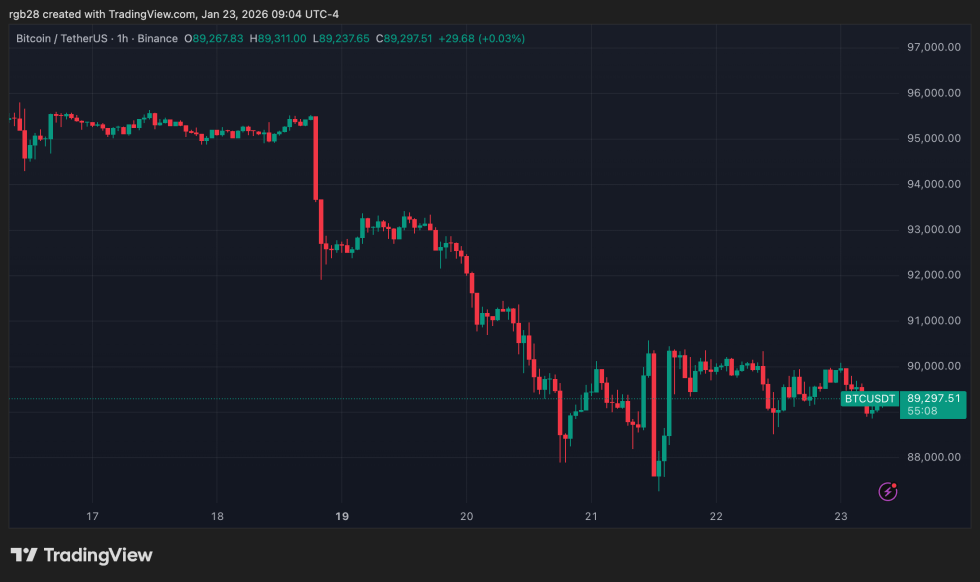
Bitcoin (BTC) trades at $89,297 in the one-week chart. Source: BTCUSDT on TradingView


Related Questions

QWhat is the purpose of the joint event being hosted by the SEC and CFTC next week?

AThe purpose of the joint event is to discuss regulatory harmonization between the SEC and CFTC, outline efforts to cooperate, and deliver on President Trump's promise to make the United States the crypto capital of the world.

QWhere and when will the SEC-CFTC joint event take place, and how can the public access it?

AThe event will be hosted on January 27 at the CFTC headquarters. It will be open to the public and livestreamed on both agencies' websites.

QAccording to the agency chairmen, what problem has forced market participants to navigate unclear regulatory boundaries?

AThe chairmen stated that market participants have been forced to navigate regulatory boundaries that are unclear in application and misaligned in design, based solely on legacy jurisdictional silos.

QWhy did Coinbase CEO Brian Armstrong withdraw support for the Senate Banking Committee's market structure bill?

ABrian Armstrong withdrew support because he believed that version of the bill would be materially worse than the current status quo, stating, 'We'd rather have no bill than a bad bill.'

QWhat recent legislative action did the Senate Agriculture Committee take regarding crypto, and when is its markup session?

AThe Senate Agriculture Committee published its version of the CLARITY Act, which mainly addresses the CFTC's role and regulations, and scheduled its markup session for January 27.

Related Reads

Google and Amazon Simultaneously Invest Heavily in a Competitor: The Most Absurd Business Logic of the AI Era Is Becoming Reality

In a span of four days, Amazon announced an additional $25 billion investment, and Google pledged up to $40 billion—both direct competitors pouring over $65 billion into the same AI startup, Anthropic. Rather than a typical venture capital move, this signals the latest escalation in the cloud wars. The core of the deal is not equity but compute pre-orders: Anthropic must spend the majority of these funds on AWS and Google Cloud services and chips, effectively locking in massive future compute consumption. This reflects a shift in cloud market dynamics—enterprises now choose cloud providers based on which hosts the best AI models, not just price or stability. With OpenAI deeply tied to Microsoft, Anthropic’s Claude has become the only viable strategic asset for Google and Amazon to remain competitive. Anthropic’s annualized revenue has surged to $30 billion, and it is expanding into verticals like biotech, positioning itself as a cross-industry AI infrastructure layer. However, this funding comes with constraints: Anthropic’s independence is challenged as it balances two rival investors, its safety-first narrative faces pressure from regulatory scrutiny, and its path to IPO introduces new financial pressures. Globally, this accelerates a "tri-polar" closed-loop structure in AI infrastructure, with Microsoft-OpenAI, Google-Anthropic, and Amazon-Anthropic forming exclusive model-cloud alliances. In contrast, China’s landscape differs—investments like Alibaba and Tencent backing open-source model firm DeepSeek reflect a more decoupled approach, though closed-source models from major cloud providers still dominate. The $65 billion bet is ultimately about securing a seat at the table in an AI-defined future—where missing the model layer means losing the cloud war.

marsbit3h ago

Google and Amazon Simultaneously Invest Heavily in a Competitor: The Most Absurd Business Logic of the AI Era Is Becoming Reality

marsbit3h ago

Computing Power Constrained, Why Did DeepSeek-V4 Open Source?

DeepSeek-V4 has been released as a preview open-source model, featuring 1 million tokens of context length as a baseline capability—previously a premium feature locked behind enterprise paywalls by major overseas AI firms. The official announcement, however, openly acknowledges computational constraints, particularly limited service throughput for the high-end DeepSeek-V4-Pro version due to restricted high-end computing power. Rather than competing on pure scale, DeepSeek adopts a pragmatic approach that balances algorithmic innovation with hardware realities in China’s AI ecosystem. The V4-Pro model uses a highly sparse architecture with 1.6T total parameters but only activates 49B during inference. It performs strongly in agentic coding, knowledge-intensive tasks, and STEM reasoning, competing closely with top-tier closed models like Gemini Pro 3.1 and Claude Opus 4.6 in certain scenarios. A key strategic product is the Flash edition, with 284B total parameters but only 13B activated—making it cost-effective and accessible for mid- and low-tier hardware, including domestic AI chips from Huawei (Ascend), Cambricon, and Hygon. This design supports broader adoption across developers and SMEs while stimulating China's domestic semiconductor ecosystem. Despite facing talent outflow and intense competition in user traffic—with rivals like Doubao and Qianwen leading in monthly active users—DeepSeek has maintained technical momentum. The release also comes amid reports of a new funding round targeting a valuation exceeding $10 billion, potentially setting a new record in China’s LLM sector. Ultimately, DeepSeek-V4 represents a shift toward open yet realistic infrastructure development in the constrained compute landscape of Chinese AI, emphasizing engineering efficiency and domestic hardware compatibility over pure model scale.

marsbit3h ago

Computing Power Constrained, Why Did DeepSeek-V4 Open Source?

marsbit3h ago

Trading

Spot
Futures

Hot Articles

Ethena: Building a New Era of Web3‑Native Digital Dollars

Ethena is an Ethereum‑based synthetic dollar protocol that delivers crypto‑native monetary solutions, including USDe, a synthetic dollar, and sUSDe, a globally accessible U.S. dollar savings asset.

52.6k Total ViewsPublished 2026.03.16Updated 2026.03.16

Ethena: Building a New Era of Web3‑Native Digital Dollars

Discussions

Welcome to the HTX Community. Here, you can stay informed about the latest platform developments and gain access to professional market insights. Users' opinions on the price of ERA (ERA) are presented below.

活动图片