Author: Santiago Roel Santos
Compiled by: Deep Tide TechFlow
Deep Tide's Introduction: The core argument of this article is a counterintuitive judgment: the biggest beneficiaries of stablecoins are not the startups building them, but the established institutions that own the distribution channels.
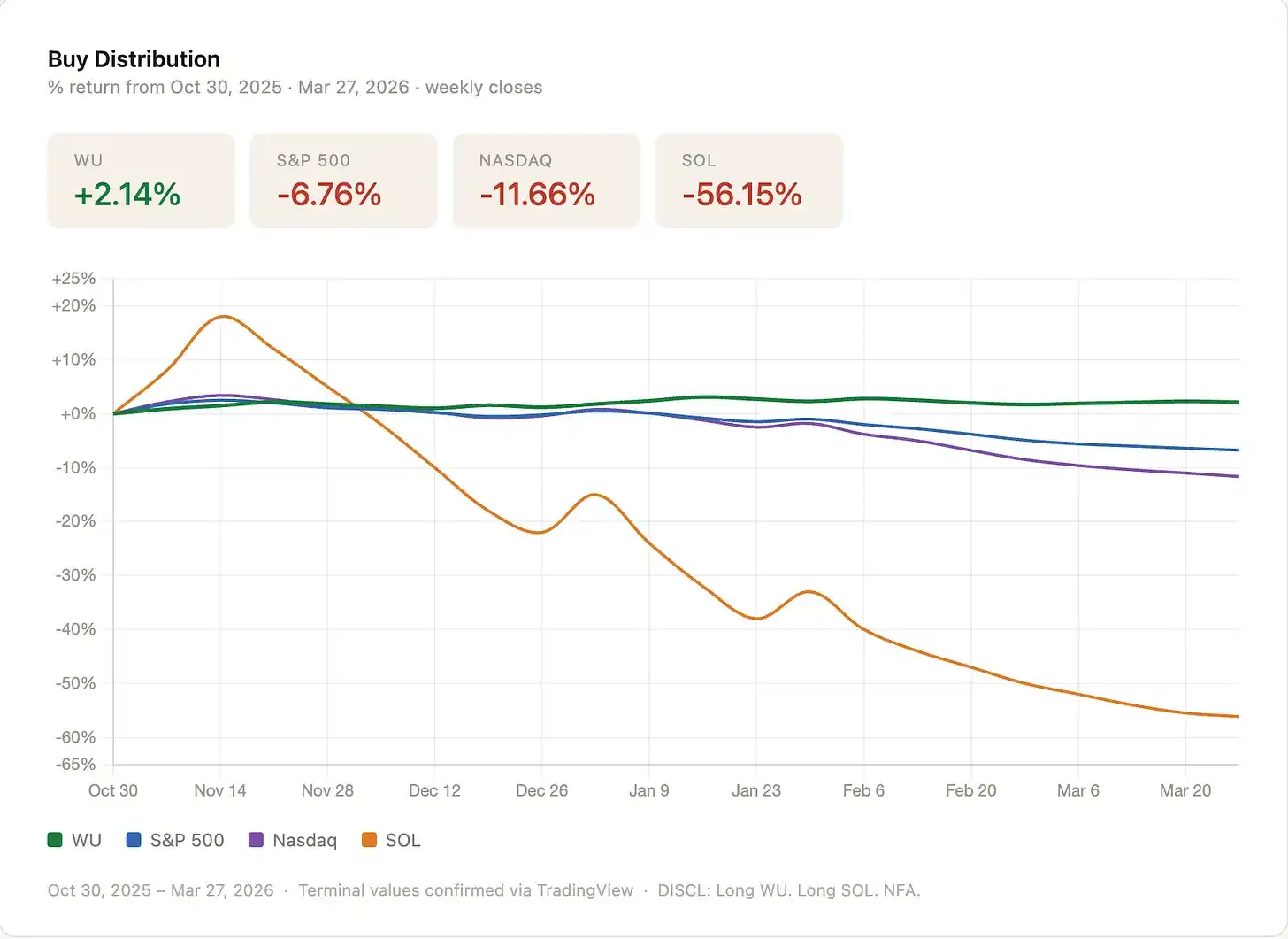
The author bet in November 2025 that Western Union would outperform Solana, and it paid off, also incidentally outperforming the S&P and Nasdaq.
What's worth reading is not just the conclusion, but the framework he uses to find opportunities: "the disruption narrative depresses valuations, distribution channels are priced at zero."
Full text as follows:
I started researching Western Union because I thought stablecoins would disrupt its business. Why pay WU fees when you can use stablecoins to send money anywhere in the world at extremely low cost? Later I realized: WU's business is much stronger than this framework suggests, and it is better positioned than almost anyone to embrace stablecoins itself. It has the brand and the distribution channels. The key risk is whether management will act.
They hadn't acted before. Until recently, they were dismissive. When I placed my bet in November 2025, I was willing to bet that they would eventually act, or someone would force them to act. I'm not an activist investor, but I felt the pressure building.
This week I also spoke at the Digital Asset Summit, and WU's CEO was on stage. I saw a completely different CEO, one who clearly articulated how stablecoins will compress the cost of global money movement.
I took on the risk of this happening, but I liked my odds. At the time, WU's P/E ratio was 3x, and it was experiencing declining growth. Many companies trade at these valuation levels and then go bankrupt. Betting on troubled companies is tempting; some will transform, some will go to zero.
What I saw in WU, and still see, is the distribution channel. A market leader with a brand, trust, and deep insight into consumer behavior—understanding both consumer resistance to new financial primitives like stablecoins and their reliance on the familiar. People will always pay for convenience. They trust WU. It's embedded in small grocery stores, convenience stores, and retail service points where less tech-savvy consumers withdraw cash. This won't disappear overnight.
I've read *The Innovator's Dilemma*, and I've invested in the very technology that claims to replace WU. But I've come to recognize that distribution channels are incredibly hard to build, and trust is even harder—especially in financial services.
All this is to say: Since I bet on WU to outperform Solana, it has indeed outperformed, and by a significant margin, also incidentally beating the S&P and Nasdaq. A classic mean reversion.
Starting from the assumption that the market is right
I always assume the market is right, then work backwards to understand why.
For WU, I kept arriving at the same answer: the market was pricing it as a melting ice cube. A business heading towards its end, slowly being eroded by Remitly, Wise, and some stablecoin-native remittance startup that just got seed funding last week. If management does nothing, maybe it's right. But price is the most important variable, and at this valuation level, there was a significant margin of safety.
WU's market cap is $2.8 billion. When I first researched it last year, the P/E ratio was nearly 3x; today it's 6x. $4.1 billion in revenue, $923 million EBITDA, $500 million net profit, 12% net margin. This isn't a dying business; it's a cash machine the market has given up on.
The gap in valuation multiples is real, and the reasons behind it are real.
WU's business is larger than both (referring to Remitly and Wise), covers over 200 countries, and generates nearly $1 billion in EBITDA annually. A 6x P/E ratio means you're not paying for any recovery, any technology adoption, any optionality. The market is pricing future upside at zero. The margin of safety is here.
Core Thesis
This is the core thesis that prompted me to found Inversion.
The market will treat certain businesses as dead men walking, assume disruption is imminent, and give zero credit for the brand and distribution channels these companies built over decades. Layer on the optionality of technology adoption, and the asymmetry becomes interesting.
The market is structurally long tech and short anything that looks old. The pace of innovation is accelerating, and it feels like AI will replace everything. This isn't a discussion about whether creative destruction will happen—it always does. It's a discussion about price, and what you're paying for it.
WU is acting, and faster than expected.
Western Union CEO Devin McGranahan has recently changed his stance. He clearly articulated this week at the New York Digital Asset Summit how stablecoins will compress the cost of global money movement—turning negative float into positive float, turning a cost center into a revenue source. WU has now announced the launch of its own stablecoin, USDPT, on Solana, ironically issued through Anchorage Digital. This shift was catalyzed by the GENIUS Act.
This is not a small signal. A 175-year-old money transfer company going from skeptical to launching its own stablecoin on Solana in less than a year is a major shift in management posture. The bear case was always that they wouldn't act, and they are now acting. That alone warrants a repricing.
Execution risk remains, it always will. Everything gets disrupted eventually. The key is understanding what price you are paying for the future to happen. The downside risk is a 20% to 30% drawdown if revenue decline accelerates, buffered by a 10% dividend yield and $500 million in annual net profit. The upside, as noted above, is 4x to 5x if they regain any growth credibility.
In contrast, most high-multiple tech companies are priced for perfect execution, and when something is priced for perfection, it only takes a small deviation to upend the thesis. When something is seen as dead, it only takes a small sign of life. WU is showing signs of life.
The product vision I keep coming back to
As much as I believe in technology, its deployment and persuading customers to use it takes a long time. The more you understand technology, the more you realize it's brilliant at what it does, but certain core human behaviors don't change. This is especially true when it comes to money. Most people won't try something new when the existing thing works fine. Consumers will always pay for convenience.
A user would rather click on WU than download and learn a digital wallet. This isn't ignorance; it's a lifetime of accumulated inertia, trust, and familiarity. This inertia has real economic value. That's why WU still processes nearly 300 million transactions annually, and why you can buy it at 6x P/E and collect a 10% dividend while you wait.
My core thesis and position is this: the biggest beneficiary of cost-reducing technology is not the startup building it, but the mature enterprise that adopts it and owns the distribution channel. Whether it's stablecoins compressing money movement costs or AI compressing operational costs, incumbent distribution channels are the leverage point. Startups commoditize infrastructure, incumbents capture profits.
WU can use stablecoin rails to reduce costs while maintaining its trait of being known for convenience. If they're smart, they'll launch a digital wallet to lower payout commissions. Global users could choose to receive and hold dollars in a WU wallet, then spend with a Visa card. If users don't withdraw cash, WU doesn't need to raise liquidity in the destination market, further compressing costs. The distribution channel remains the same, the infrastructure gets cheaper, margins expand. Cost reduction is something you can control, inherently less risky than underwriting revenue growth.
This is the optionality the market prices at zero.
WU is just one example
I've long accepted that I will never get the timing right. My predictions about the future are no better than the next person's. What I believe is that, with the right positioning, I can get better returns.
That positioning always comes back to the same thesis: buying durable businesses with distribution channels at the right price. These businesses have massive embedded optionality. Not all will act in time; some will die. But those that do will massively outperform, and those gains will far outweigh the losses.
You see General Catalyst, Thrive, and Bezos now moving into traditional businesses to inject AI. The opportunity with stablecoin and blockchain rails is the same.
Inversion's thesis is simple: buy assets with distribution channels at the best possible price, with the optionality of reshaping the business with technology. The disruption narrative depresses valuation multiples; that's the entry point.
Invert, always invert. The question isn't whether WU will be disrupted, but whether you are sufficiently compensated for taking that risk at ~$923M EBITDA and ~6x P/E. I think yes, and generously so.
Disclosure: Long WU. Long SOL. This is not investment advice.