The First to Ride the Hype of Robinhood Chain: Arbitrum, Up Nearly 20%

marsbitPublished on 2026-07-11Last updated on 2026-07-11

Abstract

ARB rose nearly 20% recently, becoming one of the top-performing major L2 tokens. The catalyst was the launch of Robinhood Chain, an RWA-focused Layer 2 built on Arbitrum's Orbit tech. A key driver is the revived "Arbitrum Expansion Program" (AEP), a revenue-sharing rule from 2024 requiring independent Orbit chains to give 10% of their net protocol revenue to the Arbitrum ecosystem. While smaller chains already paid this, Robinhood Chain, with its significant TradFi backing, is the first large-scale tenant to make the mechanism economically meaningful. Despite impressive early metrics (over 35k addresses, $2.5B TVL, $1B+ DEX volume in its first week), Robinhood Chain's current contribution to Arbitrum's treasury is minor (~$14.7k net revenue). The price surge reflects a narrative-driven premium on AEP's future potential, given Robinhood's vast off-chain assets. The situation mirrors Optimism's "landlord" model with OP Stack, which is now facing a decline as its major tenant, Base, plans to leave. Similarly, analysts question if the high-earning Robinhood Chain will eventually follow Base's path and seek independence from Arbitrum's tech stack, especially as its activity already benefits Ethereum more directly through ETH fee burns.

Author:angelilu, Foresight News

ARB hit $0.094 intraday today, up nearly 20% in the past week, making it one of the best-performing mainstream L2 tokens over that period.

The catalyst for this rally is the launch of "Robinhood Chain"—Robinhood's RWA (Real World Asset) Layer2 built on Arbitrum technology, which officially went live on mainnet at a launch event in London on July 1.

A more subtle logic behind this is that a year-and-a-half-old rule has been brought back into the spotlight: A portion of Robinhood Chain's revenue will automatically flow back into the Arbitrum ecosystem, with a significant chunk going directly to the ArbitrumDAO treasury. This isn't a new policy, but a previously lukewarm revenue-sharing mechanism that is now being seriously priced in by the market for the first time, thanks to the entry of the heavyweight TradFi brand Robinhood.

The First Major Tenant in a Year and a Half

This rule is called the Arbitrum Expansion Program (AEP), launched jointly by the Arbitrum Foundation and Offchain Labs in January 2024. Simply put, it allows Arbitrum to open up its technology for others to build their own chains, with the condition of revenue sharing.

The sharing logic is straightforward: Any independent chain built using Arbitrum Orbit technology but not settling on Arbitrum One/Nova (e.g., settling directly to Ethereum or Base) must share 10% of its net protocol revenue with the Arbitrum ecosystem—8% to the DAO treasury and 2% to the Developer Guild. However, L3s that settle back to Arbitrum One/Nova, like Xai and Sanko, are exempt from this share and retain their status as first-tier ecosystem members.
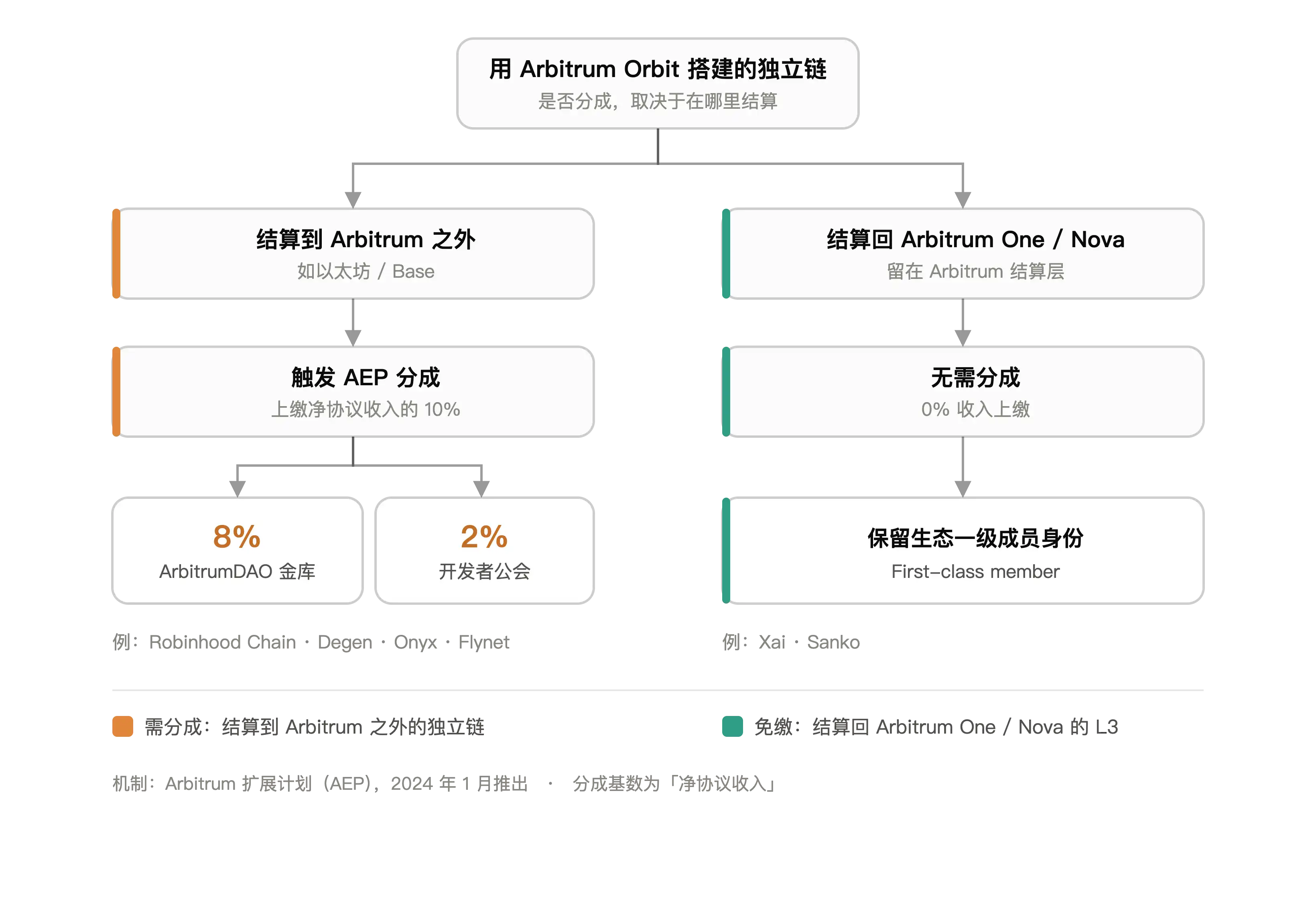
The key point is that Robinhood Chain is not the first chain to trigger the AEP. Smaller chains settling on Base, like Degen Chain, Onyx, and Flynet, have been paying this share for a while, but their volumes were too small to draw attention. What sets Robinhood Chain apart is simply that it's the first heavyweight chain to bring scale to this shared revenue amount.

Impressive Data, but the Rent Plate is Still Small

According to the latest data disclosed by Johann, Robinhood's Head of International & Crypto Business: As of July 10, just over a week after launch, Robinhood Chain has processed over 17 million transactions, has over 350,000 addresses, a TVL of approximately $250 million, and DEX trading volume exceeding $1 billion. For a newly launched chain, this report card is indeed impressive.

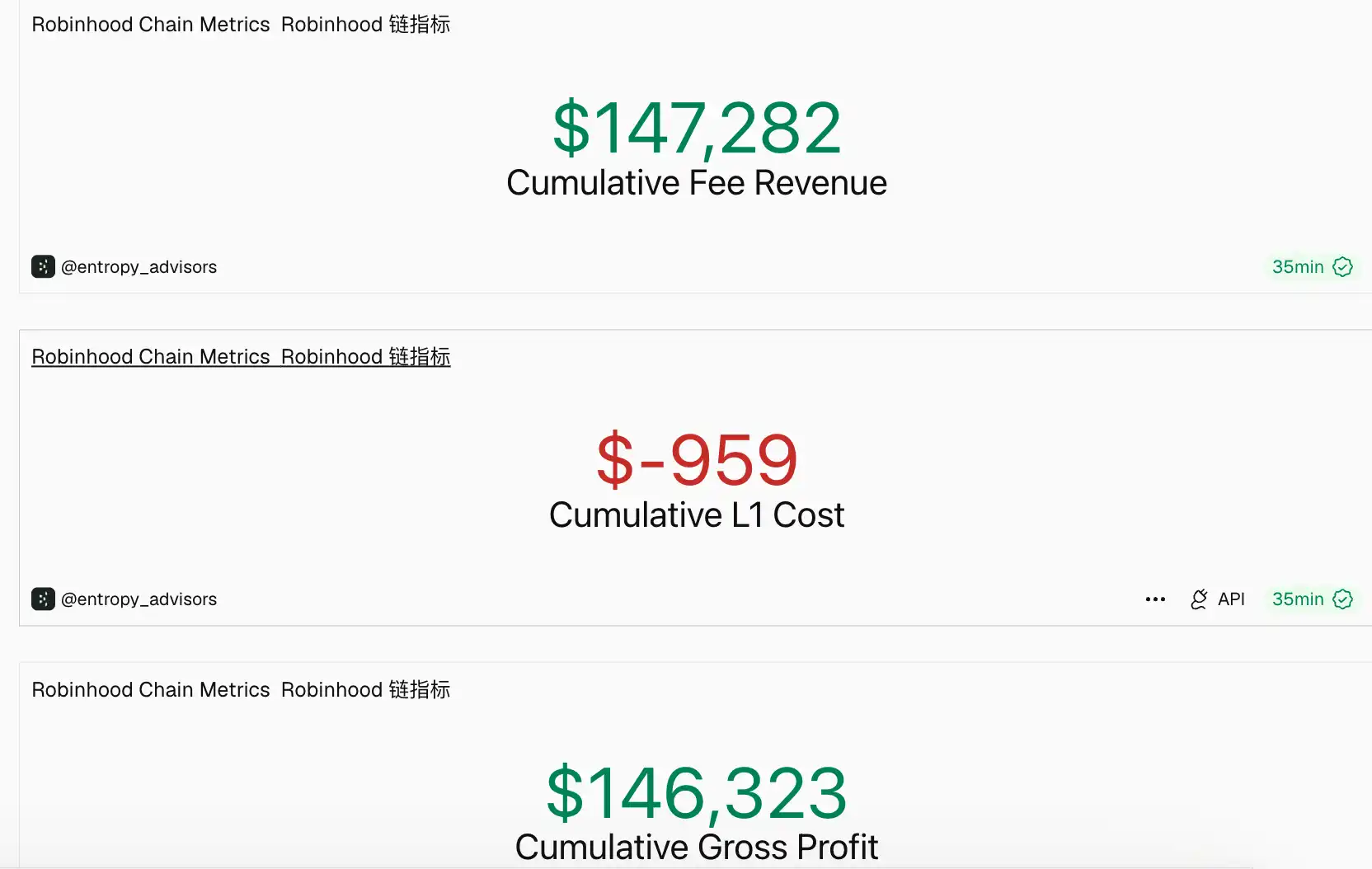
But the rent plate is far from this large. According to Dune data, as of the time of writing, Robinhood Chain's current protocol revenue is about $147,000. After deducting the cost of data settlement back to Ethereum L1, it's only $146,000. Even if 10% of this is shared with Arbitrum DAO, the amount is pitifully small. ARB's current rally reflects the market's premium valuation on the future scaling boundaries of the AEP protocol—a typical narrative-driven market move.
Looking at the potential upside, the ceiling for AEP is indeed not low: The Robinhood platform holds total assets of approximately $324 billion, custodies assets of about $143.6 billion, and its tokenized stocks have expanded to over 2,000 tokens covering 120 countries—most of these assets are not yet on-chain today. Once settlement gradually migrates, the $57,000 sharing base will stand at a completely different scale.

Old Landlord About to Lose Biggest Tenant, New Landlord Just Landed a Big Deal

Arbitrum's "rent collection" model isn't actually new. Optimism has been running the "landlord" business for a long time.

The Optimism Collective collects rent from all Superchain member chains (Base, Zora, Mode, Unichain, etc.) through OP Stack—charging 2.5% of sequencer revenue or 15% of net profit (whichever is higher), and OP Mainnet itself also contributes its net revenue to the treasury. However, its rental income has been gradually shrinking, falling further to about $2.9 million in Q1 2026 (with Base alone contributing about $1.4 million), down 21.5% quarter-on-quarter from $3.7 million in the previous quarter.
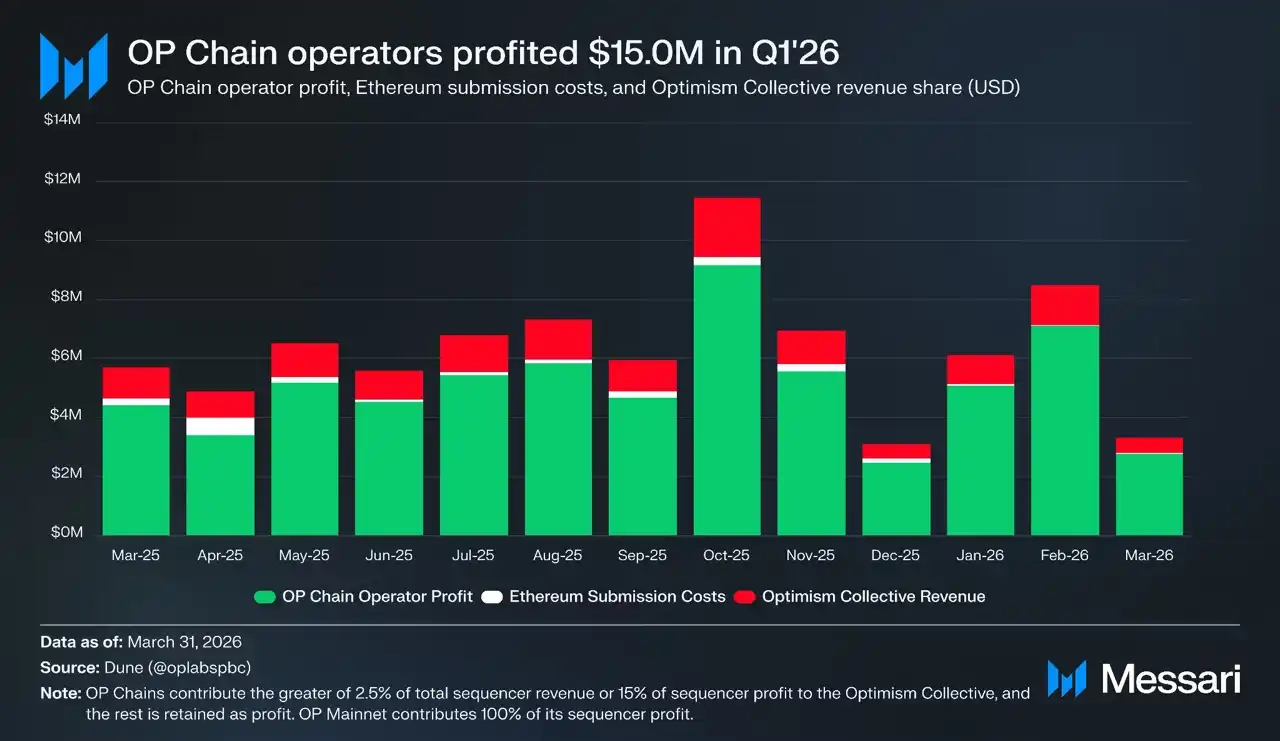
In February of this year, Base officially announced plans to leave OP Stack—Base accounted for about 96.5% of revenue flowing into the Collective on a gas fee basis. Upon the news, the OP token fell 28% within two days.

Meanwhile, Arbitrum just managed to revitalize its own landlord business from zero, thanks to Robinhood Chain. Their structures are completely parallel—both are underlying technologies charging rent from external chains, with the money going into their own DAO treasuries (ArbitrumDAO vs. Optimism Collective). The only difference is that Arbitrum's AEP, although the rules were written in 2024, never had a major tenant until this week, finally giving its "rent collection" a sense of scale for the first time.

But Can This Big Tenant Be Kept?

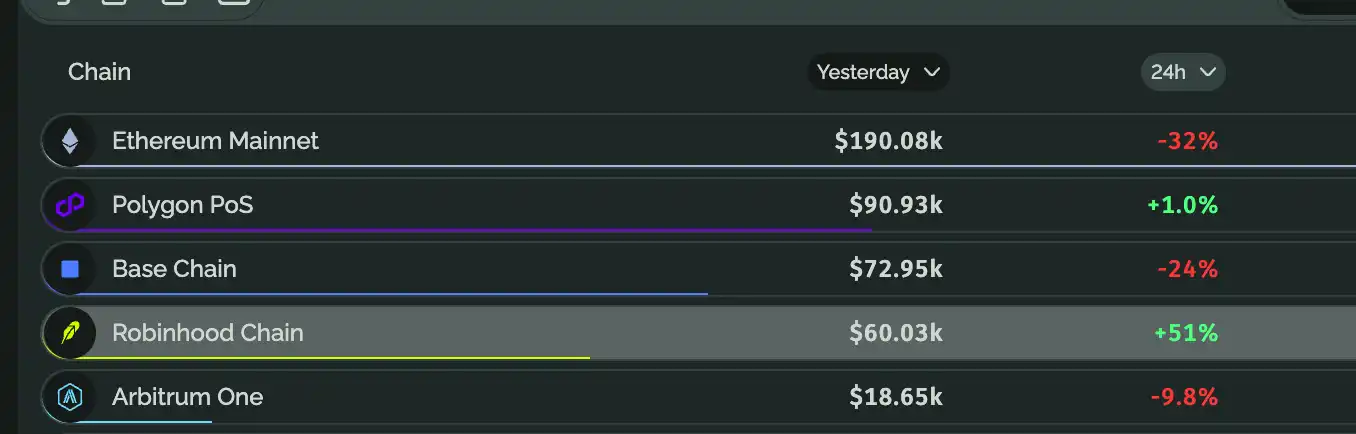
It's precisely this history with Base that some analysts are using to throw cold water. Some believe that, following the same script, Robinhood Chain will eventually leave Arbitrum Orbit just as Base left OP Stack and align directly with Ethereum. According to growthepie data, Robinhood Chain's daily sequencer revenue is already nearly $60,000, second only to Base's $72,000 among Ethereum L2s, approaching three times that of its parent chain, Arbitrum.
Even more delicate is the question of the beneficiary. In its first week, Robinhood Chain has become the second-largest demand source for Ethereum DA after Base, with its sequencer paying blob fees, settling in ETH, and permanently burning it. Some analysts argue that if this chain can only have one ecosystem currency, it's more likely to be ETH than ARB.

Trending Cryptos

Related Questions

QWhat is the primary reason behind Arbitrum (ARB) token's recent price surge of nearly 20% according to the article?

AThe primary reason is the launch of 'Robinhood Chain,' a Layer 2 for Real World Assets (RWA) built by Robinhood using Arbitrum technology. This event brought significant market attention to Arbitrum's revenue-sharing model for the first time.

QWhat is the name of Arbitrum's program that mandates revenue sharing from chains built with its technology, and what are the specific terms?

AThe program is called the Arbitrum Expansion Plan (AEP). It requires independent chains built with Arbitrum Orbit technology, which do not settle back to Arbitrum One/Nova (e.g., those settling directly to Ethereum or Base), to share 10% of their net protocol revenue with the Arbitrum ecosystem (8% to the DAO Treasury, 2% to the Developer Guild).

QWhy is Robinhood Chain's launch significant for Arbitrum's revenue-sharing model, unlike previous users of the AEP like Degen Chain?

AWhile other small chains like Degen Chain have been paying under AEP, their volume was too insignificant to matter. Robinhood Chain is significant because it is the first major, heavyweight chain from a major TradFi brand to trigger the AEP, bringing substantial potential scale and market credibility to the revenue-sharing model.

QWhat historical event from the Optimism ecosystem is cited as a cautionary tale regarding the sustainability of such revenue-sharing models?

AThe article cites Base's announcement in February (2026) to break away from the OP Stack as a cautionary tale. Base was the largest contributor (providing ~96.5% of revenue) to the Optimism Collective's treasury, and its departure caused the OP token price to drop 28% over two days.

QAccording to analysts in the article, what are the potential risks that Robinhood Chain might pose to Arbitrum's long-term benefits from the AEP?

AAnalysts suggest Robinhood Chain might eventually follow Base's example and break away from Arbitrum Orbit to align directly with Ethereum, especially as its sequencer revenue grows rapidly. Furthermore, the chain's economic activity primarily benefits Ethereum (ETH) through blob fee payments and burning, not necessarily the ARB token.

Related Reads

In Just 11 Days, Claude Rewrote Millions of Lines of Code, an Epic AI Engineering Feat Sparks Fury

In just 11 days, Bun's founder Jarred Sumner used Anthropic's Claude AI models to rewrite its million lines of code from Zig to Rust. This move sparked significant controversy, particularly from Zig's creator, Andrew Kelley, who publicly criticized Sumner's engineering practices and the decision to use AI for such a massive rewrite. Bun, a high-performance JavaScript/TypeScript runtime and rival to Node.js, was originally written in Zig. After Anthropic acquired Bun, the team encountered persistent stability and memory safety bugs in the Zig codebase. These issues, combined with Zig's strict policy against LLM-generated code, led to the decision to rewrite in Rust. The rewrite was executed using Claude AI tools at an estimated API cost of $165,000, dramatically reducing the expected time and financial cost. Andrew Kelley's response was scathing. He blamed the original bugs on poor engineering habits, calling Bun's Zig code a collection of "hacks on top of hacks." He expressed relief that Bun was no longer associated with Zig, fearing it would misrepresent the language and attract low-quality, AI-generated contributions. The tech community is divided; some view Kelley's critique as unprofessional, while others see it as a defense of engineering integrity. A major concern about the AI-driven rewrite is the resulting code quality. The translation from Zig left approximately 27,000 lines of unsafe Rust code, raising fears about long-term maintainability and technical debt. The debate centers on whether this project is a milestone in AI-assisted development or a future maintenance nightmare.

marsbit51m ago

In Just 11 Days, Claude Rewrote Millions of Lines of Code, an Epic AI Engineering Feat Sparks Fury

marsbit51m ago

From Auto Finance to Bitcoin to AI Engines: An Analysis of Cango's 'What Not to Do' Strategy

From Auto Finance to Bitcoin and Now AI: Cango's "What Not to Do" Strategy Cango, a Chinese auto finance platform that went public on the NYSE in 2018, is undergoing its third major transformation. After selling its entire auto business in 2024, it pivoted to become a large-scale Bitcoin miner, acquiring 50 exahash of mining rigs from Bitmain. However, its true goal was never Bitcoin, but owning and controlling energy infrastructure. Now, Cango is pivoting again. While most listed Bitcoin miners are leasing power to giant hyperscalers for AI training clusters, Cango is taking the opposite path. It has launched an AI inference subsidiary called EcoHash, focusing not on training but on distributed inference. The company's strategy hinges on the insight that over 70% of mining industry power is controlled by small, independent sites (10-50 MW), which are too small for hyperscalers but ideal for low-latency AI inference. Cango aims to partner with these small operators, providing the AI technology, customers, and financing through its EcoLink software layer, which can distribute workloads across sites for reliability. Cango maintains a hybrid model, running roughly 31.7 EH/s of Bitcoin mining for cash flow while aggressively cleaning its balance sheet—slashing long-term debt by 94.5% to $30.6 million and raising $75 million for its AI venture. Its first AI deployment will be at a 50 MW site in Georgia. The strategy faces skepticism, given the high costs of converting mining sites and the potential for an AI bubble. However, Cango's leadership believes discipline around "what not to do"—avoiding direct competition with hyperscalers in training—positions it to capture the long-tail demand for distributed AI inference power.

Foresight News1h ago

From Auto Finance to Bitcoin to AI Engines: An Analysis of Cango's 'What Not to Do' Strategy

Foresight News1h ago

Strategy's Bitcoin Sales Cap Far Exceeds $1.25 Billion: A Detail the Market Overlooked

The article discusses how MicroStrategy's potential Bitcoin sales go far beyond the announced $1.25 billion "reserve-building capacity." It clarifies a key distinction in the company's "BTC Monetization Program": selling Bitcoin to *build* a new dollar reserve (the $1.25B cap) versus selling to *replenish* the existing USD Reserve after it's used for expenses like preferred share dividends. The recent $216M BTC sale for dividend payments was a "replenishment," leaving the headline $1.25B building quota untouched. The plan actually outlines three potential funding pools from BTC sales: 1) Building the reserve ($1.25B cap), 2) Covering preferred share/ debt costs (no specified cap), and 3) Funding buyback programs (up to $20B). This means the structured sales potential exceeds $30 billion, not including uncapped replenishment sales. The piece argues this marks MicroStrategy's shift from a passive "buy-and-hold" Bitcoin proxy to an actively managed entity using BTC as a balance-sheet tool to manage its complex capital structure (common stock, preferred shares, debt, reserve). This creates new dynamics and potential conflicts, as actions benefiting one part (e.g., selling BTC to pay dividends) may pressure another (e.g., undermining the "never sell" narrative). Investors must now parse the company's specific terminology ("build" vs. "replenish") to understand the true scope of future BTC sales, which is significantly larger than the market initially perceived.

marsbit1h ago

Strategy's Bitcoin Sales Cap Far Exceeds $1.25 Billion: A Detail the Market Overlooked

marsbit1h ago

Goldman Sachs Report Deconstructs the Competitive Landscape of China's AI Large Models: Who Will Be the Long-Term Winner?

Goldman Sachs analyzes China's AI large language model (LLM) landscape, identifying key players and a strategic shift towards efficiency and global expansion. The report highlights that Chinese open-source/open-weight models are closing the performance gap with top global proprietary models at significantly lower cost, driven by architectural innovations like MoE. This enables a "two-tier" market: a high-end segment (e.g., GLM5.2, Qwen3.7 Max) with pricing at ~$1 per million tokens, and a low-end, price-sensitive global segment. Open-source strategies aid adoption but limit monetization, as deployments via third-party platforms (e.g., AWS Bedrock, Alibaba Cloud) may not generate direct revenue for model creators. The industry is thus moving towards "open-weight + community license" models with revenue-sharing to improve unit economics. Internationally, the focus is shifting from "token maximization" to ROI-driven enterprise adoption, particularly in non-U.S. markets. Major cloud platforms are integrating Chinese models (e.g., DeepSeek, MiniMax). Using a competitive framework based on pricing power, cost advantage, and financial strength, Goldman Sachs identifies **Zhipu AI** and **DeepSeek** as leaders in foundational text models, and **ByteDance** (with Seedance) leading in multimodal/video generation. **MiniMax** and **Kuaishou** are also rated favorably. The firm forecasts China's AI model API/subscription revenue growing from ~RMB 35bn (2026E) to RMB 879bn by 2030.

marsbit1h ago

Goldman Sachs Report Deconstructs the Competitive Landscape of China's AI Large Models: Who Will Be the Long-Term Winner?

marsbit1h ago

Trading

Spot

Hot Articles

How to Buy HYPE

Welcome to HTX.com! We've made purchasing Hyperliquid (HYPE) simple and convenient. Follow our step-by-step guide to embark on your crypto journey.Step 1: Create Your HTX AccountUse your email or phone number to sign up for a free account on HTX. Experience a hassle-free registration journey and unlock all features.Get My AccountStep 2: Go to Buy Crypto and Choose Your Payment MethodCredit/Debit Card: Use your Visa or Mastercard to buy Hyperliquid (HYPE) instantly.Balance: Use funds from your HTX account balance to trade seamlessly.Third Parties: We've added popular payment methods such as Google Pay and Apple Pay to enhance convenience.P2P: Trade directly with other users on HTX.Over-the-Counter (OTC): We offer tailor-made services and competitive exchange rates for traders.Step 3: Store Your Hyperliquid (HYPE)After purchasing your Hyperliquid (HYPE), store it in your HTX account. Alternatively, you can send it elsewhere via blockchain transfer or use it to trade other cryptocurrencies.Step 4: Trade Hyperliquid (HYPE)Easily trade Hyperliquid (HYPE) on HTX's spot market. Simply access your account, select your trading pair, execute your trades, and monitor in real-time. We offer a user-friendly experience for both beginners and seasoned traders.

4.0k Total ViewsPublished 2024.03.29Updated 2026.06.02

How to Buy HYPE

Discussions

Welcome to the HTX Community. Here, you can stay informed about the latest platform developments and gain access to professional market insights. Users' opinions on the price of HYPE (HYPE) are presented below.

活动图片