These days, the tech community has been feasting on drama: Zig programming language creator Andrew Kelley is furious.
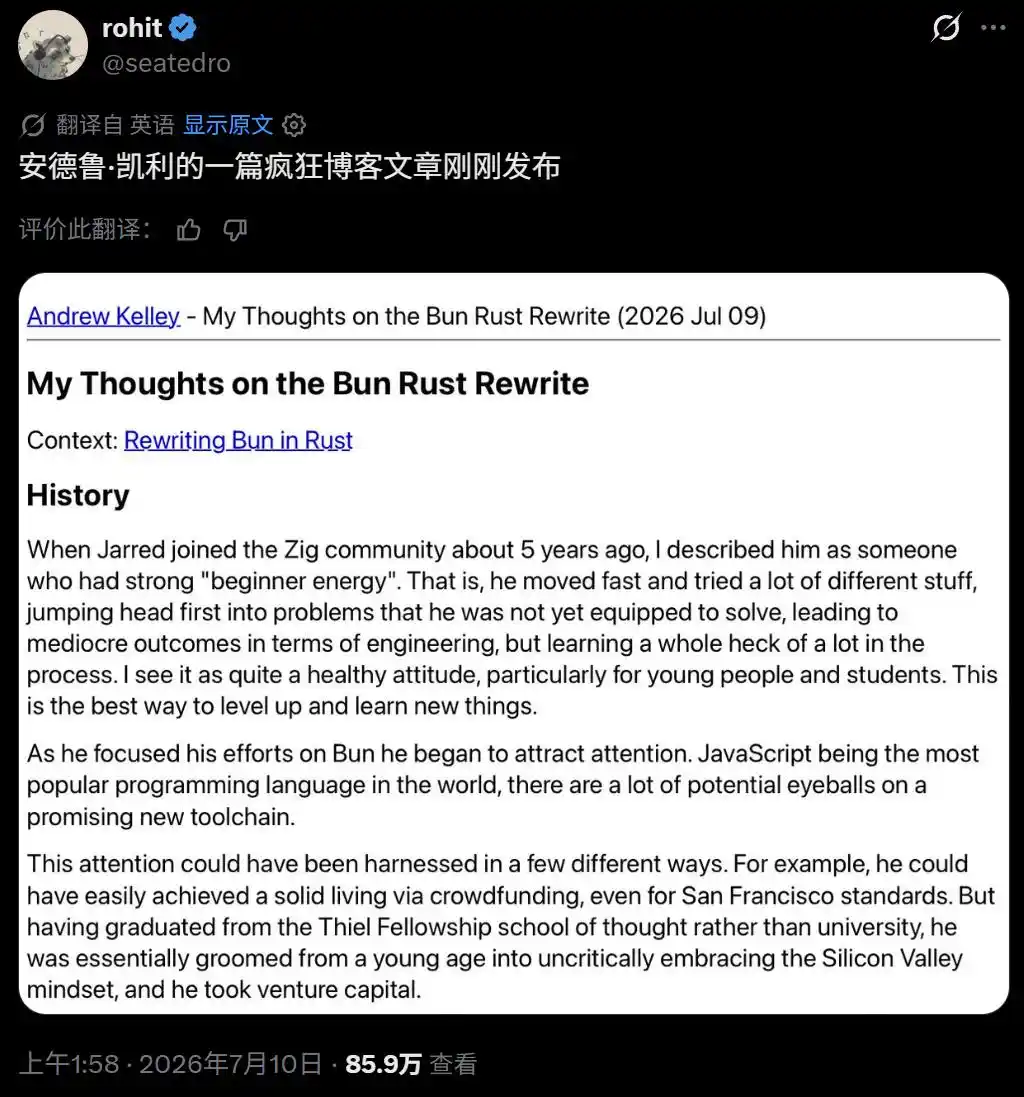
The reason? Bun, which had fully committed to the Zig language, was rewritten in Rust by its founder, Jarred Sumner.

Andrew Kelley didn't mince words, showing his anger without the usual polite discourse surrounding such a phenomenal tech event. He directly targeted Jarred Sumner's personal engineering habits, management abilities, and the business logic behind this move.
Bun is a high-performance JavaScript/TypeScript runtime, designed to be a faster, modern direct replacement for Node.js. In recent years, it has become a heavyweight contender challenging Node.js's dominance in the frontend world.
Bun's core selling point is speed: whether it's startup time, dependency installation, or test execution, it far outpaces its competitors, partly because it was originally written in Zig.
In December last year, Anthropic announced its acquisition of Bun, planning to use it as infrastructure to power its AI coding tools, Claude Code and the Claude Agent SDK. Jarred Sumner and other Bun team members are now working at Anthropic.
After large-scale application, especially as the underlying layer for Claude Code, the Bun team encountered what they deemed to be intractable stability issues.
Specifically, the Zig version of Bun had a significant number of memory safety bugs — use-after-free, double-free, forgetting to free memory on error paths, etc. In Zig, these issues rely on coding conventions for prevention, whereas in Rust, the borrow checker and Drop mechanism turn them directly into compilation errors.
On another front, the upstream Zig community maintains a zero-tolerance policy towards code generated by large language models (LLMs). Even optimization patches unrelated to AI could not be merged upstream. The Bun team heavily relies on AI-assisted development, and continuing with Zig meant having to maintain their own compiler fork long-term, at a high cost.
Thus, in May of this year, we witnessed a major engineering feat in the tech world: Bun's founder Jarred Sumner announced that they had rewritten Bun's million lines of code in Rust within 11 days. They used Anthropic's then-unreleased Claude Fable 5 (a Mythos-level model) and the dynamic workflow capabilities of Claude Code.
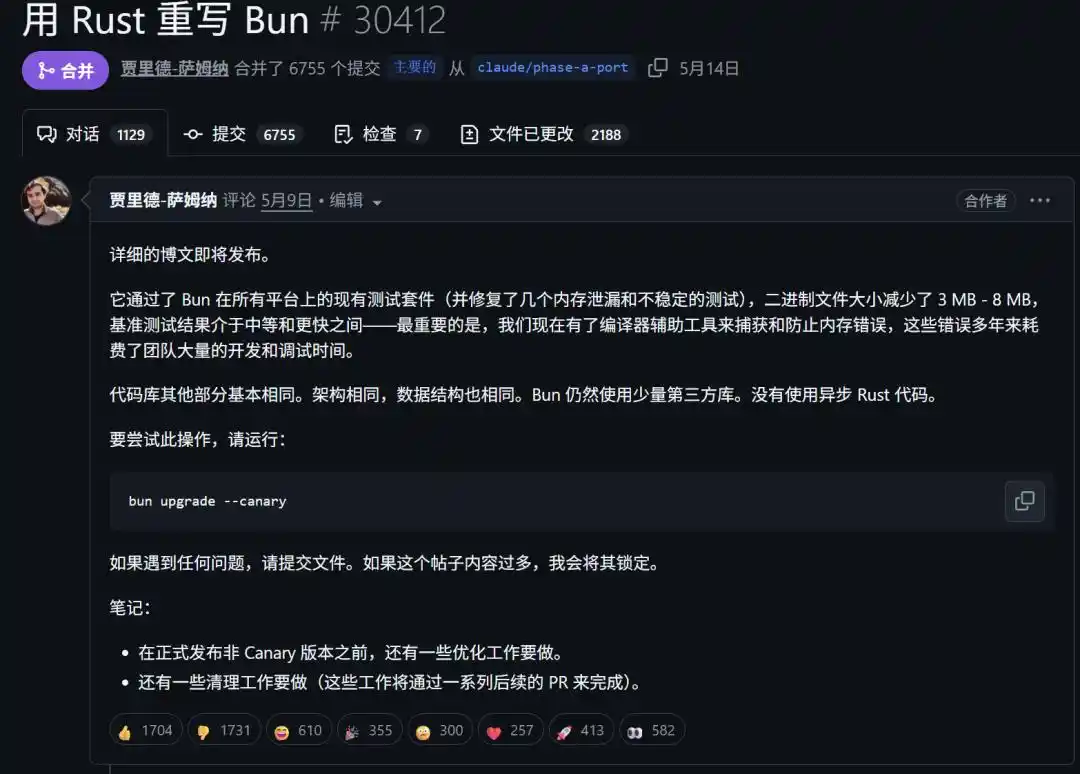
This was an epic large-scale test of Agentic Workflows, later promoted by Anthropic as a benchmark case for Dynamic Workflows, but it also sparked controversy for "betraying the faith."
In a recent blog post, Zig creator Andrew Kelley argued that the root cause of Bun's bugs before the rewrite was Jarred Sumner's poor engineering habits.
First, even before AI became prominent, Jarred was consistently writing poor-quality code. Kelley stated that the Zig team often reviews users' codebases, and Bun's codebase filled them with "extreme fear." It was full of hacky patches stacked on top of more hacks, abused assertions, and in the rush to push new features quickly, they almost never took time to fix bugs or address technical debt.
Then came the million lines of code generated by Claude. Kelley countered: "Bun officially claims that 1 million lines of unvetted Rust (AI-written) code are safe because there are test cases; well, if the test cases were really that comprehensive, why didn't they catch all those pesky bugs in the original Zig-written version?"
Now, Kelley expresses deep disappointment with Jarred's transformation from an open-source developer with "beginner energy" into a "stinky manager."
Kelley bluntly stated that when he learned Bun was abandoning Zig, he wasn't angry about the betrayal but rather relieved. He was afraid that Bun, bearing the Zig name, would create misunderstandings externally and, worse, attract users who only copy-paste AI-generated code. He even sarcastically remarked that he's now enjoying a cup of tea, glad that "this is finally not my problem anymore."
With such direct confrontation, others in the tech community have joined the fray, sharing their views.
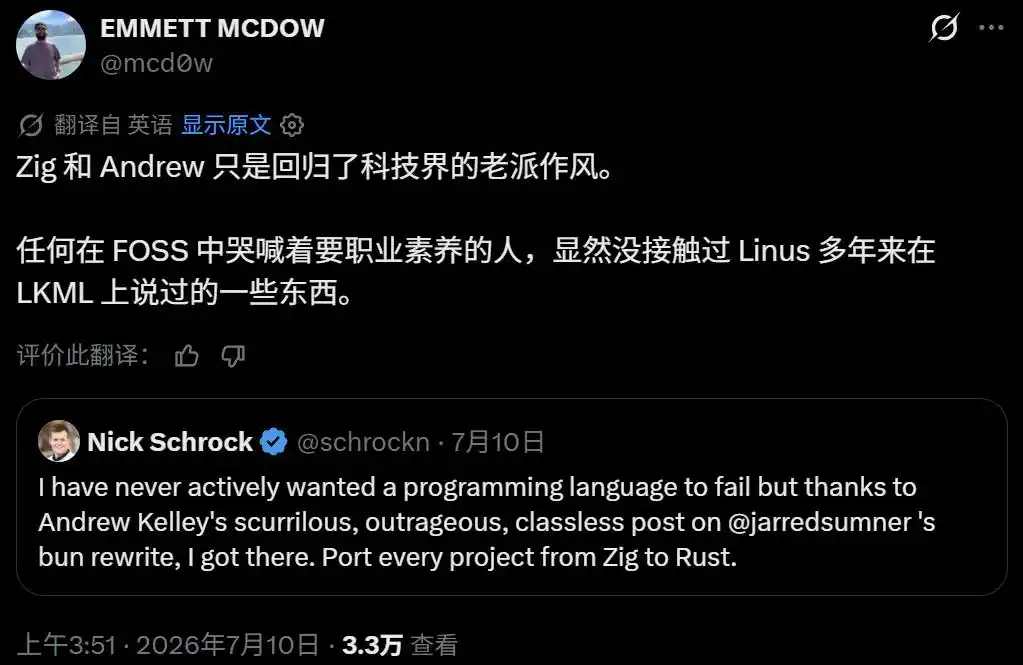
First, some did the math: Claude's tokens are often criticized as expensive, but based on data released by Jarred Sumner and Bun, the Rust rewrite of the Bun project is estimated to have consumed $165,000 in API fees. In the tech and engineering world, this price and timeline are frighteningly cheap.
On paper alone, AI compressed development costs to about one-tenth of the original estimate, and the time was reduced from roughly a year to less than two weeks.
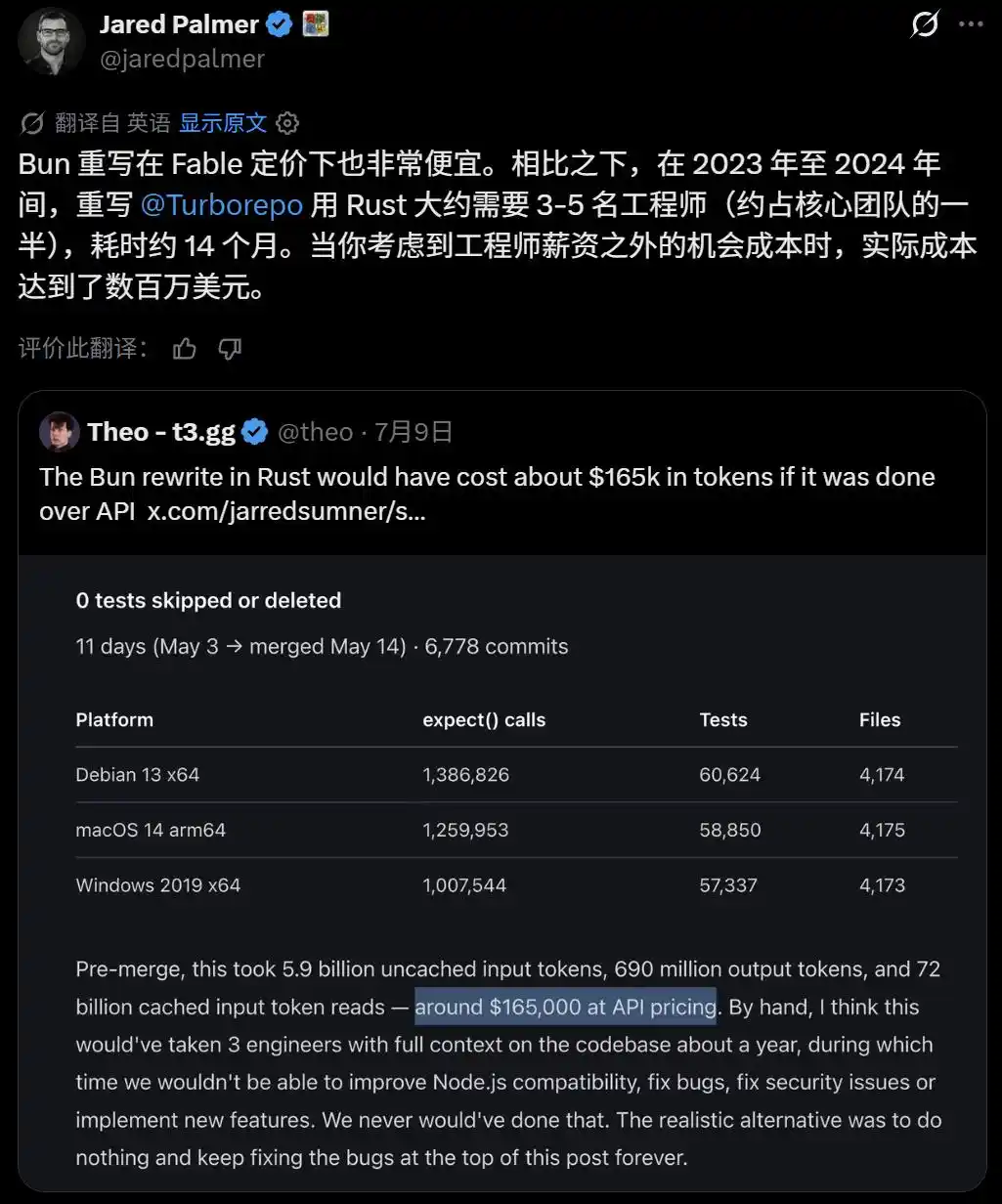
Secondly, there's the debate on the collision of open-source community culture with the AI era. After reading Andrew Kelley's blog post, some felt extremely uncomfortable, believing his public attack on a former major user and sponsor (Bun had long funded Zig) showed a lack of professionalism. Some even radically expressed they had "never before so actively wished for a programming language to fail."
However, veteran programmers also voiced support, arguing that in this era driven by capital and AI hype, Andrew is merely defending pure engineering quality, reminiscent of Linus Torvalds's style back in the day.
Of course, everyone is more concerned about whether the project is still usable after such a drastic overhaul.
The biggest point of contention currently is that, since the 1 million lines of code were mechanically translated from Zig by AI, they lack the architectural refactoring a human engineer would provide. The new codebase retains a staggering 27,000 lines of `unsafe` code blocks. Many worry that the cognitive and debugging costs for human developers maintaining, reading, and modifying this massive "AI-generated blob" in the future might ultimately exceed the upfront development costs saved today.
Will this project, which breaks the established rules of software engineering history, become a milestone where AI reshapes programming paradigms, or will it eventually erupt as an unmaintainable volcano of technical debt? Only time will tell.
References:
https://bun.com/blog/bun-in-rust
https://andrewkelley.me/post/my-thoughts-bun-rust-rewrite.html
This article is from the WeChat public account "Machine Heart" (ID: almosthuman2014), author: Focus on AI.