Grayscale cuts fees ahead of MSOL launch – Will institutions drive Solana’s next rally?

ambcryptoPublished on 2026-06-26Last updated on 2026-06-26

Abstract

Grayscale has reduced the fee for its Spot Solana (SOL) ETF from 0.35% to 0.19%, positioning it among the lowest-cost Solana ETFs. This move is seen as a competitive response to Morgan Stanley's planned launch of a Solana ETF (MSOL) with an even lower 0.14% fee. While the broader crypto market is weak, with over $100 billion flowing out recently, institutional interest in Solana appears to be growing strategically. This interest is underpinned by Solana's on-chain strength, including a record Real-World Asset (RWA) ecosystem value surpassing $3.10 billion. Additional institutional support comes from listings like the Solana ETF on the Kazakhstan Stock Exchange. Analysts suggest these converging signals—ETF competition, sustained on-chain activity, and institutional positioning—could set the stage for a stronger institutional cycle for SOL in Q3, potentially diverging from broader market weakness.

Institutional moves in a volatile market are rarely a coincidence.

On the macro side, things are still looking risk-off. Over $100 billion has flowed out of crypto this week, dragging total market cap down to $1.99 trillion, levels not seen since September 2024.

Clearly, the market is in a weak phase, where technical downside could start lining up with softer on-chain signals.

But is Solana starting to diverge from the broader trend? From a technical view, SOL’s 5.7% weekly pullback shows it’s still tracking the wider market weakness, and a move toward $60 isn’t off the table if pressure continues.

That said, Grayscale’s move has definitely sparked some attention around SOL’s Q3 setup.
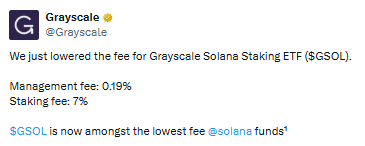
Source: X

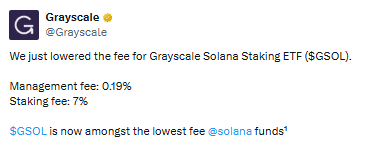
As the post above highlights, Grayscale has cut its Spot Solana [SOL] ETF annual fee to 0.19%, down from 0.35%. More importantly, that now puts it among the lowest-fee Solana ETFs in the market (tied with FT), which is a pretty aggressive positioning shift compared to its earlier standing.

However, when you look at the recent move by Morgan Stanley, Grayscale’s decision doesn’t seem random. On Thursday, the firm filed amended Form S-1 statements with the SEC for its ETF lineup, signaling plans to undercut current market offerings with a 0.14% fee for its Solana ETF (MSOL).

In essence, Grayscale looks like it’s reacting to growing fee competition in the ETF space.

Notably, timing matters here. Solana’s technical setup is still weak, but institutional interest hasn’t really faded. Instead, it appears that positioning is continuing or rotating quietly even as broader market conditions stay soft.

And when you factor in Solana’s on-chain activity, these strategic moves don’t look random.

Institutional flows hint at Solana Q3 setup

The market is betting on a strong foundation building for Solana over the next 18 months.

At the developer level, this is driven by tokenomics improvements, tokenized asset trading, and renewed speculation across meme coins and AI plays. On top of that, Solana’s RWA sector is already seeing record activity this year.

The RWA ecosystem has surpassed $3.10 billion in total value, hitting a new all-time high, while the number of holders has crossed 290,000.

Supporting this view, Multicoin co-founder Tushar Jain says Hyperliquid [HYPE] is “complementary” to the firm’s SOL positions, with Solana leading in spot trading, while Hyperliquid leads in derivatives. Jain adds that while the two may compete, Multicoin expects both to outperform the rest of the field.


Source: X

Against this backdrop, Grayscale’s latest move extends beyond simple fee competition.

Further supporting Solana ETF momentum, the Kazakhstan Stock Exchange (KASE), one of Central Asia’s largest exchanges, has listed the Volatility Shares Solana ETF (SOLZ), adding another layer of institutional access and global distribution to the ecosystem narrative.

Hence, calling Solana’s Q3 setup a strong institutional cycle for SOL might not be too far-fetched. Instead, with ETF momentum and on-chain signals starting to converge, Solana increasingly looks like it’s entering a phase where institutional flows could start catching up with fundamentals.



Final Summary

Trending Cryptos

Related Questions

QWhy did Grayscale cut its Spot Solana ETF annual fee?

AGrayscale cut its Spot Solana ETF annual fee from 0.35% to 0.19% as a competitive response to fee pressures in the market, notably ahead of Morgan Stanley's planned launch of its own Solana ETF (MSOL) with an even lower fee of 0.14%.

QWhat is the current state of the broader crypto market according to the article?

AThe broader crypto market is in a risk-off and weak phase, with over $100 billion flowing out this week, dragging the total market cap down to $1.99 trillion, a level not seen since September 2024.

QWhat are some of the fundamental factors supporting institutional interest in Solana (SOL)?

AKey factors include tokenomics improvements, growth in tokenized asset trading, activity in meme coins and AI projects, and a rapidly expanding Real-World Asset (RWA) ecosystem, which has surpassed $3.10 billion in total value and has over 290,000 holders.

QHow is Solana's price action currently relating to the broader market trend?

ASolana is still largely tracking the broader market weakness, with a 5.7% weekly pullback, and a potential move toward $60 is not off the table if selling pressure continues.

QWhat recent development adds to the institutional access for Solana ETFs?

AThe Kazakhstan Stock Exchange (KASE), one of Central Asia's largest exchanges, has listed the Volatility Shares Solana ETF (SOLZ), adding another layer of institutional access and global distribution to the Solana ecosystem.

Related Reads

Google's 'Reasoning King' Also Departs for Meta, Originally Recruited by Fei-Fei Li

"Google's 'King of Reasoning' Leaves for Meta, Quietly Departing After Over Eight Years. Denny Zhou, a key figure behind Google's AI reasoning advancements including work showcased by CEO Sundar Pichai, has joined Meta's MSL as a research scientist. His low-profile move, discovered via a LinkedIn update, occurred months before the high-profile departures of Noam Shazeer to OpenAI and Nobel laureate John Jumper to Anthropic. Zhou was originally recruited to Google by Fei-Fei Li's China center initiative after nearly 11 years at Microsoft. This is part of a significant talent drain at Google, with top researchers like Shazeer (co-author of the Transformer paper) and Jumper (AlphaFold lead) recently leaving for rivals. Reports suggest internal friction is a contributing factor, particularly around Google's strategic shift. The company has reportedly formed a high-priority 'AI Coding Strike Team,' involving co-founder Sergey Brin, to urgently bridge the gap in AI coding agents, potentially reallocating resources and focus away from other research directions like DeepMind's 'world model' AGI approach. This pivot towards commercially-proven coding applications may have influenced departures, as hinted by Shazeer's comment about his compute allocation being given to another team. Meanwhile, Meta continues to bolster its team, also recently hiring UC Berkeley professor and 'security godmother' Dawn Song, along with her startup Virtue AI team, as a VP of AI research."

marsbit59m ago

Google's 'Reasoning King' Also Departs for Meta, Originally Recruited by Fei-Fei Li

marsbit59m ago

How Did Hundreds of Billions of Dollars Flow into SpaceX After Its Index Inclusion on June 26th? Will SpaceX Experience a Massive Price Surge?

Will SpaceX ($SPCX) stock surge when billions in passive index fund money flows in on the effective date? A common retail investor belief is that a massive wave of buying will hit on July 6th, when SpaceX joins the Nasdaq-100, potentially causing a huge price spike. However, the reality is far more complex and less dramatic. The anticipated billions are not controlled by a single entity but are spread across hundreds of passive fund managers (e.g., BlackRock, Vanguard) whose sole mandate is to minimize "tracking error." They aim to buy shares at prices as close as possible to the index's closing price on the effective date, not to aggressively drive the price up. There are two key index inclusion scripts: 1) For the Russell US Index (effective June 26th at close), buying is compressed into the final minutes via Market-On-Close (MOC) orders. 2) For the Nasdaq-100 (announced June 26th, effective July 6th), a 10-day window creates a layered game. Arbitrage funds buy early, betting on selling to passive funds later. Some index funds "front-run" by accumulating shares gradually before the deadline. The bulk of passive funds execute large MOC orders at the July 6th close, often trading directly with arbitrageurs. A critical wildcard is SpaceX's limited free float due to a standard 180-day post-IPO lockup. To avoid causing a massive price spike by competing for scarce shares on the open market, large funds will likely use off-exchange methods: 1) Negotiating large block trades (over-the-counter) with major holders. 2) Using derivatives like total return swaps with locked-up shareholders to gain economic exposure without physically buying the stock. Most of the index-driven buying will thus happen invisibly, not on public exchanges. For retail investors, trying to front-run these sophisticated flows is risky. More viable strategies include: waiting for post-inclusion volatility to subside before establishing a long-term position, or employing options strategies like selling strangles to profit from elevated, but potentially overstated, implied volatility around the event. In conclusion, while price appreciation may occur in the days following the announcement due to arbitrage and front-running activity, a single-day "explosive pump" on July 6th is highly unlikely. The major index fund buying will be executed efficiently and discreetly, often away from public markets, turning the anticipated climax into a well-orchestrated, anti-climactic settlement.

marsbit1h ago

How Did Hundreds of Billions of Dollars Flow into SpaceX After Its Index Inclusion on June 26th? Will SpaceX Experience a Massive Price Surge?

marsbit1h ago

Trading

Spot

Hot Articles

Discussions

Welcome to the HTX Community. Here, you can stay informed about the latest platform developments and gain access to professional market insights. Users' opinions on the price of SOL (SOL) are presented below.

活动图片