The "departure wave" at Google is becoming even more significant.
It has just come to light that the man known as DeepMind's "Reasoning King"—Denny Zhou—had already left Google some time ago.
His current employer is Meta, where he serves as a Research Scientist at MSL.
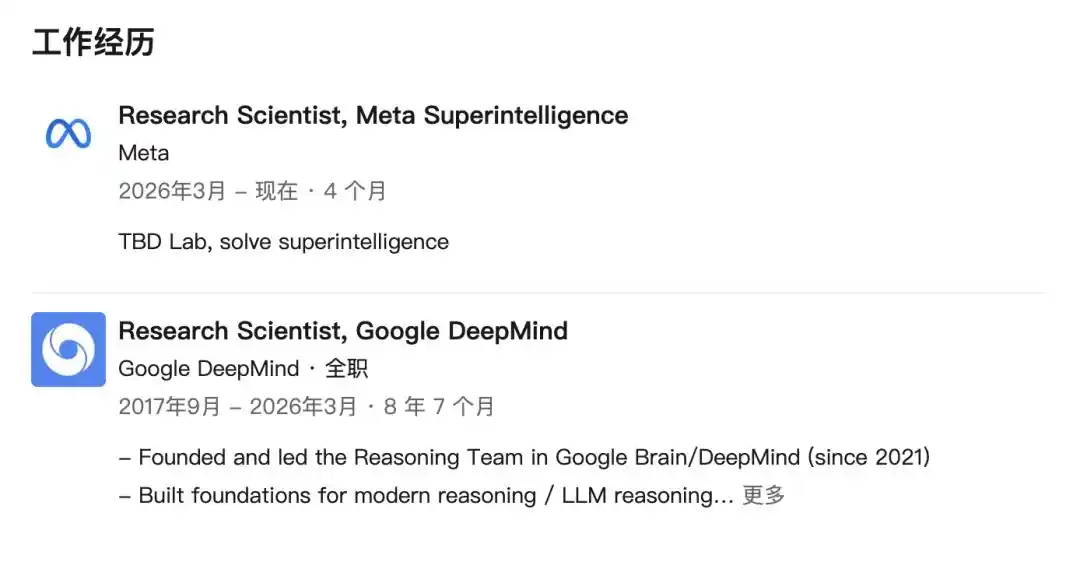
The whole process was extremely low-key. No lengthy farewell letter, no high-profile announcement from Meta. If not for the quietly updated position information on LinkedIn, the outside world might not have even known this top talent had changed masters.
The truth is, Denny Zhou had already been working quietly at Meta for four months before the news of Noam Shazeer moving to OpenAI and Nobel laureate John Jumper defecting to Anthropic rocked the tech world.
The talent earthquake at Google may have erupted much earlier and been hidden much deeper than what we've seen trending.
And now, The Information, in its latest report, has finally lifted the veil on the brutal reality behind this series of personnel changes—
The newly formed Google Coding Strike Team is frantically seizing internal priority.
Who is Denny Zhou?
Denny Zhou, the Reasoning #1 at Google.
In a way, this "Reasoning #1" was someone Fei-Fei Li helped Google recruit.
Denny Zhou was originally at Microsoft, having worked there for nearly 11 years.
Later, attracted by the Google AI China Center initiative, he moved from Microsoft to Google.
And this initiative was spearheaded by Professor Fei-Fei Li.

Little did anyone expect he would stay for over eight years.
Joining Google Brain in 2017, he single-handedly created the Reasoning team, which later merged into the Gemini team under Google DeepMind.
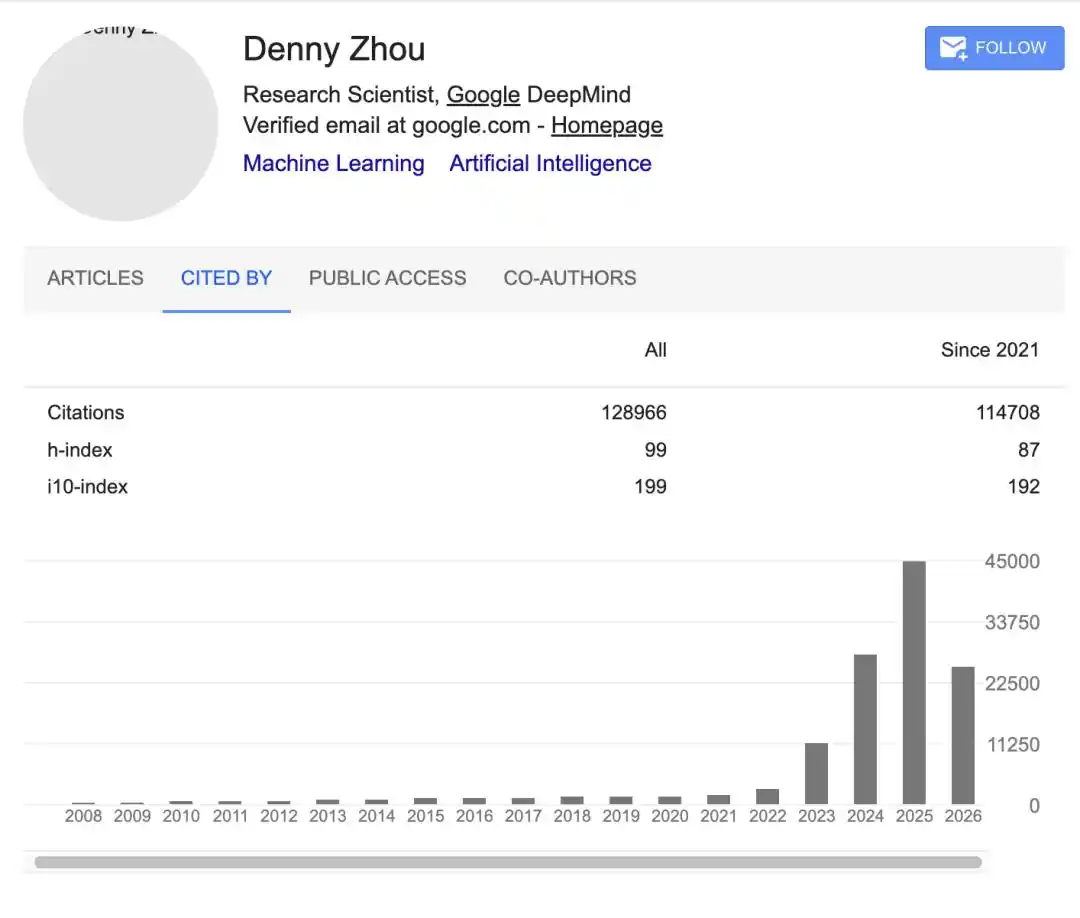
Over eight years, Denny Zhou made significant contributions to foundational LLM work such as CoT, Self-Consistency, Least-to-Most Prompting, accumulating over 128,000 citations on Google Scholar.
At the 2022 Google I/O, Sundar Pichai personally took the stage to explain the progress in reasoning research, which was the work of Denny Zhou's team behind the scenes.
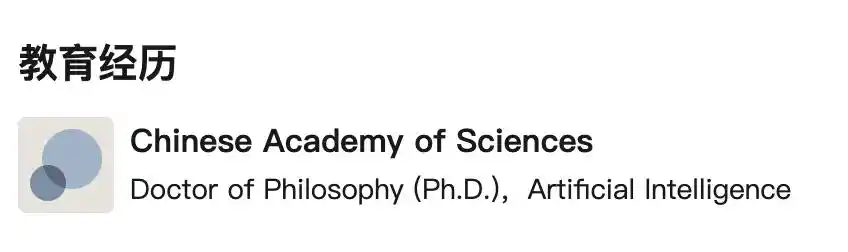
With a Ph.D. in AI from the Chinese Academy of Sciences, he is a rare all-rounder in both academia and industry.
Now, this person has gone to Meta.
Meta's Sweet Victory
Meanwhile, Meta has recently gobbled up another heavyweight piece.
UC Berkeley professor Dawn Song officially joined as Vice President of AI Research at Meta MSL.
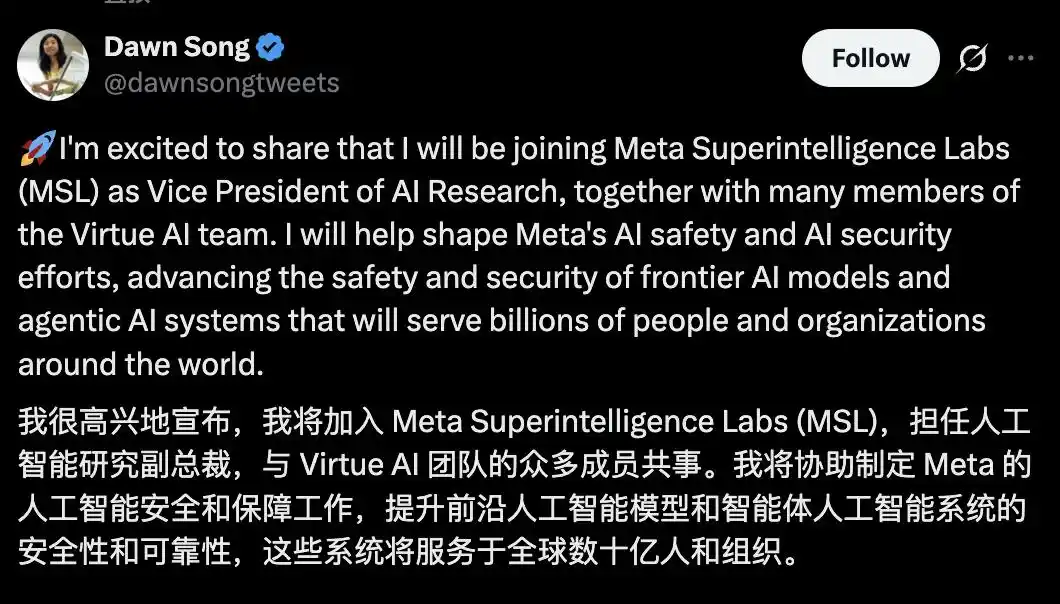
Dawn Song, nicknamed the "Security Godmother."
One of the most cited scholars in the field of computer security, with about 169,000+ citations on Google Scholar. She made foundational contributions early on in areas like program analysis, binary security, encrypted search, before fully pivoting to AI safety and trustworthy AI.
Undergraduate from Tsinghua University, Master's from CMU, Ph.D. from UC Berkeley... and has been a professor at Berkeley for 19 years.
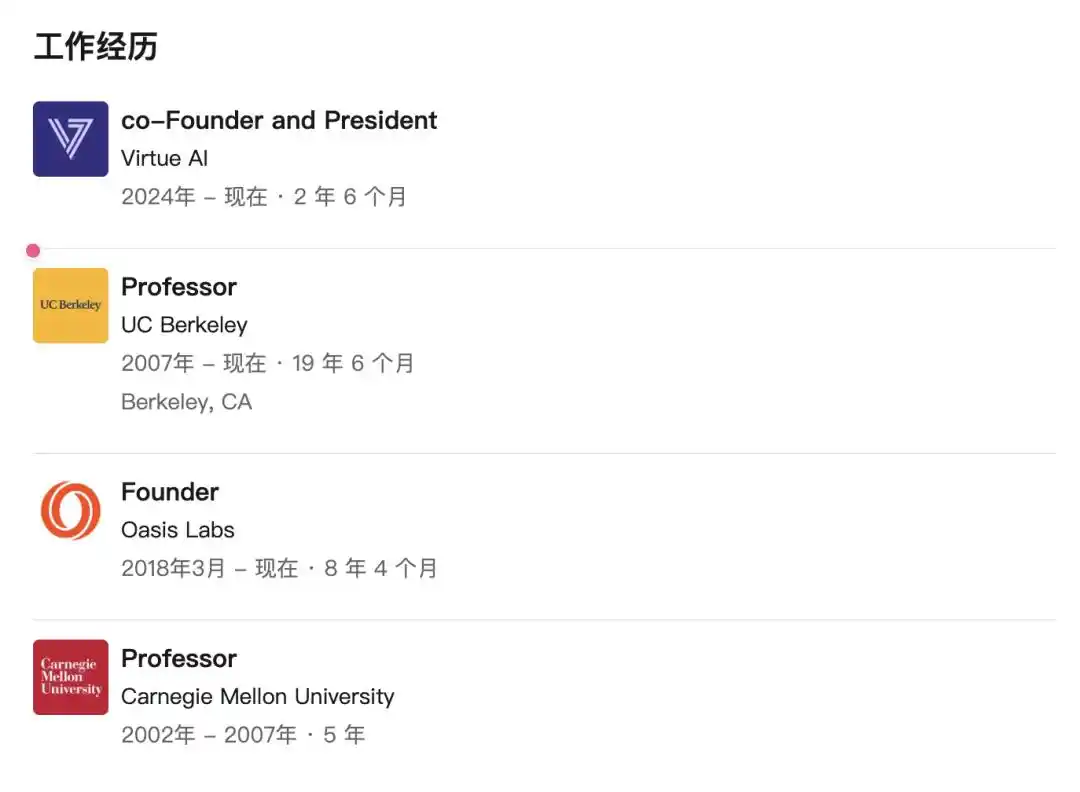
In 2024, she founded Virtue AI, building enterprise-grade AI security infrastructure—having established cooperative relationships with multiple cutting-edge AI labs.
Now, the entire team has joined Meta, including Dawn Song and the other two co-founders.
It must be said, Meta's harvesting efficiency has been quite high lately. It seems playing the "research card" is still more attractive to talent.
Google, What Is Going On??
While OpenAI, Anthropic, and even the internet-era peer Meta are welcoming new arrivals—
Google is continuously bleeding talent.
On June 18th, Noam Shazeer announced joining OpenAI.
This name needs no introduction. One of the core authors of the 2017 paper "Attention Is All You Need" that ignited the entire AI era. He left Google in 2021 to found Character.AI. In 2024, Google bought him and his company back for $2.7 billion to have him co-lead Gemini.
Yet, in less than two years, he has returned to OpenAI.
A $2.7 billion acquisition, not even retained for two years.
On June 19th, John Jumper announced his move to Anthropic.
DeepMind Vice President, a core general promoted by Hassabis himself—just six months after his Ph.D., he was entrusted with leading the AlphaFold team.
In 2024, he and Hassabis jointly won the Nobel Prize in Chemistry for AlphaFold's groundbreaking work in protein structure prediction.
But now, the Nobel laureate has chosen a competitor.
After two heavy blows, Google continues to bleed.
On June 24th, two new names appeared on Google's talent "bounty board": Jonas Adler and Alexander Pritzel.

Both are core contributors to Gemini. Adler leads Google's AI programming direction, Pritzel works on pre-training. Both participated in AlphaFold research and were colleagues of John Jumper.
Their destination is also Anthropic.
Google, What Exactly Is Going On??
One theory is that A and OpenAI are simply too "attractive" financially, both preparing for IPOs.
For a top researcher, a pre-IPO equity package might be more attractive than any compensation package Google offers.
However, money is ultimately just a pull factor.
What about the push factor?
The latest clue is: Google is going all out to "arm" its AI Coding Strike Team.
This strike team was formed only about two months ago. The team is quite heavyweight, including not only DeepMind CTO Koray Kavukcuoglu, but even founder Sergey Brin has personally gotten involved.
Brin wrote very urgently in an internal memo:
To win the final sprint, we must urgently close the gap in Agents and make Gemini the main force in Coding.
Now, Brin's anxiety has been met with a response—the permissions of Google's Coding Strike Team have undergone a major upgrade.
According to The Information's report, Midtraining has been brought into the research scope of this strike team, not just focusing on engineering optimizations at the Agent level.
What does that mean?
In other words, Google is now prioritizing "Coding" as its top metric to reshape how Gemini is trained.
And this direction undoubtedly diverges significantly from the World Model AGI path originally envisioned by Hassabis and many DeepMind researchers.
From two individuals close to DeepMind, Qbit has learned that internal conflicts did indeed arise:
1. Progress on the World Model isn't going smoothly, and they might temporarily decide not to pursue it.
2. Gemini has a lot of work to do, technical leadership needs focus, and the team needs adjustments.
Combining this with various public clues, the truth might be becoming clearer.
Anthropic has turned things around with its programming focus, OpenAI later reaped similar benefits... the commercial value of the Coding route has been repeatedly validated.
In contrast, the World Model in DeepMind's narrative shows delayed commercial returns, and the progress of the technology itself has hit bottlenecks.
Where these two lines meet, the decision becomes simple—
Coding is king, adjust compute allocation, prioritize meeting all the needs of the Strike Team.
And this precisely echoes the reason for departure recently revealed by Transformer author Noam Shazeer:
My compute allocation was given to another team.
Hmm, this storyline... where have we seen it before??
Reference links:
[1]https://www.axios.com/2026/06/25/meta-hires-virtue-ai-founders-security
[2]https://www.theinformation.com/articles/google-revamps-new-ai-coding-strike-team-amid-struggle-catch-anthropic?rc=ji9vez
[3]https://dawnsong.io/
This article is from the WeChat public account "QbitAI", author: Jay