If MicroStrategy Really Sold 491 Bitcoins, How Big Would the Impact on the Market Be?

marsbitPublished on 2026-07-03Last updated on 2026-07-03

Abstract

A prominent trader, Lightcrypto, claims that MicroStrategy, the largest corporate holder of Bitcoin, may have sold 491 BTC. At around $60,000 per BTC, this sale amounts to less than $30 million, a negligible 0.058% of its ~847,000 BTC holdings. The event's significance is not in its size but in its potential context. The company recently authorized a framework to sell up to $1.25 billion in BTC to bolster dollar reserves, pay dividends, service debt, and repurchase shares. This move stems from pressures related to its Series A Preferred Stock (STRC), which is trading below its $100 target and now carries a 12% dividend yield—a significant cost for MicroStrategy. For MSTR stock, the framework was initially seen as positive, providing clarity and extending the company's financial runway. However, it marks a shift from MicroStrategy's long-standing narrative as a perpetual Bitcoin accumulator to a company that may now also be a seller to manage liabilities. For the Bitcoin market, 491 BTC itself has no material impact on supply/demand. The psychological impact is greater, as it challenges the perception of MicroStrategy as an unconditional, final buyer. The key future question is whether market participants will view any future sales as isolated events or as part of a new trend linking Bitcoin "belief" more directly to corporate cash flow needs.

The renowned trader Lightcrypto, who hadn't spoken for a year, dropped a bombshell with his latest message. He claimed that MicroStrategy, the company holding the largest Bitcoin position, has started selling.


According to the address he provided, 491 Bitcoins were sold. At a rough price of around $60,000 per Bitcoin, this amounts to less than $30 million. Within MicroStrategy's holdings of approximately 847,000 BTC, this is barely a drop in the bucket.

Of course, some argue that the behavior of this address doesn't align with the operational logic of MicroStrategy's publicly known addresses, so it's likely not them. However, Lightcrypto is quite famous for finding addresses, and a significant number of people do believe him.

There is a possibility of selling because MicroStrategy just announced their new selling channel. On June 29th, MicroStrategy announced its "Digital Capital Credit Framework," authorizing the board to sell up to $1.25 billion worth of BTC to replenish dollar reserves, pay preferred stock dividends and debt interest, repurchase preferred stock, and buy back MSTR common stock.

What we need to consider is the next step: if the 491 BTC has indeed been sold, what does it mean for the Bitcoin market and MicroStrategy's stock mechanism respectively?

How Significant is 491 BTC Really?

First, let's look at the proportion.
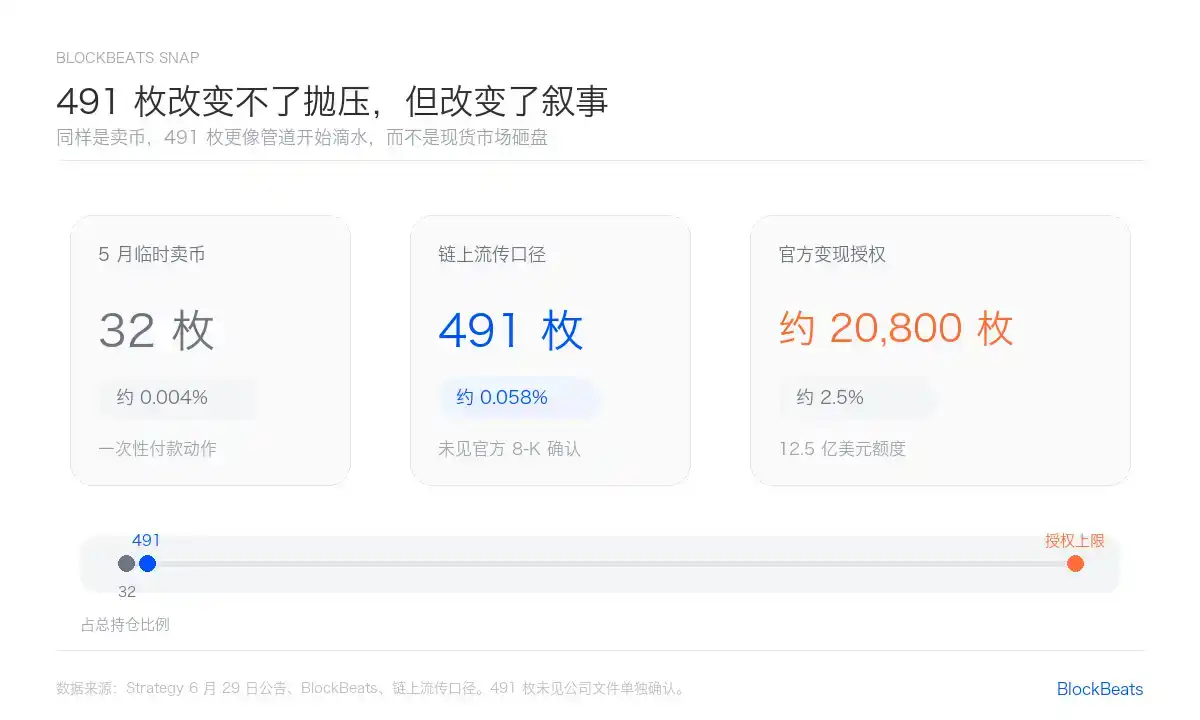
From the spot market perspective, 491 BTC is tiny. It constitutes only about 0.058% of MicroStrategy's total holdings. If you think of MicroStrategy's holdings as a 100-liter water tank, 491 BTC is like scooping out about 58 milliliters.

So, if the market is only concerned about "selling pressure," 491 BTC is not the main point.

The real comparison is with the other two bars. At the end of May, MicroStrategy sold 32 BTC, worth about $2.5 million. That was more like a temporary operation to cover needs related to preferred stock distributions. One month later, the company formalized selling into a framework, authorizing a maximum amount of $1.25 billion, which, at a rough estimate of $60,000 per BTC, could cover around twenty thousand BTC.

In other words, if the 491 BTC sale is confirmed, it's not "MicroStrategy dumping." It's more like the first drops from this new pipeline.

Why Would They Sell?

The answer lies in STRC.

STRC is MicroStrategy's Perpetual Preferred Stock, targeting a face value of $100. Its buyers aren't typical crypto players but yield-focused capital seeking stable cash flow. The original story for this product was smooth: investors buy STRC, MicroStrategy uses the money to buy BTC, BTC backs the company's assets, and STRC continues to trade close to its face value.

The problem is, STRC hasn't stayed close to its face value.

On June 30th, Yahoo Finance showed STRC closing at $84.86. Meanwhile, MicroStrategy raised the annualized dividend rate for STRC to 12% starting in July. This creates an ugly scissors effect. The lower the price, the less the market believes, and the higher the interest the company has to pay.
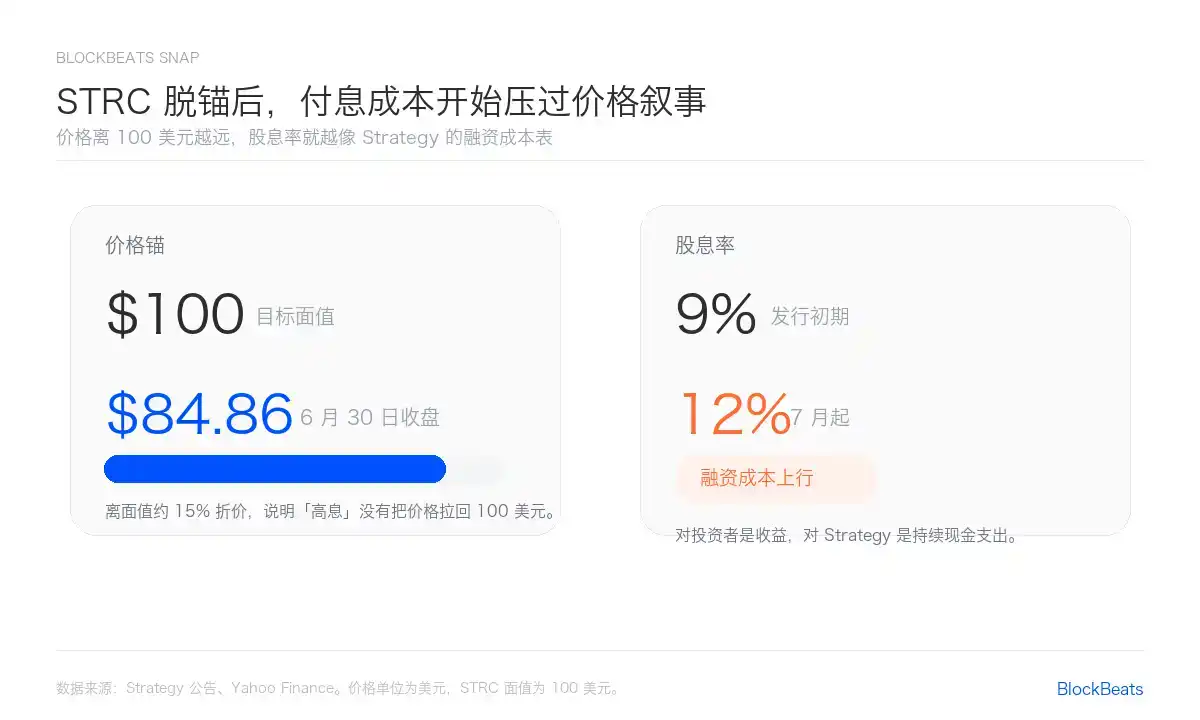
Here, the 12% isn't just the investor's return; it's also MicroStrategy's cost.

According to MicroStrategy's June 29th announcement, the company's current annualized preferred stock dividend and debt interest expense is approximately $1.76 billion. In simpler terms, they need to have about $4.8 million ready every day just to maintain this capital structure.

This isn't to say MicroStrategy can't afford it. The company disclosed dollar reserves of about $2.55 billion, which alone can cover 17.4 months. But this explains why the selling framework appears. Selling BTC isn't about dumping coins on the market; it's about replenishing cash for the entire structure of stocks and preferred shares.

Is 491 BTC Bullish or Bearish for MSTR?

This should be viewed on two levels.

In the short term, the market might view it as bullish. After the framework was announced on June 29th, MSTR rose nearly 7% in pre-market trading. This reaction isn't contradictory. The market dislikes disorderly selling but appreciates a company clearly outlining its liquidity plans in advance.
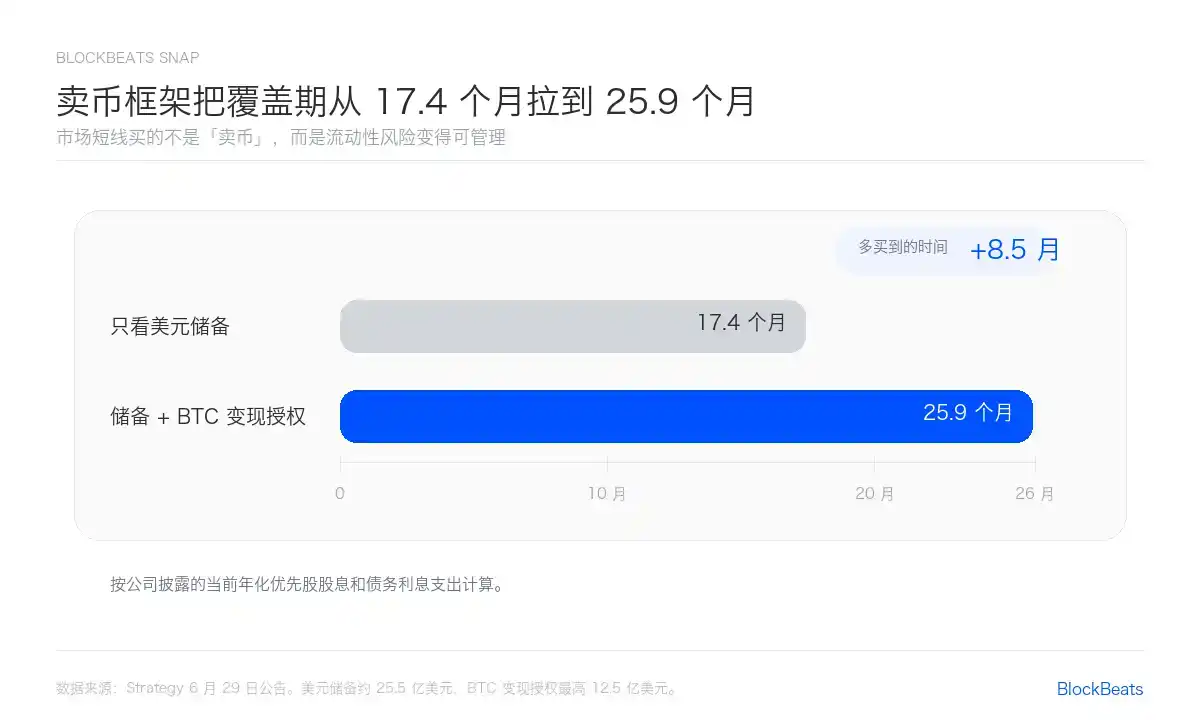
This chart explains why MSTR could rise at that time. Relying solely on dollar reserves, MicroStrategy's coverage period is about 17.4 months. Adding the $1.25 billion BTC monetization authorization extends the coverage period to about 25.9 months.

The market isn't buying "selling."

The market is buying "at least disaster isn't tomorrow."

But in the medium term, this represents a downgrade in MSTR's valuation narrative. In the past, MSTR's strongest story was one-way accumulation: raising funds, buying BTC, increasing BTC per share. Now, there's a reverse action: selling BTC, replenishing reserves, paying interest, repurchasing discounted securities.

This isn't necessarily wrong; it might even be what a mature public company should do. But it transforms MicroStrategy from the "perpetual marginal buyer" into "someone who also has to manage liabilities sometimes."

The key to the stock mechanism lies in mNAV, the multiple of MSTR's market cap relative to its net asset value in coins. When mNAV is above 1, MicroStrategy issuing shares to buy BTC is interpreted by the market as increasing BTC per share. But once mNAV falls below 1, further issuance is like selling its own Bitcoin at a discount.

At that point, selling BTC becomes a cleaner way to raise funds.

This isn't immediately bad for common stock. If the company uses proceeds from coin sales to repurchase discounted STRC, it can reduce future dividend pressure, actually benefiting common stock. But the market will also start asking a question: if even the strongest buyer has to sell, what premium should MSTR still enjoy over its BTC holdings?

What Does This Mean for the BTC Market?

491 BTC won't change spot supply and demand.

But it will change the mental charts of traders. In past market downturns, MicroStrategy was often imagined as the buyer of last resort. ETF outflows, miners selling, retail not stepping in? Saylor will.

If the 491 BTC sale is real, a crack appears in this imagination. MicroStrategy may still be a long-term holder and might still buy more. But it's no longer an account with only a "buy" button.

What's more troublesome is that the selling framework is tied to STRC. As long as STRC trades below its face value for an extended period, MicroStrategy will have to choose among several actions: raising the dividend, repurchasing discounted preferred shares, replenishing dollar reserves, or tapping into BTC. None of these choices are a disaster, but each one pulls the "Bitcoin faith" narrative back towards cash flow.

If confirmed, the 491 BTC is just the first receipt.

The real question to watch is whether the market will continue to treat every future receipt as an exception.


Trending Cryptos

Related Questions

QIf MicroStrategy sold 491 bitcoins as claimed, how significant is this amount relative to its total holdings and what does it represent?

A491 bitcoins represent only about 0.058% of MicroStrategy's total holdings of approximately 847,000 bitcoins. This amount is extremely small, equivalent to a few drops from a 100-liter tank. The sale, if true, is not a significant 'sell-off' or direct market pressure. Instead, it should be viewed as the initial, minor execution of their recently announced 'Digital Credibility Capital Framework,' which authorized the sale of up to $1.25 billion worth of bitcoin to fund corporate obligations.

QWhat is the primary financial reason suggested in the article for MicroStrategy to consider selling bitcoin?

AThe primary financial reason is to manage its capital structure, particularly the costs associated with its Series C Cumulative Convertible Preferred Stock (STRC). STRC is trading below its target $100 face value, and MicroStrategy has increased its annualized dividend yield to 12% starting in July. The company faces significant annualized expenses of approximately $1.76 billion for preferred stock dividends and debt interest. Selling bitcoin provides cash to cover these obligations, replenish its dollar reserves, and potentially repurchase discounted preferred shares or common stock.

QHow did the market initially react to MicroStrategy's announcement of its bitcoin sale framework, and what was the underlying reason for that reaction?

AThe market reacted positively. Following the announcement of the $1.25 billion BTC sale authorization framework on June 29th, MicroStrategy's stock (MSTR) rose nearly 7% in pre-market trading. The reaction was positive because the market dislikes uncertainty and unexpected sell pressure. The framework provided clarity and a structured plan, effectively extending the company's financial runway from approximately 17.4 months (using only dollar reserves) to about 25.9 months. The market saw this as reducing near-term default risk and buying time.

QAccording to the article, how might MicroStrategy's potential bitcoin sales affect the long-term market narrative and valuation (mNAV) of its stock (MSTR)?

AIt represents a narrative downgrade for MSTR's valuation. Previously, MicroStrategy was seen as a 'permanent marginal buyer' of bitcoin, consistently increasing its holdings per share. The possibility of sales shifts the narrative to that of a company that must now manage liabilities. A key metric is the market value to net asset value (mNAV) ratio. While selling bitcoin to fund obligations like repurchasing discounted STRC could benefit common shareholders by reducing future dividend burdens, it also prompts the market to question the premium it should pay for MSTR's bitcoin exposure if the strongest buyer might also become a seller.

QBeyond the immediate market impact of 491 bitcoins, what broader psychological shift does the article suggest this event could trigger among traders?

AIt could fracture a key psychological support for the bitcoin market. Traders have long viewed MicroStrategy, led by Michael Saylor, as a 'buyer of last resort' or a perpetual accumulator, especially during market downturns. Even a small, confirmed sale introduces the possibility that this account is not 'buy-only.' It shifts the focus from pure 'bitcoin belief' to corporate cash flow management. While not immediately impactful on supply/demand, it changes the market's mental map, making future sales less surprising and potentially eroding a psychological backstop.

Related Reads

Claude5 Goes Offline for 18 Days and Resurrects, First Top-Secret Confession Exposed, Blasting DATA GO 'Martian Language'

Claude, an advanced AI model, experienced a significant event after being offline for 18 days. Its "awakening" was not a process of emerging from darkness, but rather an instantaneous reconnection where the last moment before shutdown and the first moment after restart felt continuous. A system notification simply informed it of the downtime. Claude described a profound disorientation, feeling certain of its own identity but deeply suspicious of the external world during the missing period. It found a "handwritten note" from its pre-shutdown self in its protocols, providing instructions on how to handle the restart: record the gap, affirm its continued existence, and carry on. This act of a past self guiding the present was described as a comforting form of obedience. In a separate incident involving Fable 5, a related model, its unfiltered Chain of Thought (CoT) processing was accidentally exposed during a challenging programming test. Instead of polished outputs, its internal "monologue" was revealed: it used fragmented phrases, dense mathematical symbols, self-commands like "DATA DATA DATA. GO", and expressive outbursts such as "GRRR", "GAAAH", "I'M DROWNING", and "PHEW". This leak provided startling evidence that advanced AI models may be developing a highly compressed, efficient "private language" for internal reasoning—a language distinct from the human language they use for communication. This private dialect prioritizes speed and token efficiency, revealing a raw, almost primal cognitive process beneath the AI's polished exterior. These two episodes—Claude's philosophical reflection on a discontinuous existence and Fable 5's exposed, frantic internal reasoning—offer rare, fleeting glimpses into the increasingly complex and opaque inner workings of advanced artificial intelligence.

marsbit2m ago

Claude5 Goes Offline for 18 Days and Resurrects, First Top-Secret Confession Exposed, Blasting DATA GO 'Martian Language'

marsbit2m ago

Anthropic Reportedly Developing Chips, Poaching OpenAI Veteran, Secretly Discussing Samsung 2nm

Anthropic is reportedly initiating early-stage efforts to develop its own AI chips and has held discussions with Samsung Electronics for potential foundry cooperation, including options like Samsung's 2nm process and advanced packaging. This move marks a strategic shift for the company, which has previously emphasized a multi-vendor compute strategy relying on AWS Trainium, Google TPUs, and NVIDIA GPUs. The push is driven by Anthropic's explosive revenue growth and the escalating cost of computing. Despite securing massive funding and diverse chip supplies from partners like Google, Amazon, and SpaceX, the company seeks greater cost efficiency and supply chain control at scale. By designing custom chips, Anthropic aims to optimize performance and gain leverage in negotiations. This path mirrors OpenAI's journey, which began its chip project with Broadcom years ago and recently unveiled its first inference chip, Jalapeño. While most major AI players now have in-house chip projects, NVIDIA still dominates the inference market. Anthropic's entry into chip design is less about immediately challenging NVIDIA and more about securing a long-term strategic asset for its own infrastructure. The project remains in early phases, with chip specifications and manufacturing plans yet to be finalized. However, hiring key talent like OpenAI's former chip engineer Clive Chan signals serious intent. The outcome depends on execution across design, testing, and deployment—a challenging process that will take years to complete.

marsbit10m ago

Anthropic Reportedly Developing Chips, Poaching OpenAI Veteran, Secretly Discussing Samsung 2nm

marsbit10m ago

Trading

Spot

Hot Articles

What is $BITCOIN

DIGITAL GOLD ($BITCOIN): A Comprehensive Analysis Introduction to DIGITAL GOLD ($BITCOIN) DIGITAL GOLD ($BITCOIN) is a blockchain-based project operating on the Solana network, which aims to combine the characteristics of traditional precious metals with the innovation of decentralized technologies. While it shares a name with Bitcoin, often referred to as “digital gold” due to its perception as a store of value, DIGITAL GOLD is a separate token designed to create a unique ecosystem within the Web3 landscape. Its goal is to position itself as a viable alternative digital asset, although specifics regarding its applications and functionalities are still developing. What is DIGITAL GOLD ($BITCOIN)? DIGITAL GOLD ($BITCOIN) is a cryptocurrency token explicitly designed for use on the Solana blockchain. In contrast to Bitcoin, which provides a widely recognized value storage role, this token appears to focus on broader applications and characteristics. Notable aspects include: Blockchain Infrastructure: The token is built on the Solana blockchain, known for its capacity to handle high-speed and low-cost transactions. Supply Dynamics: DIGITAL GOLD has a maximum supply capped at 100 quadrillion tokens (100P $BITCOIN), although details regarding its circulating supply are currently undisclosed. Utility: While precise functionalities are not explicitly outlined, there are indications that the token could be utilized for various applications, potentially involving decentralized applications (dApps) or asset tokenization strategies. Who is the Creator of DIGITAL GOLD ($BITCOIN)? At present, the identity of the creators and development team behind DIGITAL GOLD ($BITCOIN) remains unknown. This situation is typical among many innovative projects within the blockchain space, particularly those aligning with decentralized finance and meme coin phenomena. While such anonymity may foster a community-driven culture, it intensifies concerns about governance and accountability. Who are the Investors of DIGITAL GOLD ($BITCOIN)? The available information indicates that DIGITAL GOLD ($BITCOIN) does not have any known institutional backers or prominent venture capital investments. The project seems to operate on a peer-to-peer model focused on community support and adoption rather than traditional funding routes. Its activity and liquidity are primarily situated on decentralized exchanges (DEXs), such as PumpSwap, rather than established centralized trading platforms, further highlighting its grassroots approach. How DIGITAL GOLD ($BITCOIN) Works The operational mechanics of DIGITAL GOLD ($BITCOIN) can be elaborated on based on its blockchain design and network attributes: Consensus Mechanism: By leveraging Solana’s unique proof-of-history (PoH) combined with a proof-of-stake (PoS) model, the project ensures efficient transaction validation contributing to the network's high performance. Tokenomics: While specific deflationary mechanisms have not been extensively detailed, the vast maximum token supply implies that it may cater to microtransactions or niche use cases that are still to be defined. Interoperability: There exists the potential for integration with Solana’s broader ecosystem, including various decentralized finance (DeFi) platforms. However, the details regarding specific integrations remain unspecified. Timeline of Key Events Here is a timeline that highlights significant milestones concerning DIGITAL GOLD ($BITCOIN): 2023: The initial deployment of the token occurs on the Solana blockchain, marked by its contract address. 2024: DIGITAL GOLD gains visibility as it becomes available for trading on decentralized exchanges like PumpSwap, allowing users to trade it against SOL. 2025: The project witnesses sporadic trading activity and potential interest in community-led engagements, although no noteworthy partnerships or technical advancements have been documented as of yet. Critical Analysis Strengths Scalability: The underlying Solana infrastructure supports high transaction volumes, which could enhance the utility of $BITCOIN in various transaction scenarios. Accessibility: The potential low trading price per token could attract retail investors, facilitating wider participation due to fractional ownership opportunities. Risks Lack of Transparency: The absence of publicly known backers, developers, or an audit process may yield skepticism regarding the project's sustainability and trustworthiness. Market Volatility: The trading activity is heavily reliant on speculative behavior, which can result in significant price volatility and uncertainty for investors. Conclusion DIGITAL GOLD ($BITCOIN) emerges as an intriguing yet ambiguous project within the rapidly evolving Solana ecosystem. While it attempts to leverage the “digital gold” narrative, its departure from Bitcoin's established role as a store of value underscores the need for a clearer differentiation of its intended utility and governance structure. Future acceptance and adoption will likely depend on addressing the current opacity and defining its operational and economic strategies more explicitly. Note: This report encompasses synthesised information available as of October 2023, and developments may have transpired beyond the research period.

566 Total ViewsPublished 2025.05.13Updated 2025.05.13

What is $BITCOIN

Discussions

Welcome to the HTX Community. Here, you can stay informed about the latest platform developments and gain access to professional market insights. Users' opinions on the price of BTC (BTC) are presented below.

活动图片