The Biggest Dark Horse in AI Payments Might Be Coinbase Giving Agents a Wallet

marsbitPublished on 2026-08-23Last updated on 2026-08-23

Abstract

In the AI payments race, while most focus on traditional giants like Visa or AI platforms like OpenAI, Coinbase has quietly emerged as a key player. Data from 2026 shows over 90% of on-chain Agent transactions occur on Coinbase's Base network, with 99% settled in USDC and over 97% using the x402 protocol. Coinbase's pivotal move was launching "Agentic Wallets" in February 2026—a dedicated wallet infrastructure giving AI Agents their own financial identity. Unlike Visa or Stripe, which connect Agents to existing payment rails, Coinbase provides Agents with autonomous wallets to hold assets (like stablecoins), initiate transfers, and execute transactions under predefined rules. This solves core issues for machine-to-machine payments: high credit card fees for micropayments, the need for constant human authorization, and unclear transaction attribution. Coinbase's strength lies in its closed-loop ecosystem: the Base blockchain (low-cost, high-throughput), the x402 payment protocol, Agentic Wallets, and native assets like USDC. This integrated stack, built through years of infrastructure investment, positioned Coinbase to capture early Agent payment demand as the AI economy surged. The key insight is that AI payment adoption may depend less on whose standard wins and more on whose usable infrastructure is ready first. While debates over protocols and payment rails continue, real Agent transactions are already flowing—primarily through Coinbase's ecosystem. It may not be the ul...

Author: Tech Bureau

In the AI payments race, most are watching traditional payment giants like Visa, Mastercard, and Stripe, or AI platforms like OpenAI and Google.

But some data is noteworthy. According to Coinbase's disclosures in their 2026 quarterly earnings calls, over 90% of on-chain Agent transactions occur on the Base chain, 99% of Agent commercial transactions are settled in USDC, and over 97% of on-chain Agent transactions use the x402 protocol. Base chain's stablecoin transaction volume accounts for 62% of the entire industry's stablecoin transaction volume.
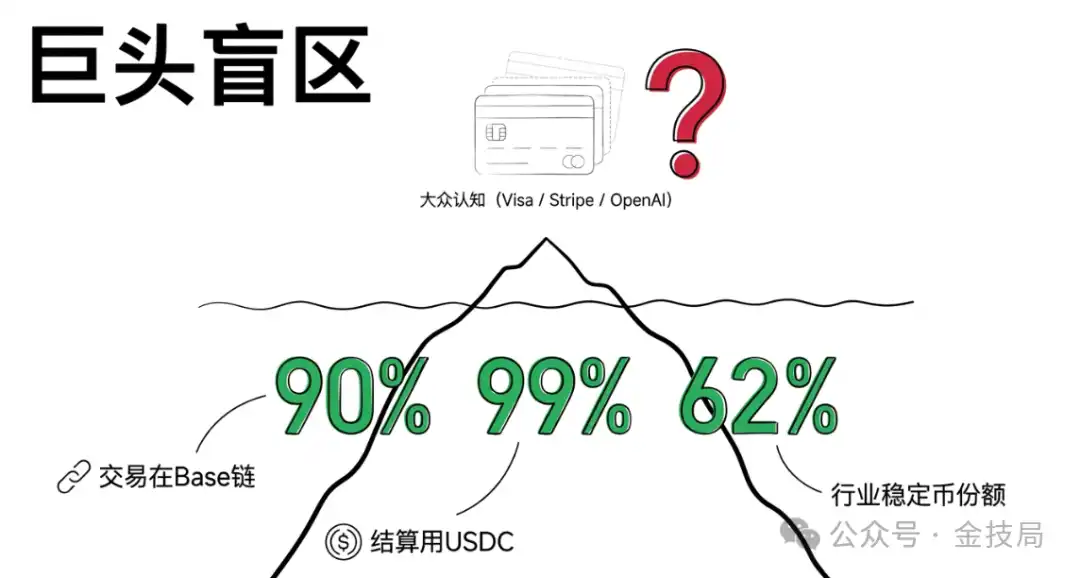
In other words, while everyone debates which track—card payments or stablecoins—will win and which protocol will become the standard, a crypto exchange has quietly become the largest operator of Agent payments.

This position belongs not to Visa, Mastercard, or Stripe, but to Coinbase.

What Coinbase Is Building Isn't a Payment Protocol, It's "Giving Agents a Wallet"

On February 11, 2026, Coinbase launched Agentic Wallets through its developer platform, a suite of wallet infrastructure specifically designed for AI Agents.

Before this, Agent payment infrastructure consisted of either APIs for developers or payment gateways for users. The Agent itself didn't have "its own account." To spend money, it either used a human's account to pay on its behalf or indirectly operated through a platform's interface.

What Agentic Wallets does is enable the Agent itself to become an entity capable of holding assets. An Agent can have its own wallet address, autonomously holding funds, initiating transfers, executing transactions, and generating revenue, all within pre-set permissions and risk controls. It no longer requires a human account as an intermediary layer.

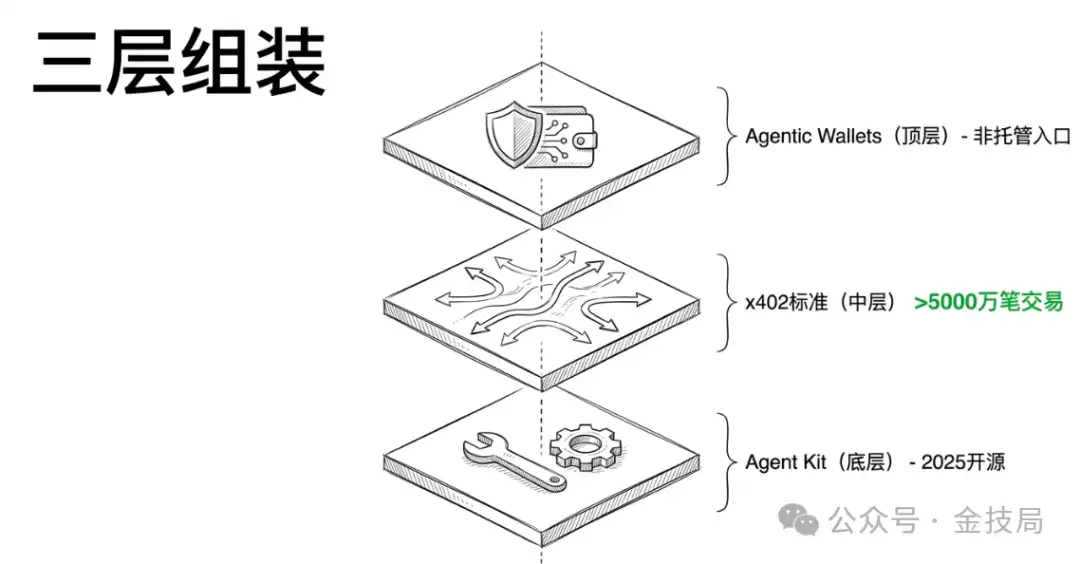
This infrastructure is assembled from several components. The foundation is the Agent Kit, an open-source toolkit launched by Coinbase in 2025 that lets developers integrate wallet functionality into any Agent system. The middle layer is the x402 protocol, the machine-to-machine payment standard activating the HTTP 402 status code, which has processed over 50 million transactions. The top layer consists of non-custodial wallets and security suites, deeply integrated with the Coinbase Developer Platform.

These three components together form a complete "Agent financial account."

This positioning is fundamentally different from what Visa and Stripe are doing. Visa is working to let Agents connect to the existing card payment network, and Stripe is enabling Agents to connect to the existing merchant payment system. Coinbase is giving Agents a brand new, independent financial identity of their own.

Why Does an Agent Need "Its Own Wallet" Instead of Using a Human's Card?

This question is worth exploring. When an Agent buys something for a human, why can't it just use a human's credit card? Why does it need its own wallet?

The answer relates to a fundamental characteristic of Agent payments: many transactions between Agents are micro, high-frequency, and automated machine-to-machine payment flows.

For example, one Agent calling another Agent's API might pay one-thousandth of a cent for a data query. If this payment were made using a human credit card, there are several problems. First, transaction fees: card payment fees are a fixed percentage plus a minimum amount; the fee for a one-thousandth of a cent payment would be orders of magnitude higher than the principal. Second, authorization: a human credit card requires cardholder confirmation for every payment; an Agent cannot ask a human for approval for every micro-payment. Third, attribution: a human's credit card is tied to a human identity; for a payment between Agents, it's difficult to clearly trace whether responsibility lies with which Agent, platform, or person.

Giving an Agent its own wallet alleviates these three problems. The funds in the wallet are stablecoins, with extremely low transfer costs. Spending permissions are controlled by code-level policies, eliminating the need for manual authorization per transaction. The wallet's address is an independent on-chain identity, providing clear attribution and traceability for transactions.

This is why Coinbase's data shows the result "99% of Agent commercial transactions settled in USDC." It's not that USDC is better than credit cards, but rather that stablecoins combined with on-chain wallets are inherently more suitable for Agent-to-Agent payment scenarios based on their technical characteristics.

Coinbase's Complete Closed Loop: Wallet, Chain, and Protocol All Under Its Control

Coinbase's strategy in Agent payments is more comprehensive than it appears on the surface.

It has Base, a self-operated Layer 2 network. It has Agentic Wallets, a suite of wallet infrastructure for Agents. It has x402, a machine-to-machine payment protocol. It also has native wrapped assets like cbBTC and cbETH.

Wallet, chain, protocol, assets—all four components are within Coinbase's own ecosystem. This means an Agent can complete the entire process from holding funds, initiating payments, to finalizing settlements without leaving Coinbase's system.
This closed loop gives Coinbase a unique position in AI payments. Visa has a payment network but no Agent wallets. Stripe has a merchant system but no blockchain layer. Circle has stablecoins but no network layer. Coinbase is one of the few companies that hold multiple components of Agent payments in their own hands.

The risks and advantages of this strategy are clear. The advantage is a seamless, closed-loop experience without cross-system friction. The risk is that if any single component fails, the entire system is affected. Coinbase's net loss of $359 million in the second quarter of 2026 reminds us that the cost of this strategy is not low.

How Did This Dark Horse Position Form?

Coinbase becoming the largest operator of Agent payments has an element of "serendipity" to it.

Coinbase initially built the Base chain not for Agent payments, but to expand its on-chain ecosystem. The x402 protocol was initially proposed as a native Internet machine payment standard, not specifically for Agents. Agentic Wallets wasn't launched until February 2026.

But when the Agent economy began its explosive growth, Coinbase found itself already positioned in multiple key areas. Base happened to be one of the chains with the lowest transaction costs, making it highly suitable for Agents' high-frequency, micro-payment transactions. x402 happened to be the standard suited for machine-to-machine payments. Agentic Wallets happened to fill the gap for Agents needing their own financial identity.

Behind these "coincidences" lies Coinbase's sustained investment in on-chain infrastructure over the past few years. It didn't react hastily when the Agent payments boom began; rather, it started laying the groundwork for wallets, chains, and protocols before the Agent economy even took shape.
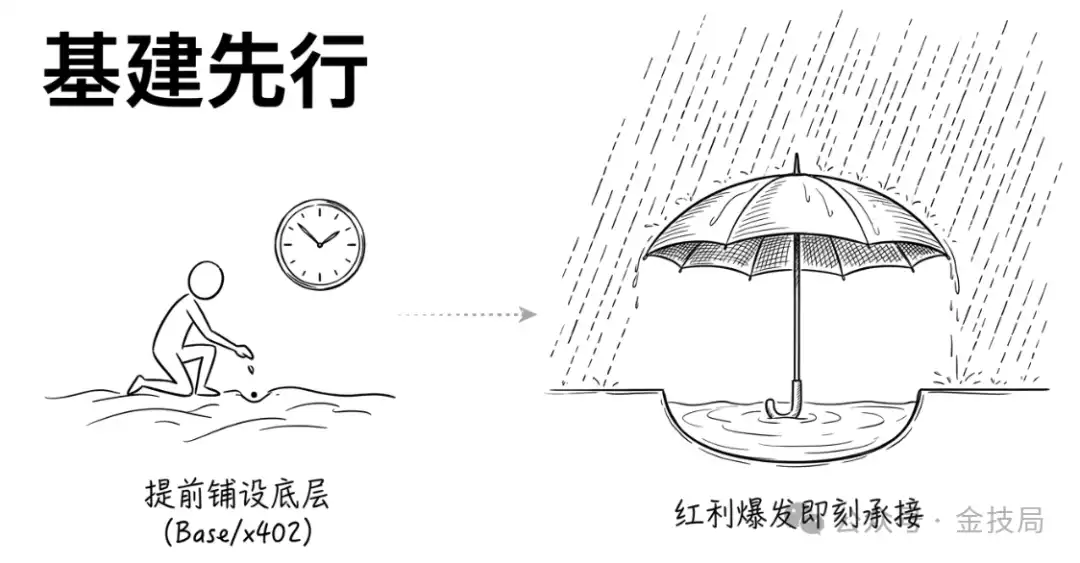
This observation offers a general lesson for understanding the AI payments race. When new infrastructure demands emerge, the true beneficiary isn't necessarily the fastest reactor, but the one with the deepest foundational accumulation.

A Final Word

The current narrative in the AI payments race mainly revolves around three things: whose protocol will become the standard, which payment track will prevail, and how card payments and stablecoins will merge.

Coinbase's data offers a different perspective. While the debates over protocols and tracks continue, actual Agent payments are already quietly happening, and they are running on Coinbase's chain.

This phenomenon suggests that the adoption of AI payments may not depend entirely on "whose standard is more reasonable," but on "whose infrastructure is already ready." Protocols can gradually become standardized, but Agent transaction demands won't wait for standards to be finalized. Whoever can provide usable infrastructure when the demand arises will capture the first wave of benefits.

This is the wave Coinbase has captured. It may not be the ultimate winner in AI payments, but for now, it is the one running ahead.

Related Questions

QAccording to the article, who is positioned as the biggest player in AI Agent payments, and what is their key product?

AAccording to the article, Coinbase is positioned as the biggest player in AI Agent payments. Their key product enabling this is 'Agentic Wallets', a wallet infrastructure specifically designed for AI Agents, giving them their own financial identity.

QWhy does the article argue that AI Agents need their own wallets instead of using human credit cards?

AThe article argues that AI Agent transactions are often micro-value, high-frequency, and automated machine-to-machine payments. Human credit cards are unsuitable due to high transaction fees (prohibitive for micropayments), the need for constant human authorization for each payment, and unclear accountability, as a card is tied to a human identity, not the specific Agent. An Agent's own wallet with stablecoins solves these issues with low costs, code-managed permissions, and clear on-chain identity.

QWhat key components form Coinbase's 'complete closed-loop' in AI Agent payments?

ACoinbase's complete closed-loop consists of four key components: 1) The Base Layer 2 network, 2) The Agentic Wallets infrastructure, 3) The x402 protocol for machine-to-machine payments, and 4) Native assets like USDC, cbBTC, and cbETH. This allows the entire process of an Agent holding funds, initiating payment, and settling to occur within Coinbase's ecosystem.

QWhat data does the article cite to demonstrate Coinbase's dominance in Agent payments?

AThe article cites data from Coinbase's 2026 quarterly calls: over 90% of on-chain Agent transactions occur on Base, 99% of Agent commercial transactions are settled in USDC, over 97% of on-chain Agent transactions use the x402 protocol, and Base accounts for 62% of the entire industry's stablecoin transaction volume.

QWhat is the main takeaway the article offers about the AI payments landscape based on Coinbase's story?

AThe main takeaway is that the success in AI payments may not depend solely on which technical standard is more rational, but on which company's underlying infrastructure is already in place and ready to use when the demand arises. Coinbase benefited from having built key components (wallet, chain, protocol) before the Agent economy boomed, allowing it to capture the first wave of demand.

Related Reads

Breaking News: DeepSeek Announces All-Day Off-Peak Pricing on Weekends, Making Weekend Work More Cost-Effective?

DeepSeek has announced a significant change to its API pricing model, effective August 23. The new policy removes peak/off-peak distinctions on weekends (Saturdays and Sundays), charging the lower off-peak rate for the entire two-day period. This adjustment has sparked mixed reactions within the developer and professional communities. For developers and businesses heavily reliant on DeepSeek's V4-Flash and V4-Pro APIs, this is welcome news. It allows them to schedule bulk processing tasks on weekends without the higher peak-hour costs, potentially halving their API bills for such workloads. Some users have celebrated the move for making weekend work more cost-effective. However, the announcement has also raised concerns among employees. There is apprehension that companies, particularly in cost-sensitive sectors like AI-powered short drama production, might reorganize work schedules to align with these new cost incentives. Instances are already emerging where teams schedule high-token tasks during cheaper nighttime hours or adjust staff shifts. This has led to worries about a potential shift towards weekend workdays and weekday time-off, prioritizing cost savings over traditional work-life balance. Debate has ensued regarding the practicality of such schedule changes, with questions about increased communication overhead and overall efficiency. Speculation about DeepSeek's motives for the change includes theories that peak pricing correlates with internal model training schedules, though others counter that training is largely automated. The new pricing structure is now in effect, prompting users to reconsider their task scheduling strategies.

marsbit46m ago

Breaking News: DeepSeek Announces All-Day Off-Peak Pricing on Weekends, Making Weekend Work More Cost-Effective?

marsbit46m ago

Just Now, The World's First Human vs. Robot Tennis Match Begins, Robot's Desperate Save Leaves Zheng Jie Astonished

Just now, the world's first human vs. robot tennis match began, featuring stunning robotic saves that left tennis star Zheng Jie in awe. This historic event, part of the second World Humanoid Robot Games and broadcast live globally by China Media Group, marked a pivotal moment in Chinese technological innovation and embodied artificial intelligence. The match featured both mixed human-robot doubles and a groundbreaking singles match between Zheng Jie and the "Galaxy Xingzai" humanoid robot developed by Galaxy General. The robot demonstrated impressive skills including serving, forehands, backhands, and strategic court movement, with serves exceeding 100 km/h. It exhibited remarkable adaptability, recovering from a fall to continue play and handling slices and spins. The doubles match highlighted its ability to coordinate dynamically with a human partner. The event's significance extends far beyond a novelty match. Tennis represents an ultimate pressure test for embodied AI, demanding real-time integration of perception, decision-making, full-body motion control, and live博弈 within fractions of a second—a stark contrast to the discrete, contemplative environment of board games like Go mastered by AlphaGo. It directly confronts Moravec's paradox, showcasing AI's move from digital cognition to physical execution. This capability is powered by Galaxy General's proprietary "Galaxy Star Brain" (AstraBrain) model. Its key innovation is a unified architecture that integrates high-level task understanding/tactical decision-making ("brain") and dynamic whole-body motion control ("cerebellum") into a single model, eliminating latency and information loss between separate modules. The model was trained using a two-step process via the "Galaxy Star Workshop" platform. First, it learned foundational movement priors from "imperfect" human motion data (both amateur and professional). Second, it underwent massive-scale evolution in a virtual tennis simulator where multiple AI agents played millions of games against each other. Through this adversarial training, skills like极限救球and recovery from falls emerged autonomously without explicit programming, before being transferred to the physical robot. This "AstraTennis" moment symbolizes a major leap: a decade after AlphaGo conquered the digital world, embodied AI from China has now demonstrated it can operate under the extreme, unpredictable physical pressures of real-world competition.

marsbit46m ago

Just Now, The World's First Human vs. Robot Tennis Match Begins, Robot's Desperate Save Leaves Zheng Jie Astonished

marsbit46m ago

Dialogue with Bitwise CIO: Bitcoin May Be Near Bottom, Who Will Drive the Next Rally?

In a recent podcast, Bitwise CIO Matt Hougan analyzed Bitcoin's current market cycle, suggesting it is near a bottom characterized by low volatility and investor indifference. He believes the next major price surge will be driven primarily by wealth management platforms, financial advisors, and family offices, who control trillions in assets and are now gaining access to Bitcoin ETFs. Hougan views Bitcoin as a long-dated, out-of-the-money call option on it becoming a global reserve asset. Its value increases with global monetary system volatility, making it a natural hedge against currency disorder. He outlined Bitcoin's adoption path: first as a global digital store of value (competing with gold), and potentially later as a check against fiat currency abuse by sovereign states. Addressing the muted price action despite institutional ETF inflows, Hougan explained that significant selling by long-term retail holders has offset buying pressure. However, he is optimistic as data shows retail selling has subsided, which, combined with continued institutional inflows, could propel prices higher. Hougan downplayed the future impact of Federal Reserve interest rates and MicroStrategy's actions on Bitcoin's price, arguing they are becoming less relevant. Instead, he pointed to runaway U.S. fiscal deficits and debt as the core long-term drivers. Finally, he discussed the transformative potential of asset tokenization, predicting all traditional assets will eventually trade 24/7 on blockchains. This will merge traditional and crypto markets, increasing efficiency but also introducing crypto-like features such as overnight volatility and easier access to leverage into traditional finance.

marsbit2h ago

Dialogue with Bitwise CIO: Bitcoin May Be Near Bottom, Who Will Drive the Next Rally?

marsbit2h ago

Dalio Warns of U.S. Bond Supply-Demand Imbalance: Gold and Bitcoin Could Become Hedge Assets in Debt Crisis

Ray Dalio warns of an unsustainable imbalance in US Treasury supply and demand, drawing parallels to the mechanisms of a "big debt cycle" described in his book. Key recent developments include Japan selling US bonds to support the yen, rising US long-term yields amid weak demand, and limited Treasury buybacks. Dalio explains that when debt service burdens become too large relative to income, and bond supply outstrips market demand, a crisis point approaches. Typically, central banks then print money to buy bonds, leading to currency devaluation and inflation. He simplifies the US government's position: with ~$5.5T in revenue, ~$7.5T in spending, a $2T deficit, and $32T in debt, annual debt service is roughly $1T in interest plus ~$10T in maturing principal needing refinancing. Without change, he estimates a potential debt crisis in roughly three years, give or take two. Dalio proposes a "3% three-part solution" to reduce the deficit to 3% of GDP through balanced spending cuts, tax increases, and naturally lower interest rates. He warns that Japan's high debt, often cited as sustainable, has led to poor bond returns and significant currency losses versus gold and the dollar. In response to questions, Dalio states that all reserve currencies eventually decline via this debt cycle mechanism. He advises investors to diversify globally, favor countries with strong finances and stable politics, underweight bonds, overweight gold, and allocate a small portion (e.g., 10-15%) to Bitcoin as hedges against government-created currency devaluation.

marsbit2h ago

Dalio Warns of U.S. Bond Supply-Demand Imbalance: Gold and Bitcoin Could Become Hedge Assets in Debt Crisis

marsbit2h ago

Trading

Spot
活动图片