Original Ryan Berckmans
Compiled / Odaily Planet Daily Golem
The previous era of the crypto industry dumped tokens via infrastructure, while its next era will choose Ethereum L1+L2 to build real businesses.
Travis Kling posed a question this week: "Is it now obvious that companies doing real business are not interested in L1/L2?" Robinhood was his first example. But on the contrary, Robinhood is almost a perfect counterexample: when entity companies make business decisions, they almost always choose the Ethereum L1+L2 model.
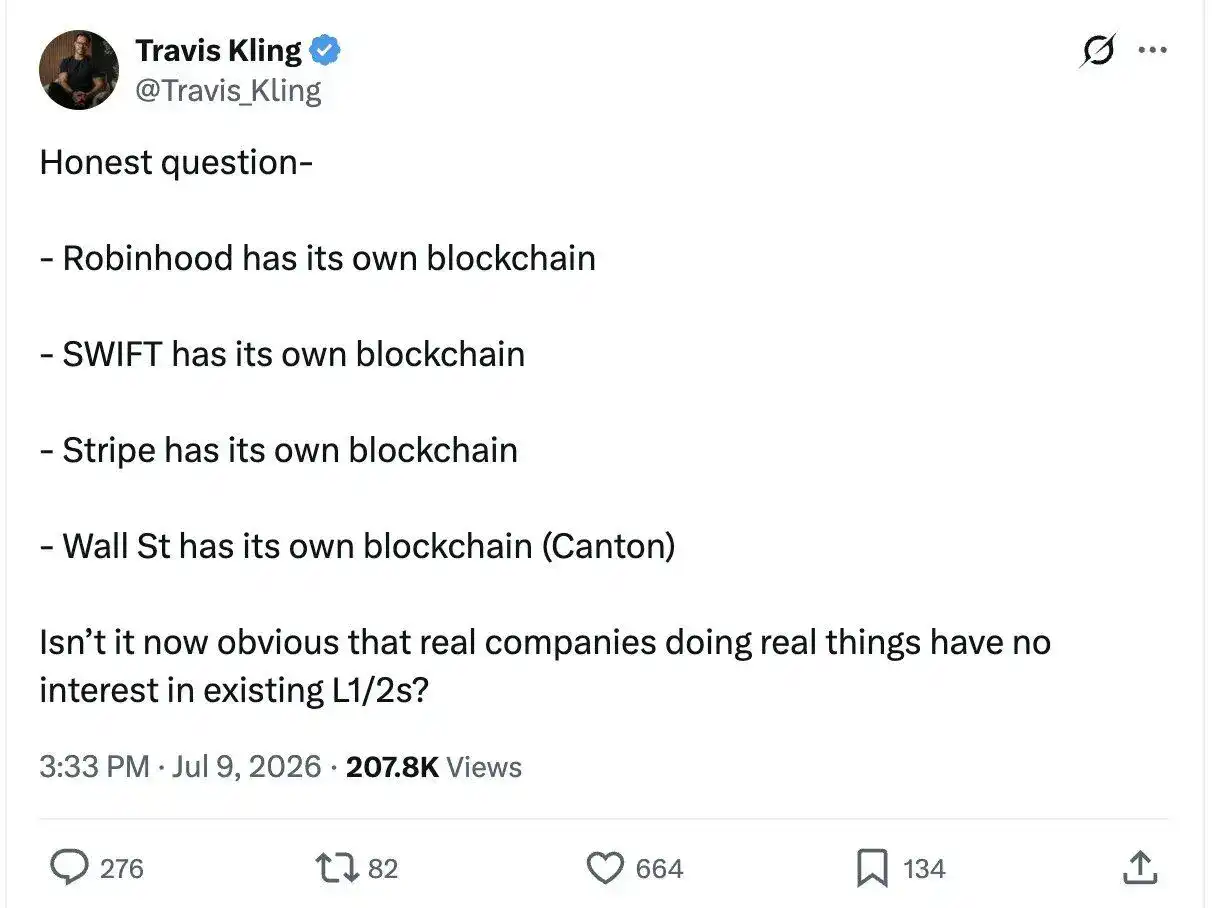
Robinhood chose an existing L1—Ethereum, and then built its own Ethereum L2 leveraging Arbitrum technology. Robinhood Chain uses Ethereum blobs for data availability, uses ETH as its native gas token, and its security is also provided by Ethereum.
Therefore, Robinhood has not negated Ethereum's L1+L2 model; on the contrary, the model is running on Robinhood as intended.
The "buyers" choosing Ethereum have changed. In the past, crypto projects chose public chains and technologies to sell their own tokens, while the emerging real-world on-chain economy is adopting the Ethereum L1+L2 model as the foundation for cash businesses.
As the composition of buyers changes, I believe Ethereum's advantages will become even more apparent.
The Old Crypto Economy Was Token-Centric
By "real businesses serving real users," I mean a traditional corporate model: building products customers need, earning profits by serving them, and increasing the equity value of those profits.
"Real users" here refers to consumption demand arising from ordinary economic needs, not speculative demand primarily generated by new token issuance. Crypto-native users are obviously real users. This is not a moral judgment on a protocol's usefulness or its developers' sincerity, but merely a distinction regarding the goal of operating a real economy business.
Token value can only come from three sources:
- Cash: A reliable claim on future cash flows, similar to on-chain equity or bonds;
- Utility: Access, control, governance, or other privileged participation rights to a valuable system. Even without cash flow, tokens that control important things clearly have value;
- Monetary Premium: People hold the asset because they expect others to accept and recognize its value in the future. This asset is no longer merely a claim that must ultimately be exchanged for something else; it becomes a store of wealth—a terminal value asset.
The monetary premium is real but extremely difficult to sustain. It requires deep network effects in trust, liquidity, distribution, integration, and utility. Gold, the US dollar, Bitcoin, and Ethereum have all built different versions of this effect, while few other assets have achieved it.
Looking back, since programmable cryptocurrencies became popular, the vast majority of industry participants have not been ordinary cash flow businesses. Their economic goal has often been to sell a token whose value is primarily based on utility, an anticipated monetary premium, or distant promises of future cash.
Sometimes their plans were straightforward—launch a protocol and sell its token; sometimes more indirect—receive funding from a token-funded ecosystem and then cash out the tokens; sometimes a project genuinely expected future profitability, but since the token's valuation was detached from any plausible future cash, the actual business model still relied on confidence in the token itself.
This became the norm because almost every project was doing something similar, but there were exceptions.
Centralized exchanges are inherently cash transaction platforms and are naturally multi-chain, adding another chain is like adding another deposit/withdrawal channel. Some stablecoin issuers are also cash transaction businesses, initially serving crypto-native clients and now rapidly expanding into the broader economy.
But these exceptions precisely prove the point: Businesses aiming for ordinary cash transactions choose infrastructure that maximizes their business, not token value.
Different Business Goals Will Build Different Projects
A business's ultimate goal determines its technology choices.
If the goal is a cash transaction business, then blockchain is infrastructure, and the selection criteria are to reduce risk, improve the product, reach customers, and secure profits. If the goal is token monetization, then blockchain choice has more degrees of freedom. After receiving funding from a public chain, a business can choose to develop on the chain that funded it.
For example, if a protocol succeeds on Chain A, you can launch a similar protocol on Chain B so investors can price your token by comparison. Want momentum for a new token? Then a new L1, L2, appchain, gas token, governance system, or a particular tech stack can become selling points.
The problem is not technological diversity itself; the crypto industry will continue to see an explosion of applications, protocols, L2 architectures, and specialized execution environments. The problem is the tendency to turn every new idea into a sovereign, independent ecosystem (with its own L1 architecture, security validation, liquidity base, and monetary asset), regardless of whether the underlying product warrants it.
As the industry now shifts toward cash businesses, experiments continue, but they will increasingly be built on shared infrastructure. Businesses will specialize at the application layer or on L2s, while relying on the Ethereum L1 layer for settlement, security validation, liquidity maintenance, and monetary asset management. The result is not less innovation, but a balance: more diversity at the edges, more concentration at the base.
The traditional crypto economy typically chose architecture around the token it wanted to sell, while the emerging on-chain economy will choose architecture around the product it wants its customers to buy.
The Buyers Are Changing
The future of the crypto industry will be fundamentally different from the past because the "buyers" have changed.
Previous US administrations actively suppressed on-chain transaction development. Now this trend has reversed. The GENIUS Act is now in effect, providing a legal framework for payment stablecoins, and Europe's MiCA regulatory framework is fully applicable. Brokers, payment companies, banks, asset managers, and governments worldwide are formulating strategies for stablecoins, tokenization, and on-chain transactions.
This doesn't mean all regulatory issues are resolved, but at least it shows large institutions can attempt more blockchain business.
We are approaching the beginning of the S-curve for true crypto industry adoption.
When we emerge from this phase, the crypto industry and traditional finance will no longer be distinct categories. Property, money, transactions, finance, identity, and trust will all be coordinated through a network of on-chain and off-chain systems. Eventually, "Web 3" will fade away like "Web 2," and everything will simply be the internet.
As this process advances, a larger proportion of crypto market participants will be entity businesses serving ordinary consumers in the broader economy. This proportion will be reflected not just in the number of companies, but in capital volume, user numbers, asset scale, and institutional influence.
These companies are no longer crypto projects seeking a business model to support their token, but businesses using crypto technology to optimize existing or emerging cash businesses. This determines their technology choices. Infrastructure choices made for token economics do not well guide choices made for cash economics.
Entity Businesses Won't Build Infrastructure from Scratch
Typically, entity businesses have limited budgets for risky infrastructure development. They don't want consensus mechanisms, cross-chain bridges, validator economics, gas, governance tokens, and liquidity bootstrapping to become six separate side hustles. Each additional element must create customer value or it becomes a burden.
The chain should serve the business, not the business serve the chain.
Some businesses are inherently multi-chain. Exchanges, wallets, stablecoin issuers, and certain asset issuers may require broad distribution. Even then, "multi-chain" rarely means all chains are equally important. Different chains often have their own domains in terms of liquidity, issuance, settlement, product status, or deeper integration.
Most on-chain businesses need to commit to one chain or a small number of chains. Their choice typically takes three forms:
- When on-chain businesses need maximum decentralization, credible neutrality, minimized risk, or liquidity, they use Ethereum L1 services. L1 execution is more costly because it bears the most powerful shared environment;
- When businesses need control, customization, compliance, predictable unit economics, low latency, or high throughput, they build their own Ethereum L2. Because they can have their own dedicated chain as they wish, while maintaining a direct connection to Ethereum;
- When businesses don't need L1 and building their own L2 isn't necessary, they typically use one or more mature shared L2s. Base, Arbitrum One, Robinhood, and other mature Ethereum L2s have become common deployment platforms.
These on-chain businesses will still bridge assets, "export products," and connect to other networks. Having a main chain doesn't mean isolation; importing, exporting, and interoperability are also core parts of on-chain business. But the main chain remains crucial. It determines the system's security, canonical state, liquidity relationships, operational model, and long-term dependencies.
Why Ethereum's L1+L2 Model Remains Useful
Ethereum separates the two major elements large enterprises need.
The L1 provides a highly decentralized, credibly neutral, and highly liquid global hub. L2s provide a market of fast, low-cost, specialized, controllable, and customizable execution environments.
The L1 remains neutral, while L2s at the edge can adapt to different operators, jurisdictions, products, and users. L2s extend Ethereum not just technically but also politically: organizations can operate their way without asking the global hub (L1) to become their private chain.
Independent L1s can offer control and performance advantages. In some cases, full sovereignty over consensus and data availability is worth it for a project, but acquiring it isn't cheap.
A new L1 must create and maintain its own security system, validator or operator set, bridges, liquidity, tooling, integrations, and reputation. It creates a new security and liquidity silo, increasing the cost and friction of interoperability with Ethereum L1 and the broader L2 economy (the dominant on-chain economic network).
For the vast majority of businesses, the value created by an independent L1 doesn't offset these costs.
A custom Ethereum L2 gets most of the business advantages a company wants from an independent L1: high TPS, control over execution, upgrades, fees, sequencing, latency, access rules, and product-specific features.
Furthermore, L2s provide advantages independent L1s don't inherently have: Ethereum for settlement and data availability, a standard L1 bridge, proximity to Ethereum's assets and capital, and a path for increasingly trust-minimized interoperability.
L2 design still matters. Admin keys, upgrade keys, proof systems, and withdrawal guarantees determine how much security users have at any moment. But even an L2 controlled by a few operators can offer users a solid settlement foundation on Ethereum L1. Companies don't need to operate and maintain their own L1 layer to run their business.
Ethereum L2s are both independent blockchains and part of the Ethereum economic system. They can own and customize their execution environment while leveraging Ethereum for settlement, data availability, and interoperability management.
L2s often deeply integrate ETH into their application economies, for example as the native Gas token. Canonical bridging models provide a trust-minimized path for capital and assets on L1 to enter the L2's "local economy." Each new L2 has a unique product interface, and Ethereum's network effects grow stronger.
Robinhood Made This Business Decision
Robinhood's development path is highly instructive.
It first launched stock tokens on the mature L2 Arbitrum One, validated the product, and understood its own needs, then launched a proprietary chain built on the Arbitrum platform.
This will likely become a standard strategy for entity businesses: build a business on a blockchain first, then upgrade to a dedicated L2 once scale, product needs, and unit economics justify it.
Robinhood Chain is customized for the financial services industry. It uses Arbitrum technology, offers 100-millisecond latency, predictable transaction pricing, high throughput, and infrastructure tailored to Robinhood's performance, security, and regulatory requirements.
At the same time, Robinhood Chain remains an Ethereum L2. It uses Ethereum blobs for data availability and uses ETH as the native gas. Its official bridge to Ethereum requires no third-party validator set. This is what it looks like when an entity business builds a real on-chain product.
Robinhood doesn't need to launch a Robinhood gas token or convince the public it's worthy of a lasting monetary premium. Robinhood itself owns stock; its economic gains come from customers, products, assets, transactions, and cash flow. Blockchain is just its infrastructure.
Using ETH as gas is a simple business decision. L2 services already use ETH to pay for L1 services. ETH is liquid, widely adopted, and the system's native token. If Robinhood used a proprietary Gas token, it would add issues of distribution, liquidity, pricing, and legality, and launching a token wouldn't improve Robinhood's core product.
Robinhood's success will depend on its application layer and the off-chain business enabled by it, not the efficiency with which it creates a new monetary asset. Therefore, when someone says Robinhood built its own blockchain and rejected existing L1 and L2 services, it's inaccurate.
Robinhood merely rejected sharing its dedicated execution environment with other projects, not Ethereum. On the contrary, it chose Ethereum as the parent chain for its proprietary blockchain.
Previously, Coinbase made a similar decision by launching Base. Coinbase is not an Ethereum maximalist, and it's well known that Brian Armstrong has publicly stated his enthusiasm for Bitcoin far exceeds that for Ethereum. Yet, when Coinbase chose infrastructure for its on-chain business, it still chose to become an Ethereum L2.
Base is precisely the strongest evidence that Ethereum's L1+L2 model is not just talk; Coinbase's decision was business-driven, not ideological.
When companies build cash businesses rather than conduct token sales, they make business decisions, and this leads them to choose infrastructure—the Ethereum L1+L2 model.
What This Means for Ethereum and ETH
This shift in participant composition is extremely bullish for Ethereum.
Historically, the blockchain competitive landscape was dominated by teams whose incentives focused on token creation, ecosystem funding, and token valuation. Looking ahead, the blockchain competitive landscape will increasingly be dominated by companies optimizing for security, customers, control, distribution, liquidity, and interoperability—all to serve cash businesses.
This shifts demand toward Ethereum's "barbell" structure: L1 for maximum risk reduction and liquidity; L2s for scaling, customization, and operator control.
Ethereum developed into a global universal platform not by forcing all companies into the same shared execution environment, but by becoming the common underlying settlement, security, liquidity, and asset layer for numerous environments.
This is also bullish for ETH. ETH's success lies in building a monetary network and global trust. ETH is an excellent staking asset and the native asset of Ethereum's global settlement layer. Across the ecosystem, it serves as collateral, a liquid asset, a treasury asset, a productive asset, and is becoming a terminal asset.
As more entity businesses build on Ethereum, they will distribute ETH to more users, integrate it into more products, and make it useful in more areas. This enhances ETH's liquidity and investor confidence, which in turn strengthens the monetary premium, which ultimately evolves into a larger network effect.
Robinhood is not an exception, but a beacon.
Real businesses use Ethereum L1 when they need the world's most neutral, lowest-risk, and most liquid shared environment. When they need control, customization, and high performance, they build their own Ethereum L2. And when their business doesn't yet justify building an independent blockchain, they deploy to mature blockchains, typically Ethereum L2s.
This is not because they are Ethereum fans, but because they are making rational business decisions.