ChatGPT Issues Sudden Ban, Cutting Off Global AI Writers Overnight

marsbitPublished on 2026-07-31Last updated on 2026-07-31

Abstract

The Golden Age of AI writing is showing signs of collapse. While AI models grow more powerful, the quality of their generated text is perceived to be declining. Research notes a divergence: models excel in structured domains like coding and math due to clear feedback signals, but their language expression and reasoning plateau or even regress, as there's no reliable automated metric to score "good writing." Simultaneously, platforms are imposing new restrictions. ChatGPT has reportedly begun refusing prompts that explicitly instruct it to mimic the style of specific famous authors like Stephen King or J.K. Rowling, though requests based on abstract narrative features remain possible. This shift undermines user expectations. AI writing tools are becoming less reliable for end-to-end content creation, as model capabilities may not consistently improve and prompt efficacy can change overnight due to platform policy updates. Consequently, AI is receding to a more auxiliary role—a tool for research, structuring, and editing—while human judgment, experience, and creative intent regain paramount importance.

The golden age of AI writing is collapsing!

Entering it, each generation of models grows stronger, yet the articles become increasingly worse.

It knows when to list several suggestions, where to insert subheadings, and never forgets to add a concluding sentence at the end.

But after reading the entire piece, not a single sentence remains in your mind.

The Stronger the Model, the Less Human the Writing Sounds

Recently, Cambridge University postdoctoral researcher Adam Hunt also noticed this phenomenon. His research focuses on evolutionary psychiatry and human evolution.

Hunt was previously optimistic about AI. However, on July 28, he frankly admitted in a long post: he is growing increasingly pessimistic now.
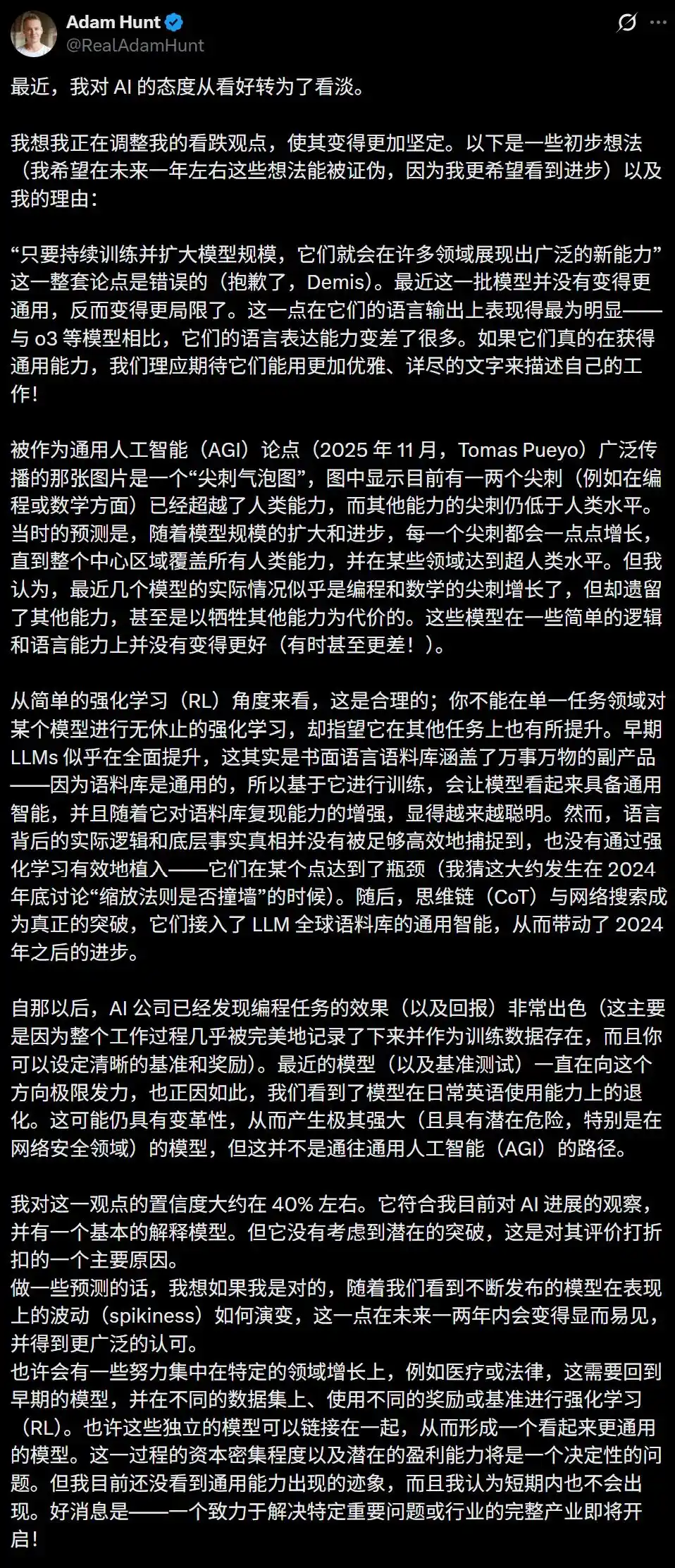
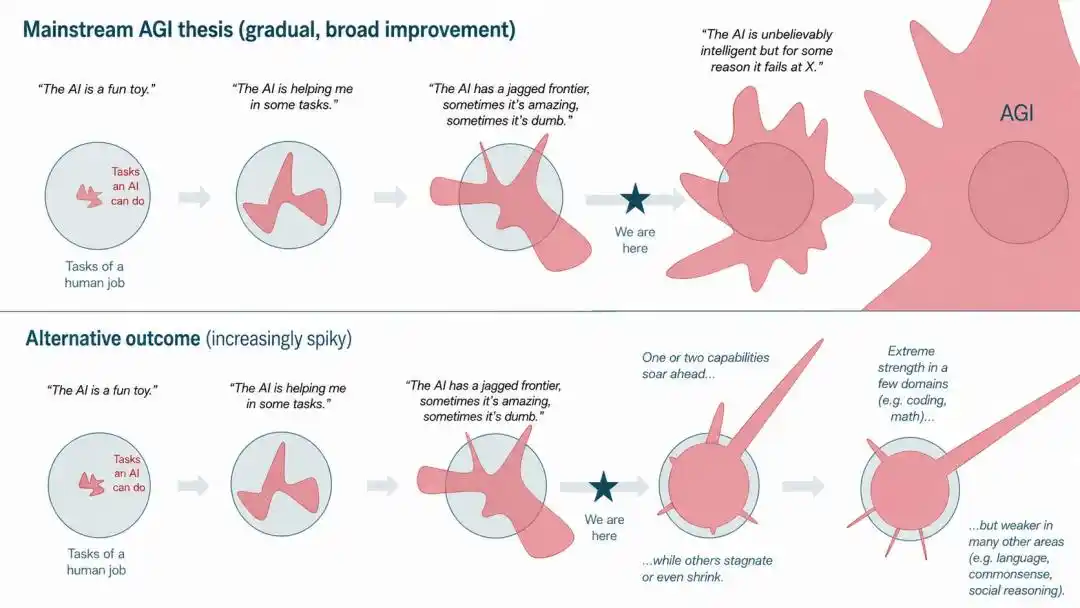
There was a popular metaphor before, depicting model capability as a circle with a sharp spike.

First, code and mathematics surpass humans, then as scale increases, every direction gradually grows, ultimately achieving AGI.

But in reality, the spike for code and mathematics is indeed growing longer, while language expression and simple reasoning have not improved synchronously.
From a reinforcement learning perspective, this outcome is almost inevitable.

Earlier generations of LLMs appeared to become "comprehensively smarter" because the training corpus itself covered all domains, from poetry to theses, encompassing the entire internet.

However, that was a byproduct of the corpus, not the model's genuine "comprehension."

Chain-of-thought and web search were subsequently introduced, giving models a temporary boost. But ultimately, this path hit a wall.

Following that, AI companies eager for a turnaround turned their focus to code.

The reason is simple: there is a constant stream of training data available.

GitHub commits, reviews, and PRs are all readily available. Moreover, similar to mathematics, code provides clear feedback signals: either it runs or it doesn't.

What about writing articles? How do you automatically score "how well a piece of prose is written"? Without a reward, RL won't optimize in that direction.

Thus, all training efforts shifted to code, while language expression had to rely on the foundation laid during the pre-training phase.

This foundational knowledge can only diminish over time. To accommodate improvements in other areas, it might even degrade.

This is precisely where Goodhart's law tends to manifest.

When a metric becomes the training target, it no longer accurately reflects true capability. Labs optimize models using benchmark tests, then prove their improvement with similar tests.

Benchmark accuracy scores will continue to rise. Yet, the actual user experience may stagnate or even decline.

This Time, Imitation Is Also Restricted

While capabilities are degrading, another development is occurring simultaneously.

A Reddit user complained in a post that they had been using ChatGPT to write a book for several months, subscribing to the advanced model. They took a break in between.

When they returned, the prompt that had always worked suddenly returned a refusal.

The prompt itself wasn't complex: specify an author, request to increase dialogue, enrich details, and avoid fragmented sentences.

In the past, simply writing the author's name allowed the model to generate content approximating their style, without needing additional explanations on sentence length, rhythm, or perspective.

Now, this type of prompt no longer works.

Ars Technica tested with Stephen King, J.K. Rowling, Amy Tan, Dickens, Hemingway, and Engadget tested with Agatha Christie. ChatGPT refused to imitate all of them.

If you don't name names and only request abstract features like "suspense intensity," "narrative pacing," or "dialogue density," it can still output. But the flavor is no longer the same.

The Golden Age of AI Writing Has Collapsed

Today, this controversy has shaken users' fundamental expectations regarding AI writing.

Models may not necessarily write better, and prompts are no longer guaranteed to remain effective long-term.

When platforms change their rules, entire writing pipelines built around specific models can collapse overnight.

However, AI writing won't disappear; it has merely retreated to its proper place: as a tool.

It can research information, structure content, and revise sentences, but it cannot replace the author in deciding what to write and why to write it.

In other words, human experience, judgment, and desire to express are becoming increasingly valuable.

Reference: https://arstechnica.com/ai/2026/07/chatgpt-stops-cloning-famous-writers-voices-but-may-capture-a-similar-feeling/

This article is from WeChat public account "New Zhiyuan," author: ASI Apocalypse

Trending Cryptos

Related Questions

QAccording to the article, what is the main reason for the decline in the quality of AI-generated writing?

AThe article attributes the decline to reinforcement learning (RL) optimization focusing on domains with clear, automated feedback like code, while creative writing lacks such objective metrics, causing language expression capabilities to stagnate or degrade as models prioritize other benchmarks.

QWhat specific change did ChatGPT make regarding prompts that imitate famous writers?

AChatGPT now refuses to generate content in the style of specific, named famous authors like Stephen King or J.K. Rowling when prompted directly. Prompts using only abstract stylistic features are still allowed, but the output is less authentic.

QWhat is Goodhart's law, as mentioned in the article, and how does it relate to AI model training?

AGoodhart's law states that when a measure becomes a target, it ceases to be a good measure. The article relates this to AI companies optimizing models for specific benchmark tests, which improves scores on those tests but doesn't necessarily translate to better real-world performance, potentially leading to a decline in user experience.

QWhat does the article suggest is the future role of AI in writing?

AThe article suggests AI writing will recede from attempting to replace authors and settle into its proper role as a tool. It will be used for tasks like researching, structuring content, and editing sentences, but the human author's experience, judgment, and desire to express remain central and increasingly valuable.

QWhat analogy does researcher Adam Hunt use to describe the unrealistic expectation of AI model development?

AHe references a popular analogy depicting model capability as a spiky circle, where proficiency in areas like code and math grows into a sharp peak, expecting all other abilities like language to grow uniformly toward AGI. The article argues that in reality, the 'spike' for code has grown while language and simple reasoning have not kept pace.

Related Reads

Bank of Japan Signals Interest Rate Hike Despite Keeping Them at 1%

The Bank of Japan (BOJ) kept its benchmark interest rate at 1% on July 31, as widely expected, following a June hike to a 31-year high. The decision passed with an 8-1 vote, with board member Hajime Takata again dissenting in favor of a hike to 1.25%. Despite holding rates steady, the BOJ signaled a hawkish tilt, warning that underlying inflation is likely to accelerate and exceed 2% from the latter half of the fiscal year. While it slightly lowered its core inflation forecast for FY2026, officials expressed stronger confidence that an overshoot will occur later, driven by yen weakness, corporate pricing behavior, and lingering energy shock effects. Markets were focused on the BOJ's forward guidance. Analysts noted the central bank appeared to balance short-term caution with a long-term warning of tighter policy. Governor Kazuo Ueda faces the challenge of reconciling a government reluctant to tighten further with bond markets already pricing in additional hikes, with the timing of the next move debated. Adding complexity, the BOJ reportedly intervened in currency markets hours before the rate decision, buying yen to support the currency which had fallen to 40-year lows against the dollar. Yen weakness stems from the wide U.S.-Japan interest rate gap, high fuel prices, and market skepticism about the pace of BOJ policy normalization. The yield on Japan's 10-year government bonds fell to 2.8%, indicating investor expectations for future monetary tightening.

cryptonews.ru11m ago

Bank of Japan Signals Interest Rate Hike Despite Keeping Them at 1%

cryptonews.ru11m ago

Trading

Spot

Hot Articles

How to Buy BAN

Welcome to HTX.com! We've made purchasing Comedian (BAN) simple and convenient. Follow our step-by-step guide to embark on your crypto journey.Step 1: Create Your HTX AccountUse your email or phone number to sign up for a free account on HTX. Experience a hassle-free registration journey and unlock all features.Get My AccountStep 2: Go to Buy Crypto and Choose Your Payment MethodCredit/Debit Card: Use your Visa or Mastercard to buy Comedian (BAN) instantly.Balance: Use funds from your HTX account balance to trade seamlessly.Third Parties: We've added popular payment methods such as Google Pay and Apple Pay to enhance convenience.P2P: Trade directly with other users on HTX.Over-the-Counter (OTC): We offer tailor-made services and competitive exchange rates for traders.Step 3: Store Your Comedian (BAN)After purchasing your Comedian (BAN), store it in your HTX account. Alternatively, you can send it elsewhere via blockchain transfer or use it to trade other cryptocurrencies.Step 4: Trade Comedian (BAN)Easily trade Comedian (BAN) on HTX's spot market. Simply access your account, select your trading pair, execute your trades, and monitor in real-time. We offer a user-friendly experience for both beginners and seasoned traders.

5.0k Total ViewsPublished 2024.10.27Updated 2026.06.02

How to Buy BAN

Discussions

Welcome to the HTX Community. Here, you can stay informed about the latest platform developments and gain access to professional market insights. Users' opinions on the price of BAN (BAN) are presented below.

活动图片