Artemis: A Review of Figma's Q2 Earnings, Optimistic About Current Market Pricing

marsbitPublished on 2026-08-10Last updated on 2026-08-10

Abstract

**Summary of "Artemis: Figma Q2 Earnings Review, Bullish on Current Market Pricing"** Following Figma's strong Q2'26 earnings report (revenue of $370.1M, up 48% YoY), the stock price fell 17%. The article argues this market reaction is mistaken, as it underestimates Figma's transformation from a tool for designers to the foundational design layer for all software creation in the AI era. Key supporting arguments are: 1. **Rise of the "Product Engineer":** AI is lowering coding barriers, leading to the emergence of hybrid "product engineers" who handle both engineering and design. As engineering teams are historically larger than design teams, this role significantly expands Figma's potential user base. 2. **AI Agents as Users:** The future SaaS model will charge not only for human users ("seats") but also for the work done by AI agents on their behalf. These agents will consume computational resources within Figma (e.g., editing components, converting designs to code), creating a new revenue stream. 3. **Margin Expansion:** While AI inference initially pressured gross margins, Figma's introduction of paid credits for AI usage (like Figma Make) has allowed its non-GAAP gross margin to recover to 85% in Q2'26. Monetizing its AI products further will likely drive continued margin improvement. The article acknowledges the long-term risk that AI tools like Claude could bypass the "design-to-code" workflow entirely. However, Figma's established customer base, integrated workfl...

Author: Artemis Analytics

Compiled by: Deep Tide TechFlow

Deep Tide Intro: Figma's stock price plunged 17% after earnings, but analysts believe the market is wrong—with the rise of product engineers and AI agents taking over design workflows, Figma's TAM (Total Addressable Market) is much larger than Wall Street expects. This is no longer just a story of "selling a few more designer seats," but a fundamental change in the underlying way software is produced.

On August 5, 2026, Figma (NYSE ticker: $FIG) released its Q2 '26 earnings report. A quick recap:

  • Revenue $370.1 million (up 48% year-over-year)
  • Net Dollar Retention Rate 136%
  • GAAP Gross Profit $309.6 million; GAAP Gross Margin 84%
  • GAAP Net Loss $112.2 million, primarily driven by stock-based compensation costs of $147.6 million
  • 15,964 paid customers with annual contract value over $10,000 (up 34% year-over-year)
  • 1,635 paid customers with annual contract value over $100,000 (up 46% year-over-year)

The numbers are strong, but Figma's stock fell 17% post-earnings. I was curious about what happened. After digging deeper, I realized:

I believe Figma will become the design layer for all software creators and AI agents.

Before AI, the workflow was simple:

Designer → Figma → Engineer → Code → Software

Now the workflow has become:

Designer / Engineer / PM / Product Engineer / AI Agent

Figma / Design System

Software

Three points support my view.

1. The Rise of the Product Engineer

The term "product engineer" was popularized by people like Sherif Mansour, Jean-Michel Lemieux, and Gergely Orosz, shaping our understanding of this role today.

What is a Product Engineer?

A product engineer is someone who writes code, understands customer pain points, and helps shape the product.

AI has made software development easier. As the cost of writing code decreases, engineers are taking on more product and design work. These boundaries are blurring.

I think this is important for Figma because historically, engineering teams have always been much larger than design teams. For one of Figma's largest customers, engineer seats now outnumber designer seats, and this will become more common in the future.

I wondered if people were searching for "product engineer." Google Trends confirmed my suspicion. The term has been searched significantly over the past few years.
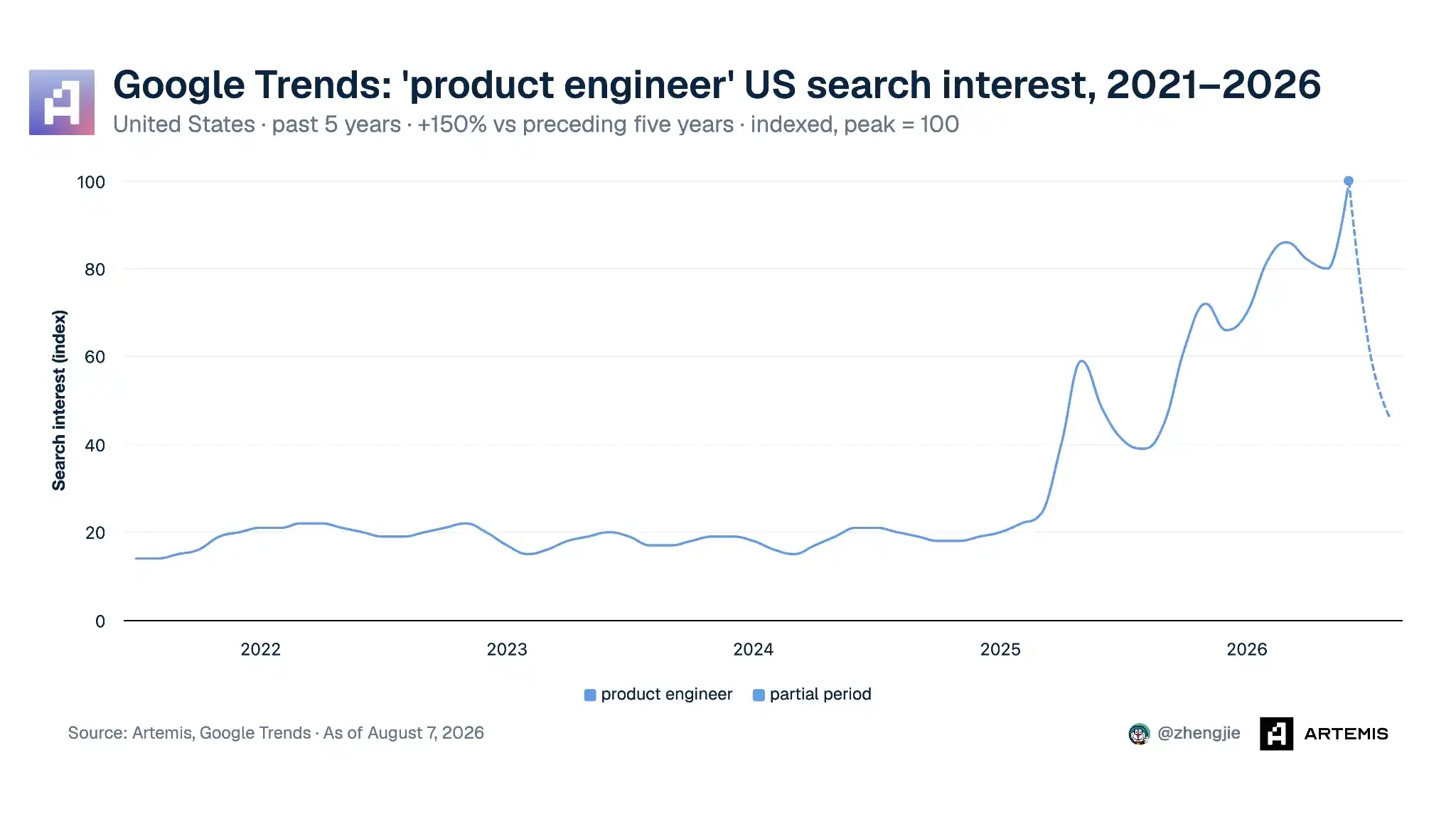
If this trend continues, I believe product engineers will become one of Figma's key growth drivers.

2. Every Employee Will Have an Agent (Figma Agent)

In 2026, everyone is talking about AI agents. Figma's next expansion frontier is from humans to agents.

Traditional SaaS monetization is straightforward:

Cost per seat ✕ Number of seats

I believe in an agentified world, every employee will have one or more agents working on their behalf. These agents will help iterate on products (editing components, turning designs into code). These operations will naturally consume inference and compute resources.

The future SaaS business model will look like this:

(Cost per seat ✕ Number of seats) + (Consumed credits ✕ Cost per credit)

I believe Figma will continue to charge for people using the product (seats) and also charge for the work done through the product (agents).

3. Margin Expansion

AI is expensive. Compute and inference are costs for every company wanting to enable AI.

When Figma launched Figma Make, gross margins dropped from 90% to 80% because inference became part of the cost of revenue. In Q2 '26, non-GAAP gross margin rebounded to 85% as Figma began charging for AI usage via credits.

What I (and everyone on Wall Street) thought would become a cost for Figma has instead turned into an additional revenue stream.

I genuinely believe that as Figma continues to charge for its suite of AI products (Figma Make, Figma Agent, Figma Weave, and Figma MCP), their margins will continue to expand.

Will AI Tools Like Claude/OpenAI Replace Figma?

The biggest risk to this thesis is that these AI tools become so good that the entire "design-to-code" workflow collapses. If users can describe a product's look and feel in natural language and have it delivered end-to-end, Figma could be done.

Mitigating factors: I think this is far from reality (or won't happen in the near term). Figma already has customers. Customers are familiar with the current tools and have built workflows around them. Furthermore, years of design systems are already embedded within Figma, which is a huge moat.

Why Is the Market Pricing Wrong?

Figma's stock price is down 80% since its first-day close (July 31, 2025, at $115.50).
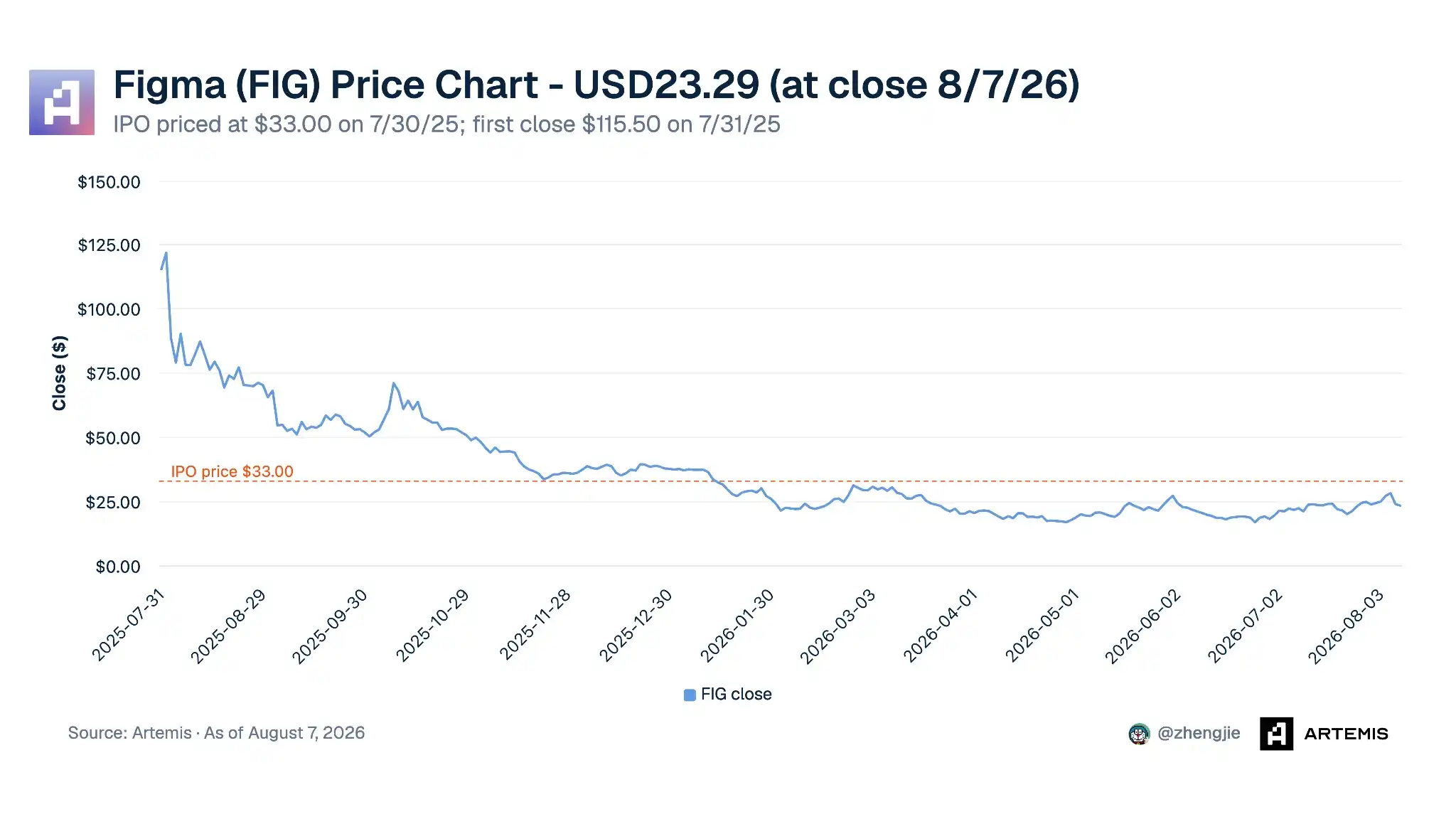
In my view, three things illustrate that Figma is mispriced:

Q2 '26 revenue continues to grow 40% year-over-year (meaning even with the explosion of Claude tools, people are still using Figma)

NRR (Net Revenue Retention) is 136% (seat expansion remains high, and the market is extremely pessimistic about software stocks)

Trading at an EV/ARR of 7.3x, near historical lows (not cheap, but reasonable considering Figma's growth rate)

The market still treats Figma as a software company serving designers.

I think this misses the bigger opportunity.

As role boundaries continue to blur (new roles emerging: product engineers) and agents help build software, Figma has the opportunity to become the de facto design layer that connects everyone.

The bull narrative is no longer just more designers paying for more seats:

More creators using Figma

More agents operating through Figma

More AI usage monetized on top of this

When this happens, Figma's TAM will be much larger than the market is pricing in today.

Trending Cryptos

Related Questions

QWhat were the key financial highlights of Figma's Q2 '26 earnings report?

AKey highlights included: Revenue of $370.1 million (up 48% YoY), a net dollar retention rate of 136%, GAAP gross margin of 84%, a GAAP net loss of $112.2 million (driven by $147.6 million in stock-based compensation), 15,964 customers paying over $10,000 annually (up 34% YoY), and 1,635 customers paying over $100,000 annually (up 46% YoY).

QAccording to the article, why did Figma's stock drop 17% after earnings, and what is the analyst's counter-argument?

AThe stock dropped 17% despite strong earnings, likely due to market skepticism about Figma's role in an AI-driven future. The analyst's counter-argument is that the market is mispricing Figma by still viewing it as a tool just for designers. They believe Figma's TAM is much larger, as it is poised to become the essential design layer for all software creators, product engineers, and AI agents, representing a fundamental shift in how software is built.

QHow does the article define a 'Product Engineer,' and why is their rise significant for Figma?

AThe article defines a 'Product Engineer' as someone who writes code, understands customer pain points, and helps shape the product. Their rise is significant for Figma because engineering teams have historically been much larger than design teams. As AI lowers the cost of coding, engineers are taking on more product and design work. This trend means Figma's user base can expand dramatically from just designers to include this larger, growing cohort of product engineers.

QWhat is the proposed future SaaS business model for companies like Figma in an 'agentified' world?

AIn an 'agentified' world where each employee may have AI agents working for them, the future SaaS business model is proposed as: (Cost per seat * Number of seats) + (Tokens consumed * Cost per token). This means Figma would charge not only for human users (seats) but also for the work completed by AI agents (agent usage), turning a potential cost center (AI compute) into a new revenue stream.

QWhat does the article identify as the biggest risk to Figma's bullish thesis, and what are the mitigating factors?

AThe biggest risk is that AI tools like Claude or OpenAI could become so advanced that they bypass the 'design-to-code' workflow entirely, allowing users to generate software from natural language descriptions and making Figma obsolete. The mitigating factors are that this scenario is still far from reality, Figma has an entrenched customer base with established workflows, and years of design system data embedded within Figma create a significant moat.

Related Reads

RIP: Atlas, Which Lived Only 292 Days

On August 9, 2026, OpenAI discontinued its standalone AI browser, Atlas, just 292 days after its launch on October 21, 2025. Initially positioned as a challenger to Chrome and the broader AI browser ecosystem, Atlas aimed to fundamentally redesign how users interact with browsers by deeply integrating ChatGPT. Its features included an AI-powered address bar, a sidebar for webpage analysis, Browser Memories for context retention, and an Agent Mode to automate multi-step tasks like shopping and research. Despite building on Chromium with a custom OWL (OpenAI Web Layer) framework, OpenAI struggled with the immense complexity of maintaining a full-fledged browser. The team spent significant time addressing basic functionalities—password managers, extensions, input methods—that mainstream browsers already handled seamlessly. Atlas's core AI agent capabilities also faced issues with reliability, speed, and security vulnerabilities like prompt injection. Furthermore, Atlas was limited to Apple Silicon Macs, failing to release promised Windows, iOS, and Android versions. This, coupled with the high switching cost for users entrenched in Chrome or Edge's ecosystems, hindered its adoption. By mid-2026, updates slowed, and OpenAI announced its shutdown, opting to integrate Atlas's AI explorations into the ChatGPT desktop app and browser extensions instead. The article contrasts two AI browser development paths: standalone products like Atlas, Perplexity's Comet, and Dia, which redesign the browser around AI but face user migration barriers; and the approach of incumbents like Chrome and Edge, which add AI features atop existing, widely-used platforms. The key question remains whether users need a completely new "AI browser" or simply AI capabilities within their current browser. While Atlas's experiment ended, the broader trend of AI integration into browsing continues.

marsbit9m ago

RIP: Atlas, Which Lived Only 292 Days

marsbit9m ago

Bitcoin's "Anti-Spam" Update Failed, Lasting Less Than a Day

A Bitcoin update proposal aimed at curbing spam by temporarily banning non-financial data from being stored on the network, BIP-110, has failed decisively. After months of debate, developers attempted to launch a separate blockchain, which collapsed within a day. The failure stemmed from a critical lack of miner support, with less than 1% signaling approval for the update. The vast majority of miners chose to continue mining the main Bitcoin blockchain without providing explanations. Despite this, the initiative's developers proceeded to launch an alternative blockchain—a hard fork of Bitcoin—on August 8. This meant a small subset of miners stopped mining Bitcoin to support the new chain with BIP-110 changes. However, the new network inherited Bitcoin's mining difficulty. With only a tiny fraction of the total computational power, block times stretched to roughly 7 hours instead of the standard 10 minutes, rendering the network practically non-functional. Michael Saylor, founder of major corporate Bitcoin holder MicroStrategy and a vocal opponent of BIP-110, commented: "Bitcoin worked exactly as designed. The BIP-110 fork occurred, and network participants were free to choose which chain to follow. As a result, about 99.85% of the network's hash power remained with Bitcoin." The event had no significant impact on Bitcoin's price, which traded in a narrow range between approximately $64.5k and $65.5k from August 7 through August 10.

cryptonews.ru15m ago

Bitcoin's "Anti-Spam" Update Failed, Lasting Less Than a Day

cryptonews.ru15m ago

Trading

Spot

Hot Articles

Discussions

Welcome to the HTX Community. Here, you can stay informed about the latest platform developments and gain access to professional market insights. Users' opinions on the price of S (S) are presented below.

活动图片