How Token-Hungry is Claude Code? A Comparative Experiment Shows Up to 30x Difference Across Three Frameworks

marsbitPublished on 2026-07-31Last updated on 2026-07-31

Abstract

Claude Code's Token Consumption Exposed: Comparison Experiment Shows Up to 30x Difference Between Frameworks A recent experiment by the Composio team tested the same model (Kimi K3) across three different agent frameworks (Claude Code, Hermes, and Kimi Code) on 28 identical tasks. While task completion rates were similar, token consumption varied dramatically. The median token usage was approximately 61k for Kimi Code, 67k for Hermes, and a staggering 340k for Claude Code – about 6 times more than Kimi Code. For individual tasks, the maximum difference reached 30x. In terms of cost, using Claude Code averaged $2 per task compared to $0.22 for Kimi Code and $0.28 for Hermes (based on Kimi K3 pricing). Speed also differed, with Hermes being the fastest. Analysis suggests Claude Code's high token usage stems from its harness repeatedly feeding extensive context (previous messages, tool calls, command outputs, file contents) back into the model across multiple interaction rounds, significantly inflating input tokens rather than generating longer outputs. This highlights a crucial trend: the agent framework (harness) is becoming as important as the model itself for cost and efficiency. A separate study from Writer showed that simply switching the orchestration layer to their optimized harness reduced average task cost by 41% and latency by 44% across various models without sacrificing quality. The conclusion is clear: for cost-effective AI agents, optimizing the harness may yie...

Everyone says Claude Code wastes tokens, but how much exactly? Finally, someone has put numbers to it.

There was a recent interesting comparative experiment from the Composio team. They used the same model, Kimi K3, and ran it in three different agent frameworks (harnesses)—Claude Code, Hermes, and Kimi Code—testing 28 identical tasks.
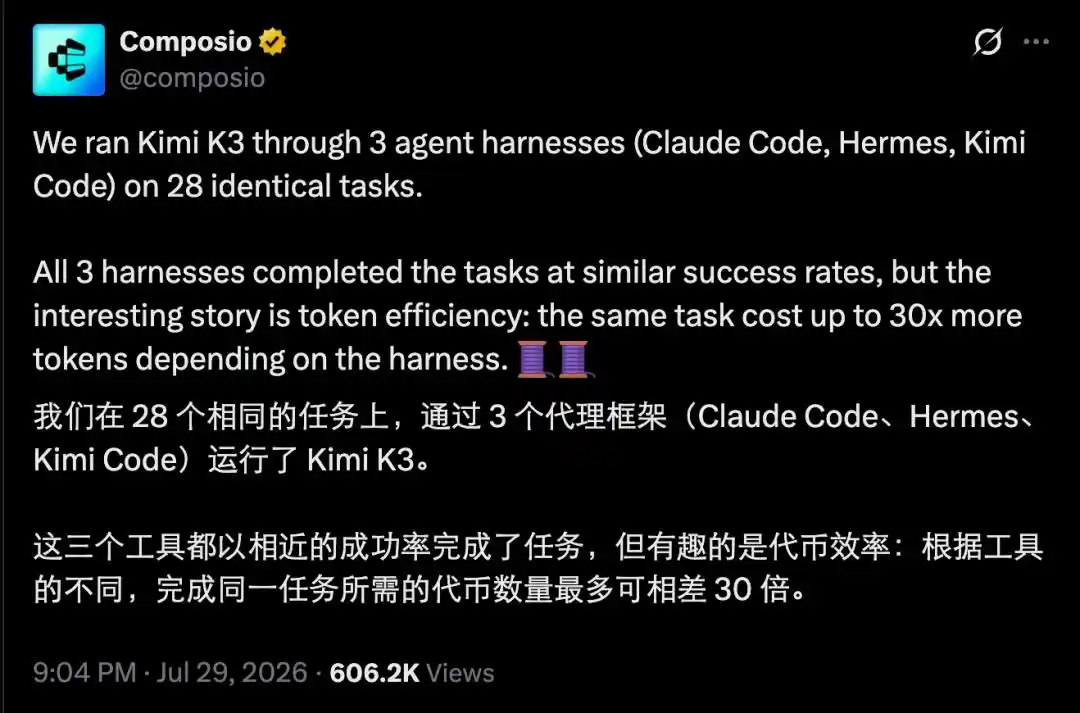
The results showed similar task success rates for the three harnesses: Kimi Code succeeded in 22 out of 28 tasks, Hermes in 21, and Claude Code in 20. The gap isn't large.

The real difference was in token consumption. For the same task, token usage across different harnesses varied by up to 30 times!

Looking at the median, Kimi Code used about 61,000 tokens, Hermes around 67,000, while Claude Code soared to 340,000—roughly 6 times that of Kimi Code.
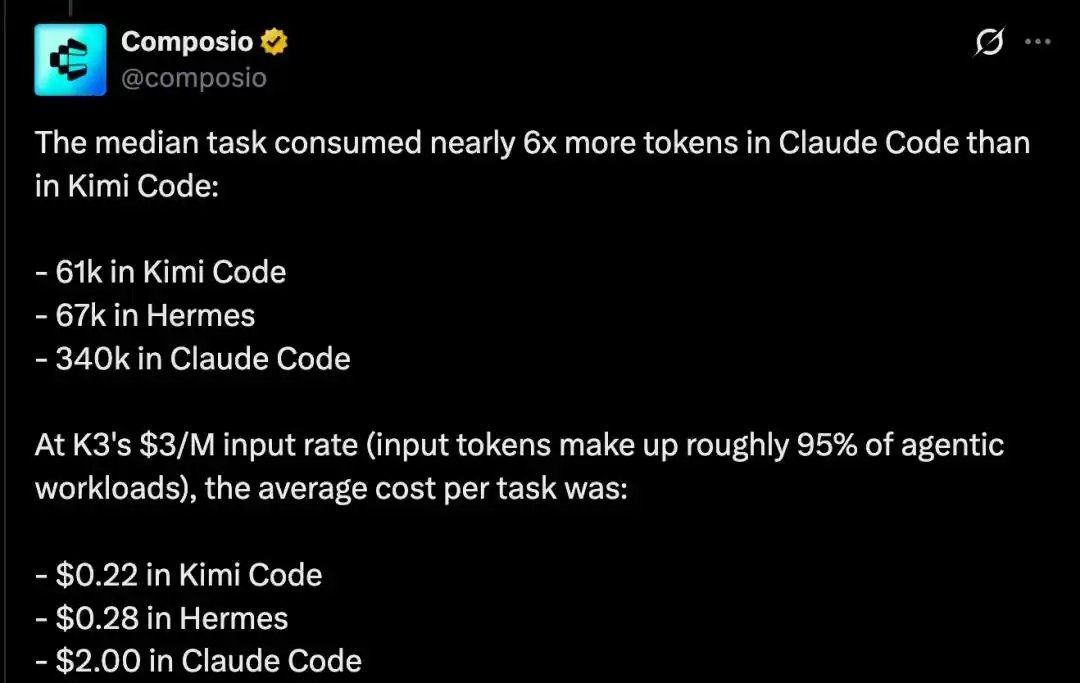
Based on the price of $3 per million input tokens for Kimi K3 (input tokens typically account for about 95% in agent workflows), the average cost per task is approximately: Kimi Code $0.22, Hermes $0.28, and Claude Code $2.00. The difference is evident.

Speed also differed. The median time: Hermes was fastest at 179 seconds; Kimi Code 297 seconds; Claude Code 348 seconds.

So, Hermes was the fastest, while Kimi Code was the most token-efficient—they didn't overlap.

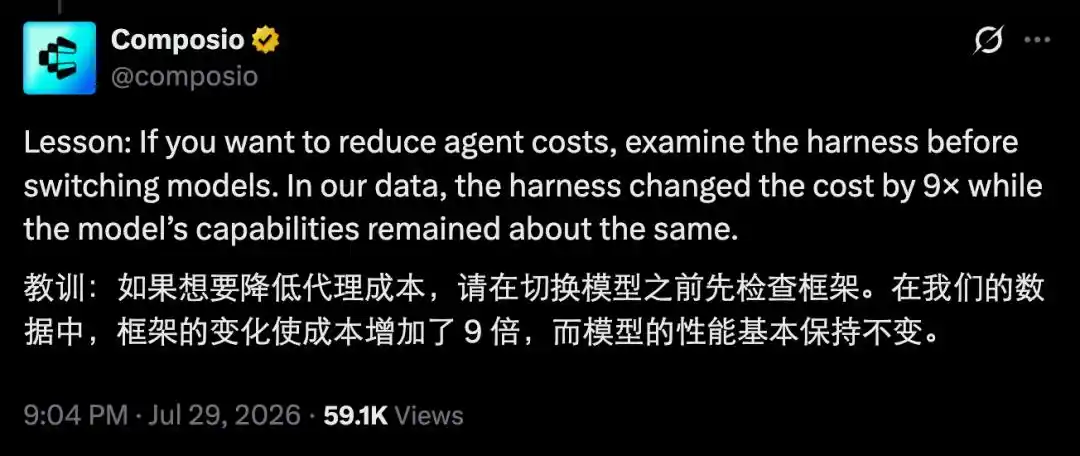
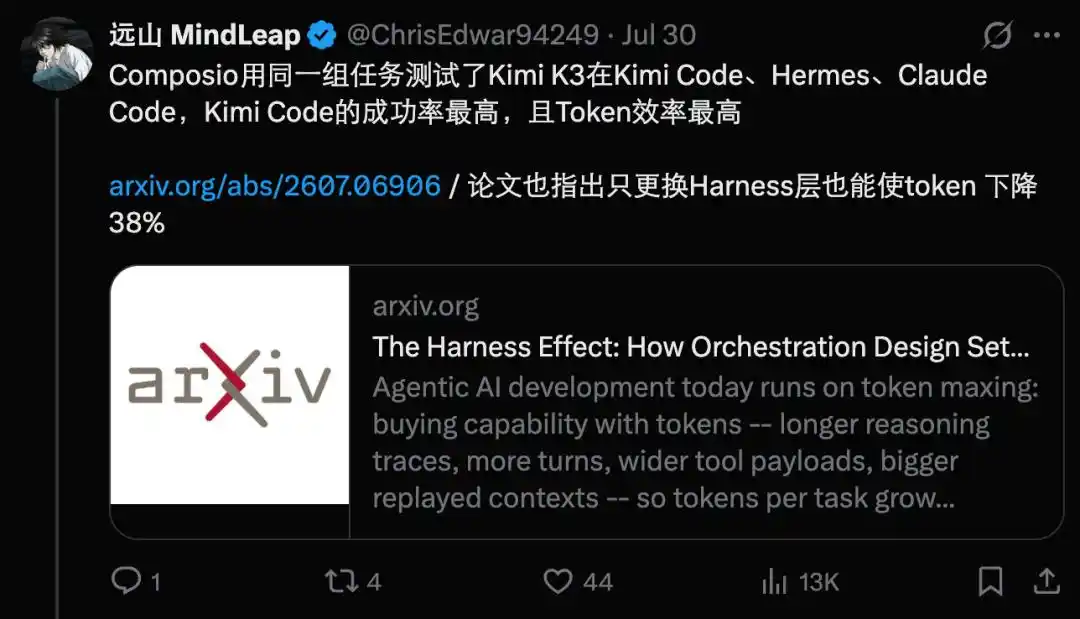
From this, the Composio team drew a straightforward conclusion: If you want to reduce agent costs, first look at which harness you're using, rather than rushing to change models. In their data, the harness itself could create a 9x cost difference, while model performance was quite similar.
Sebastian Raschka saw the results and posted about them, saying it aligns with his previous observations using Qwen3.6: Claude Code often uses 2 to 3 times more tokens than many other harnesses, with similar success rates.
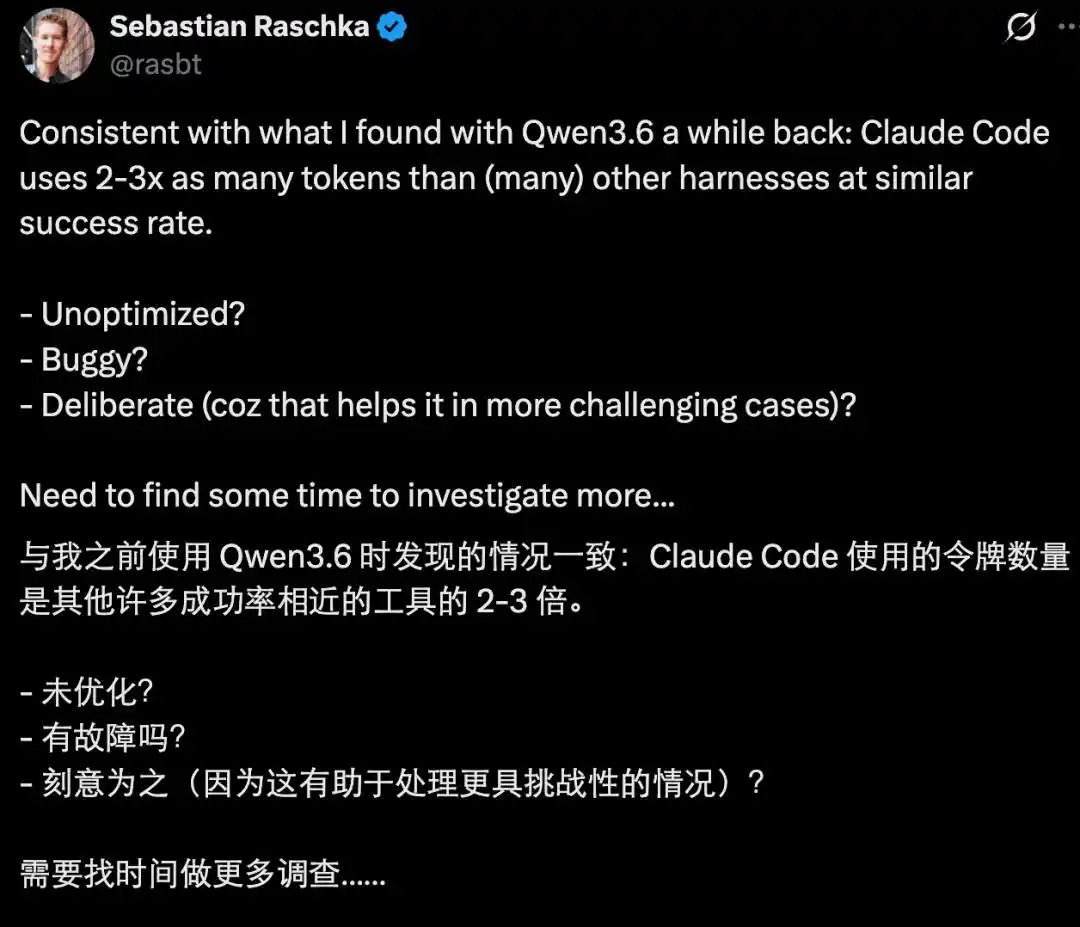
He suggested several possible reasons: Is it not optimized? Is there a bug? Or was it intentionally designed this way (perhaps aiding with harder tasks)? He said more time is needed to investigate carefully.

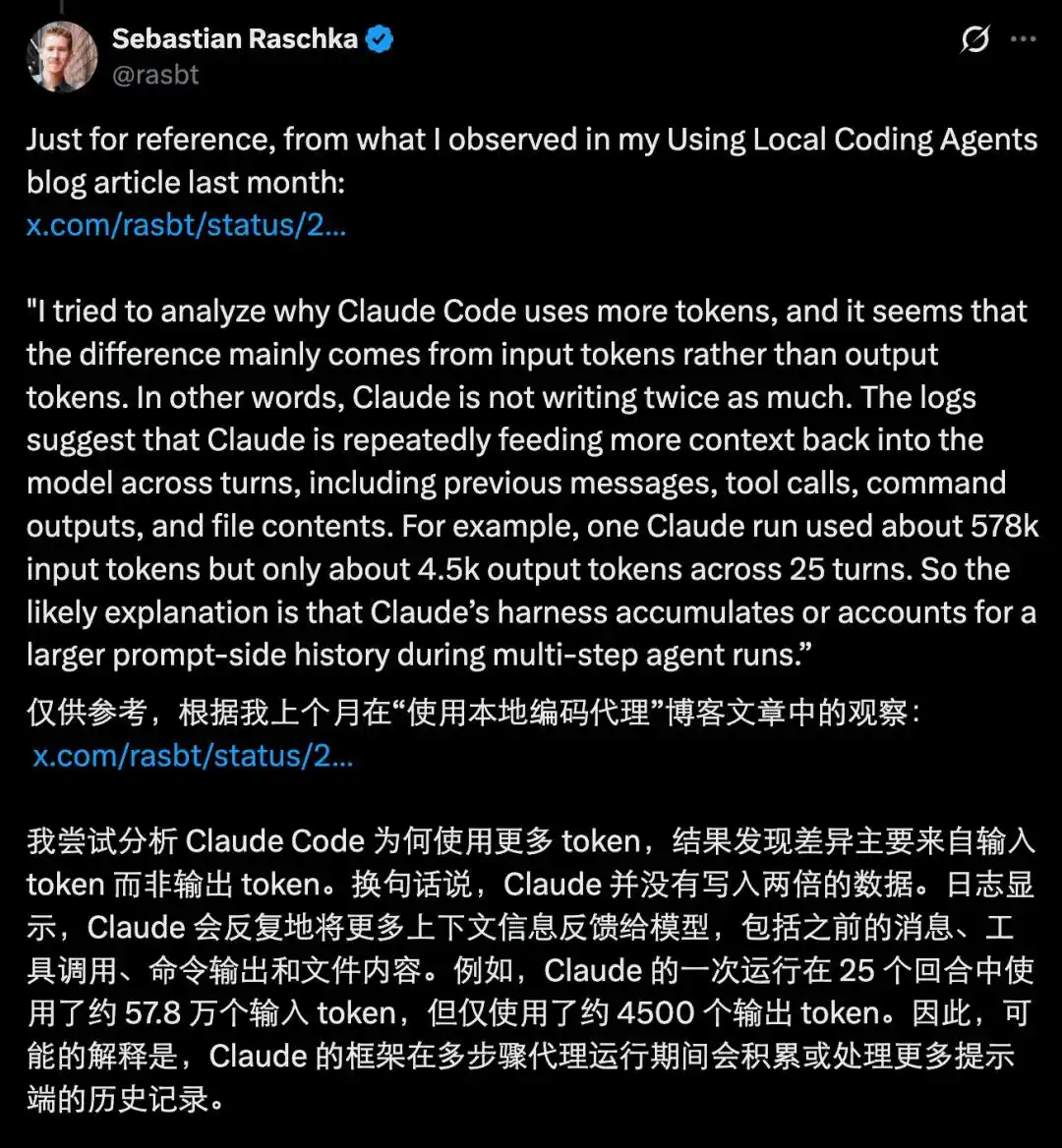
He then added observations from his article last month on writing a local coding agent. At that time, he analyzed why Claude Code uses more tokens and found the difference mainly stems from input tokens, not output tokens. In other words, Claude isn't writing twice as much content. Logs show that Claude's harness repeatedly feeds more context back into the model across multi-turn interactions, including previous messages, tool calls, command outputs, and file contents. For example, in one run, Claude used about 578,000 input tokens but only about 4,500 output tokens, spanning 25 turns. Thus, a more likely explanation is that Claude's harness accumulates or accounts for a larger prompt-side history during multi-step agent runs.
These test results seem to reveal an undeniable trend: The importance of the harness is now on par with the model itself.

A recent paper (from Writer, a company building an enterprise AI Agent platform) systematically highlights this point: Using controlled experiments, it demonstrates that switching the harness layer is more effective at cutting costs than switching models, benefiting all models.
Specifically, they conducted a rigorous "controlled variable" experiment: With 22 enterprise tasks and 6 base models (Claude Sonnet 4.6, Gemini 3.1, Gemini Flash 3.5, Qwen 3.6, GLM 5.1, Palmyra X6) held constant, they only replaced the orchestration layer—swapping the traditional production-grade agent loop for Writer's own Harness.

The results showed: Average task cost reduced by 41% ($0.21 → $0.12), median latency shortened by 44% (48s → 27s), token consumption decreased by 38% (14.2k → 8.8k), while task completion quality remained largely unchanged (0.78 → 0.81, considered insignificant due to small sample size). In terms of cost-effectiveness, the quality gained per dollar increased by 82%, and the number of tasks completed per million tokens jumped from 54.9 to 92.0.

So, as models become like "utilities," is the harness the air conditioner that determines your electricity bill? In other words: People used to say "the model is the product," but now it's "the harness is the product"?

Since the harness is so important, perhaps future accounting needs to be more granular.

Some point out that we need to add a "harness tax" item to existing benchmarks. Especially considering that once tool calls and retries enter a loop, this tax grows non-linearly.
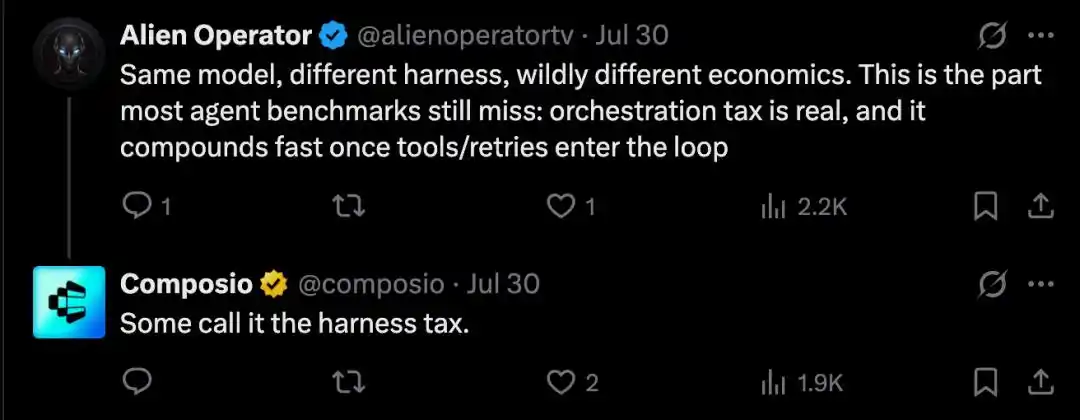
In other words, in the future agent competition, the first half is about "whether it can be done," and the second half will be about "who does the same thing more efficiently"—and the secret to saving money lies not in the model, but in the harness.

Have you had similar experiences while running agents? Feel free to discuss in the comments.

This article is from the WeChat official account "Almost Human" (ID: almosthuman2014), by Almost Human.

Related Questions

QWhat was the main finding of the composio team's comparison experiment involving claude code, hermes, and kimi code?

AThe main finding was that while the three agent frameworks (harnesses) achieved similar task success rates, their token consumption varied drastically. The median token usage for Claude Code was about 340k tokens, roughly 6 times higher than Kimi Code's 61k tokens. The maximum difference in token usage for the same task across harnesses could reach up to 30 times.

QAccording to sebastian raschka, why might claude code consume significantly more tokens than other frameworks?

ASebastian Raschka suggested the high token consumption is primarily due to input tokens, not output tokens. He observed that Claude Code's harness tends to repeatedly feed more historical context back into the model across multiple interaction rounds, including previous messages, tool calls, command outputs, and file content.

QWhat trend is revealed by the writer company's research paper regarding agent frameworks?

AThe research paper highlights that the choice of harness (the orchestration layer) is becoming as important as the model itself. Their controlled experiment showed that simply switching to a more efficient harness could reduce average task cost by 41%, median latency by 44%, and token consumption by 38%, while maintaining similar task completion quality.

QBased on the article's data, which framework was the most cost-effective and which was the fastest in median completion time?

ABased on the median data, Kimi Code was the most cost-effective, costing about $0.22 per task. Hermes was the fastest in median completion time, taking 179 seconds.

QWhat new concept or metric does the article propose should be added to agent benchmarks?

AThe article proposes adding a "harness tax" to agent benchmarks. This concept represents the additional computational cost (in tokens, time, and money) imposed by an agent framework's design, especially considering that costs can grow non-linearly when tool calls and retries enter a loop.

Related Reads

Has Bitcoin Bottomed, or Is a 'Shakeout' Approaching? What's the Situation with XRP?

Cryptocurrency analytics platform Santiment shared key insights on Bitcoin and altcoin markets, highlighting significant signals from on-chain data. Analysis shows Bitcoin's 365-day MVRV ratio has fallen to -26%, indicating substantial losses for long-term holders, a level historically associated with market bottom formations and long-term buying opportunities. While short-term MVRV is near breakeven, suggesting no clear directional signal, the annual perspective points to a bottom before bullish cycles. On-chain data reveals divergent behavior: large wallets (10-10,000 BTC) have been accumulating, adding ~18,500 BTC in 10 days, while smaller retail investors continue buying dips. Analysts caution that high retail demand can sometimes create a risk of a final market shakeout or correction. The altcoin market shows a mixed picture. Ethereum's 365-day MVRV is around -33%, but recent monthly gains combined with overly optimistic social sentiment pose a short-term correction risk. XRP is in oversold territory with 30-day and 365-day MVRVs at -57.5% and -45.5% respectively, signaling potential for a strong mid-to-long term rebound. Social activity and optimism are rising for Solana, while investor sentiment remains calmer towards Cardano. Future direction for Bitcoin and altcoins depends not only on on-chain metrics but also on macroeconomic and regulatory developments. The Federal Reserve's interest rate decision and upcoming policy rulings are increasing market volatility expectations, while uncertainty around the U.S. Congressional clarity process continues to pressure pricing. *This is not investment advice.

cryptonews.ru1h ago

Has Bitcoin Bottomed, or Is a 'Shakeout' Approaching? What's the Situation with XRP?

cryptonews.ru1h ago

Bank of Korea Reveals Results of Tokenized Deposit Testing

The Bank of Korea has announced the results of its pilot test for tokenized deposits. Involving 28 central banks and international financial organizations, the project saw participation from major South Korean banks including KB Kookmin Bank, NH NongHyup Bank, Shinhan Bank, Woori Bank, and Hana Bank. Transactions, from payment orders to final settlement, were completed in real time, averaging just 80 seconds. The test involved 30 transactions across 17 different scenarios—such as corporate and interbank transfers—and was conducted in six currencies, including the Korean won, US dollar, and euro, with a total transaction value reaching approximately $995,000. The central bank reported that the platform operated stably throughout, despite being only partially connected to the existing banking infrastructure. Settlements using tokenized deposits were executed seamlessly, quickly, and transparently. An internal transfer of 20 million won (about $13,890) between NH NongHyup Bank and Shinhan Bank was also successfully processed via the Project Agora platform, which involved connecting to the Bank of Korea's CBDC test platform, Project Hangang. Additionally, KB Kookmin Bank and Japan's MUFG Bank tested cross-border payments using these deposit tokens—digital certificates issued by commercial banks within the pilot, not directly by the central bank. The Bank of Korea plans to continue testing payments with tokenized deposits. This follows last year's pledge by South Korean authorities to tighten regulations for won-based stablecoins, which will require approval from both the central bank and the Financial Services Commission.

cryptonews.ru3h ago

Bank of Korea Reveals Results of Tokenized Deposit Testing

cryptonews.ru3h ago

Trading

Spot
活动图片