IOSG Founder: Web3 Is 'Losing Blood,' How Can Practitioners Survive Better?

marsbitОпубликовано 2026-05-23Обновлено 2026-05-23

Введение

IOSG Founder: Web3 Is "Bleeding Out" – How Can Practitioners Survive Better? In a candid reflection, the founder of IOSG Ventures voices deep concerns about the current state of Web3, describing an ecosystem experiencing severe "blood loss." Despite the recent MuShanghai event showcasing a successful pivot towards a more diverse, global community, a somber reality persists: many crypto-native attendees were there exploring exits or new labels in biotech, AI, and robotics. The core issue is identified as a breakdown in the ecosystem's positive feedback loop. Alarmingly, underestimated "low-probability bad events" are occurring simultaneously: a significant brain drain of Chinese developers to AI, a lack of breakout applications despite massive funding, and a widening credibility gap for practitioners globally, often stigmatized as scam artists. This has created a dire接班人 (successor) problem, with the next generation seeing little professional prestige or financial upside in crypto compared to fields like AI. A significant portion of the critique focuses on Ethereum and Vitalik Buterin. While not pessimistic about Ethereum's technology, the founder worries that critical development windows were missed by focusing on niche technical narratives like ZK and L2 instead of mass-market applications. A more urgent concern is that Vitalik may be isolated in an "information bubble," shielded from the grassroots community's hardships by layers of intermediaries, preventing crucial fee...

Those carrying firewood freeze to death on the road, those selling soup die of thirst on the path. Weavers wear coarse cloth, grain growers cannot eat their fill.

After meeting with an OG today, these four lines sprang to mind, echoing the sentiments of countless practitioners still active on the front lines of Web3. I retweeted a post I wrote as a whistleblower for the industry over a year ago. While the outcome was predicted correctly, it's not the result any practitioner wanted. No one thought this would happen.

But it is happening. No one is willing to speak up. So I will dare to speak.

Introduction

This week in Shanghai, I attended MuShanghai hosted by Sun in Hongqiao. A month-long event, divided into 4 thematic weeks—biotech, AI, culture, robotics. Over 2000 people globally applied, and finally, more than 800 were screened to attend in person, ranging from Stanford entrepreneurs to former OpenAI engineers, YC, HF0, and Jacob from Frontier Tower.

Sun and Sunny, three people plus a twenty-person volunteer team, accomplished something perhaps only they in all of China could do—they navigated visas, international internet, and government relations to create a truly global gateway.

For this alone, every person in the industry should applaud them. This is one of the most successful teams transitioning from a crypto community to a diversified one. But after walking around a few times, my feelings were complicated. Nearly half of the attendees were people with a crypto background.

The new labels they wore were biotech founder, AI agent builder, robotics entrepreneur, cultural curator. Some were genuinely exploring the next leg of their journey, some were gracefully preparing to leave crypto. This is the great self-rescue the people in this industry are unfolding—in a way I've never seen before.

Main Text

1/ In the past two years, I have been more pessimistic than ever, but also more unwilling to give up than ever

I've met many people recently and heard many things. The industry's problem is no longer just a bear market issue; it's that the positive feedback mechanism of the entire ecosystem is broken. I've compiled these scattered observations, conversations, and reflections. This is not a complaint; it's a hope that more people will shoulder this together.

2/ 'Low-Probability Bad Events' Are Happening in Batches

I've been reading probability theory recently. We veterans are accustomed to understanding the market through cycles—the last cycle had an alt season, this cycle will too. But this year, all the originally underestimated low-probability events are occurring simultaneously: In China, 50–60% of top Web3 developers have flowed to AI.

Those who leave will mostly not return. Thousands of projects raised tens of billions of dollars, few have truly broken through. Wall Street, Trump, and sovereign funds are taking Bitcoin away, leaving less room for native builders. U.S. fund fundraising is booming, the Asian ecosystem faces a survival crisis, entrepreneurs are bleeding upon token listing, investors are exiting. It's not that the cycle hasn't arrived; it's that the script for this generation's cycle is completely different from the past.

3/ About Ethereum: I'm Not Pessimistic, But I'm Worried

Ethereum's reform has reached a critical moment. The best windows in the past—the 2021 bull market, the 2022 turning point—were prime opportunities to push application innovation and create killer apps. The industry's greatest attention, most money, and best talent were concentrated in those windows. But the direction at that time was bet on technical narratives like ZK, L2.

The technical direction itself isn't wrong; the mistake was piling all resources into niche directions at the time when mass-market products were most needed. Now, in a bear market, trying to push out a killer app is ten times harder than in those two years. Ethereum's price weakness is essentially the weakness of the entire Web3. Because Ethereum carries the most capital, the most talent, and the most attention in the industry. Whether it can rise again concerns the future of millions of practitioners.

4/ Vitalik Might Be Living in a Huge Information Bubble

A strong feeling I have recently is: most people around Vitalik probably don't dare to directly tell him how difficult the industry is, or where Ethereum's real predicament lies. There are more groups seeking rent-seeking, and small circles and hierarchical culture are becoming more severe. New directions and opportunities often extend outward along the ties of existing circles. Ordinary community members, ordinary practitioners, have little chance to communicate normally with Vitalik or provide feedback.

Community dissatisfaction and complaints are filtered out layer by layer, kept outside the door. This isn't anyone's fault. It's that after an organization rapidly expands to 200+ people, the feedback mechanism hasn't kept up. But the cost of being a frog slowly boiled in water will ultimately fall on everyone still building in this ecosystem.

5/ Practitioners Lack Positive Feedback; Society and the Next Generation Don't Seem to Recognize It

This is the most real common predicament of this generation of practitioners, transcending geography: In China, the industry is positioned as a grey area, often lumped with pyramid schemes; In Hong Kong, due to a series of exchange runaways, practitioners are default labeled as scammers; In Singapore, crypto is seen as a subpar industry; In the U.S., compared to AI entrepreneurs, crypto practitioners have almost no social status.

I heard a practitioner say his high school child is unwilling to learn about wallet private keys, thinking his father's work is not respectable. Many founders, as parents, dare not say what they do at school parent-teacher meetings. The next generation doesn't even see this as a worthwhile cause. When an industry reaches a point where saying 'I work in it' is difficult, its succession problem is no longer abstract; it's imminent.

6/ The Succession Problem Is Arriving

Most of Ethereum's first-generation core developers have started families and have children. This is a very natural life stage; they can't code for ten-plus hours a day like a decade ago. But where is the next generation? We've tried: graduate students and PhDs from universities, engineers from Web2 giants, geeks from early communities.

But in such a booming AI era, what do we have to retain them? Bitmain and ByteDance once recruited fresh graduates at similar salaries—a decade later, the equity returns differed by tens of millions.

This generation of young people, seeing the outcomes of the previous generation, why would they choose crypto over AI? And we're not just trying to retain the next generation; we're competing directly with AI for talent. Solana, Ethereum, AI labs, robotics companies are all fishing in the same talent pool.

The compensation packages from frontline crypto projects are already struggling to remain competitive. Successors won't grow by themselves. It requires systematic cultivation: crypto schools, research grants, developer funds, long-term mentorship mechanisms. Paradigm, a16z, AllianceDAO, ResearchHub are doing it. The Chinese-speaking community must have someone do it too.

7/ Some Expectations for Vitalik

I want to say this in an encouraging way, because attacking is meaningless. Vitalik is the most influential entrepreneur in this industry. He's not just the chief scientist; he's the guiding light for the industry's direction. During Ethereum's most critical transition period, he needs to return to the entrepreneurial frontline.

Not to the person he was in 2014, but returning with the reflections of these years, returning to his entrepreneurial初心 (initial aspiration).

A bear market is the best time to build the next generation of products. He needs to rally core developers, the community, and the second generation of young people together to move towards the next decade. He must have people around him who can directly tell him the truth.

8/ The Fork for Chinese and American OGs: The Ecosystem's Blood-Making Ability

Last year, I wrote 'You Can Turn Everything Into a Meme, But Cherish This Cathedral,' contrasting these two paths. Today, I must say it again: The fundraising environment for Chinese entrepreneurial teams is extremely severe. 90% of Asian market-driven funds are in dire straits. This means the Asian Web3 ecosystem lacks the ability to generate its own vitality (blood-making).

Once the top few funds can't hold on, the entire ecosystem will collapse. The differing choices made by Chinese and American OGs after earning the industry's first pot of gold are starkly apparent today. Most American OGs are still building—people like Rune, Hayden, Juan, are continuously reinvesting their wealth into the ecosystem.

Most Chinese OGs, after making money, chose to cash out and leave, some turned to investing in AI, even fewer are doing real next-generation building. This is not a moral accusation. I hope Chinese OGs, after receiving the industry's favor, can look back and help the new generation of young people. Establishing a sound ecosystem and forming a positive feedback loop is the only way for this industry to survive.

9/ How Practitioners Can Survive

Most Web3 companies and institutions will continue to lay off 30% or more amid the ongoing AI wave and pessimistic sentiment. Therefore, survival is paramount. After discussing systemic issues, back to the individual. I'm also in this mire, so I want to share a few points. Find your 'why.' Why are you still here? Not for token price, not for KOL traffic.

It's because you believe in this, because you've received favor from this industry in the past, because your team and investors need you. Clarify this 'why,' and the rest will have direction. Keep work and life fulfilling. The industry's low morale can seep into your daily mood.

Don't let token price define your self-worth. Read more, meet offline friends more, spend more time with family, do things unrelated to the market. This is the most important homework in a bear market.

Face difficulties head-on, but don't let disappointment fester into giving up. The community's mood now isn't a 'sense of crisis'; it's 'disappointment.' The difference between these two words is—a sense of crisis implies wanting to change, disappointment implies wanting to give up. Strive to stay in the former.

Learn new things. I'm also learning AI. This week at MuShanghai, seeing so many crypto practitioners put on new labels to explore biotech, AI, robotics, I was actually moved inside. If we have the capability, we can choose; if we don't, we can only be chosen.

Web3 is still IOSG's most important business; we will not give up. Of course, this doesn't prevent me from using AI to equip and improve our workflows and strengthen our arsenal. Find your small alliance and confidence group. Deeply ally with 5, 6 friends/institutions with proven track records and mature styles.

Education, funding, talent network—fill in whatever is lacking. Self-rescue is more important than waiting for a savior. Learn to reconcile with yourself. This is something I'm still practicing. This market has not rewarded those doing the right things; it has rewarded a batch of scammers, rewarded a batch of speculators. This fact is true.

But the meaning of what you do should not be priced by the market. Allow yourself to fail in a bear market, allow yourself to feel down, allow yourself to do things that 'seemingly have no output.' This isn't giving up; it's storing energy for the next leg of the journey.

10/ We Need More Lighthouses

What the industry lacks most is not money, not technology, but lighthouses. It's not just Vitalik who needs to be a lighthouse. Everyone who remains here, who still believes in this, can become a lighthouse—giving thirty minutes to a confused young founder, a grant to a team with runway running out, a referral to a laid-off engineer, writing a sincere reflection instead of a华丽的 (glamorous/sophisticated) narrative.

Each beam of light doesn't shine far. But together, they are the reason those still moving forward in the darkness don't give up. People like Sun are doing it. People like Lao Hu are quietly giving money every month to support those non-mainstream explorations. Everyone is striving within what they can do.

11/ To Everyone Seeing This Content

If you are an OG: What the industry gave you, please give a portion back to the next generation. Not necessarily millions in grand gestures, but a mailing list, a referral, a direct transfer to a market-driven fund manager, an EIR grant for a struggling entrepreneur.

What the young generation needs is to believe that 'building this is still worth doing.' If you are a founder: Don't fight alone. Tell your real situation to people you trust.

If you are a builder/researcher: Keep building. Not the kind of building fueled purely by passion, but the kind where you exchange your labor for deserved rewards. Let the next generation believe that this still makes sense professionally.

12/ Conclusion

To everyone seeing this content, please forward it to OGs you know. Let them illuminate others. Don't forget the favor this industry brought them in the past. Call for more OGs and industry leaders to rediscover their sense of responsibility, speak up for the industry, fund more entrepreneurs, and give the next generation the opportunity to continue building Web3—not just fueled by passion.

Whether the casino swallows the cathedral is not just Vitalik's business, not just the Ethereum Foundation's business. It's the collective business of every one of us still here.

Many people ask me how to endure through this cycle; all the pressure is pushing them to exit. Often the choice is just one step away. Many young people need an old OG to tell them how to survive a bear market. But I know, if our generation doesn't step up, then the next generation won't even have the option to 'step up.'


Связанные с этим вопросы

QWhat are the key reasons the author is pessimistic about the current state of the Web3 ecosystem, according to the article?

AThe author is pessimistic primarily because the ecosystem's positive feedback loop is broken. Key reasons include: a mass exodus of developers to AI, billions in funding yielding few breakout applications, a shrinking role for native builders as institutions take over Bitcoin, a severe fundraising crisis in Asia, and a lack of social recognition for crypto professionals, making it hard to attract the next generation.

QWhat specific criticism does the author have regarding Ethereum's recent development direction?

AThe author criticizes that during the peak opportunities in 2021's bull market and 2022's transition, Ethereum directed most of its resources, attention, and capital towards niche technical narratives like ZK and L2s, instead of focusing on creating mainstream applications for the mass market. This missed the best window for a breakout product, making it ten times harder to achieve now in a bear market.

QWhat problem does the author identify with Vitalik Buterin and the Ethereum leadership structure?

AThe author suggests that Vitalik Buterin may be living in a significant information bubble. As the organization grew to over 200 people, the feedback mechanism failed. People around him often filter out or refuse to convey the community's real hardships and frustrations, protecting him from difficult truths. This lack of direct, honest feedback prevents him from fully grasping the ecosystem's urgent challenges.

QWhat crucial difference does the article highlight between American and Chinese OG (Original Gangster) founders in the crypto space?

AThe article highlights a stark contrast in how American and Chinese OGs reinvest their wealth. American OGs like Rune, Hayden, and Juan continuously reinvest their capital back into the ecosystem to build new projects. In contrast, most Chinese OGs have cashed out and left the industry, with some moving into AI investments, and very few are engaged in building the next generation of crypto infrastructure. This difference undermines the ecosystem's ability to regenerate in Asia.

QWhat practical advice does the author give to individual Web3 practitioners on how to survive the current downturn?

AThe author offers several pieces of advice: 1. Find your core "why" for staying in the industry. 2. Keep your work and life fulfilling; don't let token prices define your self-worth. 3. Focus on a sense of "crisis" (which drives change) rather than letting it turn into "disappointment" (which leads to giving up). 4. Learn new skills, like AI, to increase your optionality. 5. Form small, trusted alliances with 5-6 proven individuals or institutions to share resources. 6. Learn to make peace with yourself and allow for failure and low periods as a necessary part of the cycle.

Похожее

Warsh's First Day in Office, Markets Deliver a 'Wake-up Call': Rate Hike Expected This Year

On his first day in office, newly inaugurated Federal Reserve Chairman Warsh received a stark market warning, with expectations now fully pricing in a 25-basis-point interest rate hike this year. The shift was triggered by hawkish remarks from Fed Governor Waller, who stated that inflation is now the key policy "driver" and that the odds of a hike or cut are evenly split. This sent short-term Treasury yields higher. Waller signaled a significant pivot in his stance, citing disappointing inflation and labor data. He suggested removing "easing bias" language from Fed statements and did not rule out future rate increases if inflation fails to recede, though he noted immediate action isn't warranted without signs of unanchored inflation expectations. Chairman Warsh faces immediate pressure at his first FOMC meeting in June. With the preferred inflation gauge at a three-year high, analysts warn that failing to hike could be interpreted as an implicit easing of policy. The geopolitical situation in the Middle East is adding to existing price pressures. The market's expectation for a hike contrasts sharply with earlier forecasts for multiple cuts. While long-term Treasury yields have been contained by lower energy prices recently, analysts note they remain under structural upward pressure. Warsh's swearing-in at the White House highlights political scrutiny over Fed independence. However, the market has made it clear that inflation is the most urgent challenge, leaving the new chairman little time to settle in.

marsbit17 мин. назад

Warsh's First Day in Office, Markets Deliver a 'Wake-up Call': Rate Hike Expected This Year

marsbit17 мин. назад

Has Microsoft Lost Its Way in the AI Race, and Can Copilot Bring It Back on Track?

Microsoft, once seen as an early AI frontrunner due to its investment in OpenAI, is navigating a strategic shift amid increased competition. Its initial reliance on OpenAI’s GPT models has been complicated by OpenAI’s growing ambitions as a direct competitor, rapid advancements from rivals like Claude and Gemini, and the disruptive rise of AI agents, which challenge its traditional SaaS business model. These factors contributed to stock declines and slower-than-expected adoption of its flagship Copilot products. In response, CEO Satya Nadella has taken a hands-on role in product development, signaling the urgency of change. Microsoft is pivoting from a model-centric strategy to a "model-agnostic" enterprise platform approach. It aims to become the foundational layer connecting various AI models—from OpenAI, Anthropic, or its own new "Superintelligence" team—with enterprise workflows, data, security, and cloud services. Recent organizational changes merged consumer and enterprise Copilot teams to accelerate innovation, exemplified by new products like Copilot Tasks and Copilot Cowork. However, this transformation comes at a high cost. Microsoft faces massive capital expenditures, potentially reaching ~$190 billion by 2026, to support AI infrastructure. While its platform strategy shows early signs of traction with growing Azure AI revenue, it must balance startup-like agility with the reliability expected by enterprise clients. The core challenge is no longer being the sole AI winner but defending its position as the essential enterprise software entry point amidst rapid technological commoditization and the shift towards always-on AI agents.

marsbit57 мин. назад

Has Microsoft Lost Its Way in the AI Race, and Can Copilot Bring It Back on Track?

marsbit57 мин. назад

Why Haven't Forex Stablecoins Taken Off?

Why FX Stablecoins Never Took Off: A Path Forward via Synthetic FX Despite the explosive growth of stablecoin-powered digital banking, which has seen ~$6B in VC investment and a 24x surge in crypto card spending in under a year, a major limitation persists: these banks are essentially dollar-only accounts. This leaves 95-99% of global accounts, which are denominated in non-USD currencies, underserved. Attempts to create native foreign currency (FX) stablecoins (like EURC) have largely failed, with total FX stablecoin TVL at ~$600M compared to $400B for USD stablecoins—a 700x gap. These FX tokens face critical challenges: fragile pegs due to low liquidity, limited exchange/FinTech acceptance, poor on/off-ramps, complex regional compliance, and a chicken-and-egg adoption problem. The article argues that the solution lies not in competing with entrenched USD stablecoin networks (USDT/USDC), but in adopting a synthetic FX model inspired by traditional finance. Specifically, it advocates for Mark-to-Market Non-Deliverable Forwards (NDFs)—cash-settled FX derivatives that allow users to maintain underlying USD stablecoin holdings while having their account balance and P&L denominated in a foreign currency. This approach offers key advantages: strong oracle-based pegs, retention of deep USD stablecoin liquidity and yield, superior on/off-ramps, scalability to any currency with a reliable feed, and capital efficiency. It mirrors how modern institutional FX markets operate. Primary use cases for on-chain NDFs include: 1. **Digital Banks/Wallets:** Enabling multi-currency accounts for international users without leaving the USD stablecoin ecosystem, boosting deposits and retention. 2. **FX Carry Trade Vaults:** Offering access to sovereign interest rate differentials (e.g., earning yield on BRL) in a more stable and scalable format than crypto-native products like Ethena. 3. **Global Enterprise Payments:** Allowing merchants to receive payments in local currency equivalents while settling in USD stablecoins, similar to services offered by Stripe for fiat. The conclusion is that synthetic FX, not native FX stablecoins, is the viable path to integrating foreign exchange into the growing stablecoin digital banking landscape, potentially unlocking the next phase of institutional DeFi and multi-trillion-dollar global adoption.

链捕手1 ч. назад

Why Haven't Forex Stablecoins Taken Off?

链捕手1 ч. назад

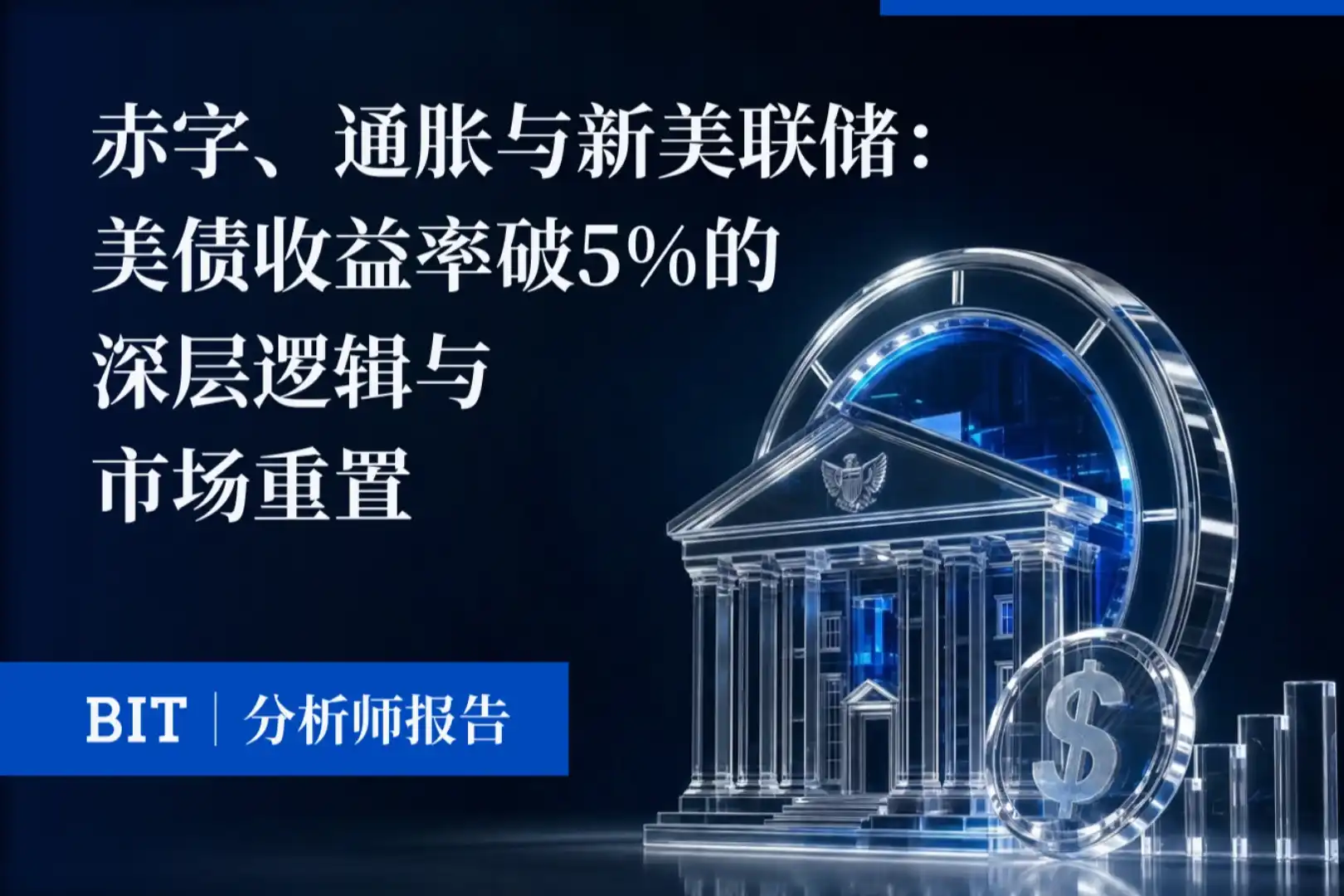
Deficits, Inflation, and the New Fed: The Deep Logic Behind US Bond Yields Breaking 5% and the Market Reset

In the week of May 15-19, 2026, U.S. long-term Treasury yields surged to multi-year highs, with the 30-year yield hitting 5.2%, a level unseen since 2007, and the 10-year yield climbing to 4.687%. Equity markets declined in response. Four primary factors are driving the rise in yields. First, stubborn inflation persists, with April wholesale prices rising 6% year-over-year, fueling expectations of potential future Fed rate hikes instead of cuts. Second, newly confirmed Fed Chair Kevin Warsh inherits a complex inflation battle, with markets closely awaiting his first FOMC meeting. Third, deteriorating U.S. fiscal health, marked by large deficits and rising debt servicing costs, is eroding the traditional "safe-haven" premium for Treasuries. Fourth, the "One Big Beautiful Bill" tax cuts are projected to add trillions to the national debt, contributing to Moody's recent credit rating downgrade. Rising yields pressure stocks through several channels: a higher discount rate reduces the present value of future earnings (especially for growth stocks); rising risk-free rates compress equity risk premiums, making bonds relatively more attractive; higher borrowing costs impact consumers and corporations; and a stronger dollar affects multinational earnings. For investors, the environment favors value and financial stocks over long-duration growth stocks. Bond investors find attractive yields in short to intermediate maturities, while income investors see the best fixed-income opportunities in over a decade. Key developments to watch include Chair Warsh's first FOMC meeting, upcoming inflation data, Treasury auction demand, and whether the 30-year yield approaches 6%, a level that could trigger a more sustained equity valuation reset. The bond market's message is clear: the era of cheap government borrowing is over, posing a central challenge for markets in late 2026.

marsbit2 ч. назад

Deficits, Inflation, and the New Fed: The Deep Logic Behind US Bond Yields Breaking 5% and the Market Reset

marsbit2 ч. назад

Торговля

Спот
Фьючерсы

Популярные статьи

Как купить T

Добро пожаловать на HTX.com! Мы сделали приобретение Threshold Network Token (T) простым и удобным. Следуйте нашему пошаговому руководству и отправляйтесь в свое крипто-путешествие.Шаг 1: Создайте аккаунт на HTXИспользуйте свой адрес электронной почты или номер телефона, чтобы зарегистрироваться и бесплатно создать аккаунт на HTX. Пройдите удобную регистрацию и откройте для себя весь функционал.Создать аккаунтШаг 2: Перейдите в Купить криптовалюту и выберите свой способ оплатыКредитная/Дебетовая Карта: Используйте свою карту Visa или Mastercard для мгновенной покупки Threshold Network Token (T).Баланс: Используйте средства с баланса вашего аккаунта HTX для простой торговли.Третьи Лица: Мы добавили популярные способы оплаты, такие как Google Pay и Apple Pay, для повышения удобства.P2P: Торгуйте напрямую с другими пользователями на HTX.Внебиржевая Торговля (OTC): Мы предлагаем индивидуальные услуги и конкурентоспособные обменные курсы для трейдеров.Шаг 3: Хранение Threshold Network Token (T)После приобретения вами Threshold Network Token (T) храните их в своем аккаунте на HTX. В качестве альтернативы вы можете отправить их куда-либо с помощью перевода в блокчейне или использовать для торговли с другими криптовалютами.Шаг 4: Торговля Threshold Network Token (T)С легкостью торгуйте Threshold Network Token (T) на спотовом рынке HTX. Просто зайдите в свой аккаунт, выберите торговую пару, совершайте сделки и следите за ними в режиме реального времени. Мы предлагаем удобный интерфейс как для начинающих, так и для опытных трейдеров.

807 просмотров всегоОпубликовано 2024.03.29Обновлено 2025.03.21

Как купить T

Обсуждения

Добро пожаловать в Сообщество HTX. Здесь вы сможете быть в курсе последних новостей о развитии платформы и получить доступ к профессиональной аналитической информации о рынке. Мнения пользователей о цене на T (T) представлены ниже.

活动图片