Microsoft CEO's Lengthy Post: Two Types of Capital in the Future, Human Capital + Token Capital

marsbitPublished on 2026-06-15Last updated on 2026-06-15

Abstract

Microsoft CEO Satya Nadella published a long essay titled "A frontier without an ecosystem is not stable," expressing deep concerns about the future of enterprises in the AI-driven economy. He argues that AI is fundamentally changing competition by enabling models to absorb and commodify human expertise, potentially allowing a few dominant AI systems to capture disproportionate economic value. To counter this, Nadella introduces the concepts of "Human Capital" (employee knowledge, judgment, creativity) and "Token Capital" (proprietary AI capabilities). He emphasizes that these two forms of capital must create a compounding "learning loop" within organizations, where human guidance drives AI improvement and accumulated institutional knowledge becomes a key competitive advantage. Nadella warns against a future where industries are hollowed out by a few AI models, similar to past outsourcing waves. Instead, he calls for building a diverse AI ecosystem where every company can innovate, retain control over its intellectual property, and ensure value flows broadly across the economy.

Last night, Microsoft CEO Satya Nadella posted a lengthy thread on X titled "A frontier without an ecosystem is not stable".

This thread attracted massive attention as soon as it went live, and its view count has now surpassed 28 million.
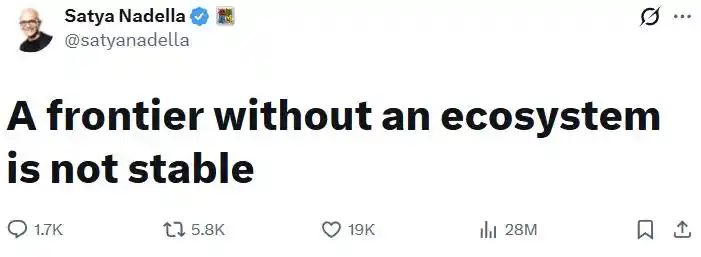
Original post: https://x.com/satyanadella/status/2066182223213293753

Nadella profoundly explores the future form of enterprises, digital sovereignty, and the socio-economic impact of AI development in an AI-driven economic era.

He introduces two concepts: "Human Capital" and "Token Capital".

In his view, AI is changing the underlying logic of corporate competition. In the past, companies bought or built digital tools to enhance human efficiency: tools amplified people, and people created value. But today, AI models themselves possess the ability to absorb human expertise and "commoditize" it. A model, after learning enough enterprise data, can turn the unique skills originally belonging to a company into a standard service accessible to everyone.

In this way, AI seems to have the ability to devour other software services, or as Nadella puts it, "every company in every industry is ceding value to a handful of voracious, all-consuming models."

This also worries him greatly. In the text, he calls for "We cannot allow a handful of AI systems to capture all the economic returns."

Interestingly, world's richest man Elon Musk, who often mocks Microsoft, commented with a sarcastic tone that the article was interesting:
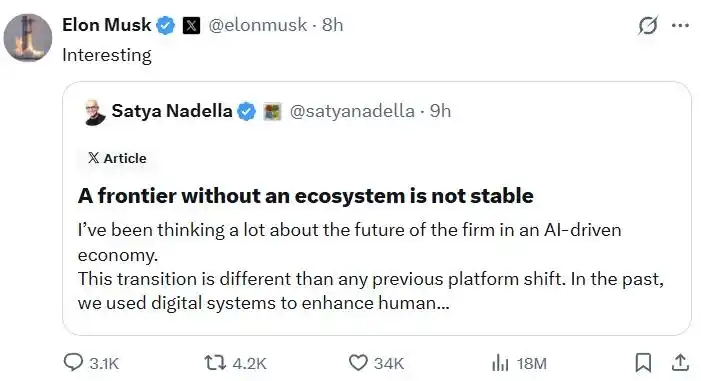
After all, this blog post seems to validate a comment Musk made in August last year: "OpenAI is going to eat Microsoft alive."
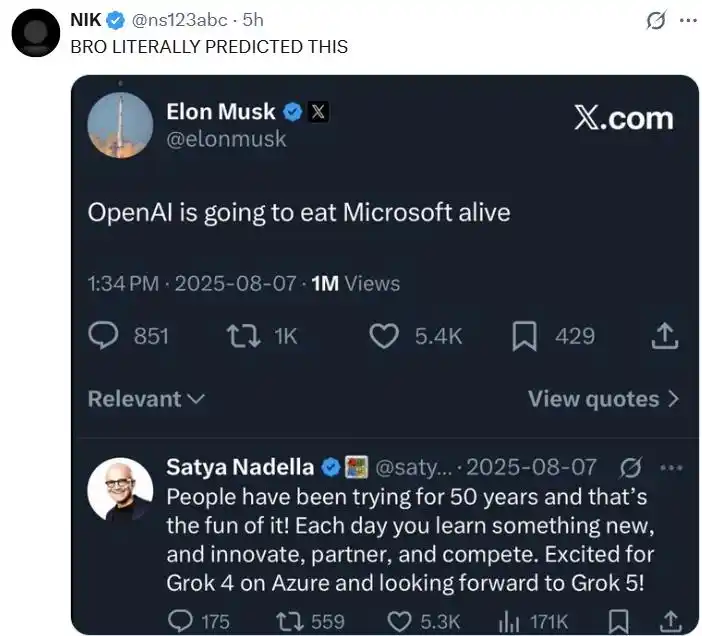
At that time, Nadella had just announced that GPT-5 would be fully integrated into Microsoft's Copilot, GitHub, and Azure product lines. His response was then light and confident: "People have wanted to eat us for 50 years, and that's what makes it fun!"

The implication of Musk's words is clear: Microsoft's proud software empire is handing over its own moat to a partner. In the field of AI, relying on someone else's model will eventually be replaced by that model.

Today's post indicates that Nadella no longer possesses that same confidence.

The following is a full translation of Nadella's post:

I've been thinking about the future of the enterprise in an AI-driven economy.

This shift is unlike any previous platform transition. In the past, we used digital systems to augment human capital. For the first time, we can establish a genuine cognitive loop between humans and digital systems. This is deeply disruptive because it changes how we conceive of work inside the enterprise.

The key issue transcends the use of certain digital tools or systems. What we need to focus on is how organizations can continue to learn, build intellectual property, stay differentiated, and thrive in a world where AI models can continuously absorb and commoditize the expertise of humans and organizations.

Every company must build what I call "Human Capital" and "Token Capital":

Human Capital encompasses employees' knowledge, judgment, relationships, creativity, and pattern recognition abilities.

Token Capital represents the AI capabilities that a company builds and owns.

Importantly, the value of Human Capital does not decrease as Token Capital grows. It only becomes more valuable! I believe human agency will be the driver of Token Capital growth. Humans will set audacious goals, connect dots across domains, build relationships, and identify the most critical patterns. Without human direction, compute just spins its wheels.

This means the real opportunity is not in picking the best model. We should build a learning loop on top of models where Human Capital and Token Capital compound. You can outsource a task, even a job, but you can never outsource your learning process. The future of a firm depends on its ability to accumulate this learning compound between humans and AI.

This requires a new kind of architectural approach, one where every enterprise can build agentic systems that evolve over time while maintaining control over their intellectual property. A company should be able to swap out a "general" model while retaining the "corporate veteran" level expertise accumulated in its learning system. This will be a crucial "test" of your control and sovereignty in the era to come.

Enterprises need to turn their workflows, domain knowledge, and accumulated judgment into AI systems that improve with every use. Private evaluation frameworks should capture whether models are truly getting better at the outcomes that matter most to the enterprise (external benchmarks aren't enough!). Private reinforcement learning environments should make models stronger on the execution trajectories real to the organization. Its knowledge base makes institutional memory queryable and token use more efficient.

This loop becomes the new intellectual property of the enterprise. I think of it as a hill-climbing machine. And unlike most assets, it compounds. Every improved workflow generates better training signals, accelerating the accumulation of tacit knowledge unique to the firm. Companies that build this early will have an advantage that's hard to replicate, no matter what new capabilities individual models come up with.

We cannot have a world where every company in every industry cedes value to a handful of voracious, all-consuming models. Assume all value gets captured by a few models, the political economy won't tolerate it. Society won't accept an AI future that hollows out entire industries.

Think back to what happened in the first phase of globalization when whole industrial economies were hollowed out by offshoring. Even though GDP numbers looked good on paper, the job losses were real and the consequences are still with us today. We cannot bring that dynamic into the AI era, with a few AI systems capturing all the economic returns while whole industries watch their knowledge get commoditized without even realizing it.

In my view, our imperative must be to build a frontier ecosystem. Merely building a frontier model isn't enough. Only then will value flow broadly across every company, every industry, and every country. In this ecosystem, every organization can own the learning loops that encode its institutional knowledge and compound its Human and Token Capital.

This is the ethos I grew up with: platforms should enable more value creation on top than they capture inside, so every company can innovate and create its own value.

When that happens, enterprises will create value for themselves and the economies around them. Employees will see their expertise amplified, their judgment becoming part of a system that's replicable and scalable. And the gains will accrue to the businesses and communities around them.

This is how enterprises drive value for themselves and the broader economy. And it's the stable equilibrium we should build together.

This article is from the WeChat public account "Machine Heart" (ID: almosthuman2014), author: Machine Heart


Trending Cryptos

Related Questions

QAccording to Satya Nadella, what are the two types of capital that every company must build in the AI era?

AAccording to Satya Nadella, every company must build 'Human Capital' and 'Token Capital'. 'Human Capital' encompasses employee knowledge, judgment, relationships, creativity, and pattern recognition. 'Token Capital' represents the AI capabilities that a company builds and owns.

QWhat is Nadella's main concern about the concentration of AI model development?

ANadella's main concern is that if value is concentrated in just a few all-encompassing AI models, the socio-economic system will not tolerate it. He warns against a future where companies across industries cede their value to a handful of models, leading to the commoditization of their unique knowledge and expertise without fair economic return.

QWhat is the key 'test' of control and sovereignty for companies in the future, as described in the article?

AThe key 'test' is a company's ability to preserve the accumulated, proprietary expertise within its learning system—akin to 'institutional veteran' knowledge—even when it switches out or replaces the underlying 'general-purpose' AI models.

QWhat does Nadella compare the learning loop between human and AI capital to, and why is it significant?

ANadella compares the learning loop between human and AI capital to a 'stairmaster' or compound interest machine. It is significant because, unlike most assets that depreciate, this loop compounds: each improved workflow generates better training signals, accelerating the accumulation of unique, implicit knowledge and creating a competitive advantage that is difficult to replicate.

QHow does Elon Musk's past comment relate to the themes in Nadella's article?

AElon Musk's past comment that 'OpenAI will eat Microsoft alive' relates thematically to Nadella's concern about AI models becoming central value extractors. The article suggests that Musk's quip highlights the risk of a company (like Microsoft) potentially ceding its competitive edge by relying heavily on a partner's AI model, which could eventually subsume the value traditionally captured by its software ecosystem.

Related Reads

Why Is the World Nervous About Japan Raising Interest Rates?

In June 2026, the Bank of Japan raised its policy rate to 1%, marking its first hike to this level since 1995. While this rate remains low compared to global peers like the US and Europe, the move signals a profound shift for a nation that has been a global source of ultra-cheap funding for decades. Japan's long-standing near-zero or negative interest rates had facilitated massive "yen carry trades," where international investors borrowed low-cost yen to invest in higher-yielding assets worldwide, such as US tech stocks and emerging market bonds. This made Japan a critical, often overlooked, source of global liquidity. Japan's ultra-loose policy stemmed from structural challenges post-1990s asset bubble: aging demographics, chronic low inflation/deflation, and high public debt. Recent shifts, including sustained wage growth (exceeding 5% in recent years) and inflation consistently above the 2% target, have created a "wage-price spiral" possibility, prompting the policy normalization. The global market's concern lies not in the absolute rate but in the potential unwinding of the yen carry trade. As Japanese borrowing costs rise, the economics of these leveraged global investments change, potentially triggering deleveraging and capital outflows from risk assets. Market anxiety focuses on the end of a thirty-year consensus that Japan would perpetually provide cheap funding. Ultimately, the global impact will depend on the interplay with US monetary policy. While Japan is tightening, the significant interest rate differential with the US remains. The key future dynamic is whether simultaneous Japanese hikes and eventual US rate cuts will narrow this gap, forcing a major recalibration of global capital flows and asset pricing built on an era of abundant, cheap yen liquidity.

marsbit1h ago

Why Is the World Nervous About Japan Raising Interest Rates?

marsbit1h ago

Research Report Analysis: MRVL's Optical AI Booming, Why High Valuation Keeps Morgan Stanley's Star Analyst Sidelined?

Report Recap: MRVL Optical AI Boom - Why High Valuation Led Morgan Stanley's Star Analyst to Stay Neutral? Morgan Stanley analyst Joseph Moore maintained an "Equal-weight" (Neutral) rating on Marvell Technology (MRVL) on May 28, raising the price target from $172 to $195, below the trading price. This stance comes despite Marvell reporting a record quarter and significantly raising its full-year outlook (FY27 revenue ~$11.5B, up ~40%). Moore's neutral view is based on valuation. The $195 target implies ~40x CY2027 P/E. He contrasts MRVL with NVDA: both trade near ~$200, but Nvidia's forward EPS is more than double Marvell's. For MRVL's valuation to hold, it needs consistent earnings upgrades, proof of networking market share gains, or certainty on large-scale custom AI chip shipments—none of which are confirmed yet. Growth is driven by two pillars: **1) Optical Interconnect** (the faster runner): Moore raised FY27 growth expectations to >70%, with the optical module product line nearing a $1B annualized run rate. **2) Custom AI Chips** (the climber): Confidence in FY28 is growing, but a major new customer project only ramps in FY28, with no current revenue visibility. Key risks are the underperforming Storage, Enterprise, and legacy Networking segments. Moore acknowledges the real AI opportunity but believes the current price already reflects it. For the stock to work from here, investors need to see the optical business hit its targets, custom chips ramp as planned, and a recovery in the weaker business units.

marsbit2h ago

Research Report Analysis: MRVL's Optical AI Booming, Why High Valuation Keeps Morgan Stanley's Star Analyst Sidelined?

marsbit2h ago

qinbaFrank: Review and Outlook of the AI Computing Power Wave — From the Three Debates on NVIDIA to Optical Interconnect and SpaceX IPO, How is Capital Rotating?

**Summary: Retrospective and Outlook on the AI Computing Wave - A Framework for Capital Rotation** Based on a presentation by investor qinbaFrank, this analysis reviews the AI computing market trajectory since 2023 and outlines a forward-looking framework. **Key Phases and Market Debates:** The AI bull market progressed through three major debates: 1) The necessity of massive capital expenditure (late 2023). 2) The sustainability of tech giants' spending (early 2024-early 2025). 3) Potential overestimation of compute needs (early 2025). Consensus solidified in late 2025 as model capabilities and utility demonstrably improved. **Core Thesis: Penetration Rate Drives Commercialization.** Unlike the 2000 dot-com bubble, the current AI wave benefits from mature digital infrastructure, enabling faster adoption. The critical threshold is 10% penetration; surpassing it (with recent enterprise intent surveys showing ~18%) indicates entry into a rapid growth "golden period" where user scale and willingness to pay increase simultaneously. **AI vs. Internet: A Fundamental Difference.** While the internet enhanced connection efficiency, AI directly substitutes human cognition and labor. Once AI performance exceeds the "societal average" human level, its commercial value scales exponentially as payment shifts from human labor costs to AI service fees. **Investment Logic Evolution in the Compute Chain.** The focus has expanded from GPUs to a systemic re-rating of the entire hardware stack: storage/HBM, CPUs, interconnects, power, and advanced packaging. The framework is: **short-term "scarcity pricing," mid-term "upgrade pricing" (e.g., optical interconnects, power networks), and long-term "Physical AI" pricing** (edge computing, robotics). **Market Focus Shift and Adjustment Framework.** The market is transitioning from "hardware scarcity" to "commercialization validation." The ultimate anchor for the narrative is sustained high growth in model providers' Annual Recurring Revenue (ARR) and cloud business revenue, which justifies continued capital expenditure. Adjustments are categorized into three levels: * **L1 (Minor):** Driven by valuation compression or macro noise (e.g., single CPI print). Fundamentals intact. * **L2 (Moderate):** Triggered by significant macro events requiring risk repricing. Requires new data for confidence restoration. * **L3 (Major):** Involves a reset of the core industrial narrative or macro regime (e.g., AI commercialization growth stalling). The **crucial dividing line** is whether AI commercialization growth slows. Without a slowdown, pullbacks are likely L1/L2 "repricing" events. A genuine growth deceleration would signal an L2/L3 narrative reset. **Conclusion: A Foundational Civilizational Leap.** AI represents a foundational upgrade to "intelligence" itself—akin to humanity mastering fire—rather than a single-point industrial revolution. This底层能力跃迁 (underlying capability leap) will spawn successive waves of innovation (Agent, robotics, industry workflow重构). The journey will be波浪式的 (wavelike), driven by cycles of scarcity, technological upgrades, and远期兑现 (long-term realization).

marsbit2h ago

qinbaFrank: Review and Outlook of the AI Computing Power Wave — From the Three Debates on NVIDIA to Optical Interconnect and SpaceX IPO, How is Capital Rotating?

marsbit2h ago

Trading

Spot
Futures

Hot Articles

Discussions

Welcome to the HTX Community. Here, you can stay informed about the latest platform developments and gain access to professional market insights. Users' opinions on the price of S (S) are presented below.

活动图片