Bitcoin Down 20% Over the Past 90 Days, While Stocks Have Risen

cryptonews.ruPublished on 2026-08-11Last updated on 2026-08-11

Abstract

According to Glassnode, Bitcoin has underperformed stocks significantly. Over the past 90 days, Bitcoin fell 20%, a drop four times larger than the S&P 500's 5% gain. This year, the crypto market has been the worst-performing among major asset classes, with Bitcoin down 35% and altcoins down 57% since January. In contrast, commodities like gold, copper, and silver, alongside stock indices, have posted substantial gains. Glassnode states the market will remain stock-dominated until Bitcoin begins to recover its relative performance against these indices. This trend persisted over the past week. Notably, in July, Bitcoin and Ethereum posted gains of 9% and 20% respectively, diverging from a broader stock market correction and breaking their previously high correlation with tech stocks. Robert Mitchnick of BlackRock views this decoupling from equities as "useful" for investors seeking diversification, calling July a potential turning point. He noted improving market sentiment and a resumed inflow into Bitcoin ETFs, with BlackRock's IBIT seeing significant August inflows. U.S. spot Bitcoin ETFs had their strongest week since mid-April in early August.

According to Glassnode, Bitcoin is significantly lagging behind stocks, and until it begins to recover its position, the current market will continue to be dominated by equities.

Over the past 90 days, Bitcoin has fallen by 20%, which is four times greater than the S&P 500 index's 5% gain over the same period.

Looking at a longer timeframe, the cryptocurrency market has shown the worst performance among major asset classes this year.

Since January, Bitcoin has fallen by 35%, and altcoins by 57%.

In contrast, gold has increased by 60%, copper by 66%, and silver by 107%. The Nasdaq and Russell 2000 indices have risen by 38% and 31% respectively, making cryptocurrencies the weakest asset on this list for the stated period.
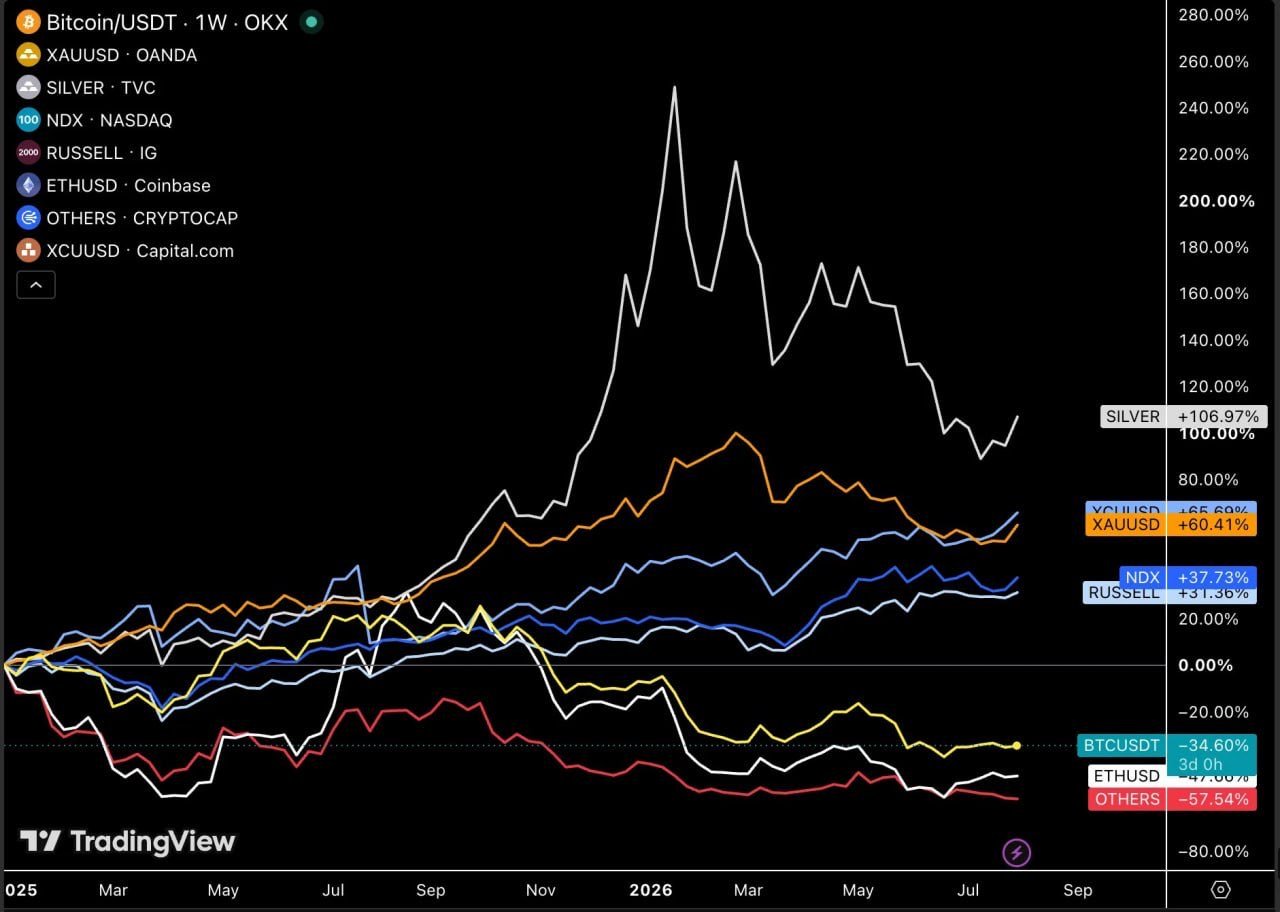
In its message on Tuesday, Glassnode stated the market will continue to be led by stocks until this gap narrows.

According to Glassnode, Markets Are Still "Influenced by the Stock Market," Except for Bitcoin Movements

According to Glassnode, this trend continued throughout the past week as well.

"The last 7 days show the same pattern," Glassnode wrote. "Until Bitcoin recovers its position relative to the indices, the market will still be oriented towards stocks."

Over the past 90 days, the S&P 500 index rose by 5%, while Bitcoin fell by 20%. The last 7 days demonstrate the same trend.

Until Bitcoin recovers its position relative to the indices, the situation remains predominantly stock-oriented.

It is noteworthy that NASDAQ is lagging behind other major indices, indicating an unfavorable situation... pic.twitter.com/TpfDwoYB9y

— glassnode (@glassnode) August 11, 2026

Glassnode's statement highlights Bitcoin's market dynamics in July.

In July, stocks of companies in artificial intelligence and semiconductors experienced a sharp market correction, with ETFs investing in the chip industry falling by more than 20%. The Nasdaq-100 index also fell by nearly 7%.

However, in the same month, Bitcoin and Ethereum rose by 9% and 20% respectively, distinguishing them from the rest of the stock market.

This is a significant change compared to their previous close correlation. In May, according to TradingView data, the 90-day correlation between Bitcoin and Nasdaq was 0.89. By July 28, K33 Research found the 30-day correlation had dropped to 0.43.

BlackRock States That Such a Separation Is a "Useful" Phenomenon

Robert Mitchnick, Head of Digital Assets at BlackRock, stated on Monday that Bitcoin's separation from stocks is "useful" for investors who see Bitcoin as a means of diversification, calling July's performance a turning point for the cryptocurrency market.

Mitchnick also noted that sentiment in the cryptocurrency market began to improve over the past month, and inflows into ETFs have resumed.

According to SoSoValue, as of August 7, the net assets of BlackRock's iShares Bitcoin Trust (IBIT) were $48.51 billion, and in August the company attracted $693.64 million.

"Over the last month or so, we've seen a noticeable, albeit subtle, shift in sentiment," Mitchnick said.

U.S. spot Bitcoin ETFs brought in $853.5 million for the week ending August 7, the best result since mid-April. IBIT accounted for about $693 million of that amount.


Trending Cryptos

Related Questions

QAccording to Glassnode, why is the market still dominated by stocks?

AAccording to Glassnode, the market will continue to be dominated by stocks until Bitcoin begins to recover and narrow the performance gap with major stock indices like the S&P 500.

QWhat was the performance difference between Bitcoin and the S&P 500 over the last 90 days?

AOver the last 90 days, Bitcoin fell by 20%, while the S&P 500 index grew by 5%.

QHow does Bitcoin's performance in 2026 compare to other major asset classes like gold or silver?

AIn 2026, Bitcoin has been the worst-performing major asset class. Since January, Bitcoin fell by 35%, while gold increased by 60%, silver by 107%, and the Nasdaq and Russell 2000 indices grew by 38% and 31% respectively.

QWhat significant market shift was observed in July regarding Bitcoin and stocks?

AIn July, Bitcoin and Ethereum rose by 9% and 20% respectively, diverging from the stock market, which experienced a sharp correction, particularly in AI and semiconductor stocks. This broke their previously strong correlation with indices like the Nasdaq.

QAccording to BlackRock's Robert Mitchnick, why is the decoupling of Bitcoin from stocks 'useful'?

ABlackRock's Robert Mitchnick stated that the decoupling of Bitcoin from stocks is 'useful' for investors who view Bitcoin as a means of portfolio diversification. He cited July's performance as a potential turning point for the crypto market.

Related Reads

The Last Mile of Stablecoins: MoneyGram Connects Crypto Wallets to Cash Outlets in Over 170 Countries

Stablecoins have revolutionized cross-border payments with speed and low cost, but a fundamental barrier remains: converting digital money into physical cash in most parts of the world. On August 11th, global remittance giant MoneyGram announced its "MoneyGram Ramps" crypto-cash service is now live on the Solana blockchain. This allows developers, via a simple API, to connect their applications to MoneyGram's network of nearly 500,000 cash agent locations across over 170 countries. Users can now walk into a local MoneyGram agent to convert their USDC into local currency cash or use cash to purchase USDC for their wallets. Solana wallet Rift is the first to integrate the service. MoneyGram, founded in 1940 and historically second only to Western Union in global remittance volume, was privatized in 2023. Since then, it has accelerated its shift into a fintech platform, opening its compliance capabilities, cash network, and settlement infrastructure as services for developers. Its involvement with crypto is not new, having previously partnered with Ripple, Stellar, and Circle, and even issuing its own stablecoin, MGUSD, on Stellar in 2026. The Ramps API solves a critical physical obstacle to stablecoin adoption. While a USDC transfer from New York to Lagos takes seconds and costs cents on-chain, the recipient often lacks a bank account to access the funds. MoneyGram's extensive physical agent network, prevalent in regions like Sub-Saharan Africa, Southeast Asia, and Latin America, bridges this gap, connecting on-chain dollars to the offline cash-based economy. No crypto-native company could replicate this network quickly. MoneyGram chose Solana for its multi-chain expansion due to its extremely low transaction fees (often less than a cent) and fast confirmation times, making it ideal for small-value, frequent remittances. Solana's developer ecosystem is also geared toward consumer-facing applications. This partnership represents a pragmatic path for stablecoins in everyday remittances. Users don't need to understand blockchain or have a bank account; they simply visit a trusted local agent. The underlying settlement shifts from SWIFT to Solana, but the user experience remains familiar. The true path to stablecoin adoption is being paved by an 85-year-old remittance company, using its physical network to solve the "last mile" problem for crypto.

marsbit11m ago

The Last Mile of Stablecoins: MoneyGram Connects Crypto Wallets to Cash Outlets in Over 170 Countries

marsbit11m ago

How to Adapt to Frequent Miraculous Comebacks After the New Patch When Trading in Polymarket's LOL Section?

After recent League of Legends (LoL) game updates, major comebacks and unpredictable outcomes have become more frequent, making trading on Polymarket's LoL prediction markets challenging. This article analyzes the causes and offers adaptation strategies. The author, a longtime LoL fan turned Polymarket trader, notes that post-update, a large early-game gold lead no longer guarantees victory. The current meta reduces the decisive weight of economy, emphasizing instead "advantage conversion, resource trading, team composition strength, and teamfight execution." Key systemic changes aiding comebacks include: Bounty/Kill Gold Compensation, Strategic Objective Bounties, and reduced Baron Nashor rewards. Furthermore, the prevalence of mage picks in the bot lane, instead of traditional marksmen (ADC), can lower sustained damage and teamfight reliability in the late game, contributing to throws. For more successful trading, the article suggests: 1. **Choosing the Right Region:** Prioritize major regions (LPL, LCK, LEC, LCS) where matches matter for World Championship qualification or player contracts, leading to more serious play. Avoid or be extremely cautious with regions like CBLOL (Brazil), TCL (Turkey), and North American Challengers, citing high volatility and potential for unreliable outcomes. 2. **Trading Strategies:** * **Placing Orders:** Use limit orders below market price for strong favorites. In close matchups, consider placing equal low-ball bids (e.g., 25-40 cents) on both sides of a match; if both fill for a total under $1, you secure profit regardless of the winner. Exploit team "power spikes" by buying low before their composition peaks and selling high. * **Timely Selling:** The most crucial lesson is to take profits. If you buy the early-leading team at a low price (e.g., 50-60 cents), sell most of your position (e.g., 75%) at 85-90 cents to lock in gains and avoid a potential comeback zeroing your position. * **Position Sizing:** Practice strict risk management. Do not exceed 5-10% of your capital per match and avoid "tilting" or chasing losses after a few bad trades. In summary, adapting to the new meta requires understanding that early advantages are less stable. Success depends on analyzing team compositions, player form, and regional contexts, combined with disciplined order placement, profit-taking, and capital preservation. The next patch in August is expected to revive traditional ADCs, potentially shifting the dynamics again.

Odaily星球日报23m ago

How to Adapt to Frequent Miraculous Comebacks After the New Patch When Trading in Polymarket's LOL Section?

Odaily星球日报23m ago

Strategy CEO Announces Plan to Resume Bitcoin Purchases This Year, With Buying Volume 25 Times Selling Volume

Strategy CEO Announces Resumption of Bitcoin Purchases This Year, Buy-to-Sell Ratio at 25x In a FOX Business interview, Phong Le, CEO of Strategy (formerly MicroStrategy), stated the company plans to resume its Bitcoin acquisition strategy within the current year. This ends a pause in buying that began in May. Le revealed that since the start of the year, Strategy has purchased approximately 175,000 bitcoins while selling around 7,000, making its buy volume about 25 times its sell volume. The company remains the world's largest corporate holder of Bitcoin, with 840,447 BTC, representing roughly 4% of the circulating supply. Le explained that recent sales were used to fulfill capital obligations under a newly approved framework, including paying preferred stock dividends, funding share buybacks, and bolstering the company's US dollar reserves, which now stand at about $4.7 billion. This move marks a shift from the firm's previous "never sell" mantra, which had contributed to its market premium. The change in strategy and the associated financial pressures led to a significant drop in its stock price (MSTR) and a rating downgrade from JPMorgan. The CEO framed the company's role as the "JPMorgan of the crypto economy," emphasizing its long-term goal of increasing the amount of Bitcoin per MSTR share. The announcement signals the return of a major institutional buyer to the Bitcoin market, which could provide price support. It is also viewed as a micro-indicator of recovering institutional confidence, suggesting the company believes the most acute phase of liquidity pressure has passed.

marsbit45m ago

Strategy CEO Announces Plan to Resume Bitcoin Purchases This Year, With Buying Volume 25 Times Selling Volume

marsbit45m ago

ArthurHayes新文:押注日元升值,ENA未来几月或涨5至10倍

Arthur Hayes argues that the Japanese Yen is significantly undervalued and posits that its appreciation against the US Dollar is imminent. He outlines three potential mechanisms for this shift, dismissing the first two—the Bank of Japan raising interest rates and domestic institutions selling foreign assets—as politically or economically unfeasible. He identifies the third and preferred method: the Japanese Ministry of Finance (MOF) using its holdings of US Treasuries as collateral in the Fed's FIMA repo facility to borrow US dollars, then selling those dollars to buy Yen in the forex market. Hayes believes US Treasury Secretary Bessant has signaled support for this approach, which requires the Fed's Foreign Currency Subcommittee, led by Chairman Walsh, to remove lending limits on the FIMA tool. Hayes asserts that implementing this "Scheme 3" would lead to a significant expansion of US dollar liquidity. He predicts this surge in liquidity will act as a catalyst, driving up the prices of assets like Bitcoin and physical gold. Within the crypto space, he views Ethereum (ETH) as undervalued and singles out Ethena's ENA token as a speculative play with potential for 5-10x gains in the coming months, contingent on a recovery in Bitcoin basis trades that would boost demand for its USDe stablecoin. He concludes that investors should watch for the Fed's rule change as the key trigger for these market movements.

marsbit57m ago

ArthurHayes新文:押注日元升值,ENA未来几月或涨5至10倍

marsbit57m ago

Trading

Spot

Hot Articles

What is $BITCOIN

DIGITAL GOLD ($BITCOIN): A Comprehensive Analysis Introduction to DIGITAL GOLD ($BITCOIN) DIGITAL GOLD ($BITCOIN) is a blockchain-based project operating on the Solana network, which aims to combine the characteristics of traditional precious metals with the innovation of decentralized technologies. While it shares a name with Bitcoin, often referred to as “digital gold” due to its perception as a store of value, DIGITAL GOLD is a separate token designed to create a unique ecosystem within the Web3 landscape. Its goal is to position itself as a viable alternative digital asset, although specifics regarding its applications and functionalities are still developing. What is DIGITAL GOLD ($BITCOIN)? DIGITAL GOLD ($BITCOIN) is a cryptocurrency token explicitly designed for use on the Solana blockchain. In contrast to Bitcoin, which provides a widely recognized value storage role, this token appears to focus on broader applications and characteristics. Notable aspects include: Blockchain Infrastructure: The token is built on the Solana blockchain, known for its capacity to handle high-speed and low-cost transactions. Supply Dynamics: DIGITAL GOLD has a maximum supply capped at 100 quadrillion tokens (100P $BITCOIN), although details regarding its circulating supply are currently undisclosed. Utility: While precise functionalities are not explicitly outlined, there are indications that the token could be utilized for various applications, potentially involving decentralized applications (dApps) or asset tokenization strategies. Who is the Creator of DIGITAL GOLD ($BITCOIN)? At present, the identity of the creators and development team behind DIGITAL GOLD ($BITCOIN) remains unknown. This situation is typical among many innovative projects within the blockchain space, particularly those aligning with decentralized finance and meme coin phenomena. While such anonymity may foster a community-driven culture, it intensifies concerns about governance and accountability. Who are the Investors of DIGITAL GOLD ($BITCOIN)? The available information indicates that DIGITAL GOLD ($BITCOIN) does not have any known institutional backers or prominent venture capital investments. The project seems to operate on a peer-to-peer model focused on community support and adoption rather than traditional funding routes. Its activity and liquidity are primarily situated on decentralized exchanges (DEXs), such as PumpSwap, rather than established centralized trading platforms, further highlighting its grassroots approach. How DIGITAL GOLD ($BITCOIN) Works The operational mechanics of DIGITAL GOLD ($BITCOIN) can be elaborated on based on its blockchain design and network attributes: Consensus Mechanism: By leveraging Solana’s unique proof-of-history (PoH) combined with a proof-of-stake (PoS) model, the project ensures efficient transaction validation contributing to the network's high performance. Tokenomics: While specific deflationary mechanisms have not been extensively detailed, the vast maximum token supply implies that it may cater to microtransactions or niche use cases that are still to be defined. Interoperability: There exists the potential for integration with Solana’s broader ecosystem, including various decentralized finance (DeFi) platforms. However, the details regarding specific integrations remain unspecified. Timeline of Key Events Here is a timeline that highlights significant milestones concerning DIGITAL GOLD ($BITCOIN): 2023: The initial deployment of the token occurs on the Solana blockchain, marked by its contract address. 2024: DIGITAL GOLD gains visibility as it becomes available for trading on decentralized exchanges like PumpSwap, allowing users to trade it against SOL. 2025: The project witnesses sporadic trading activity and potential interest in community-led engagements, although no noteworthy partnerships or technical advancements have been documented as of yet. Critical Analysis Strengths Scalability: The underlying Solana infrastructure supports high transaction volumes, which could enhance the utility of $BITCOIN in various transaction scenarios. Accessibility: The potential low trading price per token could attract retail investors, facilitating wider participation due to fractional ownership opportunities. Risks Lack of Transparency: The absence of publicly known backers, developers, or an audit process may yield skepticism regarding the project's sustainability and trustworthiness. Market Volatility: The trading activity is heavily reliant on speculative behavior, which can result in significant price volatility and uncertainty for investors. Conclusion DIGITAL GOLD ($BITCOIN) emerges as an intriguing yet ambiguous project within the rapidly evolving Solana ecosystem. While it attempts to leverage the “digital gold” narrative, its departure from Bitcoin's established role as a store of value underscores the need for a clearer differentiation of its intended utility and governance structure. Future acceptance and adoption will likely depend on addressing the current opacity and defining its operational and economic strategies more explicitly. Note: This report encompasses synthesised information available as of October 2023, and developments may have transpired beyond the research period.

1.8k Total ViewsPublished 2025.05.13Updated 2025.05.13

What is $BITCOIN

Discussions

Welcome to the HTX Community. Here, you can stay informed about the latest platform developments and gain access to professional market insights. Users' opinions on the price of BTC (BTC) are presented below.

活动图片