US Treasury Buys Up Government Debt: Cryptocurrencies Surge on Treasury Yield Collapse

cryptonews.ruPublished on 2026-08-22Last updated on 2026-08-22

Abstract

U.S. Treasury Buys Up Government Debt: Cryptocurrencies Surge Amid Treasury Yield Plunge Bitcoin rose nearly 19% between August 14-21, 2026, reaching a new 2.5-month high, with its best single-day gain in six months occurring on August 19. The primary catalyst was a U.S. Treasury announcement to at least double purchases of long-term government bonds, causing Treasury yields to crash and capital to flow into risk assets like Bitcoin. Positive rhetoric from President Donald Trump regarding crypto legislation and massive short liquidations (over $2.1bn vs. only $48.19m in longs) fueled the rally. Spot Bitcoin ETFs saw their first weekly inflow since January, totaling $1bn, led by BlackRock's IBIT. Ethereum surged over 26% during the same period, breaking above $2,300 for the first time since May, driven by spiking trading volume and a $291.47m inflow to spot Ethereum ETFs. Development progressed for the upcoming "Glamsterdam" hard fork. Other major beneficiaries included Dogecoin (+20.12%), Zcash (+31.28% on news of Grayscale's latest spot ETF filing), and Ethena (+59.5% following a $1bn lending program launch with FalconX). Overall, the week was marked by a broad crypto market surge fueled by the Treasury's bond-buying policy, increased exchange volumes, and forced short covering.

Bitcoin gained almost 19% from August 14 to August 21, 2026. This allowed $BTC to update its price maximum for the last two and a half months. Wednesday, August 19, when the largest cryptocurrency by market capitalization grew by more than 7%, became the best day in the last six months.
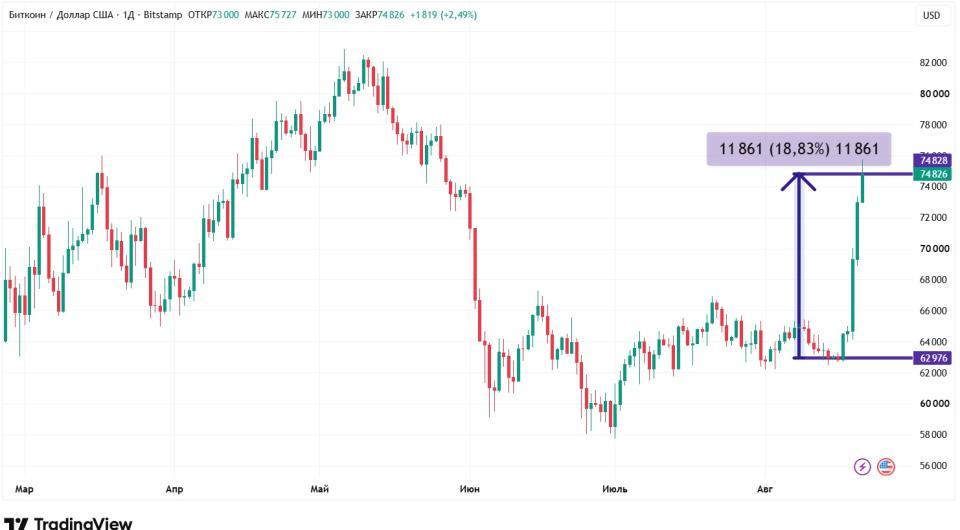
Source: tradingview.com

The main catalyst for the rapid growth of Bitcoin was the statement by the US Department of the Treasury about increasing the purchase of government bonds with maturities from 10 to 20 and from 20 to 30 years at least twofold. The statement triggered a collapse in Treasury yields and a flow of capital into risky assets like Bitcoin.

$BTC received support from a meeting between Donald Trump and representatives of the crypto industry on August 19. The American president urged Congress to consider the stalled CLARITY bill. Trump's positive rhetoric regarding cryptocurrencies added optimism to investors.

Another reason for the growth of $BTC was mass short liquidations from August 19 to August 21. In less than three days, short positions worth over $2.1 billion were forcibly closed. During the same period, only $48.19 million in long positions were liquidated, which is 43.6 times less.
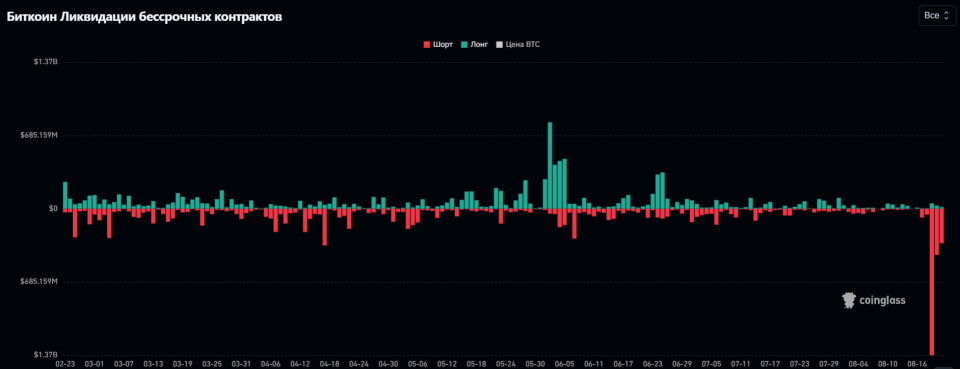
Source: coinglass.com

Spot Bitcoin ETFs recorded a weekly inflow of funds of $1 billion for the first time since January. The majority of this amount, $588.54 million, came from BlackRock's fund, the iShares Bitcoin Trust (IBIT).
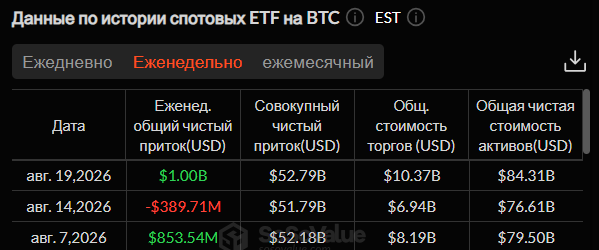
Source: sosovalue.com

From a technical analysis perspective, Bitcoin's trend has become upward. This is confirmed by the price overcoming the 50-day moving average (marked in blue) and its position well above it. However, the RSI indicator has entered the overbought zone, which serves as a harbinger of at least a short-term correction. The former resistance level of $67,253 has now become support. The principle of polarity change has worked. The new resistance on the daily chart is the zone around $76,000.
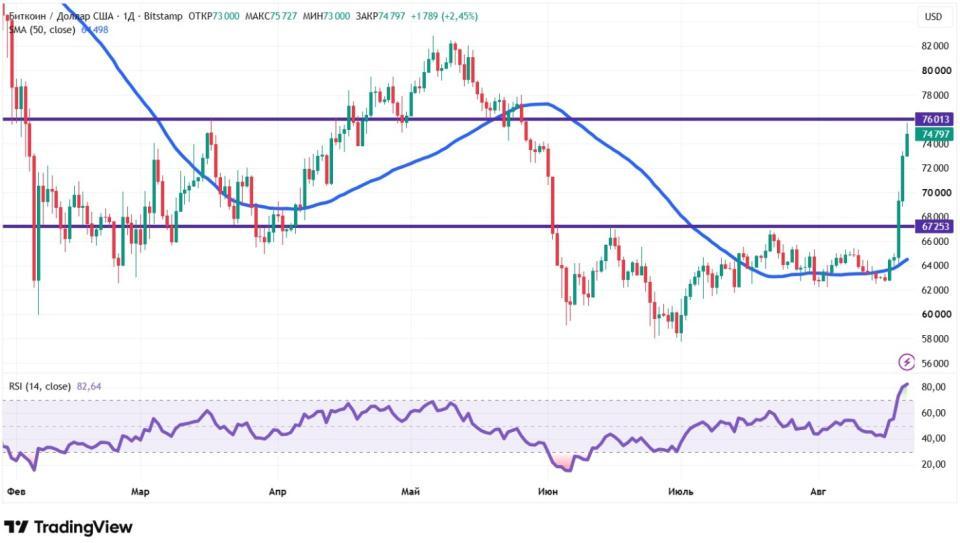
Source: tradingview.com

The Fear and Greed Index made a huge gain of 43 points to 72 compared to last week. Greed now prevails in the sentiments of crypto investors.

Ethereum

Ether added more than 26% from August 14 to August 21. $ETH rose above $2300 for the first time since May. Most of the growth occurred on Wednesday, August 19, when the second-largest cryptocurrency by market capitalization rose in price by 17.51%.
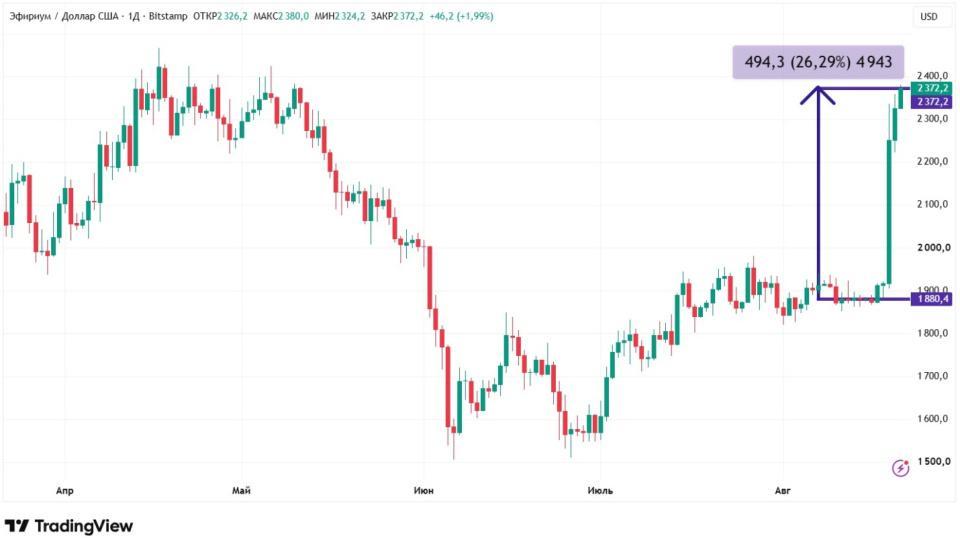
Source: tradingview.com

The growth of Ether was facilitated by a surge in trading volume. According to Coinglass, on August 20, the cumulative figure exceeded $90 billion. Prior to this, Ether's trading volume last reached such figures on June 6.
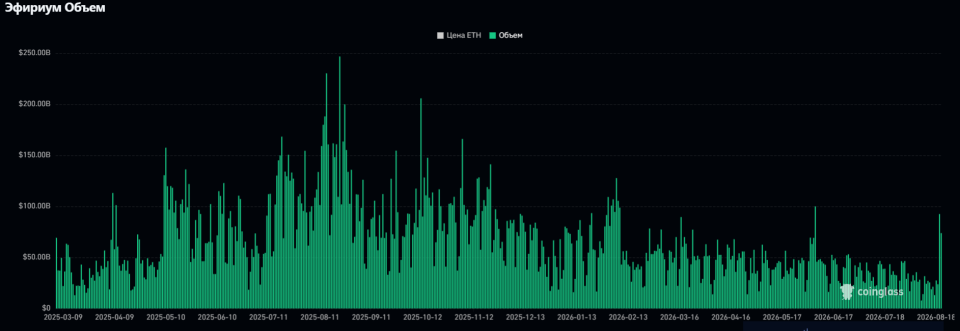
Source: coinglass.com

Spot Ethereum ETFs recorded an inflow of funds for the sixth time in seven weeks. Its size this time was $291.47 million. The majority of this amount, $212.7 million, came from BlackRock's fund, the iShares Ethereum Trust (ETHA).

Ethereum continues to prepare for the Glamsterdam hard fork. This week, developers launched a new test network, Plataberget. It will be used to test the capabilities of the hard fork. Then Glamsterdam will be deployed in the older test networks Sepolia and Hoodi. Presumably, Plataberget will involve 50,000 validators distributed across 50 nodes to test various combinations of client software.
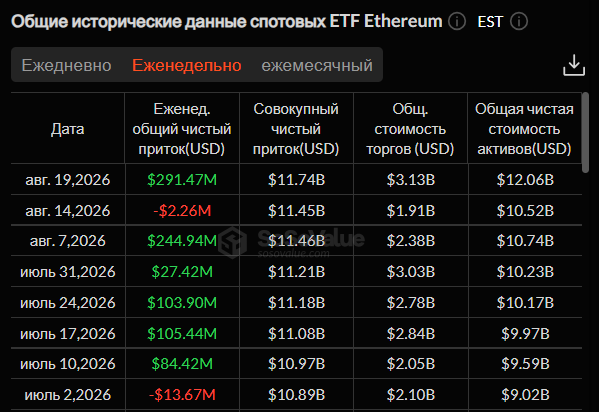
Source: sosovalue.com

From a technical analysis perspective, Ether, like Bitcoin, has switched to an upward trend. Confirmation is the price exceeding the 50-day moving average (marked in blue). Nevertheless, the Stochastic has risen into the overbought zone, indicating a likely correction in the near future. The nearest support and resistance levels on the daily chart are $2219.3 and $2469.3.
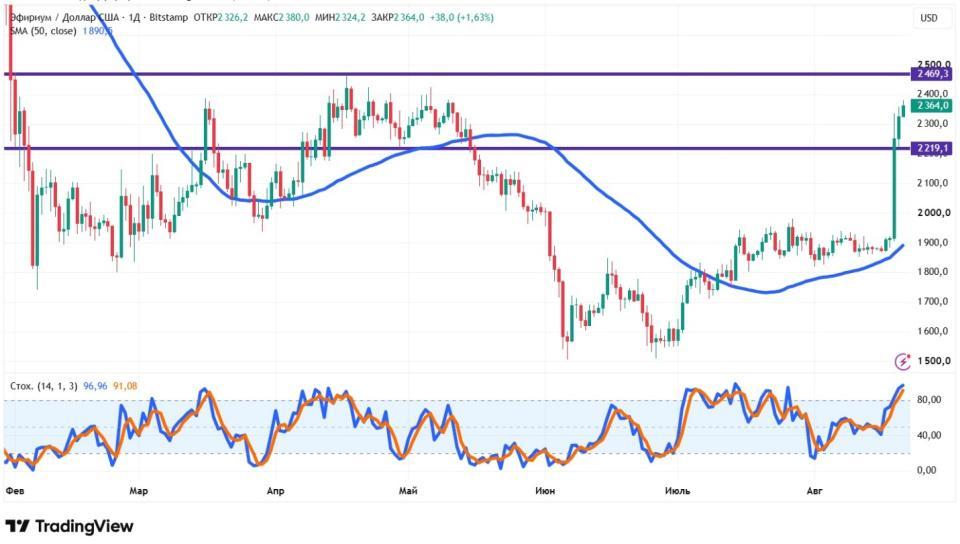
Source: tradingview.com

Dogecoin

The largest memecoin by market capitalization, Dogecoin, like other major altcoins, also became a beneficiary of the growth of $BTC and $ETH. Co-founder of this cryptocurrency Billy Markus, known under the pseudonym Shibetoshi Nakamoto, commented on this:

"Crypto is back!?!?!?!?! Is the 2026 nightmare over ?!?!!?"

Statements on social networks usually have a strong influence on the mood of DOGE holders and investors. This time, the positivity resulted in a 20.12% growth from August 14 to August 21.
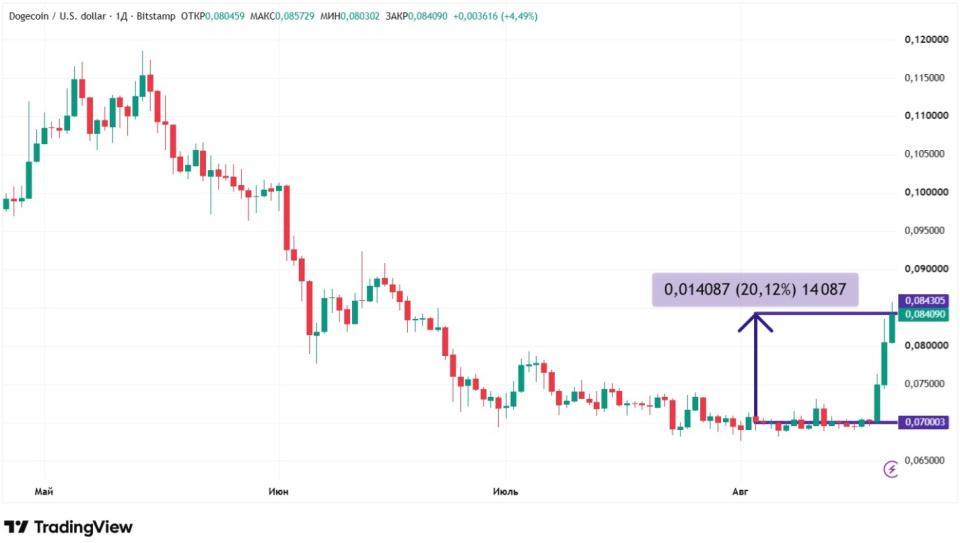
Source: tradingview.com

Zcash

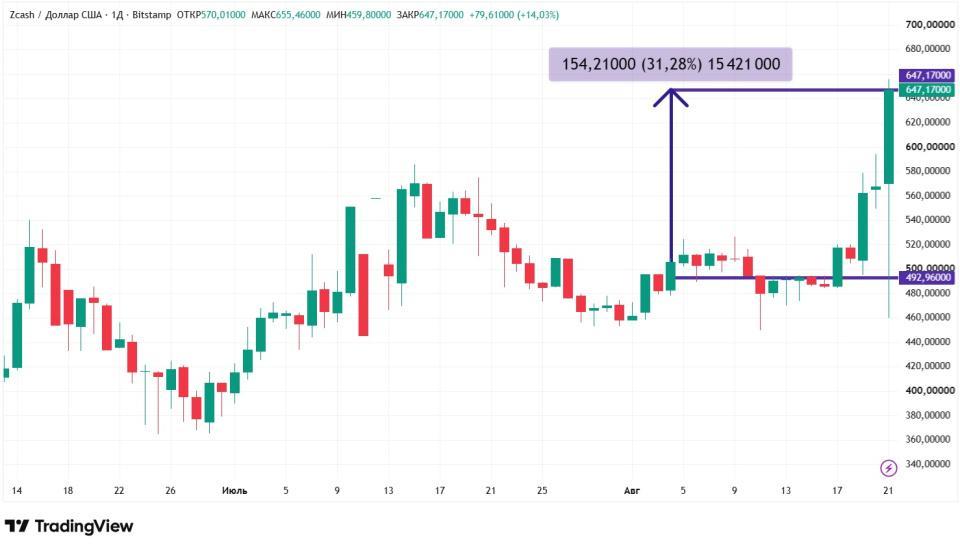
The crypto industry is getting closer to the appearance of the first spot ETF on $ZEC. This week, Grayscale filed its fourth version of an application with the US Securities and Exchange Commission (SEC) to convert its Grayscale Zcash Trust into an exchange-traded fund. Compared to the previous version, the main difference is in how ETF shares will be created and redeemed. Primarily for fiat money. However, the option for in-kind creation of shares remains, but for redemption, it does not. It also discloses the intention of DCG, Grayscale's parent company, to invest 200,000 $ZEC (about $110 million) in the fund's shares through an authorized market participant on the exchange. The potential new ETF will trade on the NYSE Arca platform, but information on management fees is not yet disclosed.

The appearance of a spot exchange-traded fund on Zcash suggests an inflow of corporate capital. It is not surprising that investors reacted positively to the news, resulting in a weekly growth of 31.28%.
Source: tradingview.com

Ethena

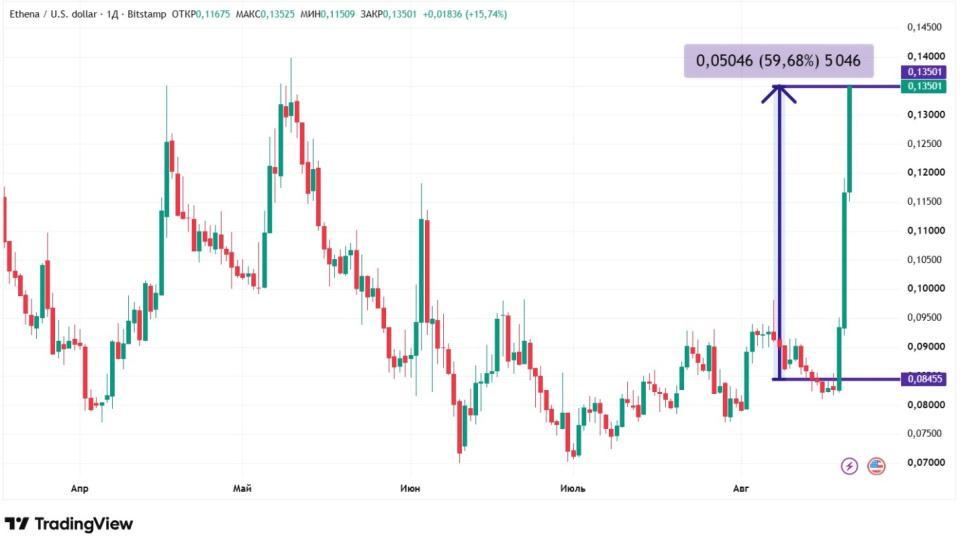
Developers of the Ethena cryptocurrency, together with the crypto brokerage company FalconX, launched a $1 billion lending program. The program is designed for corporate investors. The reserves backing the stablecoin $USDe will be used as loanable funds. Loans can be taken out with collateral exceeding the value of the borrowed assets. FalconX is responsible for all administrative work. The benefit for Ethena is an additional source of income related to $USDe.

Against the backdrop of the launch of a new product, as well as general optimism in the crypto market, Ethena added 59.5% over the past week, approaching its May highs.
Source: tradingview.com

Conclusion

The result of the week was a stormy growth in the price of Bitcoin and altcoins. Investors positively received the news about the increase in the budget that the US Department of the Treasury will allocate for the purchase of government bonds. This caused an increase in trading volumes on crypto exchanges and the liquidation of short positions of speculators.

This material and the information in it are not individual or any other recommendation. The opinion of the editorial staff may not coincide with the opinions of analytical portals and experts.



end-content

Trending Cryptos

Related Questions

QWhat was the main catalyst for Bitcoin's rapid rise according to the article?

AThe main catalyst was the announcement by the U.S. Department of the Treasury to at least double the purchase of government bonds with maturities of 10 to 20 and 20 to 30 years. This statement triggered a collapse in Treasury yields and a flow of capital into risk assets like Bitcoin.

QWhat were the two key reasons, besides the Treasury announcement, that supported Bitcoin's price increase from August 14-21, 2026?

AFirst, a meeting between Donald Trump and crypto industry representatives on August 19, where he urged Congress to consider the stalled CLARITY bill, providing positive investor sentiment. Second, massive short liquidations from August 19-21, totaling over $2.1 billion, far exceeding long liquidations.

QWhich asset had the highest weekly gain from August 14-21, 2026, and what was a major event driving its price?

AEthena had the highest weekly gain at 59.5%. This surge was driven by the launch of a new $1 billion lending program in partnership with crypto broker FalconX, aimed at institutional investors and using the reserves backing the $USDe stablecoin.

QWhat positive development for Zcash was reported, and what was the market's reaction?

AGrayscale filed its fourth version of an application to convert its Grayscale Zcash Trust into a spot ETF. The application revealed that DCG, Grayscale's parent company, intends to invest 200,000 ZEC (about $110 million) into the fund's shares. The market reacted positively, with Zcash gaining 31.28% for the week.

QWhat change in market sentiment was indicated by the Fear and Greed Index compared to the previous week?

AThe Fear and Greed Index surged by 43 points to 72 compared to the previous week, indicating that greed had become the prevailing sentiment among crypto investors.

Related Reads

Grayscale Report: Financial Privacy in the AI Era, Why Zcash Should Not Be Overlooked?

Title: Grayscale Report: Financial Privacy in the AI Era – Why Zcash Should Not Be Overlooked The article argues that privacy is a fundamental, not niche, attribute of functional money. It highlights that technological shifts, like the rise of AI and stablecoins, are driving a new wave of public focus on financial privacy. Zcash, a decentralized digital currency similar to Bitcoin but with built-in privacy via zero-knowledge proofs, is positioned to address this need. Unlike transparent blockchains, Zcash offers users the option to conduct "shielded" transactions that hide sender, receiver, and amount while remaining verifiable. The report details Zcash's evolution, noting key upgrades that improved usability and security. It points to rising on-chain usage of privacy features as evidence of real demand. Currently, ZEC holds a minimal share (~0.4%) of the total crypto market cap. Grayscale suggests this reflects a market assumption that privacy is a marginal concern. The investment thesis hinges on a potential market re-evaluation: if privacy is recognized as a core monetary feature in an era of enhanced surveillance, Zcash's current valuation represents significant upside potential. Key risks discussed include regulatory challenges, historical trusted setup concerns for older pools (mitigated by newer protocols), quantum computing threats, and execution risks associated with future technical upgrades. The conclusion is that while the future scale of private digital currency is uncertain, the market currently prices in little chance of its value increasing substantially, presenting a potential opportunity for investors.

marsbit57m ago

Grayscale Report: Financial Privacy in the AI Era, Why Zcash Should Not Be Overlooked?

marsbit57m ago

Vitalik Moves to Local Mixing as Obfuscation Series Reaches Third Stage

Ethereum co-founder Vitalik Buterin published the third part of his series on cryptographic obfuscation, focusing on a method called "local mixing." This method abandons lattices and elliptic curves in favor of ideas borrowed from hash function design. Buterin described local mixing as a "completely different way of cryptography," free from elliptic curves, prime factorization, and lattices, making it more akin to symmetric cryptography used in everyday encryption. The process begins with a circuit of logic gates like XOR, AND, and NOT. It undergoes a pipeline that ensures a correct output while obscuring any trace of the internal logic. Key steps include adding reversibility, strengthening, mechanization, mixing, and finally obfuscation. The mixing step scatters extra logic gates and shuffles their arrangement. Reversibility is foundational, allowing gates to be rewritten as other reversible gates with similar behavior. Buterin acknowledged local mixing is a "wild and risky undertaking," lying on the "graveyard of failed attempts at white-box cryptography." However, its proponents argue it needs more research effort and a willingness to accept higher overhead costs. Buterin suggested AI could accelerate its development. He called obfuscation the "final boss of cryptography," with the most complex constructions having runtimes exceeding the universe's age. The article concludes by explaining obfuscation's utility: it can encrypt a program so it still functions with normal inputs and outputs while hiding the code. Combined with blockchain, this moves toward a "trusted third party that requires no trust," enabling applications like private, collusion-resistant voting without relying on a trusted committee.

cryptonews.ru1h ago

Vitalik Moves to Local Mixing as Obfuscation Series Reaches Third Stage

cryptonews.ru1h ago

Trading

Spot

Hot Articles

What is $BITCOIN

DIGITAL GOLD ($BITCOIN): A Comprehensive Analysis Introduction to DIGITAL GOLD ($BITCOIN) DIGITAL GOLD ($BITCOIN) is a blockchain-based project operating on the Solana network, which aims to combine the characteristics of traditional precious metals with the innovation of decentralized technologies. While it shares a name with Bitcoin, often referred to as “digital gold” due to its perception as a store of value, DIGITAL GOLD is a separate token designed to create a unique ecosystem within the Web3 landscape. Its goal is to position itself as a viable alternative digital asset, although specifics regarding its applications and functionalities are still developing. What is DIGITAL GOLD ($BITCOIN)? DIGITAL GOLD ($BITCOIN) is a cryptocurrency token explicitly designed for use on the Solana blockchain. In contrast to Bitcoin, which provides a widely recognized value storage role, this token appears to focus on broader applications and characteristics. Notable aspects include: Blockchain Infrastructure: The token is built on the Solana blockchain, known for its capacity to handle high-speed and low-cost transactions. Supply Dynamics: DIGITAL GOLD has a maximum supply capped at 100 quadrillion tokens (100P $BITCOIN), although details regarding its circulating supply are currently undisclosed. Utility: While precise functionalities are not explicitly outlined, there are indications that the token could be utilized for various applications, potentially involving decentralized applications (dApps) or asset tokenization strategies. Who is the Creator of DIGITAL GOLD ($BITCOIN)? At present, the identity of the creators and development team behind DIGITAL GOLD ($BITCOIN) remains unknown. This situation is typical among many innovative projects within the blockchain space, particularly those aligning with decentralized finance and meme coin phenomena. While such anonymity may foster a community-driven culture, it intensifies concerns about governance and accountability. Who are the Investors of DIGITAL GOLD ($BITCOIN)? The available information indicates that DIGITAL GOLD ($BITCOIN) does not have any known institutional backers or prominent venture capital investments. The project seems to operate on a peer-to-peer model focused on community support and adoption rather than traditional funding routes. Its activity and liquidity are primarily situated on decentralized exchanges (DEXs), such as PumpSwap, rather than established centralized trading platforms, further highlighting its grassroots approach. How DIGITAL GOLD ($BITCOIN) Works The operational mechanics of DIGITAL GOLD ($BITCOIN) can be elaborated on based on its blockchain design and network attributes: Consensus Mechanism: By leveraging Solana’s unique proof-of-history (PoH) combined with a proof-of-stake (PoS) model, the project ensures efficient transaction validation contributing to the network's high performance. Tokenomics: While specific deflationary mechanisms have not been extensively detailed, the vast maximum token supply implies that it may cater to microtransactions or niche use cases that are still to be defined. Interoperability: There exists the potential for integration with Solana’s broader ecosystem, including various decentralized finance (DeFi) platforms. However, the details regarding specific integrations remain unspecified. Timeline of Key Events Here is a timeline that highlights significant milestones concerning DIGITAL GOLD ($BITCOIN): 2023: The initial deployment of the token occurs on the Solana blockchain, marked by its contract address. 2024: DIGITAL GOLD gains visibility as it becomes available for trading on decentralized exchanges like PumpSwap, allowing users to trade it against SOL. 2025: The project witnesses sporadic trading activity and potential interest in community-led engagements, although no noteworthy partnerships or technical advancements have been documented as of yet. Critical Analysis Strengths Scalability: The underlying Solana infrastructure supports high transaction volumes, which could enhance the utility of $BITCOIN in various transaction scenarios. Accessibility: The potential low trading price per token could attract retail investors, facilitating wider participation due to fractional ownership opportunities. Risks Lack of Transparency: The absence of publicly known backers, developers, or an audit process may yield skepticism regarding the project's sustainability and trustworthiness. Market Volatility: The trading activity is heavily reliant on speculative behavior, which can result in significant price volatility and uncertainty for investors. Conclusion DIGITAL GOLD ($BITCOIN) emerges as an intriguing yet ambiguous project within the rapidly evolving Solana ecosystem. While it attempts to leverage the “digital gold” narrative, its departure from Bitcoin's established role as a store of value underscores the need for a clearer differentiation of its intended utility and governance structure. Future acceptance and adoption will likely depend on addressing the current opacity and defining its operational and economic strategies more explicitly. Note: This report encompasses synthesised information available as of October 2023, and developments may have transpired beyond the research period.

2.0k Total ViewsPublished 2025.05.13Updated 2025.05.13

What is $BITCOIN

Discussions

Welcome to the HTX Community. Here, you can stay informed about the latest platform developments and gain access to professional market insights. Users' opinions on the price of BTC (BTC) are presented below.

活动图片