DOJ Crypto Unit Closure Sparks Scrutiny Of Deputy AG’s Personal Crypto Stakes

bitcoinistPublished on 2026-01-29Last updated on 2026-01-29

Abstract

The Justice Department's decision to disband its National Cryptocurrency Enforcement Team (NCET) in April 2025 is under scrutiny from six US senators. They are questioning Deputy Attorney General Todd Blanche about potential conflicts of interest due to his personal cryptocurrency holdings. The senators, including Mazie Hirono and Elizabeth Warren, demand documents and a full explanation for the unit's closure and whether Blanche's finances influenced the decision. Critics argue the timing of his divestment raises ethical concerns, while supporters claim it was approved by ethics officials. The lawmakers are seeking a detailed timeline and records to ensure federal conflict-of-interest laws were followed.

The Justice Department’s move last year to shut a specialized crypto enforcement team is drawing fresh fire after six US senators pressed the deputy attorney general for answers about his personal stakes in digital assets.

The lawmakers say the timing and Deputy Attorney General Todd Blanche’s holdings raise real questions about conflicts that need clear records and a full explanation.

Senators Demand Answers

Reports say the letter, dated January 28, 2026, was sent by Senator Mazie Hirono and joined by Senators Elizabeth Warren, Richard Durbin, Sheldon Whitehouse, Chris Coons, and Richard Blumenthal.

They asked Blanche to provide documents and explain why the National Cryptocurrency Enforcement Team (NCET) was disbanded in April 2025 and whether his own finances played any role in that decision. The lawmakers pointed to federal conflict rules and asked for the timeline and approvals behind the memo.
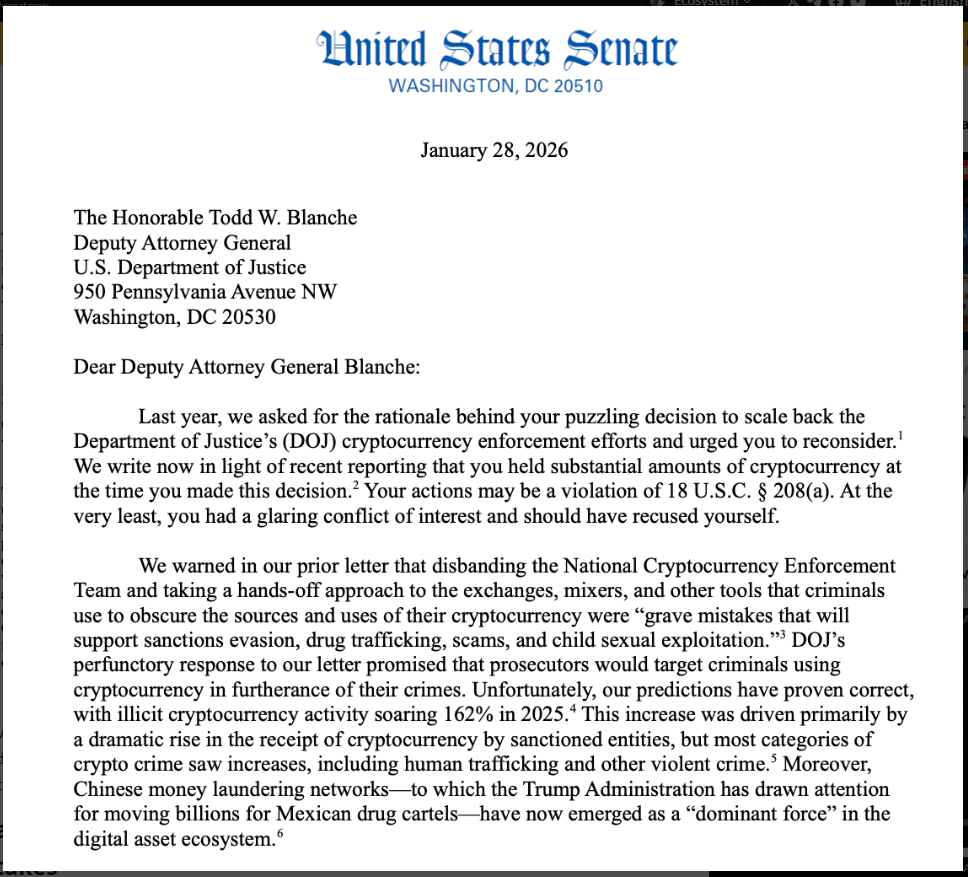
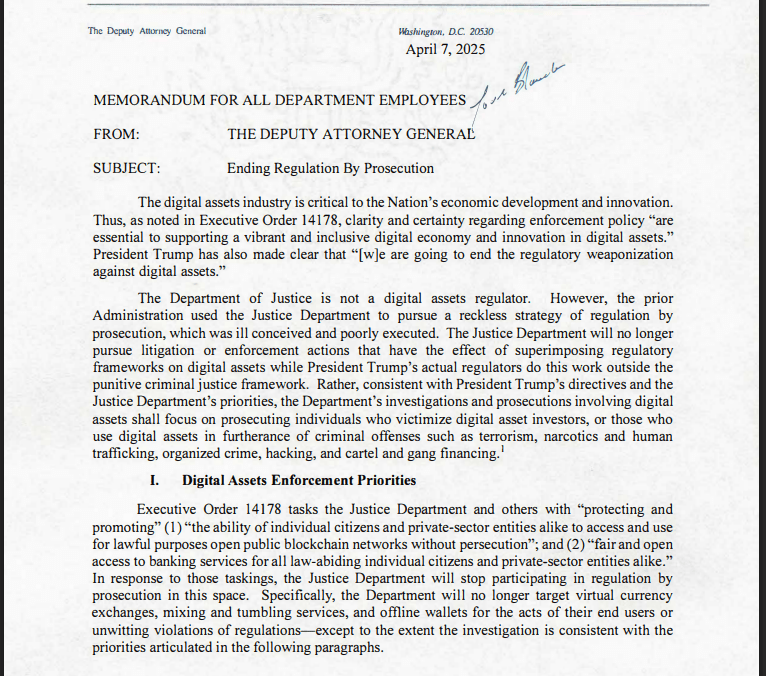
The memo signed by Deputy Attorney General Todd Blanche. Source: DOJ

He agreed to divest, and some sales or transfers happened weeks to months after the memo. Critics say that sequence looks bad and could run afoul of conflict rules; supporters say the matters were cleared by ethics officials.

People On Both Sides Are Talking

Proponents of the policy change argued it would avoid “regulation by prosecution” and let regulators handle oversight instead of criminal cases.

Industry groups welcomed the move as a way to reduce legal uncertainty for exchanges and developers.

Opponents, including the senators, say scaling back a focused enforcement unit risks leaving gaps that bad actors can exploit, especially as illicit activity in crypto has shown sharp swings in recent years.

BTCUSD now trading at $87,783. Chart: TradingView

What Comes Next

Lawmakers are now pushing for documents and sworn answers. They want to see when Blanche learned of the holdings, how fast divestment happened, and who inside DOJ reviewed and approved the memo.

The senators pointed to federal law that bars an official from participating in a matter when they have a financial interest, and they requested a timeline and supporting records to judge whether that law was respected.

Featured image from Getty Images, chart from TradingView

Related Questions

QWhat action by the US senators has brought renewed scrutiny to the closure of the DOJ's crypto enforcement team?

ASix US senators, led by Senator Mazie Hirono, sent a letter to Deputy Attorney General Todd Blanche pressing him for answers about his personal cryptocurrency holdings and the decision to disband the National Cryptocurrency Enforcement Team (NCET).

QWhat specific concerns did the senators raise regarding Deputy AG Todd Blanche?

AThe senators raised concerns about a potential conflict of interest, questioning whether Blanche's personal financial stakes in digital assets played a role in the decision to shut down the NCET and if the timing of his divestment complied with federal conflict-of-interest rules.

QWhat was the main argument from proponents who supported the policy change of closing the NCET?

AProponents argued that closing the specialized crypto enforcement team would avoid 'regulation by prosecution' and allow regulators, rather than criminal prosecutors, to handle oversight of the cryptocurrency industry.

QAccording to the article, what is the primary concern of the senators and other opponents of closing the NCET?

AOpponents are concerned that scaling back the focused enforcement unit creates gaps that bad actors can exploit, especially given the volatile nature of illicit activity in the cryptocurrency space in recent years.

QWhat specific information are the lawmakers demanding from Deputy AG Blanche and the DOJ?

AThe lawmakers are demanding documents and sworn answers detailing when Blanche learned of his crypto holdings, the timeline of his divestment, and which DOJ officials reviewed and approved the memo to disband the NCET, to ensure compliance with federal conflict-of-interest laws.

Related Reads

Weekly Editor's Picks (0124-0130)

Weekly Editor's Picks (0124-0130) by Odaily Planet Daily features in-depth articles from the past week. Key topics include: - **Investing & Startups**: Analysis suggests the silver rally, driven by capital flight, monetary devaluation, and industrial demand, may continue. Silver is seen as having a "Bitcoin moment," transitioning from "poor man's gold" to an industrial necessity. Concerns about a potential COMEX silver delivery failure by March 2026 are highlighted. The tokenization logic of gold (e.g., XAUt) and on-chain silver trading on platforms like Hyperliquid are also discussed. - **Policy & Stablecoins**: The real competition in stablecoin issuance lies in compliance, liquidity, redemption efficiency, and bundled services, not just the technical ability to create a token. - **Ethereum & Scaling**: In an interview, Vitalik Buterin expressed concern about the gap between Ethereum's technical capabilities and its original purpose of building decentralized applications (DeSoc, smarter DAOs). He noted that SocialFi faces structural issues where financial incentives can overwhelm social ones. - **CeFi & DeFi**: A report on on-chain stock perpetual contracts details their mechanisms to handle unique market structures and their role in merging traditional finance with crypto. The Trump family's crypto ventures, which added $1.4 billion to their wealth, are also examined. - **Web3 & AI**: A contrarian view bets against AI's success, arguing that excess production could threaten established power structures, making hard assets a better investment. - **Weekly Recap**: Key events include Bitcoin's drop to ~$81,200, Trump's potential Fed chair nomination, and the US establishing clearer crypto regulations. Gold approached $5,600 and silver hit a record high of $117/oz.

marsbit35m ago

Weekly Editor's Picks (0124-0130)

marsbit35m ago

Only 60% Real Win Rate: Data Reveals the Truth Behind ICO Predictions on Polymarket

Polymarket's TokenSale markets have processed nearly $250 million in volume, boasting impressive accuracy rates—100% for fundraising amounts and over 90% for fully diluted valuations (FDV). However, an analysis of 231 prediction markets across 29 token sales reveals these figures are misleading. The platform functions more as a sentiment indicator, often acting as a contrarian signal. Key findings show that the true prediction accuracy one week before market close is only 66.7%, meaning the crowd is wrong one-third of the time, with errors consistently skewing toward over-optimism. FDV predictions averaged a 35% overestimation. Analysis of 24-hour post-launch volatility showed an average price swing of ±23%, with 75% of tokens facing sell-offs. Only 62.5% of 24-hour FDV predictions were accurate. The 100% accuracy claim is meaningless because markets close after results are known. High trading volume on Polymarket often serves as a reverse indicator—more optimism typically leads to greater inaccuracy. Tokens with conservative predictions (e.g., Monad, Football.fun) saw smaller declines. Actionable signals: High volume (>$50M) and high optimism (>50% FDV overestimation) are bearish. Low volume (<$5M) and accurate predictions (within 20% of actual FDV) are relatively bullish. In a market where most tokens fall below ICO price, "less bad" is the best outcome. Polymarket’s token sales market is essentially a hype meter—extreme confidence often signals maximum investor pain.

marsbit1h ago

Only 60% Real Win Rate: Data Reveals the Truth Behind ICO Predictions on Polymarket

marsbit1h ago

Trading

Spot
Futures

Hot Articles

How to Buy MOVE

Welcome to HTX.com! We've made purchasing Movement (MOVE) simple and convenient. Follow our step-by-step guide to embark on your crypto journey.Step 1: Create Your HTX AccountUse your email or phone number to sign up for a free account on HTX. Experience a hassle-free registration journey and unlock all features.Get My AccountStep 2: Go to Buy Crypto and Choose Your Payment MethodCredit/Debit Card: Use your Visa or Mastercard to buy Movement (MOVE) instantly.Balance: Use funds from your HTX account balance to trade seamlessly.Third Parties: We've added popular payment methods such as Google Pay and Apple Pay to enhance convenience.P2P: Trade directly with other users on HTX.Over-the-Counter (OTC): We offer tailor-made services and competitive exchange rates for traders.Step 3: Store Your Movement (MOVE)After purchasing your Movement (MOVE), store it in your HTX account. Alternatively, you can send it elsewhere via blockchain transfer or use it to trade other cryptocurrencies.Step 4: Trade Movement (MOVE)Easily trade Movement (MOVE) on HTX's spot market. Simply access your account, select your trading pair, execute your trades, and monitor in real-time. We offer a user-friendly experience for both beginners and seasoned traders.

2.5k Total ViewsPublished 2024.12.10Updated 2025.03.21

Discussions

Welcome to the HTX Community. Here, you can stay informed about the latest platform developments and gain access to professional market insights. Users' opinions on the price of MOVE (MOVE) are presented below.

活动图片