Source: Bankless
Original Title: 5 Highlights from the U.S. Senate's Much-Hyped Crypto Market Structure Draft Bill
Author: Jack Inabinet
Compiled and Edited by: BitpushNews

The crypto market may finally get what it has long desired—a written market structure law. This is thanks to the "Digital Asset Market Clarity Act" (DAMCA) released last night. Due to some noteworthy compromises on the future development of cryptocurrency in the United States, the bill has garnered bipartisan support.
This 278-page text is the result of months of arduous negotiations among Senate Republicans, Democrats, and industry lobbyists.
It establishes a regulatory framework that divides the authority over digital assets between the U.S. Securities and Exchange Commission (SEC) and the Commodity Futures Trading Commission (CFTC).
The crypto community is likely to have mixed opinions on its provisions. Justin Slaughter, Policy Director at Paradigm, called the bill "a major victory for Democratic members of the Senate Banking Committee" and said it should have been passed during the Biden administration.
Today, we will delve into five key provisions of DAMCA to better understand the future evolution of transparency in the crypto market structure.
1. Strict Prohibition of Stablecoin Dividends
According to the Digital Asset Market Clarity Act, stablecoin issuers will be prohibited from distributing returns to passive holders.
Chapter 4 of DAMCA outlines the guidelines for regulated banking institutions to interact with digital assets. This chapter will prohibit stablecoin issuers (as defined in the GENIUS Act) from paying interest to holders.
Although DAMCA allows stablecoin issuers to distribute "rewards" tied to specific actions (such as account-opening incentives or cashback on spending), the fact is that protecting stablecoin returns has long been a firm red line for the crypto industry. Strict restrictions on stablecoins may put crypto-native issuers at a long-term disadvantage compared to the banking sector.
Nonetheless, many key crypto giants, including Coinbase, continue to support the wording of the bill regarding the prohibition of stablecoin returns. They see it as the worst provision they can tolerate without derailing the bill's momentum.
2. Clarity on Commodity Status
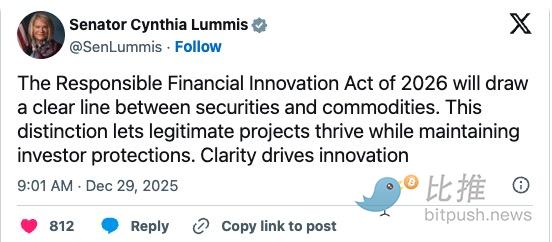
The 2026 Lummis-Gillibrand Responsible Financial Innovation Act (Chapter 1 of DAMCA) will amend the 1933 Securities Act to clarify when crypto network tokens transition from "securities" to "commodities."
According to this chapter, the SEC will, within 360 days of the bill's enactment, issue formal guidelines specifying when individuals involved in the initial offering, sale, or distribution of tokens, as well as the largest recipients of tokens, are considered "joint and several" issuers of those tokens.
Chapter 1 establishes broad oversight over anyone selling, controlling, or facilitating the initial distribution, raising concerns that even those who do not receive the largest share of tokens could be held liable. Additionally, it expands the SEC's jurisdiction to include tokens issued by foreign governments, tokens without a corporate structure, and tokens where Americans hold a majority stake.
This chapter provides some exemptions: if a network token does not attach any financial rights (such as profit-sharing or implied ownership interests), it can be considered a non-security (i.e., a commodity).
To obtain non-security status, the responsibility will fall on the network token project itself; asset issuers must submit a written certification to the SEC proving that their token is not a security. The SEC will have 60 days to reject this certification.
If a project does not or cannot certify its non-security status to the SEC, the law will require it to publish disclosure reports every six months—an obligation that alone occupies 12 pages in DAMCA. Projects with gross revenue exceeding $25 million must also publish financial statements audited by an independent public accountant.
Thankfully, Chapter 1 of DAMCA will not be retroactive. This means individuals who offered, sold, or distributed relevant tokens before the bill's enactment need not worry about retrospective legal liability.
3. DeFi Regulation
Chapter 3 of DAMCA explores the "decentralized" aspect of decentralized finance, outlining the circumstances under which crypto projects are considered—and not considered—truly "decentralized."
According to this chapter, a decentralized protocol should allow users to conduct financial transactions based on "predetermined, non-discretionary automated rules or algorithms" and, apart from the users themselves, not rely on any other party to maintain custody or control of their digital assets.
The label of "non-decentralized financial transaction protocol" will apply to any protocol where:
-
An individual or group has the ability to control or alter the application's functionality;
-
The application does not operate solely based on code;
-
An individual or group can restrict, censor, or prohibit user activities.
Non-decentralized protocols must comply with the 1934 Securities Exchange Act and the Bank Secrecy Act, and fulfill new registration, conduct, disclosure, record-keeping, and regulatory requirements.
While this chapter may harmonize the application of securities laws across different technologies and protect the public interest, it could also sweep up protocols with minimal operational control that are not immutable smart contract protocols (including those designed based on multi-signature technology or trusted execution environments).
Fortunately, Chapter 3 does contain a significant exemption: it allows a protocol's "security committee" to take "predefined, temporary, rule-based network emergency measures" in response to incidents like hacking attacks without jeopardizing its decentralized status.
Worryingly, Chapter 3 imposes requirements on "web-hosted" crypto wallets that allow users to interact with blockchain technology, mandating that such intermediaries comply with sanctions and anti-money laundering regulations. Confusingly, this regulation does not apply to "any software or hardware wallet that facilitates self-custody of digital assets by individuals."
4. "Micro-Innovation" Regulatory Sandbox
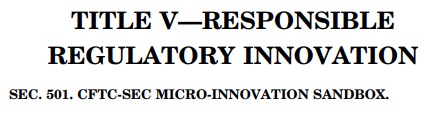
DAMCA requires the CFTC and SEC to establish a "Micro-Innovation Sandbox" within 360 days of the bill's enactment. This sandbox aims to "allow up to 10 eligible companies to test innovative activities within the United States" while still being subject to federal and state securities and commodities laws.
To participate in the sandbox, eligible entities must intend to engage in legitimate innovative activities within the U.S., have no more than 25 employees in any given fiscal year, and have gross revenue not exceeding $10 million.
All applications to enter the sandbox must be jointly approved by the CFTC and SEC. Program participants will receive regulatory exemptions, but the committees retain the discretion to revoke these exemptions at any time.
Sandbox participants must meet the disclosure requirements of both committees regarding matters within their jurisdiction. Any regulatory exemptions granted through this program will preempt any state securities or commodities registration requirements.
The program is limited to 20 projects per year, and the total funds controlled by participating companies from customers, investors, or counterparties must not exceed $20 million.
5. Crackdown on Digital Asset ATMs
Perhaps most surprisingly, the Digital Asset Market Clarity Act devotes significant effort to regulating digital asset kiosks—commonly known as Bitcoin ATMs.
According to Section 205 of DAMCA, digital asset kiosks will be designated as "money transmission businesses," imposing heavy regulatory burdens on operators of such "cash-for-crypto" machines.
Operators must submit a detailed inventory of their kiosks to the Secretary of the Treasury every 90 days, including the operator's legal name, trade name, physical address of each machine, and the types of digital assets supported for transactions.
Before conducting a transaction with a customer, operators must disclose the terms of the transaction in an easily readable manner, along with a series of government-mandated consumer risk warnings.
Additionally, digital asset kiosks must provide customers with receipts detailing transaction information and implement anti-fraud controls to prevent digital assets from being transferred to wallets known to be associated with fraudulent activities.
The Secretary of the Treasury will also have the discretionary authority to set daily deposit and withdrawal limits for digital asset kiosks. Until such limits are set, kiosk operators cannot conduct transactions exceeding $3,500 with a "new customer" within a 24-hour period.
Twitter:https://twitter.com/BitpushNewsCN
Bitpush TG Discussion Group:https://t.me/BitPushCommunity
Bitpush TG Subscription: https://t.me/bitpush