Coinbase Hit With Nevada Lawsuit Over Illegal Betting Claims

bitcoinistPublished on 2026-02-05Last updated on 2026-02-05

Abstract

Coinbase faces a civil lawsuit from the Nevada Gaming Control Board for offering event contracts that regulators claim constitute unlicensed sports betting. The state seeks a temporary restraining order and injunction to halt these operations, arguing they violate Nevada gaming laws. Coinbase contends that such contracts fall under federal CFTC jurisdiction, not state oversight, and has sued multiple states in response. The legal conflict highlights ongoing tension between state and federal regulators regarding prediction markets, as the CFTC considers new rules clarification. Similar enforcement actions are occurring in other states.

Coinbase is facing a civil enforcement action in Nevada after state gaming regulators said the company offered event contracts that look like wagers to local users.

Based on reports, the Nevada Gaming Control Board filed suit in state court asking a judge to stop Coinbase from offering these contracts inside Nevada and to grant a temporary restraining order and preliminary injunction.

Nevada Files Civil Enforcement Action

The complaint says Coinbase’s event contracts operate like unlicensed sports betting under Nevada law, and that the exchange did not hold the required state gaming license to offer them.
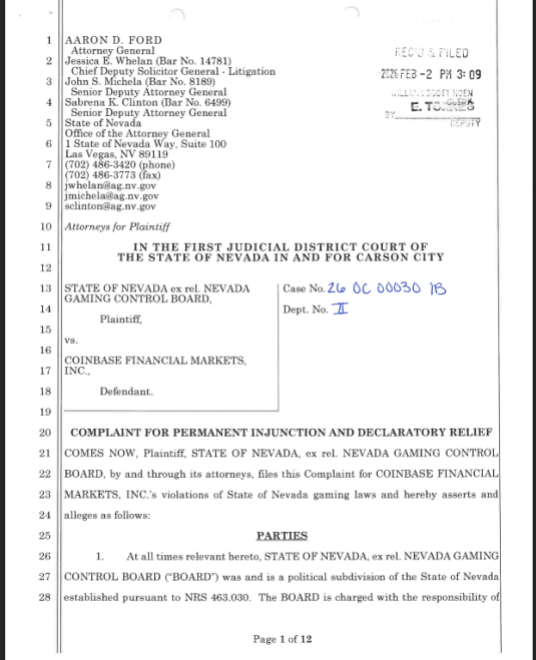
Source: Nevada Gaming Control Board

The filing seeks immediate court steps to halt the products while the state pursues its claims. Reports note the move follows similar actions against other prediction platforms and comes as the legal fight over where these products belong—state gaming law or federal derivatives law—intensifies.

Background On Prediction Markets And Coinbase’s Response

Prediction markets have grown quickly. Coinbase rolled out a prediction market product that lets customers take positions on the outcomes of sports and other real-world events, working with established market operators.

BTCUSD currently trading at $76,059. Chart: TradingView

Coinbase has pushed back by suing multiple states in federal court, arguing that event contracts are regulated by the federal Commodity Futures Trading Commission and not by individual state gaming regulators. Those federal suits targeted Connecticut, Illinois, and Michigan, among others.

Federal Regulator Signals New Rules

Reports say the CFTC’s chair has signaled a shift toward clearer federal rules for event contracts and suggested the agency may issue new guidance that affects ongoing state cases.

That announcement could change the legal balance, since a stronger federal stance would bolster exchanges that claim CFTC jurisdiction over these products. Still, state claims press on, and courts will have to sort out who has the power to regulate.

Nevada’s Push Comes As Other States Act

Nevada’s action is not isolated. A Nevada state court recently granted a temporary restraining order that barred another major prediction platform from offering event contracts in the state for a short period while the matter moved toward a hearing.

Regulators in several states have issued cease-and-desist letters or sued operators they say are offering unlicensed wagering.

Featured image from Shutterstock, chart from TradingView

Related Questions

QWhat is the main reason Nevada is taking legal action against Coinbase?

ANevada is taking legal action because state gaming regulators claim Coinbase offered event contracts that operate like unlicensed sports betting without holding the required state gaming license.

QWhat specific legal measures did the Nevada Gaming Control Board request from the court?

AThe Nevada Gaming Control Board filed a suit asking the court to stop Coinbase from offering these contracts in Nevada and to grant a temporary restraining order and preliminary injunction.

QHow has Coinbase responded to similar regulatory challenges from other states?

ACoinbase has pushed back by suing multiple states, including Connecticut, Illinois, and Michigan, in federal court, arguing that event contracts are regulated by the federal CFTC and not by state gaming regulators.

QWhat potential shift in the regulatory landscape is mentioned regarding the CFTC?

AThe CFTC's chair has signaled a shift toward clearer federal rules for event contracts and suggested the agency may issue new guidance, which could bolster exchanges' claim of CFTC jurisdiction.

QIs Nevada's action an isolated case, or are other states taking similar steps?

ANevada's action is not isolated; regulators in several states have issued cease-and-desist letters or sued operators they allege are offering unlicensed wagering.

Related Reads

Profits Fall by a Quarter: Why Tether Abandoned Its $20 Billion Financing Plan

In the face of a cooling crypto market and investor skepticism, Tether, the world's largest stablecoin issuer, has significantly scaled back its ambitious fundraising plans. Initially targeting $15-20 billion, which would have valued the company at $500 billion, the firm is now considering raising only about $5 billion. CEO Paolo Ardoino downplayed the original target, calling it a "misunderstanding" and a maximum cap, not a goal, while emphasizing that Tether is highly profitable and doesn't urgently need the capital. Despite the success of its USDT stablecoin, which has a market cap of approximately $185 billion, Tether faces persistent investor caution. Concerns revolve around its $500 billion valuation—comparable to major AI firms and SpaceX—ongoing regulatory scrutiny, and the lack of a full independent audit, relying instead on quarterly attestations. Ardoino defended the valuation, contrasting Tether's substantial profits with the losses of highly-valued AI companies. While new U.S. stablecoin legislation and competitor Circle's IPO have boosted momentum, regulatory risks and Tether's controversial history remain hurdles. The company's profits fell by about a quarter in 2025, attributed to declining Bitcoin prices, though it gained $8-10 billion from its gold holdings. Tether's massive scale has made it a major player in U.S. Treasuries and gold markets, positioning it as a critical bridge between traditional finance and the volatile crypto world.

marsbit3m ago

Profits Fall by a Quarter: Why Tether Abandoned Its $20 Billion Financing Plan

marsbit3m ago

Wintermute Ventures: By 2026, Crypto Gradually Becomes the Settlement Layer for the Internet Economy

Wintermute Ventures argues that by 2026, crypto will mature into the essential clearing and settlement layer for the internet economy, enabling value to flow as freely as information does today. The report identifies five key themes driving this transformation: 1. **Everything becomes tradable:** Prediction markets, tokenization, and derivatives are creating liquidity for previously illiquid assets and real-world outcomes, enabling new data products and replacing traditional financial infrastructure like insurance. 2. **Stablecoins as a trust layer:** The need for interoperability among the growing number of stablecoins will be met by new infrastructure that handles netting, conversion, and settlement across chains, akin to on-chain correspondent banking. 3. **Tokenomics return to fundamentals:** Markets will increasingly reward sustainable revenue and long-term value over short-term token incentives. Token launches will occur only after proven product-market fit, aligning with traditional cash-flow-based valuation models. 4. **DeFi and TradFi convergence:** The future lies in hybrid models where user-friendly fintech front-ends leverage the capital efficiency and yield of DeFi infrastructure in the background, abstracting away complexity for the end-user. 5. **Privacy as a regulatory catalyst:** Privacy technologies like zero-knowledge proofs will transition from a compliance burden to a regulatory enabler, allowing institutions to prove compliance without exposing sensitive data and unlocking new financial products. Underpinning these themes is regulatory clarity, which is shifting from a barrier to a standardized distribution channel, accelerating institutional adoption. This infrastructure maturation will see crypto fade into the background, quietly powering a new global, open financial system.

marsbit24m ago

Wintermute Ventures: By 2026, Crypto Gradually Becomes the Settlement Layer for the Internet Economy

marsbit24m ago

When Migration Becomes the Norm: Why 'Your Own EVM Chain' Is Becoming Standard

In the past year, the industry's real "voting" has shifted from governance forums to deployment scripts, migration plans, and budgets. Projects are choosing ecosystems through action, not words—migrating mainnets, prioritizing tool stacks, and betting on networks with stronger market effects. A prime example is Noble, a leading stablecoin infrastructure in Cosmos, which moved to its own EVM L1, signaling that the main battleground for stablecoins and app distribution remains in EVM ecosystem due to its mature developer tools, wallet/dApp ecosystem, and concentrated liquidity. The trend toward "having your own EVM chain" is becoming standard. While EVM offers clear advantages in assets, integrations, and tools, generic chains come with constraints like fee volatility, congestion, and shared sequencing. Application chains/rollups allow teams to internalize these constraints—tailoring block times, execution models, and infrastructure to their business needs, and aligning transaction revenue with growth incentives. Rollup-as-a-Service (RaaS) platforms like Caldera are reducing the high costs and complexity of building and maintaining chains, turning "chain-as-a-product" into a replicable strategy. They focus not just on deployment but also on solving interoperability challenges—e.g., via Caldera's Metalayer, which standardizes cross-chain bridging and integration to reduce friction for users and developers. As migration to EVM continues, the focus shifts from "which chain to choose" to "how to control growth." Owned EVM chains/rollups offer more stable fees, better performance, and tighter integration of incentives and revenue. With RaaS lowering build costs and interoperability layers reducing cross-chain friction, having a dedicated execution environment is becoming a scalable, standard solution for projects aiming to master their own growth.

marsbit26m ago

When Migration Becomes the Norm: Why 'Your Own EVM Chain' Is Becoming Standard

marsbit26m ago

Trading

Spot
Futures
活动图片