Stablecoin Yield ‘Effectively Off The Table’: White House Narrows Rewards Debate In Latest Meeting

bitcoinistPublished on 2026-02-21Last updated on 2026-02-21

Abstract

The White House took a more active role in the latest meeting between the crypto industry and banking sector to resolve the stablecoin yield dispute that has stalled the CLARITY Act. The meeting included representatives from Coinbase, Ripple, a16z, and crypto trade associations, while banks were represented through their industry groups. The White House presented a draft text addressing banking concerns, effectively ruling out earning yield on idle stablecoin balances. The debate now focuses on whether crypto firms can offer rewards linked to specific activities. Banking representatives argued that competitive pressures, rather than deposit flight, are their main concern. The White House also proposed anti-evasion measures, including significant penalties for violations. Further discussions are expected as both sides assess potential compromises.

The White House reportedly took the lead during the latest Crypto Council meeting, narrowing the stablecoin rewards dispute that has delayed progress in the long-awaited crypto market structure bill.

White House Steps In On CLARITY Act Dispute

On Thursday, the White House held another meeting between the crypto industry and the banking sector to negotiate the stablecoin yield dispute that has stalled the crypto market structure bill, known as the CLARITY Act, over the past month.

According to a report from journalist Eleanor Terret, the meeting was smaller than previous ones, with only a few representatives from each side. From the crypto sector, participants included representatives from Coinbase, Ripple, a16z, the Blockchain Association, and Crypto Council for Innovation (CCI).

Meanwhile, no individual bank representatives attended; bank voices were represented through trade associations, such as the American Bankers Association, the Banking Policy Institute (BPI), and the Independent Community Bankers of America (ICBA).

Terret sources affirmed that there was a notable difference in yesterday’s meeting as the White House “took the lead in driving the discussion, rather than letting crypto firms and bank trades steer the discussion, as in prior meetings.”

For context, banks have heavily criticized the landmark stablecoin legislation, the GENIUS Act, due to “loopholes” that could pose risks to the financial system. The framework prohibits interest payments on the holding or use of payment-purpose stablecoins, but it only addresses issuers.

The banking side argues that allowing issuers and platforms to offer interest payments on stablecoins could distort market dynamics and affect credit creation in the country, hurting small- and medium-sized financial institutions in the sector.

To address these concerns, banking associations across the US urged senators to include language in the CLARITY Act that also bans digital asset exchanges, brokers, dealers, and related entities from offering yield on stablecoins.

The Senate Banking Committee’s draft proposed that issuers offer rewards for specific actions, such as account openings and cashback. However, it also prohibited issuers from providing interest payments to passive token holders.

The crypto side criticized the proposed measures, with some industry leaders publicly opposing the draft and withdrawing their support. As a result, a markup session on the Senate Banking Committee’s portion of the bill has been delayed.

Stablecoin Yield Out Of The Picture

At the Thursday meeting, Patrick Witt, executive director of the US President’s Council of Advisors on Digital Assets, reportedly brought a draft text that served as the anchor for the discussion. Sources in the room told Terret that the draft’s language acknowledged banks’ concerns raised in last week’s “Yield and Interest Prohibitions Principles” document.

Based on this, “earning yield on idle balances (...) is effectively off the table,” the journalist affirmed. The draft also clarified that any future restrictions on rewards would be narrow in scope. Therefore, the debate has now narrowed to whether crypto firms can offer rewards linked to specific activities.

An attendee from the crypto industry side reportedly said that banks’ concerns “appear to stem more from competitive pressures than from deposit flight.” Meanwhile, someone from the banking industry told Terret that they are still pushing to include a study examining the growth of payment stablecoins and their potential impact on bank deposits in the draft.

They also noted that the White House proposed anti-evasion language. The measure would give the Securities and Exchange Commission (SEC), the Commodity Futures Trading Commission (CFTC), and the Department of the Treasury authority to enforce a ban on paying yield on idle stablecoin balances, and penalties of up to $500,000 per violation, per day, against companies that breach the ban.

Now, the banking industry representatives “will brief their members on today’s discussions and gauge whether there’s room to compromise on allowing crypto firms to offer stablecoin rewards,” Terret noted, adding that some attendees believe an end-of-month deadline isn’t unrealistic as talks are set to continue in the coming days.
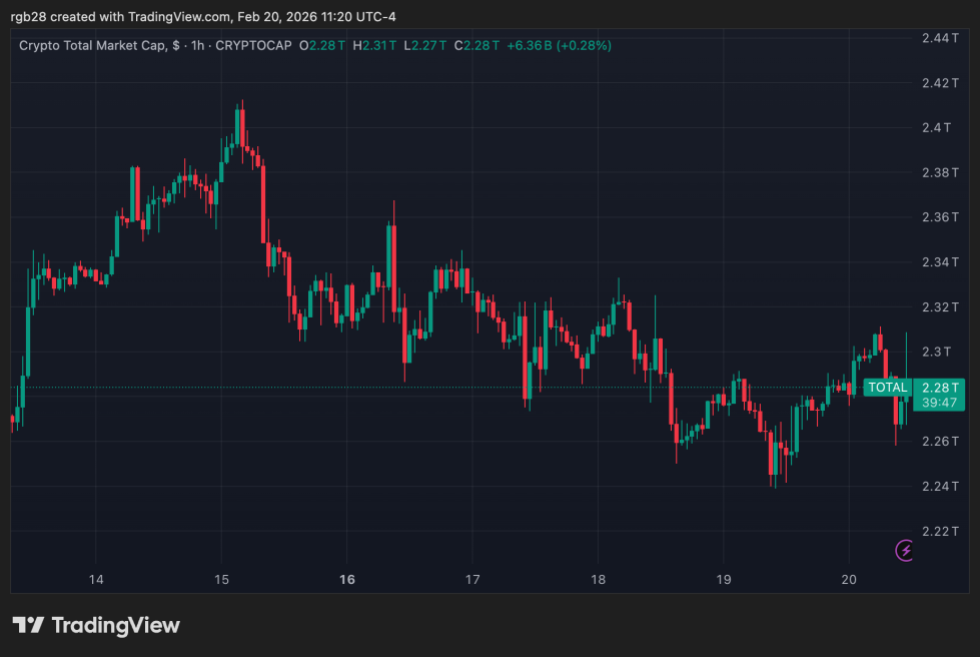
The total crypto market capitalization sits at $2.28 trillion on the one-week chart. Source: TOTAL on TradingView

Related Questions

QWhat was the main role of the White House in the latest Crypto Council meeting according to the article?

AThe White House took the lead in driving the discussion, rather than letting crypto firms and bank trades steer it as in prior meetings.

QWhich major crypto industry representatives attended the meeting?

ARepresentatives from Coinbase, Ripple, a16z, the Blockchain Association, and Crypto Council for Innovation (CCI) attended.

QWhat is the primary concern of the banking sector regarding stablecoin legislation?

ABanks argue that allowing interest payments on stablecoins could distort market dynamics, affect credit creation, and hurt small- and medium-sized financial institutions.

QWhat was the key outcome regarding 'yield on idle stablecoin balances' from the meeting?

AEarning yield on idle balances is effectively off the table, meaning it is prohibited.

QWhat enforcement measures did the White House propose for violations of the yield ban?

AThe White House proposed giving the SEC, CFTC, and Treasury the authority to enforce the ban with penalties of up to $500,000 per violation, per day.

Related Reads

Who Controls the Profit Rights of Digital Dollars? The Wall Street vs. Crypto Capital Game Behind the CLARITY Act

The CLARITY Act represents a pivotal U.S. legislative effort to regulate digital assets, moving beyond the infrastructure-focused GENIUS Act. It aims to end "regulation by enforcement" by granting the CFTC exclusive jurisdiction over digital commodities and the SEC over investment contracts. A major conflict emerged in the Senate over "yield-bearing stablecoins." Traditional banks, fearing massive deposit outflows and damage to their net interest margins, lobbied for a total ban on third-party stablecoin yields. The crypto industry, led by Coinbase, argued this would stifle innovation, deprive users of rightful earnings from underlying assets like Treasuries, and drive capital offshore. The debate reached a stalemate in early 2026, stalling the bill's progress. White House mediation set a March 1 deadline for a compromise. A proposed solution, the "Digital Markets Restructure Act," introduced a "Yield Neutrality" principle, decoupling yield rights from bank charters, and a "Residual-Risk Assessment Model" to regulate based on actual risk (enterprise, exposure, market) rather than outdated classifications. The outcome will profoundly impact the U.S. financial system: potentially deepening demand for U.S. Treasuries, lowering government borrowing costs, and extending dollar hegemony digitally. It forces traditional banks to digitize and could cause a major schism in DeFi, pushing compliant players toward institutionalization and smaller, non-compliant protocols offshore. The act ultimately decides who controls the profits of the digital dollar.

marsbit18m ago

Who Controls the Profit Rights of Digital Dollars? The Wall Street vs. Crypto Capital Game Behind the CLARITY Act

marsbit18m ago

The Economist: In Asia, Stablecoins Are Becoming the New Financial Infrastructure

Stablecoins are rapidly emerging as a new financial infrastructure across Asia, driven by real-world needs for efficient and low-cost transactions. Despite cautious or strict regulatory stances in countries like India, cryptocurrency adoption continues to thrive. India, which imposes heavy taxes and transaction fees, still leads the global crypto adoption index, with inflows reaching approximately $338 billion from mid-2024 to 2025. A key application is cross-border remittances. With 24 million migrant workers in Southeast Asia, traditional remittance fees averaging 6.5% per $200 transfer pose a significant burden. Stablecoins, unlike volatile cryptocurrencies like Bitcoin, offer a stable, fast, and accessible alternative. From January to July last year, global stablecoin transfers exceeded $4 trillion. Businesses are also adopting stablecoins to streamline payments, reducing intermediaries, delays, and costs. Monthly stablecoin transactions between enterprises surged from under $100 million in early 2023 to over $6 billion by mid-2025. Additionally, Asia’s vast gig economy—over 210 million workers—benefits from instant salary settlements via stablecoins, bypassing traditional banking delays. However, the same features that benefit legitimate transactions—speed, low cost, and accessibility—also risk being exploited for illicit activities. The future of stablecoins in Asia will depend on how effectively regulators balance innovation with oversight. Success could reshape global finance; failure may leave crypto with a practical—but illegal—use case.

marsbit1h ago

The Economist: In Asia, Stablecoins Are Becoming the New Financial Infrastructure

marsbit1h ago

Trading

Spot
Futures

Hot Articles

How to Buy HOUSE

Welcome to HTX.com! We've made purchasing Housecoin (HOUSE) simple and convenient. Follow our step-by-step guide to embark on your crypto journey.Step 1: Create Your HTX AccountUse your email or phone number to sign up for a free account on HTX. Experience a hassle-free registration journey and unlock all features.Get My AccountStep 2: Go to Buy Crypto and Choose Your Payment MethodCredit/Debit Card: Use your Visa or Mastercard to buy Housecoin (HOUSE) instantly.Balance: Use funds from your HTX account balance to trade seamlessly.Third Parties: We've added popular payment methods such as Google Pay and Apple Pay to enhance convenience.P2P: Trade directly with other users on HTX.Over-the-Counter (OTC): We offer tailor-made services and competitive exchange rates for traders.Step 3: Store Your Housecoin (HOUSE)After purchasing your Housecoin (HOUSE), store it in your HTX account. Alternatively, you can send it elsewhere via blockchain transfer or use it to trade other cryptocurrencies.Step 4: Trade Housecoin (HOUSE)Easily trade Housecoin (HOUSE) on HTX's spot market. Simply access your account, select your trading pair, execute your trades, and monitor in real-time. We offer a user-friendly experience for both beginners and seasoned traders.

2.8k Total ViewsPublished 2025.04.27Updated 2025.04.30

Discussions

Welcome to the HTX Community. Here, you can stay informed about the latest platform developments and gain access to professional market insights. Users' opinions on the price of HOUSE (HOUSE) are presented below.

活动图片