Bitcoin Hashpower Returns, Difficulty Sees Biggest Jump In Months

bitcoinistPublished on 2026-02-22Last updated on 2026-02-22

Abstract

Bitcoin's mining difficulty surged by approximately 15% to over 144 trillion, reversing a previous 10% drop caused by U.S. winter storm-related shutdowns. Miners curtailed operations to support power grids and received payments for returning electricity. The rebound in hash rate triggered the protocol’s automatic difficulty increase, which strengthens security but reduces profitability for less efficient miners. Meanwhile, Bitcoin’s price hovered near $68,000 amid geopolitical tensions and cautious trading. The U.S. now plays a major role in global hash power, making regional events significant for network stability. Some miners now use flexible energy agreements to balance grid demand and create additional revenue streams.

Bitcoin hashing power pushed the difficulty up about 15% to a little past 144 trillion on Friday, based on data from CoinWarz. That move reversed an earlier drop of 10% that followed widespread outages in parts of the US.

The numbers are blunt: machines went quiet during extreme weather, then came back online, and the protocol rebalanced itself.

Winter Outages And The Bounce Back

Foundry USA’s pool saw a dramatic swing in computing power, falling near 198 EH/s before climbing from roughly 400 EH/s. Reports say that many operators in affected regions shut down temporarily during the winter storms to protect equipment and help grids.

Some of the spaces that host miners coordinated with utilities. Power was conserved. Power was redirected.
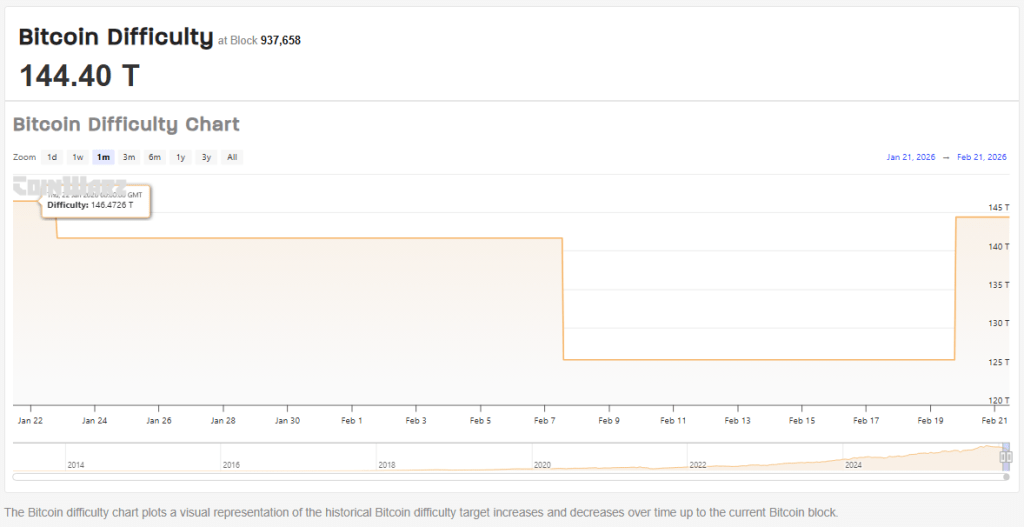
Bitcoin mining difficulty graph. Source: CoinWarz

Flexible Power Deals Changed The Game

Reports note that several miners did more than pause operations. LM Funding America reported curtailing machines and sending contracted power back to the grid, pocketing curtailment payments that helped offset lost mining time.

Canaan Inc. also said its US sites took part in demand response moves with local partners. These arrangements are part of why many facilities can afford to go offline when the grid needs relief, then restart when conditions improve.
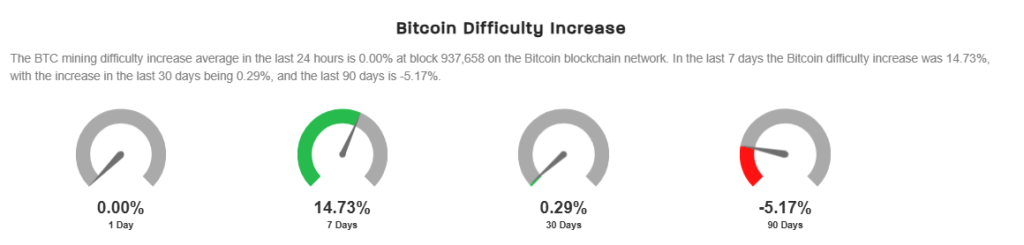
Source: CoinWarz

What Higher Difficulty Means

Bitcoin’s difficulty is designed to reset every 2,016 blocks to hold average block times close to the 10-minute target. When more hash power returns, the algorithm raises difficulty. That makes the network harder to attack and raises the work needed to win a block reward.

For miners, higher difficulty reduces the Bitcoin earned per unit of compute, squeezing margins for outfits with older rigs or higher electricity bills.

Price Moves Stay Tied To Headlines

Bitcoin traded near $68,000 as markets reacted to rising geopolitical strain, especially between the US and Iran. Trading has felt cautious. Volume is lighter. Prices have bounced and then stalled on headline-driven flows, showing that investor mood still swings with global news.

At the same time, network metrics kept shifting under the surface — a reminder that technical and macro drivers can pull in different directions.

Bitcoin is now trading at $67,974. Chart: TradingView

The US now supplies a big chunk of global hash power, according to Cambridge Centre for Alternative Finance. That means regional events, weather, and grid policies in the US matter a lot to global security and miner economics.

Some firms have begun to treat mining as a flexible load that can stabilize grids during stress, creating new income streams beyond pure block rewards.

Politics And Market Tone

Comments from politicians and geopolitical moves add friction. Mentions of US President Donald Trump in recent headlines have been tied to broader market nervousness; geopolitics can pull risk appetite downward and keep crypto prices range-bound.

The difficulty rebound itself didn’t spark a big price jump. Instead, it reinforced a simple truth: the protocol handled the shock, but miners felt the squeeze.

Featured image from Pexels, chart from TradingView

Related Questions

QWhat was the recent change in Bitcoin's mining difficulty and by how much did it increase?

ABitcoin's mining difficulty increased by about 15% to a little past 144 trillion.

QWhat was the primary reason for the previous 10% drop in hashing power that preceded this difficulty increase?

AThe previous 10% drop in hashing power followed widespread outages in parts of the US due to extreme winter weather, which caused many mining operators to temporarily shut down.

QHow did some mining companies, like LM Funding America, financially benefit from pausing their operations during the grid stress?

ACompanies like LM Funding America curtailed their operations and sent contracted power back to the grid, receiving curtailment payments that helped offset their lost mining revenue.

QWhat is the purpose of Bitcoin's difficulty adjustment algorithm?

ABitcoin's difficulty adjustment algorithm is designed to reset every 2,016 blocks to maintain an average block time of approximately 10 minutes, ensuring network security and stability regardless of changes in total hashing power.

QAccording to the article, how are some mining firms beginning to treat their operations in relation to the power grid?

ASome mining firms are treating their operations as a flexible load that can be curtailed to help stabilize the power grid during times of stress, creating a new income stream beyond block rewards.

Related Reads

Trading

Spot
Futures

Hot Articles

What is $BITCOIN

DIGITAL GOLD ($BITCOIN): A Comprehensive Analysis Introduction to DIGITAL GOLD ($BITCOIN) DIGITAL GOLD ($BITCOIN) is a blockchain-based project operating on the Solana network, which aims to combine the characteristics of traditional precious metals with the innovation of decentralized technologies. While it shares a name with Bitcoin, often referred to as “digital gold” due to its perception as a store of value, DIGITAL GOLD is a separate token designed to create a unique ecosystem within the Web3 landscape. Its goal is to position itself as a viable alternative digital asset, although specifics regarding its applications and functionalities are still developing. What is DIGITAL GOLD ($BITCOIN)? DIGITAL GOLD ($BITCOIN) is a cryptocurrency token explicitly designed for use on the Solana blockchain. In contrast to Bitcoin, which provides a widely recognized value storage role, this token appears to focus on broader applications and characteristics. Notable aspects include: Blockchain Infrastructure: The token is built on the Solana blockchain, known for its capacity to handle high-speed and low-cost transactions. Supply Dynamics: DIGITAL GOLD has a maximum supply capped at 100 quadrillion tokens (100P $BITCOIN), although details regarding its circulating supply are currently undisclosed. Utility: While precise functionalities are not explicitly outlined, there are indications that the token could be utilized for various applications, potentially involving decentralized applications (dApps) or asset tokenization strategies. Who is the Creator of DIGITAL GOLD ($BITCOIN)? At present, the identity of the creators and development team behind DIGITAL GOLD ($BITCOIN) remains unknown. This situation is typical among many innovative projects within the blockchain space, particularly those aligning with decentralized finance and meme coin phenomena. While such anonymity may foster a community-driven culture, it intensifies concerns about governance and accountability. Who are the Investors of DIGITAL GOLD ($BITCOIN)? The available information indicates that DIGITAL GOLD ($BITCOIN) does not have any known institutional backers or prominent venture capital investments. The project seems to operate on a peer-to-peer model focused on community support and adoption rather than traditional funding routes. Its activity and liquidity are primarily situated on decentralized exchanges (DEXs), such as PumpSwap, rather than established centralized trading platforms, further highlighting its grassroots approach. How DIGITAL GOLD ($BITCOIN) Works The operational mechanics of DIGITAL GOLD ($BITCOIN) can be elaborated on based on its blockchain design and network attributes: Consensus Mechanism: By leveraging Solana’s unique proof-of-history (PoH) combined with a proof-of-stake (PoS) model, the project ensures efficient transaction validation contributing to the network's high performance. Tokenomics: While specific deflationary mechanisms have not been extensively detailed, the vast maximum token supply implies that it may cater to microtransactions or niche use cases that are still to be defined. Interoperability: There exists the potential for integration with Solana’s broader ecosystem, including various decentralized finance (DeFi) platforms. However, the details regarding specific integrations remain unspecified. Timeline of Key Events Here is a timeline that highlights significant milestones concerning DIGITAL GOLD ($BITCOIN): 2023: The initial deployment of the token occurs on the Solana blockchain, marked by its contract address. 2024: DIGITAL GOLD gains visibility as it becomes available for trading on decentralized exchanges like PumpSwap, allowing users to trade it against SOL. 2025: The project witnesses sporadic trading activity and potential interest in community-led engagements, although no noteworthy partnerships or technical advancements have been documented as of yet. Critical Analysis Strengths Scalability: The underlying Solana infrastructure supports high transaction volumes, which could enhance the utility of $BITCOIN in various transaction scenarios. Accessibility: The potential low trading price per token could attract retail investors, facilitating wider participation due to fractional ownership opportunities. Risks Lack of Transparency: The absence of publicly known backers, developers, or an audit process may yield skepticism regarding the project's sustainability and trustworthiness. Market Volatility: The trading activity is heavily reliant on speculative behavior, which can result in significant price volatility and uncertainty for investors. Conclusion DIGITAL GOLD ($BITCOIN) emerges as an intriguing yet ambiguous project within the rapidly evolving Solana ecosystem. While it attempts to leverage the “digital gold” narrative, its departure from Bitcoin's established role as a store of value underscores the need for a clearer differentiation of its intended utility and governance structure. Future acceptance and adoption will likely depend on addressing the current opacity and defining its operational and economic strategies more explicitly. Note: This report encompasses synthesised information available as of October 2023, and developments may have transpired beyond the research period.

363 Total ViewsPublished 2025.05.13Updated 2025.05.13

What is $BITCOIN

Discussions

Welcome to the HTX Community. Here, you can stay informed about the latest platform developments and gain access to professional market insights. Users' opinions on the price of BTC (BTC) are presented below.

活动图片