Banks’ Concerns Over Stablecoin Interest Payments Are ‘Totally Absurd’, Circle CEO Says

bitcoinistPublished on 2026-01-23Last updated on 2026-01-23

Abstract

Circle CEO Jeremy Allaire dismissed banking industry concerns over interest payments on stablecoins as "totally absurd," arguing that fears of massive deposit flight are unfounded. Speaking at the World Economic Forum, he compared stablecoin rewards to other common financial products like credit cards, emphasizing their role in customer engagement rather than systemic risk. Allaire countered bank claims that stablecoins could drain up to $6 trillion in deposits, noting that similar concerns emerged with money market funds yet lending continued unaffected. He highlighted the shift toward private credit and capital markets, asserting that stablecoins should function as safe, regulated cash instruments while lending evolves independently through new models.

The CEO of stablecoin issuer Circle has weighed in on the importance of stablecoin rewards and why he believes the banking industry’s concerns about interest payments on these assets are “absurd.”

Circle CEO Rejects Banks’ Stablecoin Fears

Speaking at the World Economic Forum (WEF) in Davos, Circle’s CEO, Jeremy Allaire, discussed banks’ growing concerns that paying interest on stablecoins poses a threat to the industry, calling the deposit flight narrative “totally absurd.”

The banking sector has expressed concerns about stablecoin rewards, arguing that interest payments will distort market dynamics and affect credit creation. In the US, banks have heavily criticized the GENIUS Act, claiming that it has loopholes that could pose risks to the financial system.

The executive rejected the sector’s general arguments, citing historical and practical reasons. He asserted that this exact argument has been historically used when new financial products, such as government money market funds, have emerged.

Notably, Bank of America CEO Brian Moynihan recently compared the digital assets to money market mutual funds, which require reserves to be held in short-term instruments, such as US Treasuries, reducing lending capacity in the system.

The executive told investors that the banking sector, small- and medium-sized businesses in particular, could face significant challenges if the US Congress does not prohibit interest-bearing stablecoins, as up to $6 trillion in deposits, or 30% to 35% of all US commercial bank deposits, could flow out of the banking system and into the stablecoin sector.

However, Allaire pointed out that, despite institutions claiming that financial products would “draw all the deposit base,” their growth has not “stopped the ability for lending to happen.”

The importance Of Rewards

Circle’s CEO also argued that stablecoins should not be singled out when rewards for other financial products exist and contribute to the system. “Those rewards (...) exist in every balance that you have with a credit card that you use. They exist around so many other financial products and services that we have,” he detailed.

“These rewards are actually very important,” Allaire continued. “They help with stickiness, they help with customer traction. They are not themselves like these huge monetary policy dampers.”

Most importantly, he pointed out that lending is moving away from the risk-taking of banks, with “a huge amount of lending is moving towards private credit.”

He cited a Wednesday WEF panel, in which a capital markets participant highlighted how the vast majority of GDP growth in the United States was “formed by capital market formation around junk bonds.”

“So private credit issuing junk bonds, capitalizing the build out of the American technology advancements, not bank credit,” the executive added.

Previously, Coinbase Institute shared a similar argument, affirming that “credit is evolving, not shrinking. Lending is shifting to private credit, fintech, and DeFi channels that don’t depend on deposits. Liquidity moves—it doesn’t vanish.”

Allaire concluded that “we want stablecoin money to be cash instrument money, prudentially supervised, very, very safe money. And then I think what we want to do is we want to build models for lending that build on top of stablecoins.”
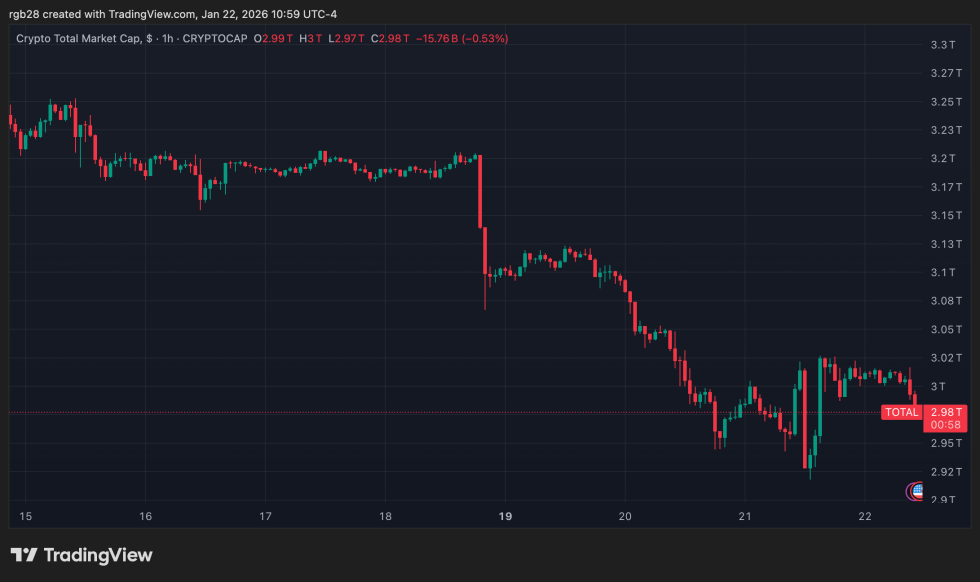
The total crypto market capitalization is at $2.98 trillion in the one-week chart. Source: TOTAL on TradingView

Related Questions

QWhat is Circle CEO Jeremy Allaire's view on banks' concerns about interest payments on stablecoins?

AJeremy Allaire calls the banking industry's concerns about interest payments on stablecoins 'totally absurd' and rejects the narrative that they pose a threat to the industry or will cause significant deposit flight.

QAccording to the banking sector, what risk does the GENIUS Act pose?

ABanks have criticized the GENIUS Act, claiming it has loopholes that could distort market dynamics, affect credit creation, and pose risks to the overall financial system.

QWhat historical financial product does Allaire compare stablecoins to when refuting the banks' arguments?

AAllaire compares stablecoins to government money market funds, which also faced similar criticisms when they emerged, yet their growth did not stop the ability for lending to happen.

QHow much in bank deposits could potentially flow into the stablecoin sector according to the concerns raised by bank executives?

ABank executives warned that up to $6 trillion in deposits, or 30% to 35% of all US commercial bank deposits, could flow out of the banking system and into the stablecoin sector if interest-bearing stablecoins are not prohibited.

QWhere does Jeremy Allaire argue that lending is increasingly moving towards?

AAllaire argues that a huge amount of lending is moving away from traditional banks and towards private credit, fintech, and DeFi channels, citing the growth of the junk bond market as an example of capital formation that doesn't rely on bank credit.

Related Reads

From Geopolitical Tensions to Liquidity Tightening: BTC Dragged into Uncontrolled Market Conditions

This analysis examines the sharp, multi-asset cryptocurrency downturn on [date], with Bitcoin (BTC) falling over 7% to briefly under $81,200. The decline was not triggered by a single event but by a confluence of factors leading to a broad market de-risking. Key drivers included a significant escalation in Middle East geopolitical tensions, marked by a US aircraft carrier group going silent and Iran's leadership adopting a war-ready posture. This created immediate uncertainty, prompting investors to reduce risk exposure. Simultaneously, the latest FOMC meeting delivered a hawkish hold, dashing remaining market hopes for near-term rate cuts. This forced a repricing of liquidity expectations, removing a key support for risk assets. The sell-off was not isolated to crypto. US equity indices (Nasdaq, S&P 500) fell, and traditional safe-haven assets like gold and silver also saw sharp pullbacks, indicating a market-wide flight to reduce overall risk exposure, not a rotation into other assets. Compounding these issues, Bitcoin ETFs recorded consistent, significant outflows over the preceding week, totaling over $1 billion. This lack of institutional buying pressure left the market without a buffer, causing prices to fall rapidly to find new equilibrium levels after breaking key technical supports like the 100-week moving average (~$85,000). In essence, this was a concentrated release of pent-up risk, driven by geopolitics, tightened liquidity expectations, and weak market structure, forcing a deleveraging event. True stability depends on reclaiming key technical levels and the return of risk capital.

Odaily星球日报29m ago

From Geopolitical Tensions to Liquidity Tightening: BTC Dragged into Uncontrolled Market Conditions

Odaily星球日报29m ago

Doubao Phone Makes a Comeback: From 'Being Surrounded' to 'Counter-Siege'

Doubao Phone, a smartphone project by ByteDance, re-emerges after facing a major setback. In December 2025, its first-generation model, developed in partnership with ZTE’s Nubia, was quickly "besieged" by major internet platforms—including Meituan, WeChat, and Alibaba—due to its AI agent accessing core app data without authorization, nearly crippling its functionality. Despite this, ByteDance is pushing forward. A second-generation Doubao Phone is slated for release in Q2 2026, with higher expectations. To avoid another blockade, ByteDance is negotiating permissions with various app providers and has already reached agreements with some companies in ride-hailing, food delivery, and ticketing. The core strategy remains a system-level GUI Agent, which enables AI to operate the phone by simulating screen interactions, bypassing the need for API approvals. Additionally, ByteDance is pursuing partnerships with other smartphone makers. For major brands like OPPO and vivo, collaboration is limited to technical integration, such as model interoperability or modular products like "Doubao Input Method." For smaller manufacturers like Transsion, Meizu, and Lenovo, ByteDance is pushing for deeper integration—embedding Doubao AI directly into the OS, with phone makers paying tech licensing and subscription fees. Beyond phones, ByteDance is developing other AI hardware, including smart glasses (with and without displays, set for release in 2026) and AI-enabled earphones with cameras. These devices are designed to work seamlessly with Doubao’s ecosystem, enabling hands-free interaction. The broader vision is to make Doubao’s AI agent a standard interface across hardware, capturing user habits and building ecosystem loyalty. Rivals like Google are pursuing similar strategies with Gemini. ByteDance is also exploring overseas expansion, negotiating with manufacturers like vivo to pre-install Doubao Assistant on international models. With strong resources in models, talent, and data, ByteDance aims to establish Doubao as a central AI hardware platform, despite the challenges.

marsbit1h ago

Doubao Phone Makes a Comeback: From 'Being Surrounded' to 'Counter-Siege'

marsbit1h ago

Trading

Spot
Futures
活动图片