Here’s The Most Important XRP Development That No One Is Talking About

bitcoinistPublished on 2026-02-24Last updated on 2026-02-24

Abstract

Crypto pundit Jay Nisbett highlights a significant yet underreported development in the XRP ecosystem: SBI is issuing on-chain bonds that immediately provide holders an equivalent amount of XRP and pay interest over three years. This $65 million retail offering in Japan is seen as a form of "carry trade easing," allowing investors to mitigate risks from yen inflation and declining spreads by holding A-rated bonds while gaining XRP exposure. Nisbett argues this mechanism is objectively better than holding yen or buying XRP outright, and could lead to larger institutional offerings, deeper liquidity pools, and broader adoption of XRP through structured financial products.

Crypto pundit Jay Nisbett has drawn attention to an important development in the XRP ecosystem that isn’t talked about enough. He further declared that this might be the most significant development for adoption at the moment.

Pundit Highlights Key Development For XRP’s Adoption

In an X post, Jay mentioned that SBI is issuing bonds on-chain, which almost immediately gives the holder an equivalent amount of XRP. Furthermore, the company will pay interest over the next three years. The pundit added that this move is “absolutely massive” if one understands the Yen carry trade and the altcoin and the relationship between the two.

The pundit opined that this move is effectively a “carry trade easing.” He explained that firms have been capturing a few points spread and that Japan is where this has been predominantly occurring. However, these firms are now getting squeezed. Jay believes that this is where XRP provides a way out for these firms, which would result in them owning the token.

The pundit reiterated that these investors in SBI’s bonds receive an amount of the token equivalent to their bond purchase price. At the same time, they get a few points of interest for doing so. He acknowledged that SBI’s offering is relatively small, totaling $65 million, since it is for retail investors in Japan.

Jay stated that he will be thoroughly surprised if this move doesn’t result in larger offerings for institutions. He added that the yen spread going down can be mitigated with bond interest of A-credit rating, with almost immediate XRP exposure. It is worth noting that the Yen carry trade continues to unwind as the Bank of Japan (BOJ) moves to hike rates.

Why This Mechanism Works Better Than Buying The Cryptocurrency Outright

Jay stated that for institutions making an investment decision, buying XRP is risky if purely for investment. However, he noted that buying an A-rated bond that earns a couple of points of interest to offset yen inflation and receiving the altcoin in the process is objectively better than holding yen.

The pundit also mentioned that this mechanism uses the carry trade as a distribution channel to build out liquidity. He noted that worldwide, Japan is used for its cheap Yen and repatriated primarily to the U.S. Meanwhile, Jay also highlighted how institutions could take advantage of these tokenized bonds and earn XRP.

He stated that all places utilizing Yen credit could take advantage of these bonds, and everyone taking advantage of the world’s largest creditor nation would demand deeper liquidity pools for their associated currency. Jay stated that they could either create or join an AMM to earn yield and compound their bond interest.

At the time of writing, the XRP price is trading at around $1.32, down in the last 24 hours, according to data from CoinMarketCap.

XRP trading at $1.33 on the 1D chart | Source: XRPUSDT on Tradingview.com

Related Questions

QWhat is the key XRP development highlighted by crypto pundit Jay Nisbett that is being underdiscussed?

ASBI issuing bonds on-chain that immediately provide holders with an equivalent amount of XRP, along with interest payments over three years.

QHow does Jay Nisbett describe the significance of SBI's bond offering for XRP adoption?

AHe describes it as 'absolutely massive' and a form of 'carry trade easing' that provides a way for firms being squeezed in the Yen carry trade to own XRP.

QWhat financial mechanism does this development relate to, and why is Japan significant in this context?

AIt relates to the Yen carry trade, where Japan is significant because it has been the primary location for firms capturing spread points using cheap Yen, primarily repatriated to the U.S.

QWhy is buying SBI's bond objectively better for institutions than holding Yen or buying XRP outright, according to Jay?

ABuying an A-rated bond earns interest to offset Yen inflation and provides immediate XRP exposure, which is less risky than purely speculative XRP investment and better than holding depreciating Yen.

QHow could institutions further benefit from these tokenized bonds beyond the initial interest and XRP exposure?

AThey could create or join an Automated Market Maker (AMM) to earn yield and compound their bond interest, while also helping build deeper liquidity pools for associated currencies.

Related Reads

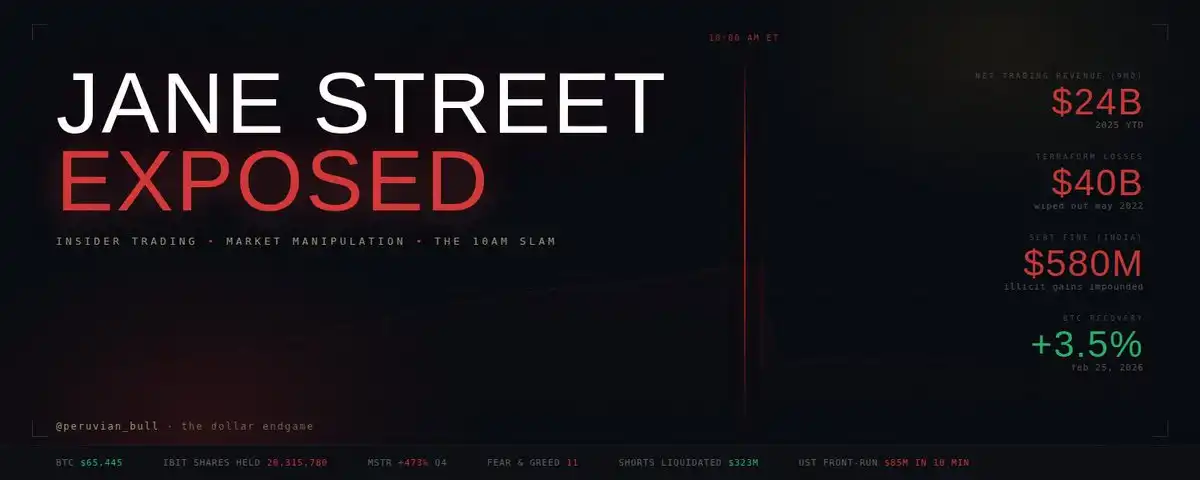
Jane Street's Three Sins: Insider Trading, Index Manipulation, and the Bitcoin 'Morning Massacre'

Jane Street, a highly profitable quantitative trading firm, faces serious allegations across multiple continents. In the U.S., Terraform Labs’ bankruptcy trustee has sued Jane Street, accusing it of insider trading related to the May 2022 collapse of Terra Luna. The suit claims Jane Street withdrew $85 million from a liquidity pool just minutes after Terraform secretly removed $150 million, allegedly using non-public information from a former intern. The action allegedly helped trigger a $40 billion crash. Simultaneously, in India, the Securities and Exchange Board (SEBI) has accused Jane Street of manipulating the Bank Nifty index through a “pump-and-dump” scheme over 18 expiration dates, resulting in alleged illegal profits of ~$580 million. Jane Street has been barred from Indian markets and is appealing. Additionally, Bitcoin traders had observed a pattern of sharp sell-offs at 10 AM ET—dubbed the "10 AM Crashes"—coinciding with U.S. market open, which many attributed to Jane Street’s trading activity. Notably, Jane Street is an authorized participant of BlackRock’s IBIT Bitcoin ETF, holding significant shares. After the Terra lawsuit was filed, the predictable sell-offs stopped, and Bitcoin saw a notable price rebound. The broader implication is the risk of market manipulation by privileged intermediaries within ETF structures—a problem Bitcoin was designed to overcome. If Jane Street halts its alleged manipulative strategies due to legal pressure, a major selling pressure on Bitcoin may be removed.

marsbit57m ago

Jane Street's Three Sins: Insider Trading, Index Manipulation, and the Bitcoin 'Morning Massacre'

marsbit57m ago

Stock Price Surges Over 35%! Circle's Earnings Report Exceeds Expectations: USDC Circulation Soars 72%

Circle (CRCL) reported strong Q4 and full-year 2025 financial results, with total revenue and reserve income reaching $770 million in Q4, up 77% year-over-year, exceeding expectations. This drove a 35% surge in its stock price. Key highlights include a 72% YoY increase in USDC circulation to $75.3 billion and a 247% rise in on-chain transaction volume to $11.9 trillion in Q4. Reserve income remained the core revenue driver at $733 million, while non-interest income reached $37 million. For the full year, total revenue grew 64% to $2.7 billion. Although the company reported a net loss of $70 million due to a one-time $424 million stock-based compensation expense from its IPO, adjusted EBITDA doubled to $582 million, indicating profitable core operations. Strategic developments include the stable testnet performance of its Arc blockchain, expansion of the Circle Payments Network with 55 financial institutions onboarded, and a key partnership with Polymarket to use native USDC. Regulatory progress includes conditional approval for a national trust bank. Looking ahead, Circle targets a 40% compound annual growth rate for USDC circulation. CEO Jeremy Allaire emphasized AI-driven payment demand, with 99% of agent-based payments currently using USDC. Despite challenges like declining yields and new competitors like USAT, Circle continues to execute its strategy as a growing internet financial infrastructure provider.

marsbit1h ago

Stock Price Surges Over 35%! Circle's Earnings Report Exceeds Expectations: USDC Circulation Soars 72%

marsbit1h ago

Trading

Spot
Futures

Hot Articles

O que é XRP 2.0

XRP 2.0: Uma Nova Fronteira no Landscape das Criptomoedas Introdução ao XRP 2.0 No reino em constante evolução das criptomoedas, novos projetos surgem continuamente, lutando por atenção e adoção. Uma dessas iniciativas promissoras é o XRP 2.0, um novo projeto de criptomoeda concebido para aproveitar a tecnologia de blockchain avançada e as metodologias de criptografia robustas. Embora o nome tenha paralelos com o XRP da Ripple, é crucial notar que o XRP 2.0 opera de forma independente, focando em melhorar a segurança das transações, a privacidade e a escalabilidade. À medida que o panorama financeiro digital abraça cada vez mais soluções descentralizadas, o XRP 2.0 visa contribuir de forma significativa para a web3 e a expansão global dos projetos de criptomoedas. O que é o XRP 2.0? No seu núcleo, o XRP 2.0 é um projeto de criptomoeda que visa criar um ecossistema de moeda digital seguro e descentralizado. Sua tecnologia fundamental integra princípios de blockchain sofisticados com técnicas de criptografia de ponta. O objetivo abrangente do XRP 2.0 é estabelecer-se como uma plataforma confiável e eficiente que possibilita a execução rápida de transações, priorizando a proteção de privacidade aprimorada para os seus usuários. O projeto é promovido como uma solução para muitas limitações enfrentadas pelas criptomoedas existentes, propondo um sistema que pode lidar com um volume maior de transações com velocidade e privacidade melhoradas. Esta versatilidade posiciona o XRP 2.0 como um concorrente significativo em um mercado repleto de várias moedas digitais. Quem é o Criador do XRP 2.0? A identidade do criador por trás do XRP 2.0 foi identificada como 'Wilbur.' No entanto, detalhes abrangentes sobre Wilbur ou a sua entidade associada permanecem elusivos. O anonimato de muitos criadores de criptomoedas não é um fenômeno incomum na indústria, muitas vezes concebido para manter um grau de privacidade e segurança. Quem são os Investidores do XRP 2.0? Até agora, informações específicas relacionadas às fundações ou organizações de investimento que apoiam o XRP 2.0 não estão disponíveis publicamente. No setor das criptomoedas, o apoio de investidores reputados pode influenciar significativamente a credibilidade e o sucesso de um projeto, no entanto, a transparência em relação aos apoiantes financeiros do XRP 2.0 não foi estabelecida. Como Funciona o XRP 2.0? O XRP 2.0 destaca-se por empregar uma combinação de tecnologia blockchain e algoritmos de criptografia avançados que asseguram transações seguras e descentralizadas. Sua estrutura inovadora inclui características únicas projetadas para fomentar o envolvimento dos usuários e ampliar as funcionalidades além das transações convencionais de criptomoedas. Entre essas características, o XRP 2.0 incorpora capacidades potenciadas por IA, como funcionalidades de texto-para-imagem e texto-para-fala. Estas adições são projetadas para melhorar a experiência interativa dos usuários, promovendo uma maior aplicabilidade em vários setores. Ao unir avanços tecnológicos com um design centrado no utilizador, o XRP 2.0 pretende captar a atenção de uma diversa gama de indivíduos e empresas que procuram integrar soluções de criptomoedas em suas estruturas operacionais. Cronologia do XRP 2.0 Compreender o XRP 2.0 requer examinar os marcos que definiram sua jornada até agora: 23 de Julho de 2023: O XRP 2.0 é apresentado como um novo projeto de criptomoeda, visando revolucionar as capacidades de transação seguras e descentralizadas no domínio do blockchain. 8 de Setembro de 2023: O lançamento de outro projeto, XRP20, ocorre, marcando o surgimento de um token ERC-20 na blockchain Ethereum que permanece não relacionado ao XRP 2.0. 13 de Novembro de 2023: O XRP Ledger passa por uma atualização significativa com o lançamento da versão 2.0.0 do software do servidor rippled. É importante notar que este desenvolvimento está desconectado do projeto de criptomoeda XRP 2.0. Pontos-chave sobre o XRP 2.0 Para destilar a essência do XRP 2.0, vários fatores críticos emergem: Características Únicas: A inclusão de características como texto-para-imagem e texto-para-fala potenciadas por IA diversifica ainda mais as aplicações potenciais do XRP 2.0. Tecnologia Blockchain: A estrutura utiliza mecanismos de blockchain avançados e protocolos de criptografia, assegurando um ambiente seguro e descentralizado para transações. Escalabilidade e Privacidade: O XRP 2.0 prioriza proteção de privacidade aprimorada nos processos de transação e a escalabilidade necessária para acomodar uma base de utilizadores crescente. Sem Afiliação com a Ripple: Importante, apesar do seu nome, o XRP 2.0 não tem qualquer lealdade ou colaboração com o XRP da Ripple, distinguindo sua estrutura operacional e objetivos dentro do ecossistema das criptomoedas. Conclusão O XRP 2.0 representa uma empreitada ambiciosa no domínio das criptomoedas, visando oferecer uma combinação de segurança, privacidade e eficiência em transações digitais. Ao integrar tecnologias sofisticadas e características amigáveis ao utilizador, o projeto propõe-se a ampliar os horizontes do que as criptomoedas podem alcançar na economia digital atual. Embora o anonimato do seu criador e a falta de investidores divulgados possam levantar questões para alguns, o foco do XRP 2.0 em funcionalidades avançadas e descentralização aumenta seu apelo num mercado de criptomoedas cada vez mais congestionado. À medida que o panorama das criptomoedas continua a evoluir, o XRP 2.0 pode ainda emergir como um jogador crucial na expansão de soluções de blockchain seguras e escaláveis.

99 Total ViewsPublished 2024.04.05Updated 2024.12.03

Como comprar XRP

Bem-vindo à HTX.com!Tornámos a compra de XRP (XRP) simples e conveniente.Segue o nosso guia passo a passo para iniciar a tua jornada no mundo das criptos.Passo 1: cria a tua conta HTXUtiliza o teu e-mail ou número de telefone para te inscreveres numa conta gratuita na HTX.Desfruta de um processo de inscrição sem complicações e desbloqueia todas as funcionalidades.Obter a minha contaPasso 2: vai para Comprar Cripto e escolhe o teu método de pagamentoCartão de crédito/débito: usa o teu visa ou mastercard para comprar XRP (XRP) instantaneamente.Saldo: usa os fundos da tua conta HTX para transacionar sem problemas.Terceiros: adicionamos métodos de pagamento populares, como Google Pay e Apple Pay, para aumentar a conveniência.P2P: transaciona diretamente com outros utilizadores na HTX.Mercado de balcão (OTC): oferecemos serviços personalizados e taxas de câmbio competitivas para os traders.Passo 3: armazena teu XRP (XRP)Depois de comprar o teu XRP (XRP), armazena-o na tua conta HTX.Alternativamente, podes enviá-lo para outro lugar através de transferência blockchain ou usá-lo para transacionar outras criptomoedas.Passo 4: transaciona XRP (XRP)Transaciona facilmente XRP (XRP) no mercado à vista da HTX.Acede simplesmente à tua conta, seleciona o teu par de trading, executa as tuas transações e monitoriza em tempo real.Oferecemos uma experiência de fácil utilização tanto para principiantes como para traders experientes.

737 Total ViewsPublished 2024.12.10Updated 2025.03.21

Discussions

Welcome to the HTX Community. Here, you can stay informed about the latest platform developments and gain access to professional market insights. Users' opinions on the price of XRP (XRP) are presented below.

活动图片