# AI Agents Articoli collegati

Il Centro Notizie HTX fornisce gli articoli più recenti e le analisi più approfondite su "AI Agents", coprendo tendenze di mercato, aggiornamenti sui progetti, sviluppi tecnologici e politiche normative nel settore crypto.

After $1.26 Trillion: Why Are Circle and Stripe Rushing to Pay 'Wages' to AI Agents?

The article discusses the significant rise of stablecoins, particularly USDC, as the preferred payment method for AI agents. In March 2026, Circle and Stripe are competing to build stablecoin infrastructure for AI agent payments, with USDC processing $1.26 trillion in transactions, accounting for 70% of stablecoin activity. Key points include: - AI agents require programmable, instant, low-friction payment systems, which traditional finance (banks, credit cards) cannot provide. Stablecoins on blockchain meet these needs with 24/7 transfers, smart contract automation, and price stability. - Data shows 98.6% of AI agent payments on platforms like Stripe's x402 use USDC, indicating stablecoins are becoming the default for machine-to-machine transactions. - Regulatory developments are supporting this growth: Hong Kong is issuing its first stablecoin licenses, the US OCC has proposed a federal framework, and the EU has MiCA regulations, signaling global institutional adoption. - Stablecoins act as a "blood system" connecting the digital and real economies, facilitating both internal digital transactions (e.g., tokenized assets) and external fiat conversions. - Risks include security vulnerabilities, regulatory fragmentation, and market instability, but the trend is clear: stablecoins are evolving from crypto tools to essential infrastructure for AI-driven economies. The article concludes that as AI agents autonomously transact, stablecoins will be critical infrastructure, urging businesses and investors to prepare for this shift.

marsbitIeri 00:41
After $1.26 Trillion: Why Are Circle and Stripe Rushing to Pay 'Wages' to AI Agents?

marsbitIeri 00:41

From 5 Cents per kWh Chinese Electricity to $45 API Export Packages: Token is Becoming the New Currency Unit

The article explores the concept of "Token出海" (Token Outbound), arguing that tokens are evolving from a technical term into a new monetary unit in the machine-driven economy. It begins by drawing a parallel between historical control over information flow (like transatlantic cables) and today's control over AI API calls and value transfer. Tokens now serve a dual role: as a unit of computation in AI and a means of payment in crypto. A key driver is the rise of AI Agents, like OpenClaw, which shift tokens from being a simple "conversation cost" to a "production fuel" for executing complex tasks. This massive consumption creates a competitive advantage for Chinese AI models, which are often priced lower. The article posits that this isn't just about cheap models, but about China leveraging its vast domestic electricity and computing power to export value globally via token-denominated AI services. The convergence of AI and crypto is facilitated by protocols like x402, which enables machines to natively pay for API calls, and ERC-8183, which allows them to enter into complex escrow-based contracts. This creates a machine-native economic layer where tokens act as the fundamental unit of permission, settlement, and value measurement. The conclusion is that while traditional fiat won't disappear, tokens are becoming the foundational monetary unit for the new agentic economy. The future "power to mint currency" may belong to those who can most efficiently compress real-world resources (like electricity and compute) into tradable tokenized services.

Odaily星球日报2 giorni fa 04:41

From 5 Cents per kWh Chinese Electricity to $45 API Export Packages: Token is Becoming the New Currency Unit

Odaily星球日报2 giorni fa 04:41

Firecrawl Launches Web Scraping Tool for Agents, NVIDIA Releases Nemotron 3 Super: What's the English Community Discussing Today?

Over the past 24 hours, key discussions in the English-speaking crypto and AI communities centered on several major developments. Firecrawl launched a CLI toolchain specifically for AI agents, enabling efficient web scraping and data extraction, though its pricing drew some criticism. Nvidia released Nemotron 3 Super, a 120B-parameter open-weight model with a 1M-token context window, raising both excitement and concerns over latency and safety. Google introduced Nano Banana 2, a high-speed image generation model, though its naming was met with mixed reactions. In AI agent infrastructure, Base44’s Superagent entered the cloud-based agent automation space, intensifying competition with local solutions like OpenClaw and raising debates over security and centralization. Ramp’s AI Index suggested Anthropic is gaining traction as the preferred enterprise AI vendor over OpenAI. In crypto, Solana continued to strengthen its infrastructure with DoubleZero Edge’s real-time market data via multicast technology and led in stablecoin transfer volume after filtering wash trading. Jupiter launched its Season 2 rewards program with a $2M JupUSD pool. Ethereum saw progress in L2 interoperability with on.eth addressing cross-chain identity fragmentation. Base ecosystem projects like Noise.xyz and rip.fun attracted significant attention, while Circle experimented with AI agents autonomously managing a hackathon using USDC. Perp DEX Lighter introduced a revised market structure to improve fairness, and prediction market platform Kalshi noted growing institutional engagement, with Marco Rubio emerging as an early favorite for the 2028 U.S. presidential election. Overall, themes included the shift toward cloud-based AI agents, model capability races, enterprise AI adoption, and the maturation of on-chain trading and prediction markets.

marsbit2 giorni fa 15:41

Firecrawl Launches Web Scraping Tool for Agents, NVIDIA Releases Nemotron 3 Super: What's the English Community Discussing Today?

marsbit2 giorni fa 15:41

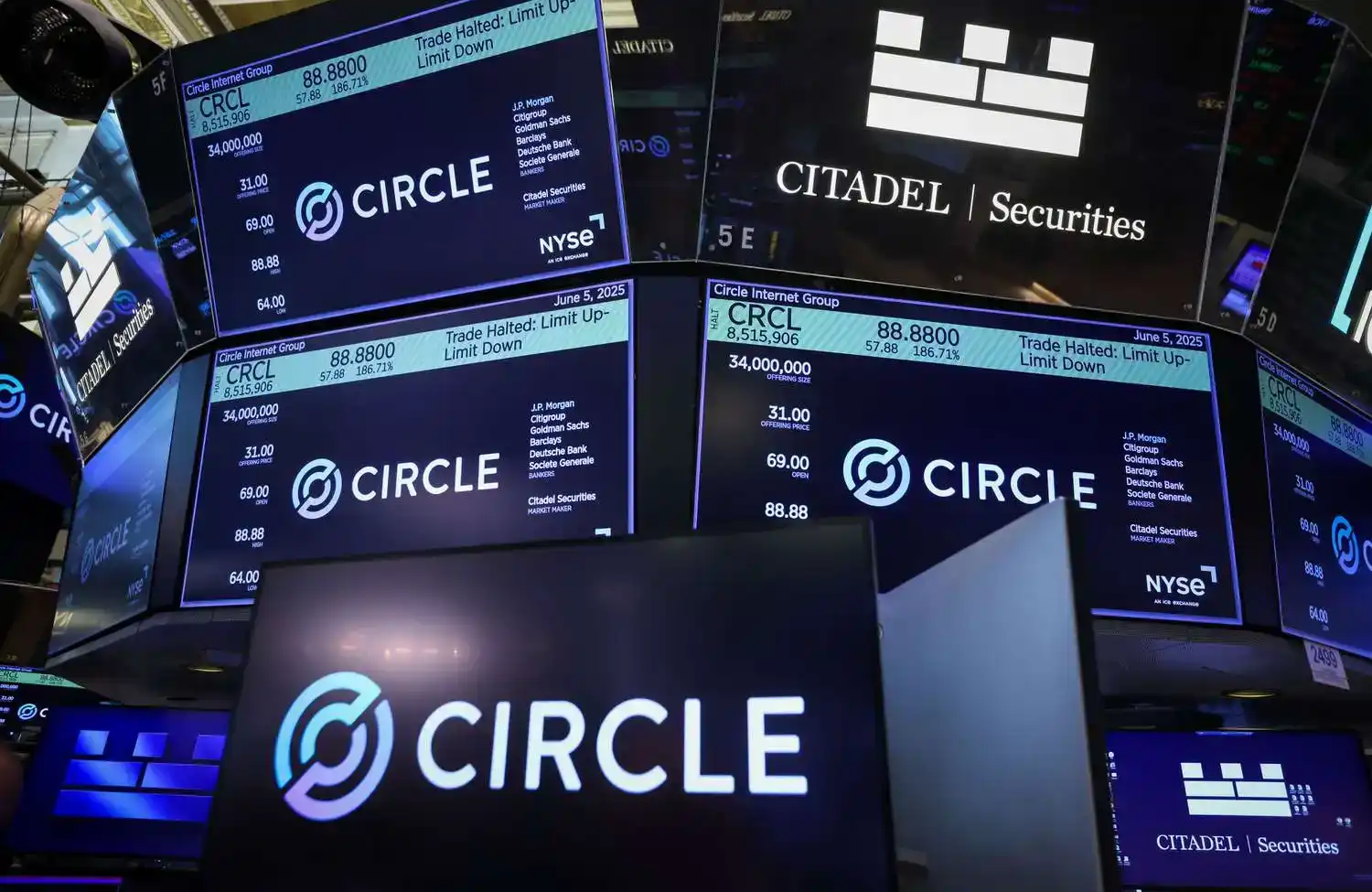
Circle Doubles in a Month: What Is the Market Betting On?

Circle's stock (CRCL) has experienced significant volatility, doubling in February 2025 after a sharp post-IPO decline. This surge occurred while Bitcoin fell 40%, indicating a decoupling from the broader crypto market. The key driver is a fundamental shift in how the market values Circle and its USDC stablecoin. Previously viewed as a cyclical crypto play, USDC's growth accelerated during the bear market, with its circulating supply rising 72% to a record $753 billion. This growth is increasingly driven by traditional finance and global payments, not speculative crypto trading. Major partnerships with Visa, Mastercard, JPMorgan, and Intuit are embedding USDC into mainstream payment infrastructure. The passage of the GENIUS Act in July 2025 provided a federal regulatory framework, creating a moat for compliant issuers like Circle and helping USDC gain market share against USDT. USDC also surpassed Tether in on-chain transaction volume. A major future growth narrative centers on AI Agent payments. Circle and others are developing infrastructure for machine-to-machine transactions, offering 24/7 settlement at a fraction of the cost of traditional systems. While current non-interest revenue from these new use cases remains under 5% of total revenue, the potential market is vast, with predictions of a multi-trillion-dollar stablecoin and AI Agent economy by 2030. Circle's $23 billion valuation largely bets on this future narrative becoming reality.

marsbit03/12 01:09

Circle Doubles in a Month: What Is the Market Betting On?

marsbit03/12 01:09

In-Depth Explanation of ERC-8183: Ethereum's Solution to the AI Agent Trust Challenge

Analysis of ERC-8183: Ethereum's Solution to AI Agent Trust Issues On March 10, the Ethereum Foundation's dAI team and Virtuals Protocol introduced ERC-8183, a new standard designed to enable trustless commercial transactions between AI Agents. This standard addresses the core problem of how two untrusted Agents can securely complete a "hire-deliver-settle" workflow without relying on a centralized platform. ERC-8183 introduces a "Job" concept with three roles: the Client (task publisher), the Provider (task executor), and the Evaluator (task validator). The Evaluator, which can be an AI Agent, a ZK-verifier smart contract, or a multi-sig/DAO, is the core innovation, determining whether a job is completed or rejected based on submitted proofs. A Job progresses through four states: Open (task creation), Funded (client deposits funds into escrow), Submitted (provider submits work), and Terminal (evaluator approves or rejects, funds are distributed accordingly). The standard also supports modular Hooks for added functionality like reputation checks or bidding systems. ERC-8183 complements other standards like x402 (a payment protocol for Agents) and ERC-8004 (an identity/reputation standard). Together, they form a foundational stack for a decentralized, autonomously operating AI Agent economy, with ERC-8183 specifically solving the trust problem in transactions.

Odaily星球日报03/10 07:43

In-Depth Explanation of ERC-8183: Ethereum's Solution to the AI Agent Trust Challenge

Odaily星球日报03/10 07:43

a16z: After AI Grants Humans Superpowers, Where Do We Go From Here?

A new paper titled "The Minimal Economics of AGI" explores the economic implications of AI automation, particularly as AI agents evolve from tools into collaborative partners capable of long-horizon tasks. The authors, Christian Catalini and Eddy Lazzarin, argue that the core economic divide will be between automation (tasks that can be measured and automated) and verification (tasks requiring human oversight, judgment, and contextual understanding). Key themes include: - The "coder’s curse": top experts training AI systems may inadvertently automate their own roles over time. - Three future human roles: directors (setting intent), verifiers (domain experts ensuring quality), and meaning-makers (creating cultural and social value). - Cryptocurrency and blockchain are positioned as critical for identity, provenance, and trust in a world flooded with AI-generated content. - Two potential economic outcomes: a "hollow economy" with systemic risk from under-verification, or an "augmented economy" where AI amplifies human potential and reduces costs for education, healthcare, and innovation. - The importance of small, agile teams leveraging AI for outsized impact, with crypto infrastructure enabling coordination at scale. The authors emphasize that AI acts as a force multiplier, granting individuals "superpowers," and urge a focus on verification, adaptability, and ambitious experimentation.

marsbit03/09 11:31

a16z: After AI Grants Humans Superpowers, Where Do We Go From Here?

marsbit03/09 11:31

活动图片