Bitcoin Price Remains Virtually Unchanged Amid Mass Coldcard Withdrawals and BIP-110 Failure

cryptonews.ruPublished on 2026-08-09Last updated on 2026-08-09

Abstract

Bitcoin's price remained unusually stable, trading in a narrow range between roughly $64,500 and $65,250 over the weekend of August 9, 2026, despite two significant events. First, a security flaw in Coldcard hardware wallets led to substantial thefts, with high-confidence estimates ranging from 1,596 to 1,719 BTC (approx. $133M). The market appeared to view this as a product-specific security failure rather than a systemic Bitcoin issue, as the stolen coins were a tiny fraction of circulating supply and network operations continued normally. Second, the attempted activation of BIP-110, which required 55% miner signaling, failed dramatically, achieving only about 2.53% support. A minority chain formed but quickly stalled, controlling only a tiny fraction of the network's hash rate while inheriting Bitcoin's full mining difficulty, leaving it effectively dead in the water. Throughout both episodes, Bitcoin's price showed no sharp reaction. Technical indicators like the RSI and MACD were neutral, with immediate support seen at $64,000-$64,500 and resistance at $65,000-$65,500. The most notable aspect was the lack of a significant price move following a major wallet vulnerability and an actual chain split. Traders are now watching for a breakout from the $64,000-$66,000 corridor, which may depend more on liquidity, institutional ETF flows, and macroeconomic data than on these past events.

Over the past 48 hours, $BTC has predominantly traded within the $64,500 to $65,250 range. By the morning of Sunday, August 9th, Bitcoin was trading between $64,800 and $64,900, with neither of these events triggering the sharp sell-off that often follows major security breaches or contentious network conflicts.

Coldcard Crisis Fails to Shake Bitcoin Out of Its Range

More significant financial losses are tied to Coldcard—a hardware wallet manufactured by Coinkite. A firmware vulnerability discovered in March 2021 weakened the randomness used to generate some wallet seeds, rendering certain devices susceptible to offline attacks allowing the recovery of private keys.

The attacks began on July 30th. The first major wave led to the loss of approximately 594 to 1,196 $BTC from over 1,100 addresses in less than an hour. Subsequent thefts have caused high-confidence loss estimates to rise to around 1,596–1,719 $BTC, and when including suspicious activity, the total may increase to approximately 2,055 $BTC, which at current prices is about $133 million.
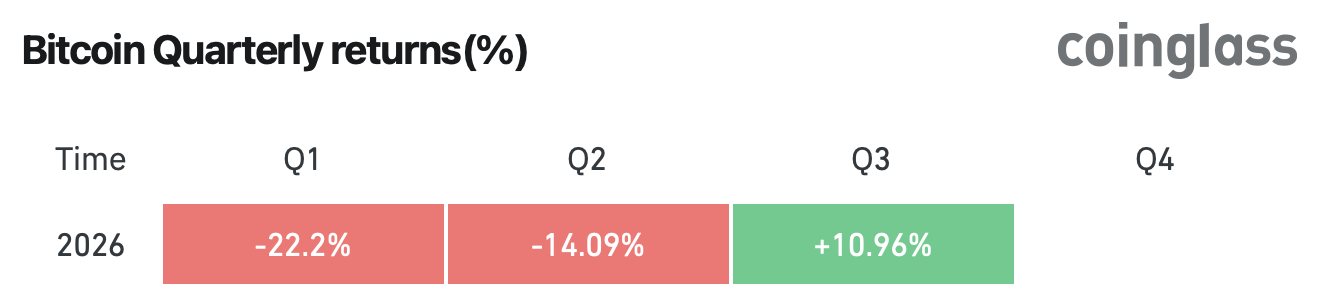
According to Coinglass statistics recorded on Sunday, August 9th, in Q3 2026, the Bitcoin exchange rate rose by nearly 11%.

Coinkite issued a patched firmware and advised affected users to create entirely new seeds and move their funds. Updating the vulnerable device itself cannot restore the old seed, as the vulnerability was embedded during the initial seed generation. Thus, the incident represents a serious failure in self-custody systems, but not a failure of the Bitcoin blockchain, its monetary rules, or its mining network.

This distinction appears to matter to traders. Rather than viewing the theft as a systemic Bitcoin problem, the market largely assessed it as a security breach specific to a particular product. The stolen coins constituted only a tiny fraction of the circulating supply, and the network overall continued to operate normally.

BIP-110 Schism Hits a Wall Almost Immediately

Bitcoin then faced a separate test when, around block 961,632, the deployment of BIP-110 began. This proposal aimed to temporarily limit certain forms of non-financial data stored on the Bitcoin network and relied on a miner signaling threshold of 55%, which was never even remotely reached. By the end of the signaling period, the support level hovered around 2.53%.

When nodes supporting BIP-110 began rejecting blocks that did not signal support for BIP-110, a minority chain emerged. Miners from "Roughnecks" generated two BIP-110-compliant blocks, but the branch quickly stalled while Bitcoin's dominant chain continued to add blocks. The minority branch inherited Bitcoin's full mining difficulty despite controlling only a tiny fraction of the network's hashpower, making the creation of additional blocks extremely slow.

By August 9th, the alternative chain was effectively dead in the water. Statistics show that approximately 99.85% of the hashpower remained on Bitcoin's main chain, leaving the BIP-110 branch facing an exceedingly long wait to reach the 2,016-block difficulty adjustment, which could have simplified mining. Discussions about changing the proof-of-work algorithm would essentially result in a separate network and asset, not a change to Bitcoin itself.

Bitcoin Traders Keep an Eye on the $64,000 Level

Throughout both episodes, the Bitcoin price remained unusually stable. The last 24 hours were characterized by a narrow intraday range: highs were near $65,000 to $65,150, and lows were in the upper $64,000 range. There was no significant spike in trading volume or a directional candlestick directly linked to either the Coldcard events or the BIP-110 split.

Momentum indicators also pointed to indecision on Sunday morning. The 14-period Relative Strength Index oscillated between 53 and 55, a neutral value, while the Moving Average Convergence Divergence (MACD) indicator remained mostly flat on shorter timeframes. The nearest support lies in the $64,000 to $64,500 range, with stronger demand seen near the $62,000–$63,000 zone. Resistance remains concentrated in the $65,000 to $65,500 range, followed by the $66,000 to $67,000 level.

The coming week may determine whether this stability will hold. A sustained move above the $65,500 to $66,000 range with increased trading volume could open the path to the $67,000 to $69,000 zone, while a breakdown below $64,000 could bring the $62,000 to $63,000 range back into play. Traders will also monitor fund flows into U.S. spot Bitcoin ETFs, macroeconomic data, exchange flows, and whether trading volume recovers on weekdays after the weekend lull.

For now, the most striking aspect of this story is what didn't happen. In the span of a week, both a hardware wallet vulnerability and a real fork into a minority chain occurred, yet $BTC remained trapped in a very tight range. The next significant move may depend less on these events and more on liquidity, institutional flows, and whether buyers or sellers can finally break through the $64,000 to $66,000 corridor.

end-content

Trending Cryptos

Related Questions

QWhat were the main factors that prevented Bitcoin's price from experiencing a sharp decline despite the Coldcard crisis and BIP-110 fork?

AThe market perceived the Coldcard theft as a product-specific security failure rather than a systemic Bitcoin problem, and the stolen amount was a small fraction of the circulating supply. Additionally, the BIP-110 minority chain quickly stalled, with over 99% of the hash power remaining on the main chain, indicating no real threat to Bitcoin's core network or monetary rules.

QWhat is the estimated total loss from the Coldcard vulnerability attacks, and what advice did Coinkite give to affected users?

AThe estimated total loss is approximately 2,055 BTC (around $133 million at current prices). Coinkite released a patched firmware and advised affected users to create entirely new wallet seeds and move their funds, as simply updating the device could not recover the compromised old seed.

QWhat was the objective of BIP-110, and why did it fail to gain traction in the Bitcoin network?

ABIP-110 aimed to temporarily limit certain forms of non-financial data stored on the Bitcoin network. It failed because it never came close to reaching its required 55% miner signaling threshold, with support levels fluctuating around only 2.53% by the end of the signaling period.

QWhat were the key technical price levels and momentum indicators for Bitcoin as described in the article?

ABitcoin's key support was in the $64,000-$64,500 range, with stronger demand near $62,000-$63,000. Resistance was concentrated between $65,000-$65,500, followed by $66,000-$67,000. The 14-period RSI hovered neutrally between 53-55, and the MACD remained flat on shorter timeframes, indicating indecision.

QAccording to the article, what factors might determine Bitcoin's next significant price movement?

AThe next significant move may depend more on liquidity, institutional fund flows, and whether buyers or sellers can finally break out of the $64,000-$66,000 corridor, rather than the specific events of the Coldcard crisis or the BIP-110 fork.

Related Reads

Trading

Spot

Hot Articles

What is $BITCOIN

DIGITAL GOLD ($BITCOIN): A Comprehensive Analysis Introduction to DIGITAL GOLD ($BITCOIN) DIGITAL GOLD ($BITCOIN) is a blockchain-based project operating on the Solana network, which aims to combine the characteristics of traditional precious metals with the innovation of decentralized technologies. While it shares a name with Bitcoin, often referred to as “digital gold” due to its perception as a store of value, DIGITAL GOLD is a separate token designed to create a unique ecosystem within the Web3 landscape. Its goal is to position itself as a viable alternative digital asset, although specifics regarding its applications and functionalities are still developing. What is DIGITAL GOLD ($BITCOIN)? DIGITAL GOLD ($BITCOIN) is a cryptocurrency token explicitly designed for use on the Solana blockchain. In contrast to Bitcoin, which provides a widely recognized value storage role, this token appears to focus on broader applications and characteristics. Notable aspects include: Blockchain Infrastructure: The token is built on the Solana blockchain, known for its capacity to handle high-speed and low-cost transactions. Supply Dynamics: DIGITAL GOLD has a maximum supply capped at 100 quadrillion tokens (100P $BITCOIN), although details regarding its circulating supply are currently undisclosed. Utility: While precise functionalities are not explicitly outlined, there are indications that the token could be utilized for various applications, potentially involving decentralized applications (dApps) or asset tokenization strategies. Who is the Creator of DIGITAL GOLD ($BITCOIN)? At present, the identity of the creators and development team behind DIGITAL GOLD ($BITCOIN) remains unknown. This situation is typical among many innovative projects within the blockchain space, particularly those aligning with decentralized finance and meme coin phenomena. While such anonymity may foster a community-driven culture, it intensifies concerns about governance and accountability. Who are the Investors of DIGITAL GOLD ($BITCOIN)? The available information indicates that DIGITAL GOLD ($BITCOIN) does not have any known institutional backers or prominent venture capital investments. The project seems to operate on a peer-to-peer model focused on community support and adoption rather than traditional funding routes. Its activity and liquidity are primarily situated on decentralized exchanges (DEXs), such as PumpSwap, rather than established centralized trading platforms, further highlighting its grassroots approach. How DIGITAL GOLD ($BITCOIN) Works The operational mechanics of DIGITAL GOLD ($BITCOIN) can be elaborated on based on its blockchain design and network attributes: Consensus Mechanism: By leveraging Solana’s unique proof-of-history (PoH) combined with a proof-of-stake (PoS) model, the project ensures efficient transaction validation contributing to the network's high performance. Tokenomics: While specific deflationary mechanisms have not been extensively detailed, the vast maximum token supply implies that it may cater to microtransactions or niche use cases that are still to be defined. Interoperability: There exists the potential for integration with Solana’s broader ecosystem, including various decentralized finance (DeFi) platforms. However, the details regarding specific integrations remain unspecified. Timeline of Key Events Here is a timeline that highlights significant milestones concerning DIGITAL GOLD ($BITCOIN): 2023: The initial deployment of the token occurs on the Solana blockchain, marked by its contract address. 2024: DIGITAL GOLD gains visibility as it becomes available for trading on decentralized exchanges like PumpSwap, allowing users to trade it against SOL. 2025: The project witnesses sporadic trading activity and potential interest in community-led engagements, although no noteworthy partnerships or technical advancements have been documented as of yet. Critical Analysis Strengths Scalability: The underlying Solana infrastructure supports high transaction volumes, which could enhance the utility of $BITCOIN in various transaction scenarios. Accessibility: The potential low trading price per token could attract retail investors, facilitating wider participation due to fractional ownership opportunities. Risks Lack of Transparency: The absence of publicly known backers, developers, or an audit process may yield skepticism regarding the project's sustainability and trustworthiness. Market Volatility: The trading activity is heavily reliant on speculative behavior, which can result in significant price volatility and uncertainty for investors. Conclusion DIGITAL GOLD ($BITCOIN) emerges as an intriguing yet ambiguous project within the rapidly evolving Solana ecosystem. While it attempts to leverage the “digital gold” narrative, its departure from Bitcoin's established role as a store of value underscores the need for a clearer differentiation of its intended utility and governance structure. Future acceptance and adoption will likely depend on addressing the current opacity and defining its operational and economic strategies more explicitly. Note: This report encompasses synthesised information available as of October 2023, and developments may have transpired beyond the research period.

1.7k Total ViewsPublished 2025.05.13Updated 2025.05.13

What is $BITCOIN

Discussions

Welcome to the HTX Community. Here, you can stay informed about the latest platform developments and gain access to professional market insights. Users' opinions on the price of BTC (BTC) are presented below.

活动图片