Author: AJC, Messari Enterprise Research Manager
Compiled by: Tim, PANews
In 2025, Base further solidified its position as the leading Ethereum L2 across numerous metrics. Among these, revenue stands out as the most indicative metric of its dominance within the L2 ecosystem.
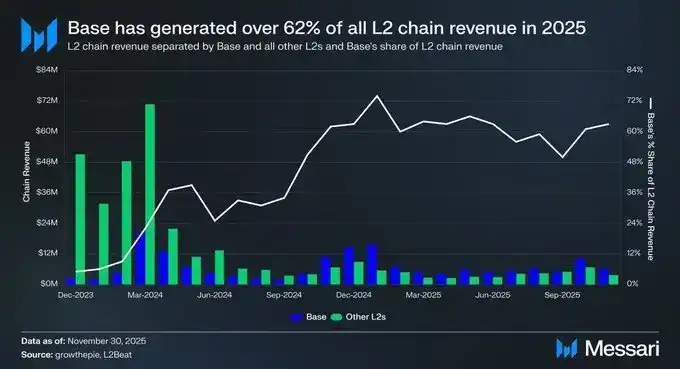
Although total L2 revenue has significantly declined from its 2024 peak, Base continues to dominate the L2 market. In December 2023, Base's on-chain revenue was $2.5 million, accounting for just 5% of the total L2 revenue of $53.7 million. A year later, Base's on-chain revenue grew to $14.7 million, representing 63% of the total L2 revenue of $23.5 million in December 2024. This trend continued into 2025, with Base generating $75.4 million year-to-date, constituting 62% of the total L2 revenue of $120.7 million.
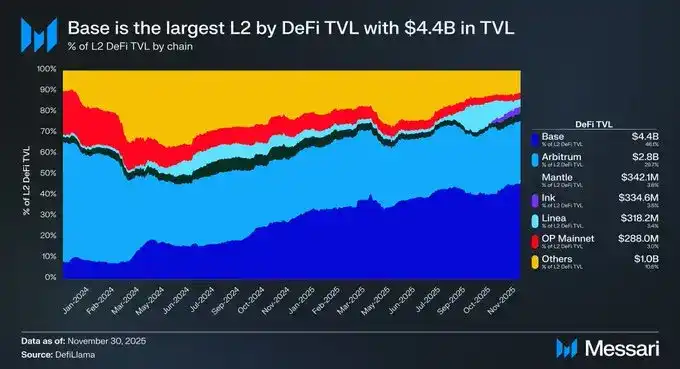
Base's leading advantage is not only reflected in revenue but also in its DeFi TVL, where it has become the frontrunner in the L2 race. After surpassing Arbitrum One in January 2025, Base now holds a DeFi TVL of $4.63 billion, capturing 46% of the entire L2 market. Crucially, Base's share of DeFi TVL has been climbing steadily throughout 2025, growing from 33% at the start of the year to its current level.
Base's greatest advantage over other L2 solutions lies in its distribution channel, the importance of which cannot be overstated. According to Coinbase's latest 10-Q filing, it had 9.3 million monthly active trading users in the third quarter. This gives Base direct access to a vast and already-onboarded user base, a reach that other L2 networks struggle to match. While most L2s must rely on incentive programs or third-party integrations to attract users, Base enjoys a natural distribution advantage through its direct connection to the largest centralized exchange in the U.S.
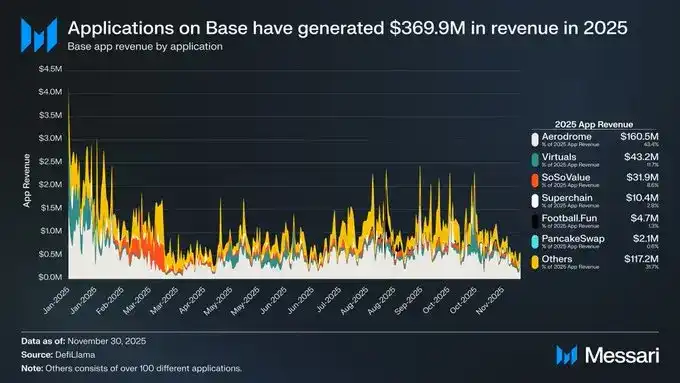
Base also stands out due to the scaling of applications within its ecosystem and their creation of tangible value. Applications in the Base ecosystem have generated $369.9 million in revenue so far this year. Notably, a significant portion of this application revenue is concentrated in Aerodrome, which contributed $160.5 million, accounting for 43% of the total application revenue. However, the leading DEX on Base was not the only successful application in 2025.
The AI agent launch platform Virtuals has achieved $43.2 million in revenue, representing 12% of the total application revenue on Base; while the recently launched sports prediction application Football.Fun has already generated $4.7 million in revenue. These figures indicate that Base has fostered a portfolio of revenue-generating products across multiple domains, with ecosystem activity not reliant on a single application or use case.
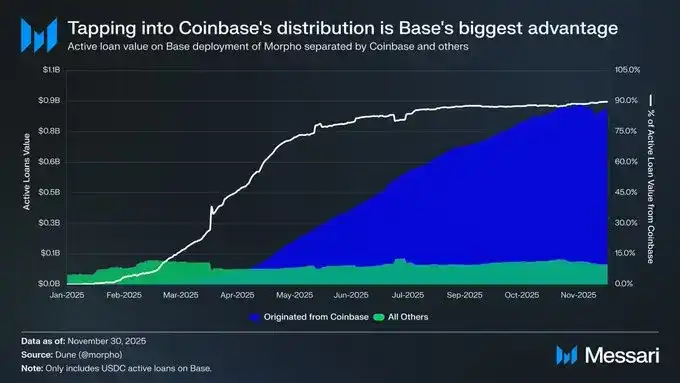
This distribution advantage is best exemplified in the case of the collaboration between Coinbase and Morpho. This partnership allows Coinbase users to borrow USDC directly on the platform using crypto assets as collateral. Although the user experience is embedded within the Coinbase website, collateral management and loan execution are completed on-chain through Morpho's deployment on Base. This lending product was launched less than a year ago but has already seen significant adoption.
Coinbase users have taken out loans totaling $866.3 million through Morpho, which currently accounts for 90% of Morpho's active loans on the Base network. During the same period, Morpho's TVL on the Base chain grew by 1906% year-to-date, climbing from $48.2 million to $966.4 million. Base's distribution advantage means that on-chain activity can be a byproduct of Coinbase product usage. This user onboarding channel is unavailable to other L2 networks, forcing them to primarily rely on incentive programs to attract liquidity and users to their DeFi ecosystems.
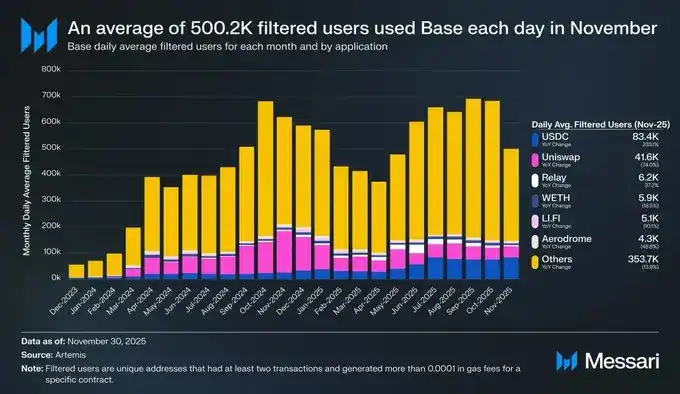
Although Base's DeFi TVL has continued to grow and on-chain revenue has remained stable throughout 2025, user on-chain behavior has begun to change. According to statistics on daily filtered users (referring to unique addresses that conduct at least two transactions on a specific contract and consume more than 0.0001 units of gas fee in a single day), USDC has now become the most widely used application on the Base chain. In November, this application reached 83,400 daily active users on average, a 233% increase compared to 25,100 users in the same period last year.
Meanwhile, interaction between retail users and DEXs has decreased significantly. The daily filtered user numbers for Uniswap and Aerodrome have fallen by 74% and 49%, respectively. More notably, however, DEX trading volume on the Base chain hit an all-time high in 2025, suggesting that activity on Uniswap and Aerodrome is increasingly concentrated in the hands of traders with larger capital and higher trading volumes.
Base's Key Focus for 2026: The Base App
Base's inherent advantage, being backed by Coinbase, is a luxury that other chains can hardly match. It has already built a solid moat in terms of user base, liquidity, and application ecosystem. Base leads L2 networks in revenue, possesses the deepest DeFi TVL in the sector, and consistently receives on-chain user flow from Coinbase. In other words, unlike most L2 networks, which are still struggling to establish a foothold or attract users, Base has long surpassed that stage of development.
Leveraging this moat, Base has set its sights beyond core L2 network metrics and onto the creator economy—a market opportunity with a potential total addressable market estimated at nearly $500 billion. To capture market share in this direction, Base's core strategy focuses on the Base App. This "super app" aims to integrate asset custody, trading, social, and core wallet functionalities into a single platform. Unlike most crypto wallets, the Base App is equipped with several innovative features that go beyond basic asset management:
- A social feed based on Farcaster and Zora;
- Direct messaging and group chat functionality via XMTP (supporting interactions with other users and AI agents like Bankr);
- Built-in mini-app discovery, allowing users to access and use various mini-apps directly within the Base App.
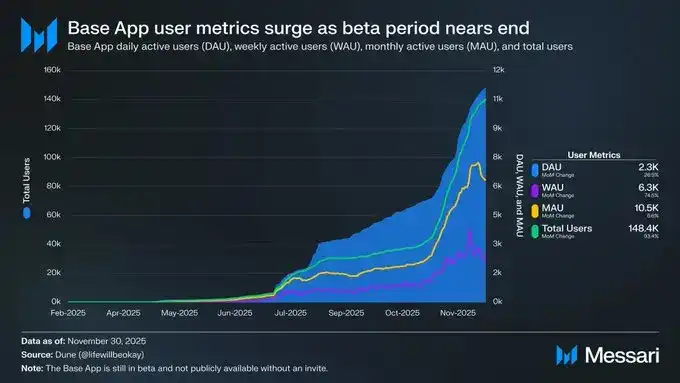
The Base App launched an internal beta in July, initially accessible only to users invited via a whitelist. Despite this, the Base App has achieved significant growth. A total of 148,400 users have created accounts, with registrations accelerating in November, showing a 93% month-on-month increase. User retention rates are also strong, with weekly active users reaching 6,300 (a 74% increase month-on-month) and monthly active users reaching 10,500 (a 7% increase month-on-month). Although not explicitly confirmed, the Base App is likely to conclude its internal beta phase this month, paving the way for a full public launch before the new year.
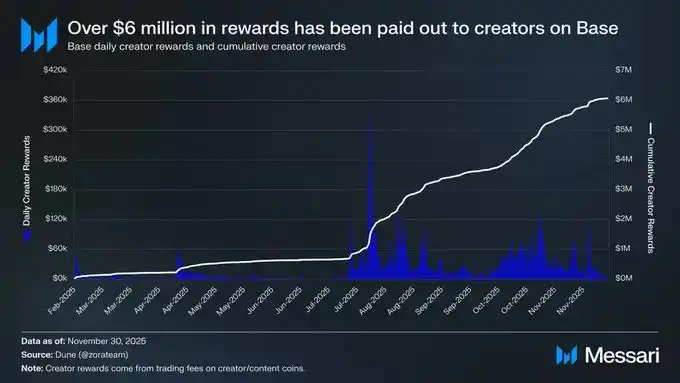
The primary goal of the on-chain economy Base is trying to build is to enable creators to monetize their content directly. Content created within the Base App is tokenized by default (though users can opt out of this feature), turning each post into a tradable market. Creators can earn a share of the transaction fees generated from their content, specifically 1% of each transaction.
Looking ahead, users will also be able to issue creator tokens for their accounts directly within the Base App, opening up another avenue for monetization (this feature is currently in early testing). Technically, both creator tokens and content tokens are tokenized based on the Zora protocol. To date, creators have accumulated $6.1 million in earnings through Zora's tokenization model, with an average monthly payout of $1.1 million since July.
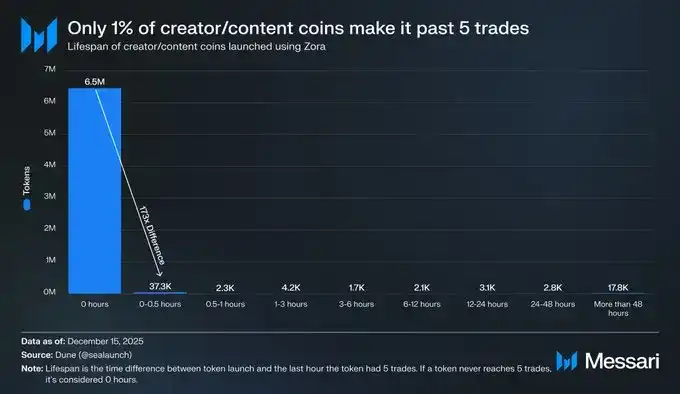
To date, the total number of creators and content tokens tokenized via Zora has exceeded 6.52 million. Of these, 6.45 million (approximately 99% of the total) failed to achieve five transactions. Only 17,800 tokens (0.3% of the total) remained actively traded 48 hours after issuance.
Before interpreting this data, a fundamental fact must be understood: the vast majority of content published on the internet is inherently valueless. From this perspective, the fact that 99% of tokens failed to gain market traction might simply reflect the natural distribution of online content, rather than indicating a structural flaw in the Base model. What truly matters are those tokens that survive beyond 48 hours. We believe that a creator or content token continuing to trade 48 hours after issuance is a signal of the genuine value of the creator or the content itself.
In other words, Base has so far barely made a ripple in the creator economy. Only 17,800 creator and content tokens have demonstrated sustained activity, which is a drop in the ocean compared to the vast amount of content produced daily online. Pessimists might conclude that this model simply doesn't work, while optimists would argue: although Base's penetration rate into the creator economy is in fact close to zero, the potential for growth is enormous if optimizations are made in content distribution, content discovery, and feature tools. Regardless, increasing the number of tokens that survive beyond 48 hours should be a primary focus for Base in 2026.
Finally, Base might also possess the most effective incentive mechanism in the crypto market: a token. In September of this year, Base confirmed it was exploring issuing a token but has not yet disclosed specific details regarding distribution, utility, or a potential launch date. The most notable aspect of a Base token is not the token itself, but its potential use cases. Unlike most L2s, Base does not need to rely on a token to attract liquidity. Instead, it could use the token to incentivize on-chain creator participation, rewarding behaviors that drive user engagement, content creation, and social activity, rather than short-term trading behavior.
In summary, leveraging its established core L2 ecosystem, Base is advancing by utilizing its distribution channels, product coverage, and potential token incentives to explore consumer and creator-facing use cases. If this strategy succeeds, Base will build a moat around social and creator ecosystems. This moat promises greater user stickiness than DeFi TVL or stablecoin balances—a game where other L2s aren't even at the table yet.