IBIT Records $1.3 Billion Outflow in a Single Week, Bitcoin's Largest ETF Becomes a Wall of Selling Pressure That Bulls Must Break Through

marsbitPublished on 2026-06-29Last updated on 2026-06-29

Abstract

BlackRock's iShares Bitcoin Trust (IBIT), the largest U.S. spot bitcoin ETF, saw $1.3 billion in net outflows for the week ending June 26, accounting for roughly 73% of total ETF outflows ($1.79B). This significant, concentrated selling pressure from the primary vehicle that previously funneled institutional demand into bitcoin is now testing the market at a key support level near $60,000. The article notes a narrative shift: the same ETF that served as a major entry ramp for compliant investment is now operating in reverse as a potential exit lane. While ETF outflows represent a transmission risk rather than direct spot selling, they create a new structural headwind. Bitcoin's next move hinges on whether non-ETF buyers can absorb this pressure. Two scenarios are presented: if IBIT outflows slow and bitcoin reclaims the $59,000-$62,000 range, the event could be seen as a clearing of weak hands. However, if IBIT continues to lead significant redemptions while bitcoin struggles to hold $60k, the ETF complex itself may become a persistent source of selling pressure, challenging the long-held "institutional demand" thesis. The coming trading sessions will determine if this is a one-time purge or the start of sustained outflows.

Author: Liam 'Akiba' Wright

Compiled by: TechFlow

TechFlow Insights: BlackRock's IBIT accounted for nearly 73% of the net outflows from US spot Bitcoin ETFs last week, with a single-week redemption of $1.3 billion. When this major gateway, which once brought Wall Street buying power to Bitcoin, starts operating in reverse, the bulls at the $60,000 level are no longer facing retail selling pressure but structural ETF selling pressure. The fund flows over the next few trading days will determine whether this is a clearing event or the beginning of sustained bleeding.

BlackRock's iShares Bitcoin Trust (IBIT) is becoming a test that Bitcoin bulls least want to face. This ETF, which helped Bitcoin open compliant funding channels and turned 'institutional demand' into a simple narrative, is now where price-sensitive holders are making their presence felt.

Bitcoin ETF flow data from Farside Investors shows that during the trading week of June 22-26, US spot Bitcoin ETFs collectively saw a net outflow of approximately $1.789 billion. IBIT alone accounted for about $1.303 billion, close to 73% of the total weekly outflow.

The latest trading day's data makes the signal even clearer: Farside's data for June 26 shows a net outflow of $444.5 million from the ETF complex, with all negative values coming from IBIT.

This concentration changes the conditions for Bitcoin's rebound test. The ETF complex can still be a demand channel, but the largest spot Bitcoin ETF must now also be viewed as a redemption channel.

If this shell, which once helped Bitcoin gain acceptance from brokerage account investors, becomes the primary exit lane, then spot buyers outside the ETFs must absorb these exposures when ETF holders reduce their positions.

IBIT Leads ETF Fund Exodus

The reason Farside's data constitutes a market structure signal is that the pressure is concentrated on Bitcoin's most prominent ETF.
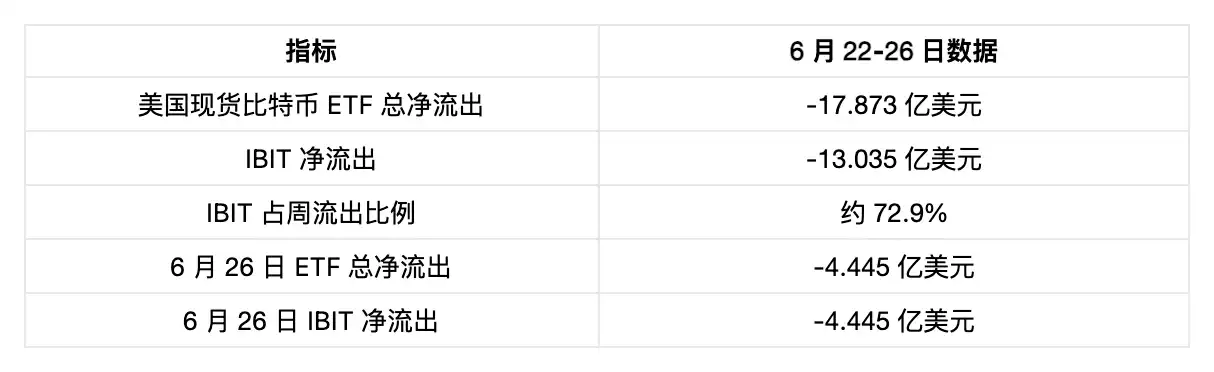
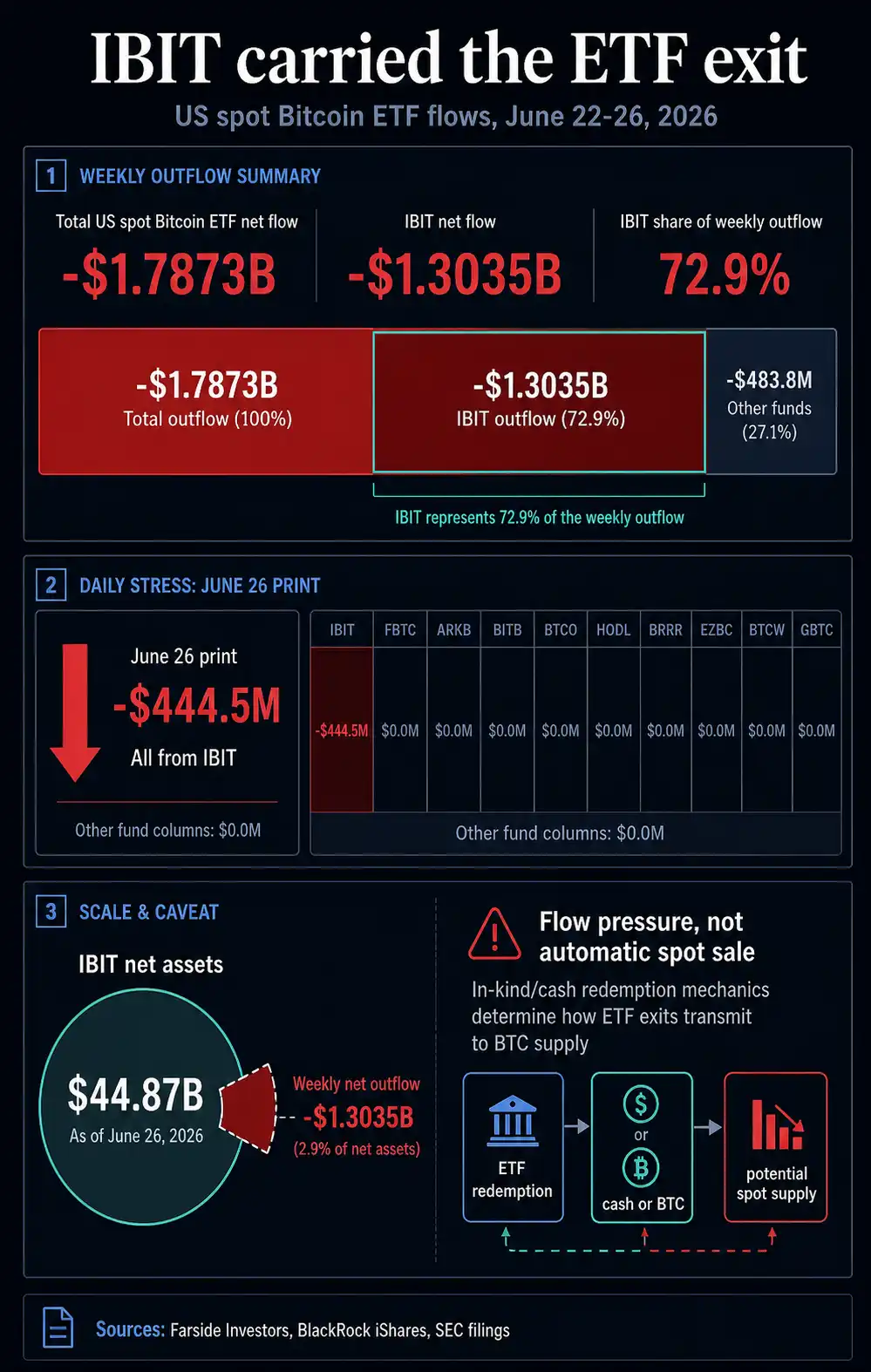
Caption: IBIT accounted for 72.9% of the total weekly outflows from US spot Bitcoin ETFs ($1.3035 billion / $1.7873 billion), data source Farside Investors.

IBIT is not just a ticker in the ETF complex. It is one of the clearest channels for Bitcoin to achieve compliant access through existing brokerage accounts. Its scale gives its fund flows more market weight than redemptions from smaller funds.

When this product contributes the majority of fund outflows in a week, the signal is no longer just 'the ETF market is cooling down.' It is a stress test on the strongest access channel Bitcoin has gained since the launch of spot ETFs.

These outflows occurred while Bitcoin itself was under pressure. CryptoSlate market data shows BTC was trading around $60,000 on June 28, with negative price changes over both 7-day and 30-day periods.

Previous CryptoSlate reports have tracked the broader context of collective ETF surrender and Bitcoin's struggle in the $58,000 to $60,000 range. The new added pressure now is that IBIT itself has become the marginal flow to watch.

Narrative Flip: The Same Channel, Operating in Both Directions

The early spot ETF story was simple: compliant channels broadened the buyer base, ETF demand reduced available supply, and Bitcoin gained a more familiar holding path for institutions and brokerage account investors.

The latest data preserves that history while revealing that the same entry point can operate in reverse when ETF holders decide to exit.

IBIT's scale is both why this week's outflow matters and provides a proportional reference. BlackRock iShares' official product page shows IBIT had net assets of $44.87 billion as of June 26, with a benchmark price around $59,813.

A $1.3 billion weekly outflow is enough to dominate the ETF complex but remains a small percentage relative to the fund's total assets. IBIT is still an important compliant Bitcoin wrapper. The market's question is what this scale means at the margin.

When IBIT was attracting capital, its scale reinforced the 'institutional demand' narrative. When IBIT is bleeding, its scale makes this outflow hard for the rest of the market to ignore.

Smaller funds can bleed continuously without altering the overall ETF narrative. IBIT cannot. Its redemptions indicate that ETF holdings may be becoming more price-sensitive near Bitcoin's support levels.

This distinction is crucial at the $60,000 level. The optimistic read: the largest redemptions have already worked through the system, outflows will slow from here, and Bitcoin reclaiming the $59,000-$62,000 range would mean the market has absorbed the selling pressure.

The cautious read: the next recovery rally must not only rebound from liquidation shocks but also withstand new ETF selling pressure.

This is the 'wall of selling pressure' version of the IBIT story. It doesn't require BlackRock to be bearish on Bitcoin or IBIT holders to exit all at once. It's a market structure argument: the largest access product can become where price-sensitive holdings surface first.

Precise Definition of the ETF Mechanism

ETF flow data is a pressure signal, not a record of direct on-chain selling.

In July 2025, the SEC approved a physical creation/redemption mechanism for crypto ETPs. IBIT's filings also show the redemption mechanism can involve cash proceeds from selling Bitcoin or Bitcoin in-kind, depending on the path used.

Therefore, ETF outflows should be seen as transmission risk, not direct evidence that for every dollar redeemed, a dollar is automatically dumped into the spot market.

The risk remains real. A large, liquid ETF can translate investors' de-risking moves into a recurring source of pressure on Bitcoin's supply side (or the expectation thereof), especially if redemptions are settled in cash or if the Bitcoin obtained from redemptions is subsequently sold.

The signal carries weight even without perfect mechanistic certainty. If IBIT continues to post large net outflow days, buyers must ask: who is absorbing these exposures when ETF holders exit?

If Bitcoin cannot reclaim $60,000 during this period, the old 'institutional demand' narrative weakens. If flows stabilize quickly, the same dataset may later be viewed as just a clearing of crowded trades.

The real test is: have ETF holdings matured into a two-way source of price pressure? Spot ETFs provided investors with a more convenient holding path. More convenient holding also means more convenient exiting.

IBIT's outflows last week placed this trade-off precisely at a fragile spot on Bitcoin's chart.

Two Scenarios

If IBIT outflows slow, Bitcoin holds the high $50,000s range, and reclaims the $59,000-$62,000 level, this week can be interpreted as a potential capitulation flush or flow reset.

In this version, the ETF holders who wanted to leave have done so, the market absorbed the transmission risk, and the largest compliant product remains a net positive for Bitcoin over a longer timeframe.

If IBIT continues to lead redemptions and Bitcoin persistently fails to re-establish a footing above $60,000, the interpretation changes. The ETF complex will define the conditions for the next recovery test: non-ETF spot buyers must hold the market on their own, without the help of the shell that once offered the simplest bullish narrative.

The IBIT-led capital withdrawal leaves Bitcoin with a live test, not a conclusion. One week of flow data cannot determine investor motives, and the redemption mechanism doesn't allow for simple 'one dollar out = one dollar spot sale' inference.

But the data does indicate that at a time when Bitcoin most needs demand from outside the ETF system, the market's most prominent Bitcoin ETF can become a primary source of outflow pressure.

For Bitcoin, the next few trading days carry unusual weight. If IBIT's bleeding slows, this week will be seen as a selling pressure exhaustion. Another round of large redemptions, and the 'wall of selling pressure' narrative becomes harder to ignore.


Trending Cryptos

Related Questions

QAccording to the article, which Bitcoin ETF was the main source of outflow for U.S. spot Bitcoin ETFs during the week of June 22-26, and how much did it contribute to the total outflow?

AAccording to the article, BlackRock's iShares Bitcoin Trust (IBIT) was the main source of outflow. It contributed approximately $1.3035 billion in outflows, representing about 72.9% of the total $1.7873 billion weekly outflow for U.S. spot Bitcoin ETFs during that period.

QWhat is the core change in the role of IBIT that the article highlights, and why is this significant for the Bitcoin market?

AThe article highlights that IBIT has transformed from being the primary compliant on-ramp bringing institutional demand into Bitcoin to now also becoming a significant off-ramp. This is significant because it means the largest and most visible Bitcoin ETF is now a source of structural selling pressure. When price-sensitive holders exit through IBIT, it creates a new challenge for the market, forcing non-ETF buyers to absorb that selling pressure, especially at a critical price point like $60,000.

QWhat are the two contrasting scenarios the article presents for Bitcoin's market depending on the future behavior of IBIT's flows?

AThe article presents two contrasting scenarios. Scenario 1 (Optimistic): IBIT outflows slow down, and Bitcoin holds the high $50,000s range and reclaims the $59,000-$62,000 area. This would be interpreted as a capitulation event or flow reset, where the selling pressure has been absorbed. Scenario 2 (Cautious): IBIT continues to dominate outflows, and Bitcoin fails to re-establish a footing above $60,000. This would confirm that the ETF complex, particularly IBIT, has become a structural headwind, forcing a market recovery without the support of its previously bullish narrative.

QDoes the article state that every dollar of ETF outflow directly results in a dollar of Bitcoin being sold in the spot market? If not, how should ETF outflows be interpreted?

ANo, the article clarifies that ETF outflow data is not a direct record of Bitcoin being sold on-chain. It explains that ETF redemptions can be settled in cash or in-kind (bitcoin), depending on the mechanism. Therefore, outflows should be interpreted as a transmission risk or a source of supply pressure, not as a 1:1 equivalent of spot market selling. The risk is that large, liquid ETFs can convert investor de-risking into recurring pressure on Bitcoin's supply side, especially if redemptions are cash-settled.

QWhat key price level is Bitcoin struggling with according to the article, and why is the timing of IBIT's significant outflows particularly problematic?

ABitcoin is struggling with the $60,000 price level. The timing of IBIT's significant outflows is problematic because it adds a new layer of selling pressure precisely when Bitcoin is trying to defend a crucial psychological and technical support area. Instead of facing just retail selling, the market must now contend with potential structural selling from the largest Bitcoin ETF, making a recovery at this level more difficult.

Related Reads

AI Sweeps the Globe, So Why Is Crypto + AI Facing Gloom?

The article "AI Sweeps the Globe, But Why Is Crypto + AI So Bleak?" analyzes the disconnect between the booming AI industry and the struggling crypto+AI sector. It argues the issue is not flawed logic but severe demand-supply mismatch across four key sub-sectors. Decentralized compute and storage projects offer theoretical benefits like cost savings and data sovereignty but lack a decisive technical edge over entrenched cloud providers (AWS, GCP). Enterprises are unwilling to risk migration for unproven infrastructure that can't guarantee the performance and reliability needed for critical AI workloads. ZKML and privacy solutions address important issues like model verification but solve non-urgent, long-term concerns for most businesses currently focused on core performance and ROI. Demand here is likely to be regulation-driven (e.g., EU AI Act) rather than organic. AI agent infrastructure is developing foundational tech for a future multi-agent economy. However, the current market phase is dominated by internal process automation within single companies, making this technology premature. AI agent payments is highlighted as the only sub-sector where blockchain competes on a level playing field with traditional finance, as neither has adequately solved the challenges of machine-to-machine micropayments and real-time settlement. Overall, crypto+AI projects are building for future needs (data ownership, decentralization, transparency) that don't align with the industry's immediate priorities (performance, cost, stability). The absence of a flagship, large-scale use case further hinders mainstream adoption and capital inflow. The path forward requires either adapting to current market demands or patiently building the foundational infrastructure for the next phase of AI.

marsbit7m ago

AI Sweeps the Globe, So Why Is Crypto + AI Facing Gloom?

marsbit7m ago

"King of Pump Calls" Arthur Hayes Strikes Again, This Time Targeting Deribit

On June 29, BitMEX co-founder Arthur Hayes purchased approximately 6.16 million SYN tokens via OTC platform Flowdesk for around $2.2 million. Hayes subsequently declared on X that SYN represents one of the most asymmetric investments he has seen since HYPE, stating it's time for an options DEX to challenge the dominant platform Deribit, and identifying Hypercall as that challenger. SYN's price surged over 40% following his comments, with a tenfold increase in June 2026 alone, bringing its FDV to roughly $110 million. The article details Synapse Protocol's evolution from a cross-chain messaging and liquidity network into the chain-based options trading protocol Hypercall. Hypercall, built on the Hyperliquid ecosystem's HyperEVM, aims to be a universal options exchange supporting any asset size with capped loss (limited to premium paid) and no forced liquidations. Deribit, established in 2016, remains the centralized leader in crypto options with an estimated 85% market share in BTC and ETH options and $3.588 billion in assets. Its strengths include deep liquidity and professional tools, but it faces criticisms over custody risk, KYC requirements, and regulatory uncertainty. The analysis positions Hypercall not as an immediate replacement for Deribit's entrenched network effects, but as a potential complementary and differentiated competitor, particularly for DeFi-native assets and new asset classes like RWA. The article concludes by noting Hayes's recent mixed "call" record, including fully exiting and later re-buying HYPE, and the controversial price target for CARDS from his family office Maelstrom, which was followed by a significant price drop.

marsbit28m ago

"King of Pump Calls" Arthur Hayes Strikes Again, This Time Targeting Deribit

marsbit28m ago

AI is Sweeping the Globe, So Why is Crypto + AI in a Slump?

AI Booms, But Crypto + AI Remains Sluggish: A Demand-Side Analysis Despite the AI industry's explosive growth and massive investment, the convergence of blockchain and AI (Crypto + AI) has seen limited traction. The core issue is a severe supply-demand mismatch, not a flawed premise. Analyzing four key sub-sectors reveals specific gaps: 1. **Decentralized Compute/Storage:** Offer logical benefits like data sovereignty and cost savings but lack a decisive technical advantage over entrenched cloud giants (AWS, GCP). Enterprises prioritize performance and stability and are unwilling to bear the switching risk and uncertainty of decentralized networks. 2. **Model Verification/Privacy (e.g., ZKML):** Address important long-term issues like auditability and data privacy, but these are not urgent operational pain points for most businesses today. Widespread demand will likely follow regulatory mandates (like the EU AI Act), not precede them. 3. **AI Agent Infrastructure:** Projects are building infrastructure for a future of autonomous, interacting agents. However, the current market focus is on internal process automation within corporate firewalls. The technology is ahead of market readiness. 4. **AI Agent Payments:** This is the only sub-sector where blockchain is on a level playing field with traditional finance. Both are trying to solve the unsolved problem of real-time, micro-transactions for machines, making it the most immediately competitive area. The overarching problem is that the AI industry invests heavily in solutions that solve immediate bottlenecks (e.g., faster memory, more power). Most Crypto + AI solutions target secondary, longer-term concerns (decentralization, transparency) and often come with performance trade-offs. The lack of a flagship, large-scale commercial success case further hinders mainstream capital inflow. The path forward requires either aligning more closely with the current industry's performance demands or patiently building the foundational infrastructure for the next phase of AI.

Foresight News38m ago

AI is Sweeping the Globe, So Why is Crypto + AI in a Slump?

Foresight News38m ago

Continuous Net Outflows from ETFs, Are Institutions Exiting?

US spot Bitcoin ETFs have experienced approximately $6 billion in net outflows over the past six weeks, marking the longest consecutive weekly withdrawal streak since their launch in 2024. The iShares Bitcoin Trust (IBIT) from BlackRock has been particularly affected, accounting for over 70% of recent outflows. On-chain analysis indicates that long-term Bitcoin holders (holding for over 155 days), who control about 83% of the circulating supply, remain steadfast. The selling pressure is primarily coming from allocators who entered through ETF brokerage accounts. This represents the first major collective capitulation since Bitcoin gained mainstream Wall Street recognition, driven more by risk-off portfolio adjustments than a fundamental rejection of the asset. Factors such as rising inflation, a hawkish shift in Federal Reserve policy, massive capital inflows into AI infrastructure, and attractive IPO opportunities have redirected speculative funds. Bitcoin, treated as a high-beta risk asset, was among the first to be sold. While the pace of outflows has slowed significantly—from $1.72 billion in early June to $226.8 million mid-month—the structural issue remains. IBIT's large size means its outflows alone exert substantial market pressure. With spot market volume thin, new capital inflows absent, and ETF buying muted, the market lacks sufficient buying support to absorb this selling. The coming sessions are critical. If IBIT outflows decelerate and Bitcoin reclaims $60,000, this phase could be seen as a healthy reset. However, if heavy IBIT redemptions resume and the price falls below $58,000, it would signal a more sustained institutional exit, requiring non-ETF buyers to shoulder the entire selling pressure alone. The ETF, while lowering entry barriers, has not removed Bitcoin's inherent volatility.

marsbit1h ago

Continuous Net Outflows from ETFs, Are Institutions Exiting?

marsbit1h ago

Introduction to the Concept of World Models: A Story from Psychology to the Main Battlefield of AI

**World Models: From Psychology to AI's Core Concept** "World model" is a trending but often confusing term in AI, describing a system that allows machines to internally simulate, predict, and rehearse potential outcomes before taking real-world action—like a mental "sandbox." While definitions vary—Yann LeCun emphasizes physical understanding, OpenAI's Sora is a video-based "world simulator," Google DeepMind's Genie 3 creates interactive 3D environments, and companies like Alibaba and Tesla focus on practical applications—the core goal is consistent: reduce reliance on vast real-world data by creating an internal, predictive model for safer and more efficient AI. The concept has deep roots, tracing back to psychologist Kenneth Craik (1943). In AI, it was revitalized by researchers like David Ha and Jürgen Schmidhuber (2018). Major technical approaches include: 1) generative video models (e.g., Sora) for visual realism; 2) abstract predictive models (e.g., LeCun's JEPA) for efficiency and physical reasoning; and 3) explicit 3D simulators (e.g., NVIDIA Omniverse) for precision. Fei-Fei Li proposes a classification based on the AI action loop: renderers (output observations), simulators (output world states), and planners (output actions). The emerging "World Action Model" (WAM) paradigm aims to unify future prediction and action generation. An industry framework is forming: upstream (data, compute, sensors), midstream (general and vertical platforms), and downstream applications (autonomous driving, robotics, gaming, etc.). Autonomous driving is currently the most mature use case. The current lack of a unified definition reflects the field's early, dynamic stage, similar to past tech revolutions. Different approaches—focusing on pixels, physics, or behavior—represent parallel explorations of how best to compress and understand the world. This diversity, while seemingly chaotic, signals that world models have moved from an academic idea to a critical industrial battleground, ultimately aiming to give machines the ability to understand, imagine, and reason about the world.

marsbit1h ago

Introduction to the Concept of World Models: A Story from Psychology to the Main Battlefield of AI

marsbit1h ago

Trading

Spot

Hot Articles

What is $BITCOIN

DIGITAL GOLD ($BITCOIN): A Comprehensive Analysis Introduction to DIGITAL GOLD ($BITCOIN) DIGITAL GOLD ($BITCOIN) is a blockchain-based project operating on the Solana network, which aims to combine the characteristics of traditional precious metals with the innovation of decentralized technologies. While it shares a name with Bitcoin, often referred to as “digital gold” due to its perception as a store of value, DIGITAL GOLD is a separate token designed to create a unique ecosystem within the Web3 landscape. Its goal is to position itself as a viable alternative digital asset, although specifics regarding its applications and functionalities are still developing. What is DIGITAL GOLD ($BITCOIN)? DIGITAL GOLD ($BITCOIN) is a cryptocurrency token explicitly designed for use on the Solana blockchain. In contrast to Bitcoin, which provides a widely recognized value storage role, this token appears to focus on broader applications and characteristics. Notable aspects include: Blockchain Infrastructure: The token is built on the Solana blockchain, known for its capacity to handle high-speed and low-cost transactions. Supply Dynamics: DIGITAL GOLD has a maximum supply capped at 100 quadrillion tokens (100P $BITCOIN), although details regarding its circulating supply are currently undisclosed. Utility: While precise functionalities are not explicitly outlined, there are indications that the token could be utilized for various applications, potentially involving decentralized applications (dApps) or asset tokenization strategies. Who is the Creator of DIGITAL GOLD ($BITCOIN)? At present, the identity of the creators and development team behind DIGITAL GOLD ($BITCOIN) remains unknown. This situation is typical among many innovative projects within the blockchain space, particularly those aligning with decentralized finance and meme coin phenomena. While such anonymity may foster a community-driven culture, it intensifies concerns about governance and accountability. Who are the Investors of DIGITAL GOLD ($BITCOIN)? The available information indicates that DIGITAL GOLD ($BITCOIN) does not have any known institutional backers or prominent venture capital investments. The project seems to operate on a peer-to-peer model focused on community support and adoption rather than traditional funding routes. Its activity and liquidity are primarily situated on decentralized exchanges (DEXs), such as PumpSwap, rather than established centralized trading platforms, further highlighting its grassroots approach. How DIGITAL GOLD ($BITCOIN) Works The operational mechanics of DIGITAL GOLD ($BITCOIN) can be elaborated on based on its blockchain design and network attributes: Consensus Mechanism: By leveraging Solana’s unique proof-of-history (PoH) combined with a proof-of-stake (PoS) model, the project ensures efficient transaction validation contributing to the network's high performance. Tokenomics: While specific deflationary mechanisms have not been extensively detailed, the vast maximum token supply implies that it may cater to microtransactions or niche use cases that are still to be defined. Interoperability: There exists the potential for integration with Solana’s broader ecosystem, including various decentralized finance (DeFi) platforms. However, the details regarding specific integrations remain unspecified. Timeline of Key Events Here is a timeline that highlights significant milestones concerning DIGITAL GOLD ($BITCOIN): 2023: The initial deployment of the token occurs on the Solana blockchain, marked by its contract address. 2024: DIGITAL GOLD gains visibility as it becomes available for trading on decentralized exchanges like PumpSwap, allowing users to trade it against SOL. 2025: The project witnesses sporadic trading activity and potential interest in community-led engagements, although no noteworthy partnerships or technical advancements have been documented as of yet. Critical Analysis Strengths Scalability: The underlying Solana infrastructure supports high transaction volumes, which could enhance the utility of $BITCOIN in various transaction scenarios. Accessibility: The potential low trading price per token could attract retail investors, facilitating wider participation due to fractional ownership opportunities. Risks Lack of Transparency: The absence of publicly known backers, developers, or an audit process may yield skepticism regarding the project's sustainability and trustworthiness. Market Volatility: The trading activity is heavily reliant on speculative behavior, which can result in significant price volatility and uncertainty for investors. Conclusion DIGITAL GOLD ($BITCOIN) emerges as an intriguing yet ambiguous project within the rapidly evolving Solana ecosystem. While it attempts to leverage the “digital gold” narrative, its departure from Bitcoin's established role as a store of value underscores the need for a clearer differentiation of its intended utility and governance structure. Future acceptance and adoption will likely depend on addressing the current opacity and defining its operational and economic strategies more explicitly. Note: This report encompasses synthesised information available as of October 2023, and developments may have transpired beyond the research period.

505 Total ViewsPublished 2025.05.13Updated 2025.05.13

What is $BITCOIN

Discussions

Welcome to the HTX Community. Here, you can stay informed about the latest platform developments and gain access to professional market insights. Users' opinions on the price of BTC (BTC) are presented below.

活动图片