Coinbase Launches Prediction Market Across US as SUBBD Explodes

bitcoinistPublished on 2026-02-04Last updated on 2026-02-04

Abstract

Coinbase has launched a U.S.-regulated prediction market platform, entering a space dominated by players like Polymarket and Kalshi. This move signals growing regulatory acceptance for event-based trading contracts. Meanwhile, attention is shifting toward utility-driven crypto projects like SUBBD Token ($SUBBD), which aims to decentralize the $85 billion content creator economy. SUBBD uses AI tools and Web3 payments to help creators monetize content more efficiently, bypassing high fees and restrictions from centralized platforms. Its ongoing presale has raised over $1.4 million, offering staking rewards and exclusive content access to token holders.

Coinbase just walked into the prediction market arena. By launching a U.S.-regulated platform for trading event contracts, the American crypto giant is taking a swing at emerging heavyweights like Polymarket and Kalshi.

This isn’t just about competition; it’s a signal. By running these contracts through its CFTC-regulated arm, Coinbase is essentially legitimizing a sector that’s spent years operating in DeFi’s gray zones.

It’s a bold move. Prediction markets used to be a niche curiosity, but recent volume on decentralized platforms proves there’s a massive appetite for betting on real-world outcomes, everything from Fed rates to election results.

Coinbase’s entry suggests infrastructure providers are finally comfortable with the regulatory landscape surrounding these ‘binary options.’ We aren’t just looking at asset speculation anymore; we’re moving toward functional markets where information, probability, and capital actually intersect.

But the democratization of markets isn’t stopping at financial derivatives. While Coinbase tackles the prediction vertical, a different shift is hitting the creator economy. Smart money is rotating into utility-driven protocols that solve actual headaches for non-financial users.

As the hype around prediction markets builds, liquidity is quietly flowing into projects that redefine content monetization. That’s where SUBBD Token ($SUBBD) steps in, a protocol aiming to dismantle the centralized monopolies choking the $85 billion content industry.

Check out the $SUBBD presale here.

SUBBD Token ($SUBBD) Redefining the $85 Billion Creator Economy

The digital content sector is facing a serious centralization problem. Platforms like OnlyFans and Patreon often take a 30% cut of earnings and hold the power to deplatform users on a whim. SUBBD Token ($SUBBD) uses a decentralized architecture to fix these inefficiencies, but it’s not just about lower fees.

By merging Web3 payments with advanced AI tools, the project offers a technological leap rather than just a financial band-aid.

The real differentiator here is the AI integration. According to the project’s whitepaper, SUBBD equips creators with an AI Personal Assistant for automated interactions and proprietary AI Voice Cloning tech.
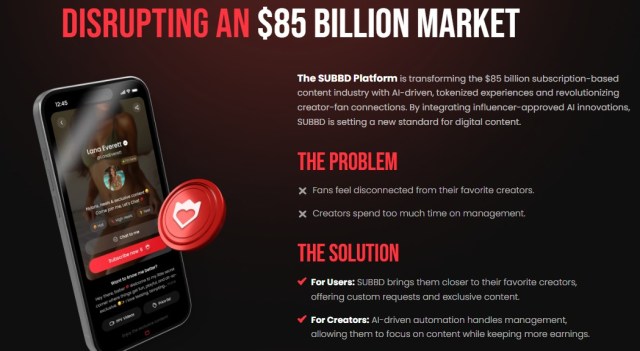
This allows for ‘AI Influencers’, autonomous personas that generate revenue 24/7. That matters. It shifts the creator economy from a labor-intensive grind to a scalable, asset-based model. Plus, by tokenizing access via Ethereum smart contracts, SUBBD ensures creators keep their data and revenue, not the platform.

The logic is simple: legacy platforms are struggling with payment restrictions and bloated fees, while decentralized alternatives offer better margins. SUBBD supports subscriptions, pay-per-view (PPV), and NFT sales, all governed by the token.

It’s a circular setup where the asset is needed for governance, staking, and premium features, theoretically driving demand as the user base grows.

Visit the $SUBBD presale.

Presale Surges Past $1.4M As Investors Seek Yield

You can see this rotation into utility tokens in the fundraising data. $SUBBD has raised over $1.4M in its ongoing presale, a figure that suggests serious conviction from early backers. With tokens currently priced at $0.05749, the entry point is still accessible relative to the roadmap.
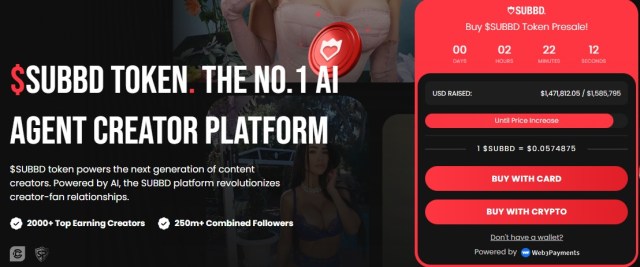
This steady inflow during a choppy market suggests investors are hedging against pure speculation by backing infrastructure plays with clear revenue models.

Staking incentives are also driving retention. SUBBD offers a fixed 20% APY for the first year to users who lock their tokens. That high-yield strategy does two things: rewards early adopters and takes supply off the table during the launch phase.

After that initial period, the model shifts to ‘platform benefit staking.’ Holding tokens then grants access to exclusive livestreams, ‘behind-the-scenes’ drops, and XP multipliers.

This structure makes the ecosystem sticky for active users. Unlike governance tokens that often lack immediate utility, $SUBBD functions as a license to operate within this new creator economy. As Coinbase validates decentralized prediction markets, projects like SUBBD are doing the same for content.

It points to a broader trend: blockchain tech finally replacing middleman-heavy industries.

Buy $SUBBD here.

Disclaimer: The content of this article is for informational purposes only and does not constitute financial advice. Cryptocurrency investments carry inherent risks, and you should perform your own due diligence before making any investment decisions.

Related Questions

QWhat is the significance of Coinbase launching a U.S.-regulated prediction market platform?

ACoinbase's launch of a U.S.-regulated prediction market platform legitimizes a sector that has operated in DeFi's gray zones and signals that infrastructure providers are becoming comfortable with the regulatory landscape for binary options.

QHow does SUBBD Token ($SUBBD) aim to address problems in the content creator economy?

ASUBBD Token uses a decentralized architecture to reduce platform fees, prevent deplatforming risks, and integrates AI tools like an AI Personal Assistant and Voice Cloning to enable scalable, asset-based revenue models for creators.

QWhat fundraising milestone has the $SUBBD presale achieved, and what does it indicate?

AThe $SUBBD presale has raised over $1.4 million, indicating strong investor conviction in utility-driven protocols with clear revenue models during a volatile market.

QWhat staking incentives does SUBBD offer to its early adopters?

ASUBBD offers a fixed 20% APY for the first year to users who lock their tokens, rewarding early adopters and reducing supply during launch, followed by platform benefit staking for exclusive content access.

QHow does the integration of AI technology differentiate SUBBD from traditional content platforms?

ASUBBD's AI integration enables features like AI Influencers and automated interactions, shifting the creator economy from a labor-intensive model to a scalable, autonomous revenue-generating system.

Related Reads

The 15-Minute Win-Lose Game: A Million Transaction Records Unveil the 'Folded World' of Bitcoin Prediction Markets

A data analysis of Bitcoin's 15-minute price prediction markets reveals a stark reality dominated by algorithmic trading bots. Over a three-day period encompassing 291 markets, 1.05 million transactions totaling $17 million were recorded. While 17,254 unique addresses participated, the vast majority were retail users treating it like a "lottery," with an almost even split between winners and losers. The key finding is the market's domination by a tiny minority: just 247 algorithm-driven addresses (3.6% of users) executed over 60% of all trades. These bots generated a collective profit of approximately $284,000, while human traders, overall, lost $154,000. Bots also boasted a significantly higher win rate of 65.5% compared to 51.5% for humans. The analysis further debunked the assumption that pure speed guarantees success. The most profitable bot, which earned $54,531, had a high win rate of 72% but was selective, participating in 61% of markets. In contrast, hyper-frequency bots trading over 50 times per hour often had negative returns due to gas fees and intense competition. For human traders, the data suggests a path to success lies in low-frequency, high-conviction trading, where the win rate can reach 55%. However, humans consistently fail at risk management, often holding onto losing positions too long and exiting winners too early, leading to a poor risk-reward ratio. The market is ultimately a hierarchy: top algorithms harvest inferior bots, which in turn harvest undisciplined human traders.

marsbit22m ago

The 15-Minute Win-Lose Game: A Million Transaction Records Unveil the 'Folded World' of Bitcoin Prediction Markets

marsbit22m ago

14 Years After Incubating Coinbase, YC Finally Decides to Issue Investment Funds in USDC

Y Combinator (YC), the renowned startup accelerator behind companies like Airbnb, Stripe, and Coinbase, announced on February 3 that, starting from the Spring 2026 batch, it will offer its startups the option to receive their $500,000 investment in USDC stablecoin. This marks the first time YC has officially introduced a stablecoin payment method for its investments. The decision follows the U.S. GENIUS Act passed in July 2025, which established a federal regulatory framework for stablecoins, requiring 1:1 reserve backing and granting holders redemption rights. This regulatory clarity has removed a major barrier to institutional adoption of cryptocurrencies. YC's move is significant because it signals a shift from being a crypto investor to an active participant using stablecoins in its core operations. Benefits include near-instant, low-cost transactions, especially beneficial for international startups in regions like India and Latin America, where traditional banking can be slow and expensive. YC specifically selected USDC due to its U.S.-based issuer, Circle, and regulatory compliance. The accelerator will support USDC on Ethereum, Base, and Solana blockchains. While crypto-native VCs have used stablecoins before, YC’s standardized integration into its process for all startups—not just crypto projects—represents a major step for mainstream venture capital. This shift reflects broader trends: 90% of financial institutions are integrating stablecoins, which saw $46 trillion in transaction volume in 2025. YC continues to seek founders in areas like stablecoin applications, tokenization, and on-chain ventures through its Fintech 3.0 initiative.

marsbit26m ago

14 Years After Incubating Coinbase, YC Finally Decides to Issue Investment Funds in USDC

marsbit26m ago

Trading

Spot
Futures
活动图片