The First to Ride the Hype of Robinhood Chain: Arbitrum, Up Nearly 20%

marsbitPublished on 2026-07-11Last updated on 2026-07-11

Abstract

ARB rose nearly 20% recently, becoming one of the top-performing major L2 tokens. The catalyst was the launch of Robinhood Chain, an RWA-focused Layer 2 built on Arbitrum's Orbit tech. A key driver is the revived "Arbitrum Expansion Program" (AEP), a revenue-sharing rule from 2024 requiring independent Orbit chains to give 10% of their net protocol revenue to the Arbitrum ecosystem. While smaller chains already paid this, Robinhood Chain, with its significant TradFi backing, is the first large-scale tenant to make the mechanism economically meaningful. Despite impressive early metrics (over 35k addresses, $2.5B TVL, $1B+ DEX volume in its first week), Robinhood Chain's current contribution to Arbitrum's treasury is minor (~$14.7k net revenue). The price surge reflects a narrative-driven premium on AEP's future potential, given Robinhood's vast off-chain assets. The situation mirrors Optimism's "landlord" model with OP Stack, which is now facing a decline as its major tenant, Base, plans to leave. Similarly, analysts question if the high-earning Robinhood Chain will eventually follow Base's path and seek independence from Arbitrum's tech stack, especially as its activity already benefits Ethereum more directly through ETH fee burns.

Author:angelilu, Foresight News

ARB hit $0.094 intraday today, up nearly 20% in the past week, making it one of the best-performing mainstream L2 tokens over that period.

The catalyst for this rally is the launch of "Robinhood Chain"—Robinhood's RWA (Real World Asset) Layer2 built on Arbitrum technology, which officially went live on mainnet at a launch event in London on July 1.

A more subtle logic behind this is that a year-and-a-half-old rule has been brought back into the spotlight: A portion of Robinhood Chain's revenue will automatically flow back into the Arbitrum ecosystem, with a significant chunk going directly to the ArbitrumDAO treasury. This isn't a new policy, but a previously lukewarm revenue-sharing mechanism that is now being seriously priced in by the market for the first time, thanks to the entry of the heavyweight TradFi brand Robinhood.

The First Major Tenant in a Year and a Half

This rule is called the Arbitrum Expansion Program (AEP), launched jointly by the Arbitrum Foundation and Offchain Labs in January 2024. Simply put, it allows Arbitrum to open up its technology for others to build their own chains, with the condition of revenue sharing.

The sharing logic is straightforward: Any independent chain built using Arbitrum Orbit technology but not settling on Arbitrum One/Nova (e.g., settling directly to Ethereum or Base) must share 10% of its net protocol revenue with the Arbitrum ecosystem—8% to the DAO treasury and 2% to the Developer Guild. However, L3s that settle back to Arbitrum One/Nova, like Xai and Sanko, are exempt from this share and retain their status as first-tier ecosystem members.
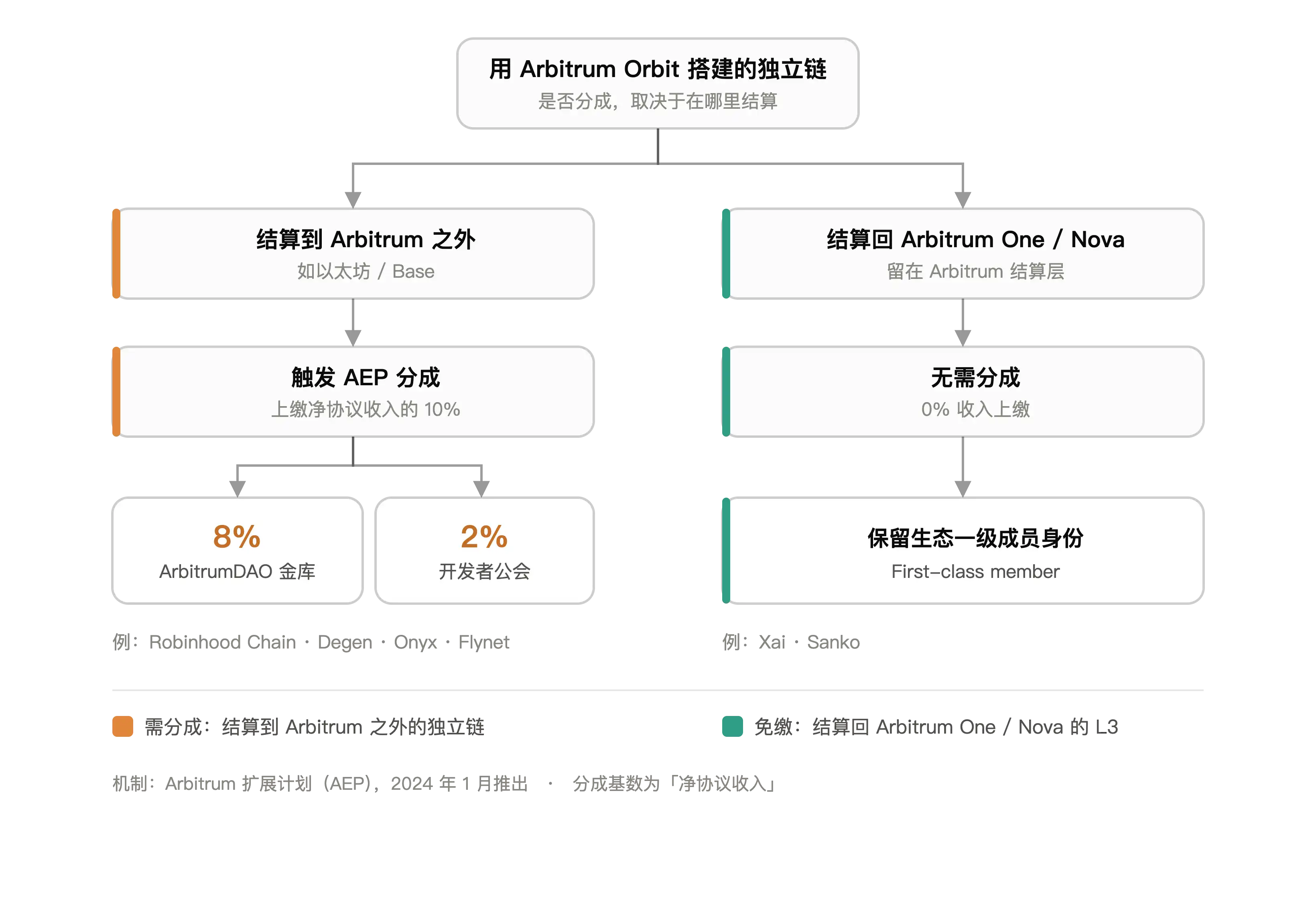
The key point is that Robinhood Chain is not the first chain to trigger the AEP. Smaller chains settling on Base, like Degen Chain, Onyx, and Flynet, have been paying this share for a while, but their volumes were too small to draw attention. What sets Robinhood Chain apart is simply that it's the first heavyweight chain to bring scale to this shared revenue amount.

Impressive Data, but the Rent Plate is Still Small

According to the latest data disclosed by Johann, Robinhood's Head of International & Crypto Business: As of July 10, just over a week after launch, Robinhood Chain has processed over 17 million transactions, has over 350,000 addresses, a TVL of approximately $250 million, and DEX trading volume exceeding $1 billion. For a newly launched chain, this report card is indeed impressive.

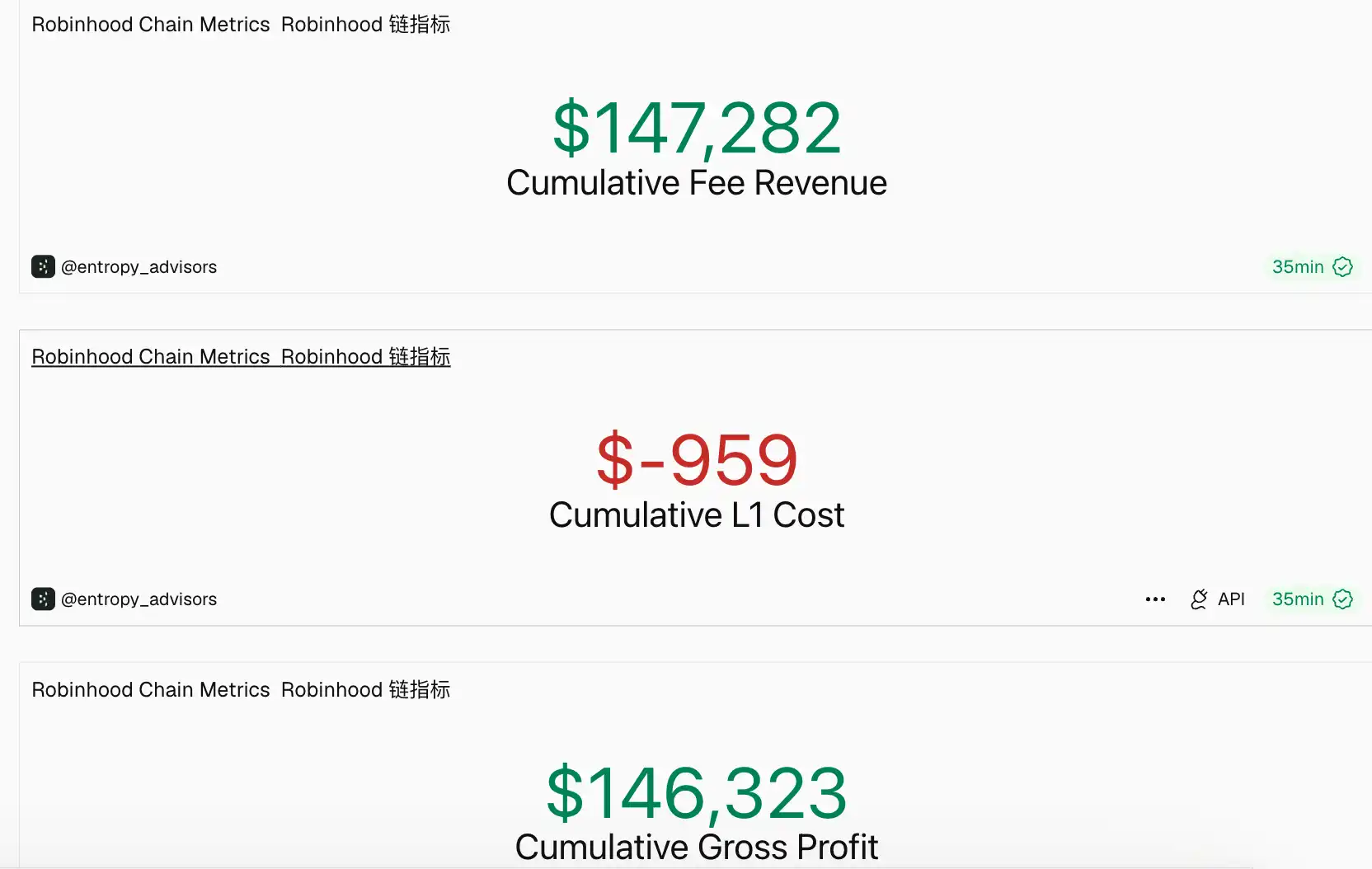
But the rent plate is far from this large. According to Dune data, as of the time of writing, Robinhood Chain's current protocol revenue is about $147,000. After deducting the cost of data settlement back to Ethereum L1, it's only $146,000. Even if 10% of this is shared with Arbitrum DAO, the amount is pitifully small. ARB's current rally reflects the market's premium valuation on the future scaling boundaries of the AEP protocol—a typical narrative-driven market move.
Looking at the potential upside, the ceiling for AEP is indeed not low: The Robinhood platform holds total assets of approximately $324 billion, custodies assets of about $143.6 billion, and its tokenized stocks have expanded to over 2,000 tokens covering 120 countries—most of these assets are not yet on-chain today. Once settlement gradually migrates, the $57,000 sharing base will stand at a completely different scale.

Old Landlord About to Lose Biggest Tenant, New Landlord Just Landed a Big Deal

Arbitrum's "rent collection" model isn't actually new. Optimism has been running the "landlord" business for a long time.

The Optimism Collective collects rent from all Superchain member chains (Base, Zora, Mode, Unichain, etc.) through OP Stack—charging 2.5% of sequencer revenue or 15% of net profit (whichever is higher), and OP Mainnet itself also contributes its net revenue to the treasury. However, its rental income has been gradually shrinking, falling further to about $2.9 million in Q1 2026 (with Base alone contributing about $1.4 million), down 21.5% quarter-on-quarter from $3.7 million in the previous quarter.
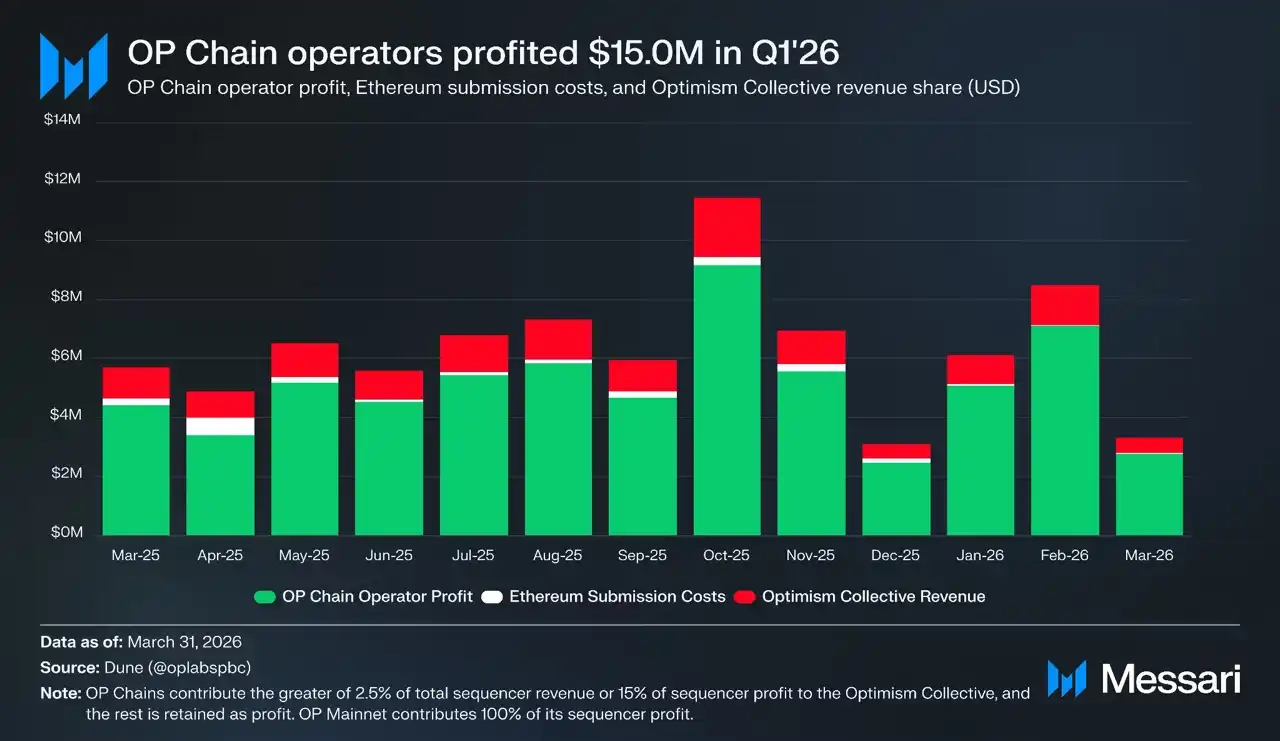
In February of this year, Base officially announced plans to leave OP Stack—Base accounted for about 96.5% of revenue flowing into the Collective on a gas fee basis. Upon the news, the OP token fell 28% within two days.

Meanwhile, Arbitrum just managed to revitalize its own landlord business from zero, thanks to Robinhood Chain. Their structures are completely parallel—both are underlying technologies charging rent from external chains, with the money going into their own DAO treasuries (ArbitrumDAO vs. Optimism Collective). The only difference is that Arbitrum's AEP, although the rules were written in 2024, never had a major tenant until this week, finally giving its "rent collection" a sense of scale for the first time.

But Can This Big Tenant Be Kept?

It's precisely this history with Base that some analysts are using to throw cold water. Some believe that, following the same script, Robinhood Chain will eventually leave Arbitrum Orbit just as Base left OP Stack and align directly with Ethereum. According to growthepie data, Robinhood Chain's daily sequencer revenue is already nearly $60,000, second only to Base's $72,000 among Ethereum L2s, approaching three times that of its parent chain, Arbitrum.
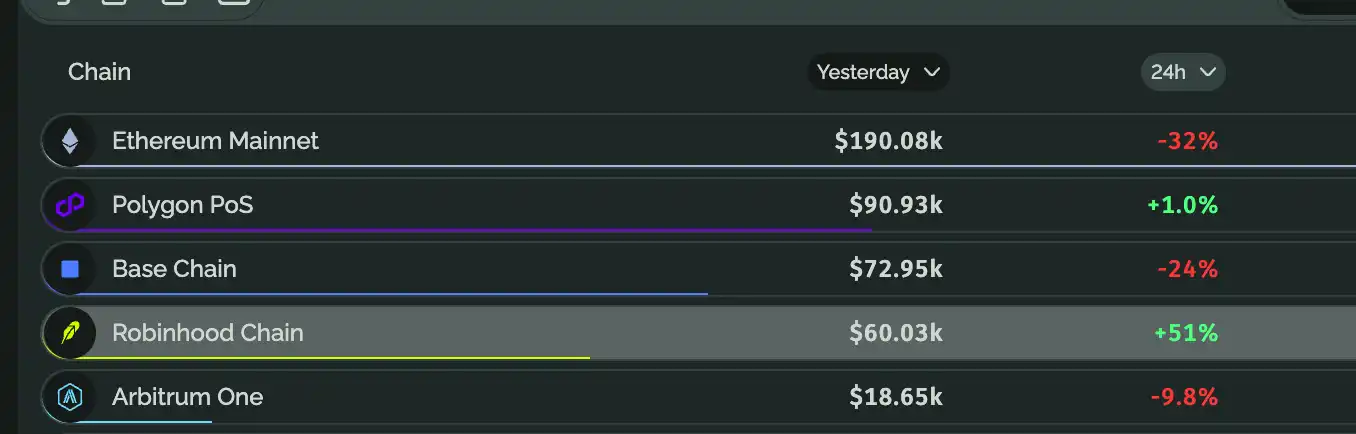
Even more delicate is the question of the beneficiary. In its first week, Robinhood Chain has become the second-largest demand source for Ethereum DA after Base, with its sequencer paying blob fees, settling in ETH, and permanently burning it. Some analysts argue that if this chain can only have one ecosystem currency, it's more likely to be ETH than ARB.


Trending Cryptos

Related Questions

QWhat is the primary reason behind Arbitrum (ARB) token's recent price surge of nearly 20% according to the article?

AThe primary reason is the launch of 'Robinhood Chain,' a Layer 2 for Real World Assets (RWA) built by Robinhood using Arbitrum technology. This event brought significant market attention to Arbitrum's revenue-sharing model for the first time.

QWhat is the name of Arbitrum's program that mandates revenue sharing from chains built with its technology, and what are the specific terms?

AThe program is called the Arbitrum Expansion Plan (AEP). It requires independent chains built with Arbitrum Orbit technology, which do not settle back to Arbitrum One/Nova (e.g., those settling directly to Ethereum or Base), to share 10% of their net protocol revenue with the Arbitrum ecosystem (8% to the DAO Treasury, 2% to the Developer Guild).

QWhy is Robinhood Chain's launch significant for Arbitrum's revenue-sharing model, unlike previous users of the AEP like Degen Chain?

AWhile other small chains like Degen Chain have been paying under AEP, their volume was too insignificant to matter. Robinhood Chain is significant because it is the first major, heavyweight chain from a major TradFi brand to trigger the AEP, bringing substantial potential scale and market credibility to the revenue-sharing model.

QWhat historical event from the Optimism ecosystem is cited as a cautionary tale regarding the sustainability of such revenue-sharing models?

AThe article cites Base's announcement in February (2026) to break away from the OP Stack as a cautionary tale. Base was the largest contributor (providing ~96.5% of revenue) to the Optimism Collective's treasury, and its departure caused the OP token price to drop 28% over two days.

QAccording to analysts in the article, what are the potential risks that Robinhood Chain might pose to Arbitrum's long-term benefits from the AEP?

AAnalysts suggest Robinhood Chain might eventually follow Base's example and break away from Arbitrum Orbit to align directly with Ethereum, especially as its sequencer revenue grows rapidly. Furthermore, the chain's economic activity primarily benefits Ethereum (ETH) through blob fee payments and burning, not necessarily the ARB token.

Related Reads

$8 Trillion: The Second-Largest IPO in History Has Arrived

SK Hynix Makes History with World's Second-Largest IPO. The global memory chip leader SK Hynix debuted on Nasdaq, raising $26.5 billion and achieving a market cap exceeding $1.2 trillion. This marks the largest U.S. IPO by a foreign company and the second-biggest globally. The company's journey is a remarkable turnaround. Founded in 1983, its predecessor, Hyundai Electronics, faced near-bankruptcy during industry downturns before being acquired by SK Group in 2011. A pivotal early bet on HBM (High Bandwidth Memory) technology, initially with AMD in 2013, ultimately paid off with the AI boom. SK Hynix now supplies HBM3 to NVIDIA and commands 58% of the global HBM market. Driven by soaring AI demand, SK Hynix reported staggering Q1 2026 profits with a 72% operating margin. Its surging stock made it South Korea's second trillion-dollar company. Profits are shared widely with employees through a new bonus system tied to 10% of annual operating profit. The article highlights an ongoing "super memory cycle" fueled by AI, with market forecasts predicting massive growth. This presents a historic opportunity for Chinese memory chip makers. ChangXin Memory Technology (CXMT) is set for a domestic IPO, potentially reaching a ~$420 billion valuation as China's top DRAM producer. Yangtze Memory is also preparing to go public. While these "domestic storage leaders" are gaining ground, the article notes they still face technology and margin gaps compared to established giants like Samsung and SK Hynix.

marsbit1h ago

$8 Trillion: The Second-Largest IPO in History Has Arrived

marsbit1h ago

US Stocks Are at an Extremely Fragile Moment as Earnings Season Kicks Off

U.S. stocks are entering a high-stakes earnings season amidst what analysts describe as an "extremely fragile" market environment. While major indices show subdued volatility, underlying pressures from geopolitics, monetary policy expectations, and mixed credit market signals are building. UBS's proprietary "Turbu-lens" market fragility indicator has reached 0.9, its highest level since September 2025, historically a precursor to a sharp spike in the VIX volatility index. The risk is amplified by elevated earnings expectations. Analysts project robust profit growth for Q2—24% for the S&P 500 and 12% for the Stoxx 600—but recent upward revisions mean disappointment could trigger outsized market moves. Current low VIX levels are seen as misleading and temporary, with the earnings season likely to push volatility higher. Market internals reveal significant stress, with single-stock volatility exceeding index volatility by more than threefold. This divergence suggests a potential convergence that could drive a sharp rise in index-level volatility. Given likely continued sector rotation, UBS suggests single-stock options may offer better tactical hedging opportunities than broad index hedges. Further pressures stem from rising oil prices, which threaten to keep inflation and interest rate expectations elevated, and a cautious credit market where CDS spreads have not confirmed the equity rally's strength. For investors, UBS recommends focusing on pair-wise correlation trades to navigate expected stock-specific volatility, highlighting sectors like Tech, Energy, and Financials in the U.S. and Energy, Tech, and Consumer Discretionary in Europe.

marsbit3h ago

US Stocks Are at an Extremely Fragile Moment as Earnings Season Kicks Off

marsbit3h ago

Trading

Spot

Hot Articles

How to Buy HYPE

Welcome to HTX.com! We've made purchasing Hyperliquid (HYPE) simple and convenient. Follow our step-by-step guide to embark on your crypto journey.Step 1: Create Your HTX AccountUse your email or phone number to sign up for a free account on HTX. Experience a hassle-free registration journey and unlock all features.Get My AccountStep 2: Go to Buy Crypto and Choose Your Payment MethodCredit/Debit Card: Use your Visa or Mastercard to buy Hyperliquid (HYPE) instantly.Balance: Use funds from your HTX account balance to trade seamlessly.Third Parties: We've added popular payment methods such as Google Pay and Apple Pay to enhance convenience.P2P: Trade directly with other users on HTX.Over-the-Counter (OTC): We offer tailor-made services and competitive exchange rates for traders.Step 3: Store Your Hyperliquid (HYPE)After purchasing your Hyperliquid (HYPE), store it in your HTX account. Alternatively, you can send it elsewhere via blockchain transfer or use it to trade other cryptocurrencies.Step 4: Trade Hyperliquid (HYPE)Easily trade Hyperliquid (HYPE) on HTX's spot market. Simply access your account, select your trading pair, execute your trades, and monitor in real-time. We offer a user-friendly experience for both beginners and seasoned traders.

4.0k Total ViewsPublished 2024.03.29Updated 2026.06.02

How to Buy HYPE

Discussions

Welcome to the HTX Community. Here, you can stay informed about the latest platform developments and gain access to professional market insights. Users' opinions on the price of HYPE (HYPE) are presented below.

活动图片