Bitcoin Rallies, But Traders Still Realizing $479M In Losses Daily

bitcoinistPublished on 2026-05-08Last updated on 2026-05-08

Abstract

Despite Bitcoin's recent rally to around $80,100, on-chain data reveals that investors are still realizing significant losses. The Bitcoin Realized Loss indicator, which measures the total loss from coins sold below their previous purchase price, has remained elevated at approximately $479 million per day. This level is about 140% above the typical baseline of $200 million seen in stable market periods. Notably, this spike in realized losses occurred even as Bitcoin's price increased, contrasting with previous loss spikes that happened during major price crashes. This pattern suggests that some investors are choosing to exit their positions at a loss during the rally, possibly due to a lack of confidence in its sustainability. Analysts suggest that for a healthier market regime to be confirmed, the daily realized loss would need to compress and sustain below the $200 million level, indicating selling exhaustion and a shift towards stronger underlying demand.

On-chain data shows the Bitcoin Realized Loss indicator has remained elevated even after the latest surge in the cryptocurrency’s price.

Bitcoin Realized Loss Has Stood At $479M Per Day Recently

In its latest weekly report, on-chain analytics firm Glassnode has discussed the latest trend in the Realized Loss for the Bitcoin network. The “Realized Loss” here refers to an indicator that measures, as its name suggests, the total amount of loss that BTC investors as a whole are realizing through their transactions.

The metric works by going through the transfer history of each token being moved to see what price it was transacted at prior to this. If the last selling price was less than the latest one for any token, then that particular token’s sale can be considered to be leading to the realization of some net loss.

The exact degree of loss involved in the transfer is equal to the difference between the two prices. The Realized Loss calculates the sum of this difference for all loss transactions occurring on the blockchain. A counterpart indicator called the Realized Profit takes care of the transfers of the opposite type.

Now, here is the chart shared by Glassnode that shows the trend in the 14-day simple moving average (SMA) of the Bitcoin Realized Loss over the last few years:
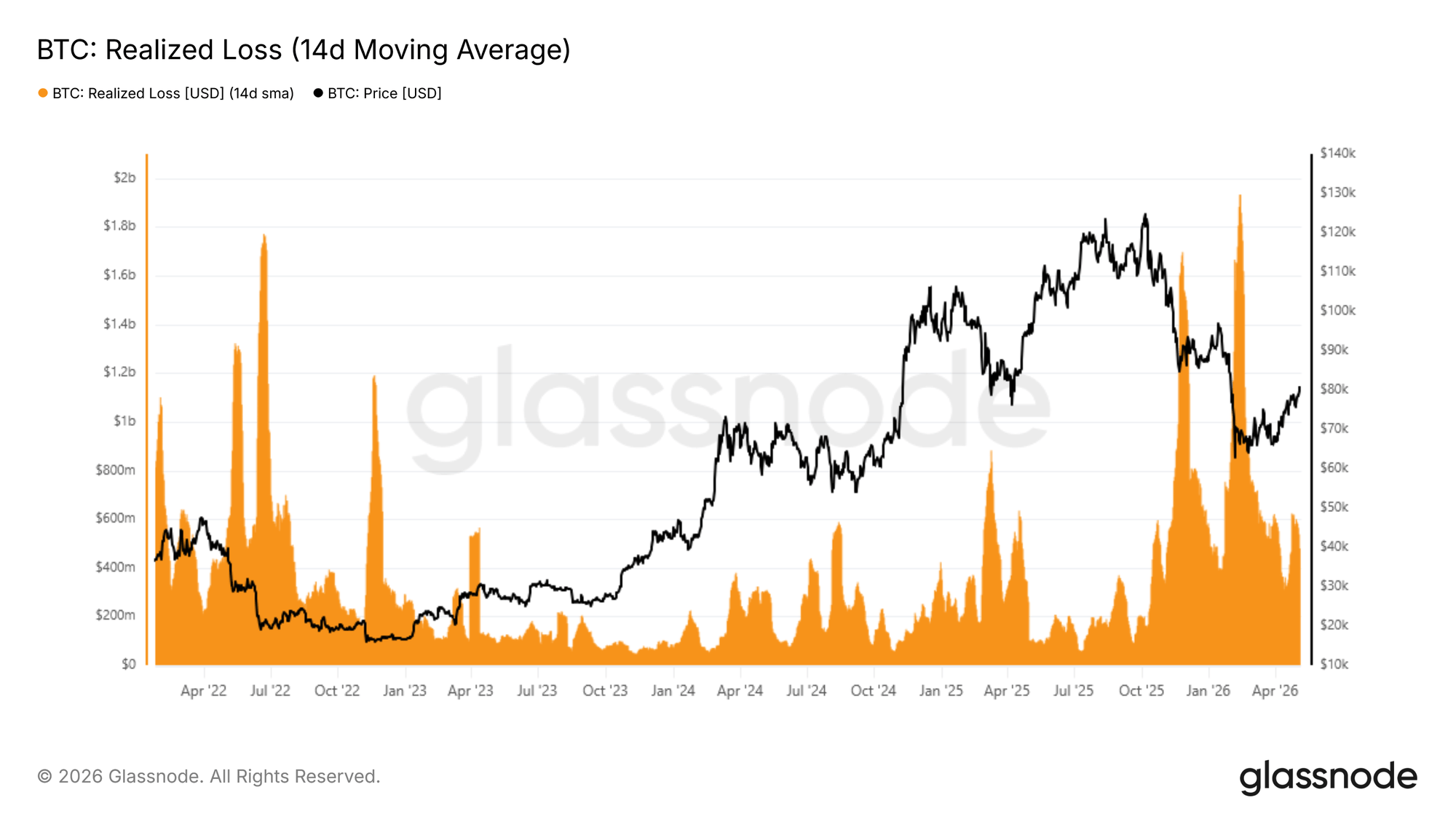
The value of the metric appears to have registered a spike in recent days | Source: Glassnode's The Week Onchain - Week 18, 2026

As displayed in the above graph, the 14-day SMA of the Bitcoin Realized Loss witnessed massive spikes as the cryptocurrency saw price crashes in November and February.

These spikes weren’t anything unusual, as price drawdowns tend to accompany panic selling from top buyers. Interestingly, however, another spike has just recently appeared in the indicator, despite the fact that BTC has been rallying.

The spike is nowhere near of a scale similar to the earlier capitulation events, but it’s nonetheless an indication that there has been a greater push to exit below cost basis alongside the price surge. This may suggest that investors don’t believe that the price rally would last, hence why they have decided to exit at this lower-loss opportunity.

Currently, the Realized Profit is sitting at $479 million per day, approximately 140% above the $200 million baseline that has generally been seen during stable phases in this Bitcoin cycle.

The analytics firm explained:

A sustained compression of this indicator back below $200M per day would serve as a strong on-chain confirmation that selling exhaustion is taking hold, and that the market is genuinely transitioning toward a healthier demand regime.

BTC Price

At the time of writing, Bitcoin is trading around $80,100, up 5% over the past week.

Looks like the price of the coin has retraced from its latest high | Source: BTCUSDT on TradingView


Related Questions

QWhat is the Bitcoin Realized Loss indicator and what does it measure?

AThe Bitcoin Realized Loss indicator measures the total amount of loss that BTC investors as a whole are realizing through their transactions by calculating the sum of losses from all tokens sold at a price lower than their last transaction price.

QWhat is the current daily value of the Bitcoin Realized Loss indicator mentioned in the article, and how does it compare to its baseline?

AThe current daily Bitcoin Realized Loss is approximately $479 million per day, which is about 140% above the $200 million baseline typically seen during stable phases in this Bitcoin cycle.

QAccording to the article, what event is unusual about the recent spike in the Realized Loss indicator?

AThe unusual event is that a spike in the Realized Loss indicator has occurred recently despite Bitcoin's price rallying, whereas previous major spikes were associated with price crashes and panic selling.

QWhat would signal a strong on-chain confirmation of selling exhaustion and a transition to a healthier demand regime, according to Glassnode?

AA sustained compression of the Realized Loss indicator back below $200 million per day would serve as a strong on-chain confirmation that selling exhaustion is taking hold and that the market is genuinely transitioning toward a healthier demand regime.

QWhat was Bitcoin's approximate price and weekly percentage change at the time of writing?

AAt the time of writing, Bitcoin was trading around $80,100, representing an increase of 5% over the past week.

Related Reads

One Article to Understand $UORE: The V4 Hook Project That Packs Mining, Lottery, and NFT Into a Single Transaction

An In-Depth Look at $UORE: The V4 Hook Project Packing Mining, Lotteries, and NFTs into a Single Transaction $UORE is the latest project leveraging the Uniswap V4 Hook mechanism, following in the footsteps of projects like SATO, uPEG, and Slonks. It distinguishes itself by integrating multiple functions—on-chain mining, a buy-to-enter lottery, auto-generated pixel NFTs (Orelings), and a deflationary burn mechanism—all within a single Uniswap V4 liquidity pool transaction. This complexity results in transaction gas fees that are 2-3 times higher than a standard swap. The project's tokenomics are intricate. Each whole $UORE token held automatically mints a corresponding Oreling NFT, a 32x32 pixel miner character with random traits determined by the next block's hash. Each Oreling has a Class (rarity) and Hash value, which combine to form its Mining Power for staking rewards. Rewards are distributed daily from an emission that decays by 1% daily, with an 80/20 split between stakers and a Motherlode lottery pool. A "refined-ore boost" mechanism taxes early reward claims, redistributing 10% to remaining stakers. The Motherlode lottery awards tickets for buys of ≥0.1 ETH, with winning chances scaling up to 1% for 1 ETH purchases. Wins split the pool 50% to the buyer and 50% to a random staker. A 1% buy tax is burned, and a 1% sell tax funds an automatic buyback-and-burn mechanism triggered at 0.1 ETH. The project's code is a fork of uPEG, with claimed fixes for NFT duplication and flash loan attacks. Its creator, Noah, describes it as a fusion of Solana's ORE mining concept with uPEG's V4 Hook framework. Key challenges noted include high gas costs, the narrowing attention window for V4 Hook narratives as it's the fourth such project, and significant complexity that creates a high barrier to understanding for users. The project's whitepaper notably advises users to "Read the contracts and understand the mechanics before deploying capital," underscoring its complex and fast-moving nature within a trend where the "alpha" lifespan for new projects appears to be shrinking rapidly.

marsbit8m ago

One Article to Understand $UORE: The V4 Hook Project That Packs Mining, Lottery, and NFT Into a Single Transaction

marsbit8m ago

Gate Institute: Polymarket Accelerates Growth, Gate Launches New Portal to Prediction Markets

Gate Research Institute: Polymarket Growth Accelerates, Gate Expands into Prediction Markets with New Portal This analysis examines the growth of the prediction market platform Polymarket, which has evolved from an early experiment into a major event-driven trading venue. Data shows a significant, step-like increase in trading volume and active users, though growth remains heavily tied to major political, sports, and geopolitical events. Fee and revenue growth is driven by both genuine trading demand and recent changes to platform fee structures. Polymarket's market structure is highly concentrated, with over 90% of volume in these few high-profile categories. While it functions as both an information and sentiment market, its price discovery is most active during high-attention news cycles. The platform's core value lies in creating a liquid market for trading the outcome of future events, a unique niche within crypto. Gate's recent integration of Polymarket addresses different challenges. It simplifies access by allowing users to trade with exchange-held USDT, lowering friction for its existing user base. This highlights two emerging pathways for prediction markets: Polymarket's native, on-chain model versus Gate's centralized, low-friction account integration. Both paths will likely coexist, targeting different user segments. Key challenges for Polymarket include ongoing regulatory uncertainty, reliance on cyclical event-driven demand, potential oracle or settlement disputes, and achieving sustainable user retention beyond peak event periods. The platform has proven its commercial viability and ability to scale but has yet to demonstrate it can become a stable, everyday trading category independent of major news cycles.

marsbit23m ago

Gate Institute: Polymarket Accelerates Growth, Gate Launches New Portal to Prediction Markets

marsbit23m ago

Dissolving xAI, Musk Wants to Rebuild an AI Company Using Rocket-Building Methods

Elon Musk is making an unprecedented move by dissolving his AI startup, xAI, and folding it into his aerospace company, SpaceX, ahead of a planned public offering. This aims to package SpaceX's lucrative rocket and Starlink business with the high-cost, high-growth potential of AI. However, xAI's flagship model, Grok, has struggled to gain significant commercial or enterprise traction compared to leaders like OpenAI's ChatGPT or Anthropic's Claude. Internal turmoil led to the departure of much of xAI's founding AI talent. Musk has responded by installing SpaceX engineers as managers to transform xAI from a research lab into a high-efficiency "AI factory," focusing on infrastructure like its Colossus supercomputing cluster. Musk's vision positions the combined "SpaceXAI" as a future AI infrastructure company, addressing bottlenecks in computing power, energy, and data centers. He even proposes futuristic concepts like space-based AI data centers. To validate this story, SpaceXAI has begun sharing compute resources with former rival Anthropic. Financially, the merger appears to be a move to secure funding for xAI's massive losses by leveraging SpaceX's stable cash flow. While the combined entity targets a $1.25 trillion valuation, the market has yet to price in significant synergy. The strategic choice of SpaceX over Tesla, despite Tesla's closer ties to physical AI applications like robots and cars, is seen as Musk securing maximum control. Ultimately, Musk is betting that his proven methodology—centralized control, vertical integration, and aggressive engineering timelines—will succeed in the AI arena. But this time, he faces competitors like OpenAI and Google who are equally fast, well-funded, and determined. The merger is less about a guaranteed victory and more about ensuring Musk remains a key player at the table, regardless of the final outcome.

marsbit50m ago

Dissolving xAI, Musk Wants to Rebuild an AI Company Using Rocket-Building Methods

marsbit50m ago

Trading

Spot
Futures

Hot Articles

What is $BITCOIN

DIGITAL GOLD ($BITCOIN): A Comprehensive Analysis Introduction to DIGITAL GOLD ($BITCOIN) DIGITAL GOLD ($BITCOIN) is a blockchain-based project operating on the Solana network, which aims to combine the characteristics of traditional precious metals with the innovation of decentralized technologies. While it shares a name with Bitcoin, often referred to as “digital gold” due to its perception as a store of value, DIGITAL GOLD is a separate token designed to create a unique ecosystem within the Web3 landscape. Its goal is to position itself as a viable alternative digital asset, although specifics regarding its applications and functionalities are still developing. What is DIGITAL GOLD ($BITCOIN)? DIGITAL GOLD ($BITCOIN) is a cryptocurrency token explicitly designed for use on the Solana blockchain. In contrast to Bitcoin, which provides a widely recognized value storage role, this token appears to focus on broader applications and characteristics. Notable aspects include: Blockchain Infrastructure: The token is built on the Solana blockchain, known for its capacity to handle high-speed and low-cost transactions. Supply Dynamics: DIGITAL GOLD has a maximum supply capped at 100 quadrillion tokens (100P $BITCOIN), although details regarding its circulating supply are currently undisclosed. Utility: While precise functionalities are not explicitly outlined, there are indications that the token could be utilized for various applications, potentially involving decentralized applications (dApps) or asset tokenization strategies. Who is the Creator of DIGITAL GOLD ($BITCOIN)? At present, the identity of the creators and development team behind DIGITAL GOLD ($BITCOIN) remains unknown. This situation is typical among many innovative projects within the blockchain space, particularly those aligning with decentralized finance and meme coin phenomena. While such anonymity may foster a community-driven culture, it intensifies concerns about governance and accountability. Who are the Investors of DIGITAL GOLD ($BITCOIN)? The available information indicates that DIGITAL GOLD ($BITCOIN) does not have any known institutional backers or prominent venture capital investments. The project seems to operate on a peer-to-peer model focused on community support and adoption rather than traditional funding routes. Its activity and liquidity are primarily situated on decentralized exchanges (DEXs), such as PumpSwap, rather than established centralized trading platforms, further highlighting its grassroots approach. How DIGITAL GOLD ($BITCOIN) Works The operational mechanics of DIGITAL GOLD ($BITCOIN) can be elaborated on based on its blockchain design and network attributes: Consensus Mechanism: By leveraging Solana’s unique proof-of-history (PoH) combined with a proof-of-stake (PoS) model, the project ensures efficient transaction validation contributing to the network's high performance. Tokenomics: While specific deflationary mechanisms have not been extensively detailed, the vast maximum token supply implies that it may cater to microtransactions or niche use cases that are still to be defined. Interoperability: There exists the potential for integration with Solana’s broader ecosystem, including various decentralized finance (DeFi) platforms. However, the details regarding specific integrations remain unspecified. Timeline of Key Events Here is a timeline that highlights significant milestones concerning DIGITAL GOLD ($BITCOIN): 2023: The initial deployment of the token occurs on the Solana blockchain, marked by its contract address. 2024: DIGITAL GOLD gains visibility as it becomes available for trading on decentralized exchanges like PumpSwap, allowing users to trade it against SOL. 2025: The project witnesses sporadic trading activity and potential interest in community-led engagements, although no noteworthy partnerships or technical advancements have been documented as of yet. Critical Analysis Strengths Scalability: The underlying Solana infrastructure supports high transaction volumes, which could enhance the utility of $BITCOIN in various transaction scenarios. Accessibility: The potential low trading price per token could attract retail investors, facilitating wider participation due to fractional ownership opportunities. Risks Lack of Transparency: The absence of publicly known backers, developers, or an audit process may yield skepticism regarding the project's sustainability and trustworthiness. Market Volatility: The trading activity is heavily reliant on speculative behavior, which can result in significant price volatility and uncertainty for investors. Conclusion DIGITAL GOLD ($BITCOIN) emerges as an intriguing yet ambiguous project within the rapidly evolving Solana ecosystem. While it attempts to leverage the “digital gold” narrative, its departure from Bitcoin's established role as a store of value underscores the need for a clearer differentiation of its intended utility and governance structure. Future acceptance and adoption will likely depend on addressing the current opacity and defining its operational and economic strategies more explicitly. Note: This report encompasses synthesised information available as of October 2023, and developments may have transpired beyond the research period.

363 Total ViewsPublished 2025.05.13Updated 2025.05.13

What is $BITCOIN

Discussions

Welcome to the HTX Community. Here, you can stay informed about the latest platform developments and gain access to professional market insights. Users' opinions on the price of BTC (BTC) are presented below.

活动图片