History favors another weak Bitcoin H2 – Can liquidity rewrite BTC’s 2026 cycle?

ambcryptoPublished on 2026-07-01Last updated on 2026-07-01

Abstract

Bitcoin’s post-halving cycles historically see major price expansions 12-18 months after the event, followed by a weaker second half (H2) as a "cooldown phase." H2 2018 and H2 2022 both saw significant declines amid tight macro liquidity. In 2026, Bitcoin is again entering H2 down over 30% in H1, mirroring those past cycles. However, a key divergence exists: while the macro backdrop remains challenging with high interest rates, the crypto market now has new sources of liquidity from growing sectors like RWA tokenization and stablecoins. The critical question is whether capital inflows into these areas are sufficient to offset broader macro pressures and break the historical pattern of a weak H2. If not, Bitcoin could face further downside, potentially leading the crypto market to its first double-digit annual decline since 2022.

The Bitcoin [BTC] halving is often misinterpreted as an instant price catalyst.

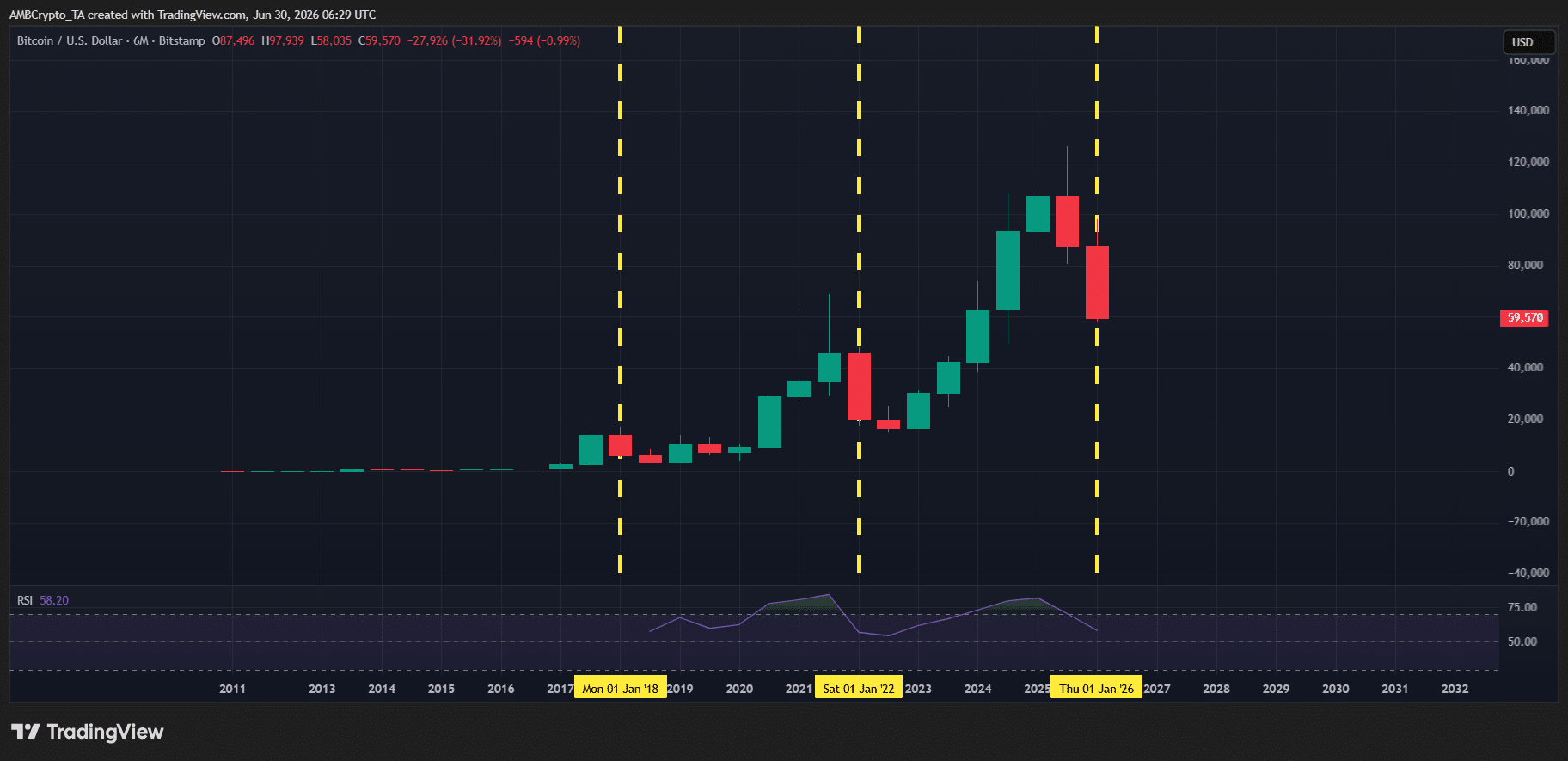
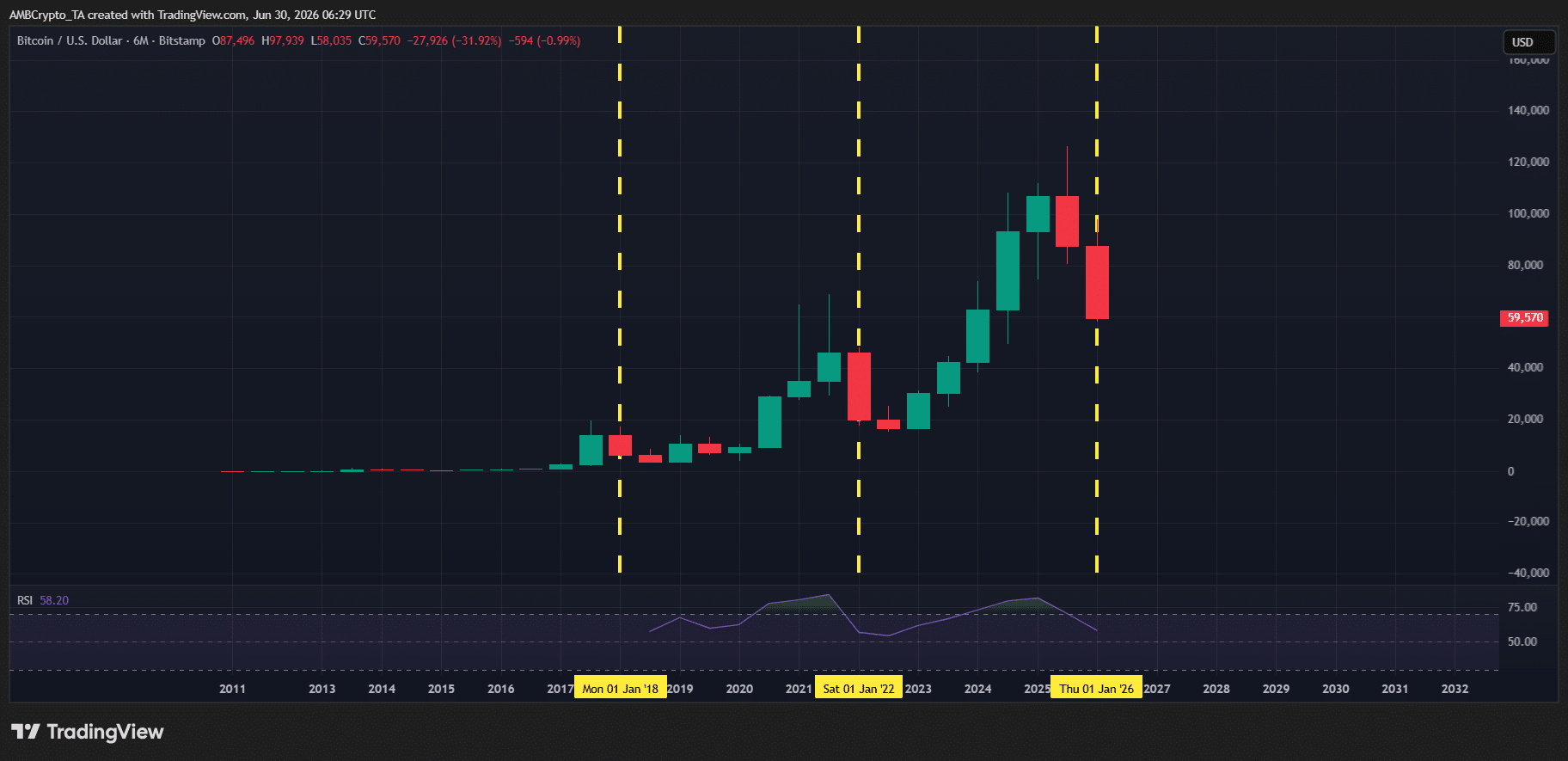
In reality, it works through a gradual supply reduction effect, supported by Bitcoin’s technical setup. Notably, major upside phases have occurred in the 12-18 months after a halving, rather than immediately. After the 2016 halving, for instance, Bitcoin saw its main expansion in 2017, gaining over 1,000%. Similarly, after the 2020 halving, the strongest upside played out through 2020-2021, with a full-cycle rally of roughly 60%.

By contrast, the second halves (H2) of 2018 and 2022 are widely viewed as late-cycle drawdowns. In 2018, Bitcoin fell 40%-45% in the second half of the year. In 2022, it fell 15%-20% before bottoming toward year-end. Taken together, it does appear that H2 weakness in those cycles reflects a “post-halving cooling phase.”
Source: TradingView (BTC/USD)

Bitcoin cycle tested as 2026 moves into H2 phase

The crypto market has officially stepped into the H2 phase of the 2026 cycle.

So far, the cycle structure is broadly tracking Bitcoin’s post-halving behavior seen in 2018 and 2022. Bitcoin is closing H1 down over 30%, which is similar in character to H1 2018 (down nearly 54%) and H1 2022 (down over 56%). In this context, 2026 looks consistent with a post-halving cooldown phase following the 2024 halving, which cut Bitcoin’s block subsidy from 6.25 BTC to 3.125 BTC per block.

If the same playbook holds, Bitcoin could be on track to close H2 in the red. This is also supported by K33 Research Senior Analyst Vetle Lunde, who noted:

The 2022 Bitcoin drawdown lasted for 286 days. In the 2014 and 2018 bear markets, the bottoms occurred 12-13 months after the bear markets began, with a max drawdown of 84-85%. If history is to repeat, a bottom could be expected to form near year-end.

In this context, the roughly 30% H1 drawdown this year can still be viewed as part of a broader post-halving cooldown phase.

However, the 2025 cycle stands out as the first time Bitcoin closed H2 down over 18%. That’s historically unusual and raises a key question: Did 2025 break the post-halving pattern? If so, does it imply Bitcoin is diverging from the 2018 and 2022-style H2 drawdowns, potentially setting up a different trajectory for 2026?

Late-cycle dynamics shift toward liquidity stress

To understand what to expect in H2 2026, it’s worth taking a step back.

Following Bitcoin’s major expansion phases in 2017 and 2021, the subsequent bear markets of 2018 and 2022 can be considered part of a broader post‐halving normalization. During these periods, the market digested prior gains, locked in profits from earlier rallies, and ultimately transitioned into large‐scale distribution and deleveraging.

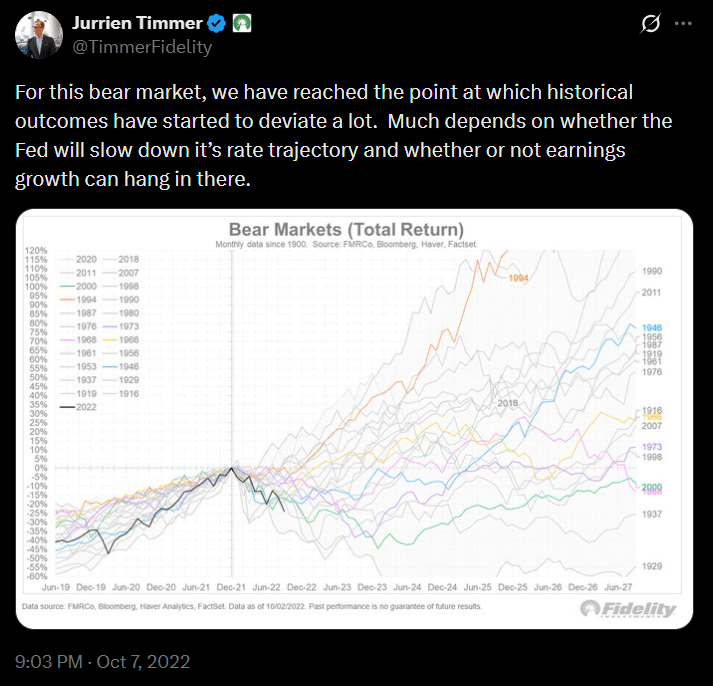
However, the similarities between the second halves of 2018 and 2022 go beyond just that structural setup. Both periods shared a similar macro backdrop. In 2018, the Fed raised interest rates four times over the year, tightening liquidity conditions. Similarly, the 2022 bear market was largely driven by the collapse of Terra, alongside a tight liquidity backdrop, as highlighted in a post by Jurrien Timmer, Director of Global Macro at Fidelity.
Source: X

Against this backdrop, calling the 2018 and 2022 H2 bear markets a “cooldown phase” may be premature.

According to AMBCrypto, this is where Bitcoin’s path into H2 2026 can be better analyzed. And one factor that may sit at the center of this discussion is not just halving structure, but “liquidity.”

Cycle history meets new market structure in Bitcoin’s 2026 outlook

The macro backdrop in 2026 has, so far, closely resembled the previous two post-halving bear markets.

From a macro perspective, geopolitical tensions in the Middle East have kept the newly appointed Fed Chair, Kevin Warsh, cautious on rate cuts, with markets increasingly pricing in a higher-for-longer interest rate environment. The economic data supports this, with U.S. inflation rising to a two-year high of 4.2% in May, keeping liquidity conditions tight.

Against this backdrop, H2 appears set to be another challenging period for Bitcoin. However, this is where the current cycle starts to diverge. Unlike the previous two post-halving cycles, the current liquidity backdrop is stronger. While Bitcoin’s supply remains fixed, liquidity across the broader crypto market has expanded, a trend also highlighted in Fidelity’s latest report:

Crypto bull markets have often been fueled by new trends that bring fresh money into the market. The 2020–2021 cycle, for example, was driven by the rise of NFTs and memecoins. Today, new growth areas such as RWA tokenization, stablecoins, and AI-powered crypto applications are gaining momentum. If these sectors continue to grow, they could bring new capital into crypto.

Now, the focus shifts to the on-chain growth across these sectors. The key question is whether the liquidity flowing into these projects is large enough to support sustained capital inflows across the broader market. If it is, Bitcoin could begin to diverge from the post-halving patterns seen in 2018 and 2022.

If not, the current macro backdrop, combined with the post-halving cooldown phase, could keep pressure on BTC through H2. In that case, Bitcoin could finish the second half in the red, potentially pulling the broader crypto market to its first double-digit annual decline since the 2022 bear market.

The liquidity landscape is changing, but can Bitcoin benefit?

The growth across these sectors is becoming increasingly difficult to ignore. Reflecting this shift, Stellar President Denelle Dixon said at the start of 2026:

On-chain finance is entering an era of exponential growth, and 2026 will be all about acceleration, not experimentation. Partners like PayPal and MoneyGram have already brought stablecoins into the mainstream, and we’ll continue to see deeper, trusted integration into the everyday financial system.

The on-chain data largely supports that view. In the RWA sector, tokenization has accelerated rapidly this year, with the total value of tokenized assets climbing to nearly $40 billion, a 90% year-to-date increase. However, the liquidity picture is more mixed. The stablecoin market (the crypto market’s primary liquidity source) has contracted by roughly $11 billion in market cap.

In essence, liquidity isn’t spreading evenly but remains concentrated in a few growth sectors. Despite not fully aligning with previous post-halving patterns, Bitcoin’s H2 2026 outlook therefore is still being shaped more by a volatile macro backdrop, which is keeping liquidity tight going into H2.

As a result, uneven capital flows across crypto are limiting a broad-based bullish Bitcoin cycle.



Final Summary

Trending Cryptos

Related Questions

QWhat is the typical pattern for Bitcoin's price performance after a halving event, according to the article?

AAccording to the article, major upside phases for Bitcoin have typically occurred 12-18 months after a halving, not immediately. For example, after the 2016 halving, the main expansion was in 2017, and after the 2020 halving, the strongest upside played out through 2020-2021.

QHow does the article characterize the second halves (H2) of the 2018 and 2022 Bitcoin cycles?

AThe article characterizes the H2 of 2018 and 2022 as 'late-cycle drawdowns' and a 'post-halving cooling phase.' Bitcoin fell 40%-45% in H2 2018 and 15%-20% in H2 2022 before bottoming toward year-end.

QWhat two key factors are suggested as central to analyzing Bitcoin's potential path in H2 2026?

AThe article suggests that to analyze Bitcoin's potential path in H2 2026, one must consider not just the post-halving structural pattern but also the broader factor of 'liquidity' and the new market structure brought by sectors like RWA tokenization and AI-powered crypto applications.

QWhat is the current macro backdrop described for 2026, and how does it compare to previous cycles?

AThe macro backdrop in 2026 features geopolitical tensions, a cautious Fed on rate cuts, a 'higher-for-longer' interest rate environment, and U.S. inflation at a two-year high of 4.2% in May. This resembles the tight liquidity conditions seen in the 2018 and 2022 bear markets.

QWhat mixed signals does the article highlight regarding on-chain liquidity and growth in 2026?

AThe article highlights mixed signals: while tokenized assets in the RWA sector have grown nearly 90% year-to-date to $40 billion, the stablecoin market (a primary liquidity source) has contracted by roughly $11 billion. Liquidity is concentrated in a few growth sectors and not spreading evenly, limiting a broad-based bullish cycle for Bitcoin.

Related Reads

The Most Hidden AI Winners

"The Most Under-the-Radar AI Winners" While core AI giants and their direct suppliers have dominated headlines, a group of seemingly unrelated, decades-old manufacturing companies have emerged as major beneficiaries. A key example is Japan's TOTO, famous for bathroom fixtures. Its stock soared 145% in a year, driven not by its mainstay toilet business but by its nearly 40-year-old semiconductor ceramic component unit. Specifically, TOTO manufactures electrostatic chucks—critical, hard-to-replace parts for advanced chip manufacturing processes like etching and EUV lithography. This segment, though only 9% of revenue, contributed over 54% of operating profit in FY2025 with a 43% margin. High barriers to entry, including deep know-how in high-purity ceramic sintering and long supplier certification cycles (5+ years), secure its position. This pattern repeats across industries. Nitto Boseki, a 128-year-old glass fiber maker, saw its stock rise 325% due to near-monopoly supply of T-glass, an essential low-expansion material for AI chip substrates. Similarly, Ajinomoto, the global MSG leader, commands 80-95% of the market for ABF film, a vital insulating layer in chip packaging. These "hidden" segments, often born from deep materials science expertise, are now bottleneck supplies in the AI hardware chain, enjoying pricing power and high margins. In China's A-share market, the theme combines this AI-driven demand with domestic substitution. Companies like Zhongci Electronic (advancing in electrostatic chucks) and Honghe Technology & Feilihua (in high-end electronic glass fabrics) are gaining traction. The investment thesis hinges on whether these domestic players can rapidly scale qualified capacity to capture the supply gap within the critical time window. Ultimately, these cases show that in the AI supply chain, high-profit concentrations exist not only at the cutting-edge tech frontier but also in indispensable, difficult-to-replicate materials and components. Market recognition often lags behind fundamental profit shifts, creating potential for significant re-ratings as traditional industrial firms are re-evaluated as key enablers of advanced semiconductor manufacturing.

marsbit13m ago

The Most Hidden AI Winners

marsbit13m ago

The Most Secretive Winners of the AI Boom

"The Most Hidden AI Winners" An unlikely group of companies are emerging as major beneficiaries of the AI boom, not from designing chips, but from supplying critical materials and components essential for advanced semiconductor manufacturing. These 'hidden winners' are traditional manufacturers whose deep expertise in materials science has become indispensable. Japanese companies are leading this trend. Toto, globally known for bathroom fixtures, has seen its stock surge 145% over the past year, driven by its 40-year-old semiconductor ceramics business, which now contributes over half of its operating profit. Its electrostatic chucks are vital for advanced chip production and require years of expertise to manufacture. Similarly, Nittobo, a 128-year-old textile firm, controls 90% of the market for T-glass, a low-expansion glass fiber essential for AI chip substrates. Ajinomoto, the world's largest MSG producer, dominates the market (80-95% share) for ABF insulating film used in chip packaging. The core insight is that chasing "advanced" chips paradoxically increases reliance on traditional, high-precision material science where supply cannot be quickly replicated. These materials are now critical bottlenecks in the AI supply chain. This trend is mirrored in China's A股 market, framed by the theme of 'import substitution'. Companies like Zhongci Dianzi (electrostatic chucks) and Honghe Technology (ultra-thin electronic cloth) are making progress, but face the test of scaling production and matching Japanese rivals' quality. The key tension lies in the slow change of market perception. While profit structures rapidly shift towards high-margin tech components, these firms retain their traditional industry classifications, creating a valuation gap that is gradually closing as their roles in the AI ecosystem become undeniable.

链捕手21m ago

The Most Secretive Winners of the AI Boom

链捕手21m ago

DeFi Enters a Moment of Value Reassessment: Risks and Opportunities Behind the $70 Billion TVL

DeFi Enters a Moment of Value Reassessment: Peril and Opportunity Behind $70 Billion TVL On July 1st, the total value locked (TVL) across all DeFi protocols fell below $70 billion to approximately $69.358 billion, hitting its lowest point since February 2024. This decline signals a significant contraction in DeFi liquidity and marks a new adjustment phase for the industry, far from its 2021 peak of over $180 billion. The primary drivers of this TVL drop are a general decrease in crypto market risk appetite, which leads capital to exit volatile sectors like DeFi first, and the fading effectiveness of the high-yield liquidity incentive models that fueled the initial DeFi boom. Many protocols' high TVL figures were built on temporary subsidy-driven capital rather than genuine demand. Furthermore, capital is migrating to newer narratives like AI, RWA, and modular infrastructure. This cooldown exposes DeFi's growth bottlenecks: innovation has slowed with rampant protocol copycats, real yields have normalized to single digits, and poor user experience continues to hinder mass adoption beyond crypto-natives. However, the TVL decline does not spell the end for DeFi. The metric itself is limited, as it fluctuates with underlying asset prices. The industry is shifting from capital accumulation to efficiency competition, leveraging Layer 2 solutions and modular architecture to do more with less locked value. Crucially, DeFi is expanding into real-world financial use cases like the tokenization of real-world assets (RWA) and the growth of the stablecoin ecosystem, moving its value proposition from speculative token subsidies to real cash flows. In conclusion, while short-term pressures from liquidity contraction and user growth stagnation persist, the sector is undergoing a necessary value reassessment. DeFi is transitioning from a subsidy-driven, hype-based era toward a more mature, rational, and efficiency-focused phase, with long-term growth hinging on meeting real-world financial needs through RWA, stablecoins, and robust infrastructure.

marsbit40m ago

DeFi Enters a Moment of Value Reassessment: Risks and Opportunities Behind the $70 Billion TVL

marsbit40m ago

Trading

Spot

Hot Articles

Discussions

Welcome to the HTX Community. Here, you can stay informed about the latest platform developments and gain access to professional market insights. Users' opinions on the price of S (S) are presented below.

活动图片