TL;DR
Nvidia's latest bond issuance is most easily misread as a simple question: with so much cash on hand, why does it need to borrow money?
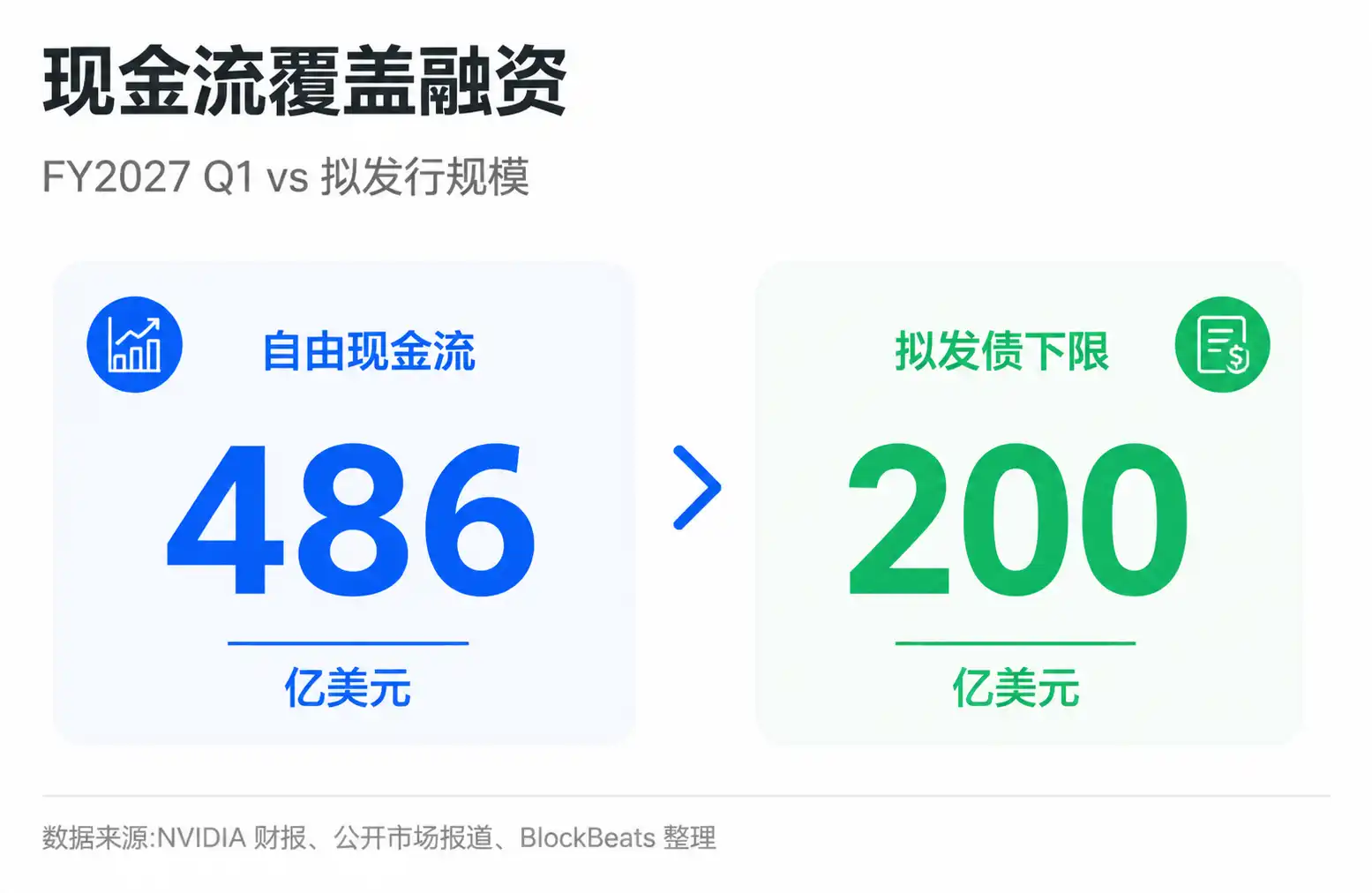
According to the company's most recent quarterly data, for FY2027 Q1 ending April 26, 2026, Nvidia's revenue reached $81.6 billion, with free cash flow around $48.6 billion. At the same time, the company added $80 billion in stock repurchase authorization and raised its quarterly dividend from $0.01 to $0.25. In other words, this is not a company with tight cash flow needing the bond market to stay afloat.
But it's precisely because of this that the market is particularly sensitive to its plan to issue at least $20 billion in senior notes. The bond maturities range from 2 to 30 years, with proceeds intended for general corporate purposes, refinancing, AI data center and infrastructure, R&D, supply chain prepayments, and strategic investments. For investors, the real question worth asking is not "Does Nvidia have money?" but rather: When the biggest AI cash cow also starts systematically using long-term debt, has the AI capital expenditure narrative entered a new phase?
The core of this matter is not that Nvidia suddenly needs money, but that it is converting its cash flow and credit rating into another form of expansion capability.
The Stronger the Cash, the More Qualified to Borrow Long-Term
The average investor seeing "bond issuance" often first thinks the company is short of money. But for mature large companies, borrowing is often not a passive plea for help, but an active choice of a cheaper, less shareholder-dilutive financing method.
Nvidia plans to issue senior notes (corporate IOUs), essentially borrowing money from bond investors, paying periodic interest and repaying principal at maturity. The biggest difference from issuing new shares is that issuing debt does not carve out a piece of the company's ownership. As long as the company's future returns exceed the debt cost, existing shareholders can retain more earnings.
This is the paradox of this transaction. Nvidia's free cash flow in the last quarter was about $48.6 billion, its single-quarter cash generation capacity already significantly exceeding the scale of this proposed financing. The company is also simultaneously conducting massive buybacks and raising dividends, indicating the bond issuance cannot be simply understood as "not having enough cash."
A more reasonable explanation is that Nvidia is locking in a source of long-term funding when its credit is strongest and the market is most willing to lend to it. For a company in an AI infrastructure expansion cycle, data centers, supply chain prepayments, ecosystem investments, and R&D spending are not short-term projects. Their payback periods may span years, even a decade or more. Matching long-term assets with 30-year debt is closer to mature capital management than relying entirely on short-term operating cash flow.
This is also the plain meaning of "capital structure optimization": the company uses not just cash on hand but also appropriately pairs it with low-cost debt. As long as the long-term return generated by the borrowed money is higher than the interest cost, debt is not just a burden; it can also be a tool to improve capital efficiency.
AA Rating Turns Bonds into AI Ammunition
That Nvidia can do this relies on the bond market being willing to lend to it at a low enough cost. The most important variable behind this is the credit rating.
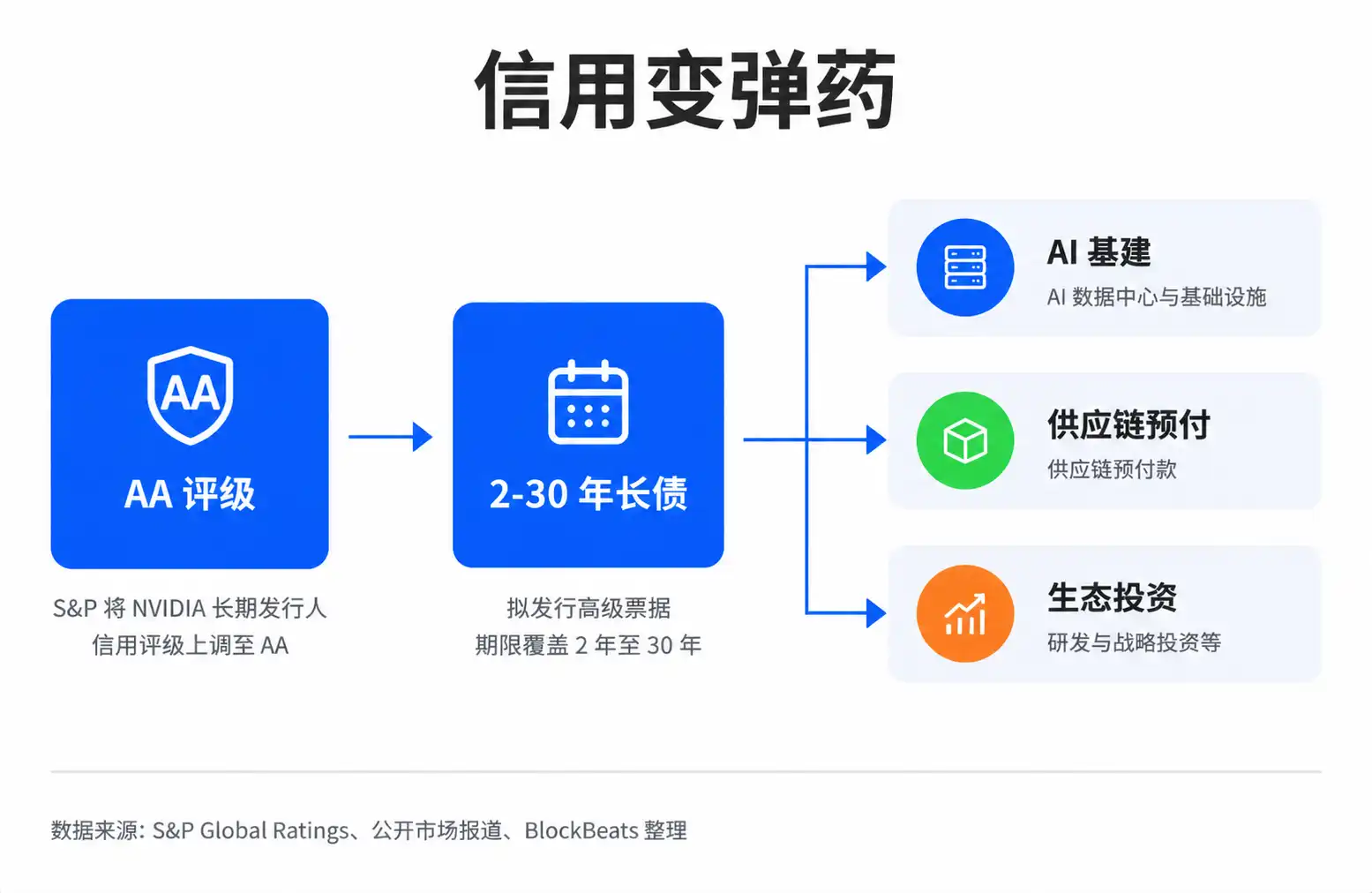
S&P Global Ratings recently upgraded Nvidia to AA, citing reasons including competitive advantages from AI demand, strong cash flow generation capacity, and a robust balance sheet. An AA rating can be understood as a high-credit label in the bond market: investors believe the company has an extremely low default risk, therefore willing to accept lower spreads and longer maturities.
This is key. Bond issuance isn't just about "getting money"; what truly determines the transaction's value is "at what cost, for how long, and in what market window." When a company is in a phase of credit upgrades, rapidly expanding cash flow, and the AI theme is still favored by institutional funds, its bargaining power for long-term funding significantly strengthens.
This also explains why Nvidia is acting at this moment. It's not waiting until cash flow weakens or expansion pressure increases to raise funds; instead, it's reducing future financing uncertainty in advance when the market most recognizes its credit quality. For shareholders, this is more attractive than being forced to finance in a worse environment in the future.
The listed uses of the bond proceeds are also worth considering together: refinancing, AI data center and infrastructure, R&D, supply chain prepayments, strategic investment. Refinancing leans towards financial management, infrastructure and supply chain towards expansion security, and strategic investment towards ecosystem positioning. They collectively point to one fact: Nvidia's capital needs are no longer just about "producing more chips," but about maintaining its position within the entire AI ecosystem.
Nvidia sells the most critical computing power tools of the AI era, but it also needs to ensure its customers, supply chain, infrastructure, and ecosystem partners can keep up. The more important this role becomes, the more its capital allocation resembles a platform company, not just a hardware company.
Borrowing Is More Aligned with Shareholder Interests Than Issuing Shares
For NVDA shareholders, this bond issuance has another direct implication: the company is reserving ammunition for long-term expansion while maintaining shareholder returns.
Nvidia's last quarter not only had strong cash flow but also added $80 billion in buyback authorization and raised its dividend. Buybacks and dividends represent the company returning cash directly to shareholders; issuing debt represents using external long-term funds to support future investments. Looking at them together conveys not an "either-or" but the company's attempt to maintain two lines simultaneously: rewarding existing shareholders while not slowing down AI expansion.
If Nvidia chose to raise funds by issuing new shares, existing shareholders would be diluted. Even if the company continues to grow, earnings per share would be reduced. In contrast, the cost of debt is clearer: interest and principal. For a company with extremely strong free cash flow and a high credit rating, this cost is easier to manage.
Of course, this doesn't mean bond issuance is necessarily positive. Debt increases fixed expenses and raises market expectations for capital allocation efficiency. The reason Nvidia can get investors to accept this debt today is that the market believes its future cash flow can cover the interest and that AI infrastructure investments will ultimately translate into revenue and profit. If these two premises change, debt could shift from an efficiency tool to a valuation pressure.
Therefore, what this bond issuance truly changes is how investors observe Nvidia. In the past, the market focused more on GPU demand, gross margins, and revenue growth; now, it must also pay attention to how cash flow is allocated: how much for buybacks and dividends, how much for supply chain and infrastructure, how much for ecosystem investment, and how much is locked in early through debt.
This will make NVDA's valuation anchor more complex. It's no longer just a "profit growth story"; it's also beginning to feature characteristics of a "credit asset" and a "long-term capital allocation platform."
The AI Financing Template for Large Tech Companies Is Taking Shape
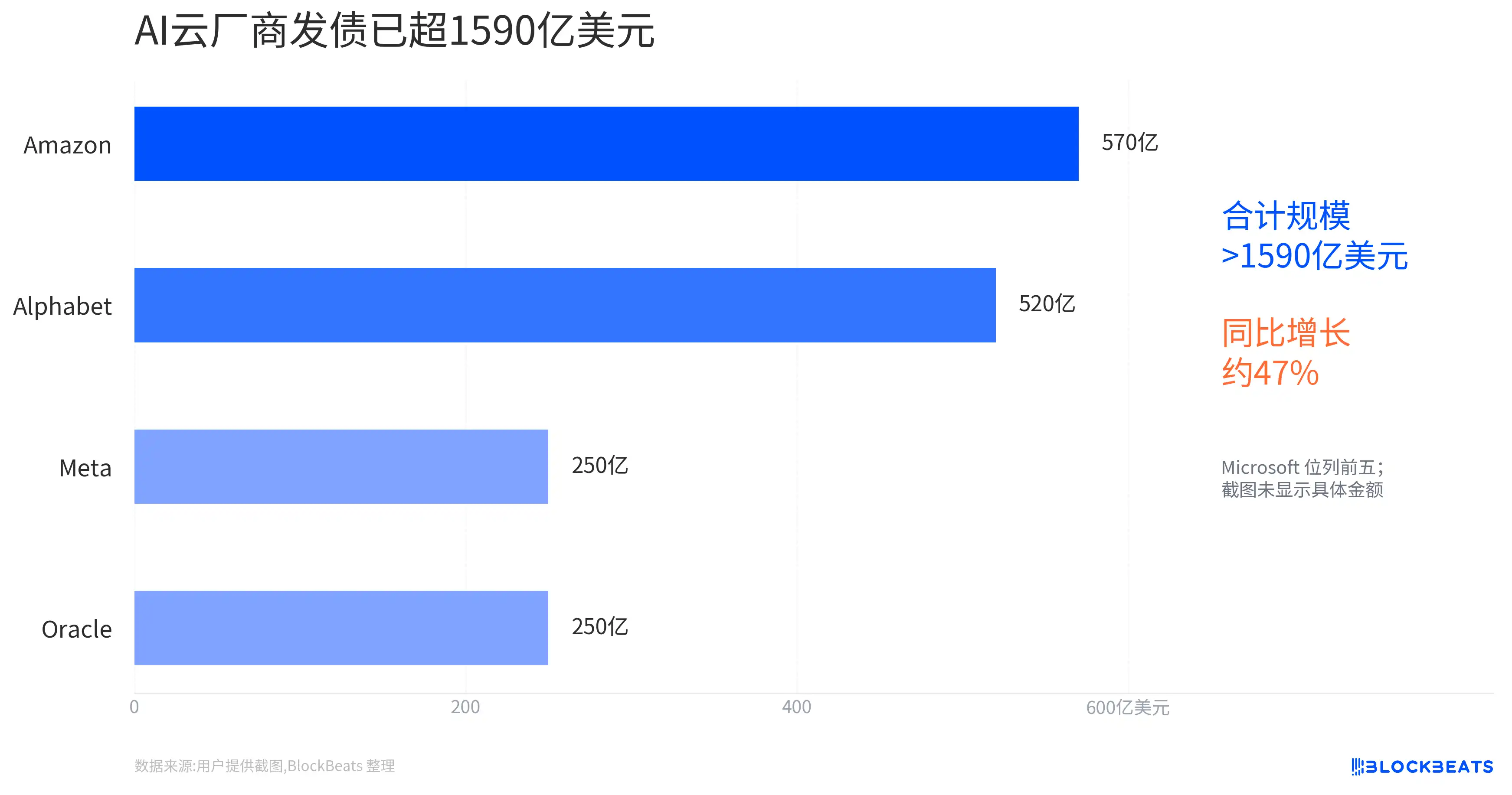
Nvidia is not the only company doing this. Alphabet completed a $20 billion bond issuance in February 2026, with maturities also covering multiple series, reportedly with orders once exceeding $100 billion. Meta, Amazon, and other large tech companies are also using debt financing during the AI investment cycle as one tool to support infrastructure spending.
These cases cannot be simply written off as "tech giants are all short of money." A more accurate description is: AI infrastructure has shifted from a light-asset software growth story to a heavy-asset cycle involving data centers, power, chips, networks, and the supply chain. The company that can obtain funds at lower costs and for longer periods will have more room to maneuver in this expansion.
This has two implications for market pricing.
First, debt financing extends the endurance of AI capex (capital expenditure). As long as the bond market is willing to buy, large tech companies don't have to rely entirely on current cash flow to pay for long-term construction. This will support demand expectations for data centers, power, optical communications, semiconductor supply chains, and other areas.
Second, debt financing will also make investors more attentive to the payback period. In the past, the market was willing to pay a high valuation for AI investments because the growth speed was fast enough. But as investments become heavier and financing terms longer, the question becomes: When will these infrastructures generate sufficient returns? If AI application revenue materializes slower than expected, or the commercial return per unit of computing power declines, the market will re-examine whether these debt-supported expansions are too aggressive.
Nvidia's special position is that it sits at the upstream of the AI capital expenditure chain. The more customers invest, the more it benefits; but if the investment returns of the entire industry are questioned, it cannot remain completely insulated. Therefore, this bond issuance both reinforces the market's recognition of its credit and cash flow and embeds it deeper into the narrative of long-cycle AI capital expenditure.
What Remains to Be Tested Is Whether Pricing and Returns Can Coexist
The most important caveat at present is: this is still a "proposed issuance of at least $20 billion"; the final issuance size, coupon, spread, and order book strength remain to be confirmed. Only after the transaction closes can the market more accurately judge at what low cost and for how long bond investors are willing to fund Nvidia.
If the final pricing shows strong demand and long-term spreads remain low, this will further prove that Nvidia is turning its AA credit into an expansion tool. It can not only profit from customers' AI spending but also finance its own long-term positioning at lower costs in the capital market.
But the more important verification later lies not in the bonds themselves, but in the next phase of earnings reports and capital expenditure data. Investors need to see whether Nvidia can continue to maintain strong free cash flow while advancing AI infrastructure, supply chain prepayments, ecosystem investment, and shareholder returns. If these variables can still progress in parallel, bond issuance becomes an amplifier of capital efficiency.
Conversely, if the payback period for future AI infrastructure lengthens, or the company increasingly relies on external financing to sustain expansion, the market's understanding of such debt will change. Then the question will no longer be "Is Nvidia short of cash?" but "Is the return rate on long-cycle AI investments sufficient to support the expectations being front-loaded by today's low-cost funds?"