A 134% Surge, 75 P/E Ratio: Why Is the Market Paying Up for Murata's 'Zero Growth'?

marsbitPublished on 2026-06-01Last updated on 2026-06-01

Abstract

Murata Manufacturing, the world's largest passive components maker, saw its stock price surge 134% over the past year and hit a record high on May 28th, despite reporting nearly zero growth in operating profit for its latest fiscal year. This has pushed its valuation to a P/E ratio of approximately 75x. The disconnect is driven by a fundamental market re-rating. The catalyst was a late-May meeting where management upgraded the AI investment cycle outlook to "lasting until around 2030" and noted that demand for its components is roughly double its supply capacity, with customers prioritizing securing volume over price. While Murata's revenue grew only 5.0% and operating profit stagnated at ¥281.8 billion for the fiscal year ending March 2026, its guidance for the current fiscal year projects a 34.8% jump in operating profit to ¥380 billion. This sharp growth is underpinned by expectations that its AI/data center-related revenue will nearly double from ¥170 billion to ¥325 billion, becoming a key pillar of its business. Analysts highlight that this growth stems not from broad price hikes but from a shift towards higher-value, cutting-edge MLCCs for AI servers, where Murata holds over 70% market share. The market is now pricing Murata not as a cyclical component maker but as a critical "AI pick-and-shovel" supplier with structural pricing power. However, the high valuation also carries risk if future AI demand or quarterly guidance falls short of the elevated expectations.

On May 28th, Murata Manufacturing, the world's largest passive component manufacturer, surged 12.36% on the Tokyo Stock Exchange, briefly hitting its daily price limit during the session. It closed at 8,787 yen, marking a new all-time high on a split-adjusted basis. Two months ago, we analyzed Murata's 15-35% price hike on MLCCs (Multilayer Ceramic Capacitors) for AI servers, explaining how this sub-millimeter capacitor is stirring up the AI computing supply chain. This time, what's worth unpacking is not the capacitor, but Murata's stock itself.

Because if you look at Murata's latest earnings report, you'll find a stark contrast: its performance is actually quite flat, yet its stock price has doubled over the past year.
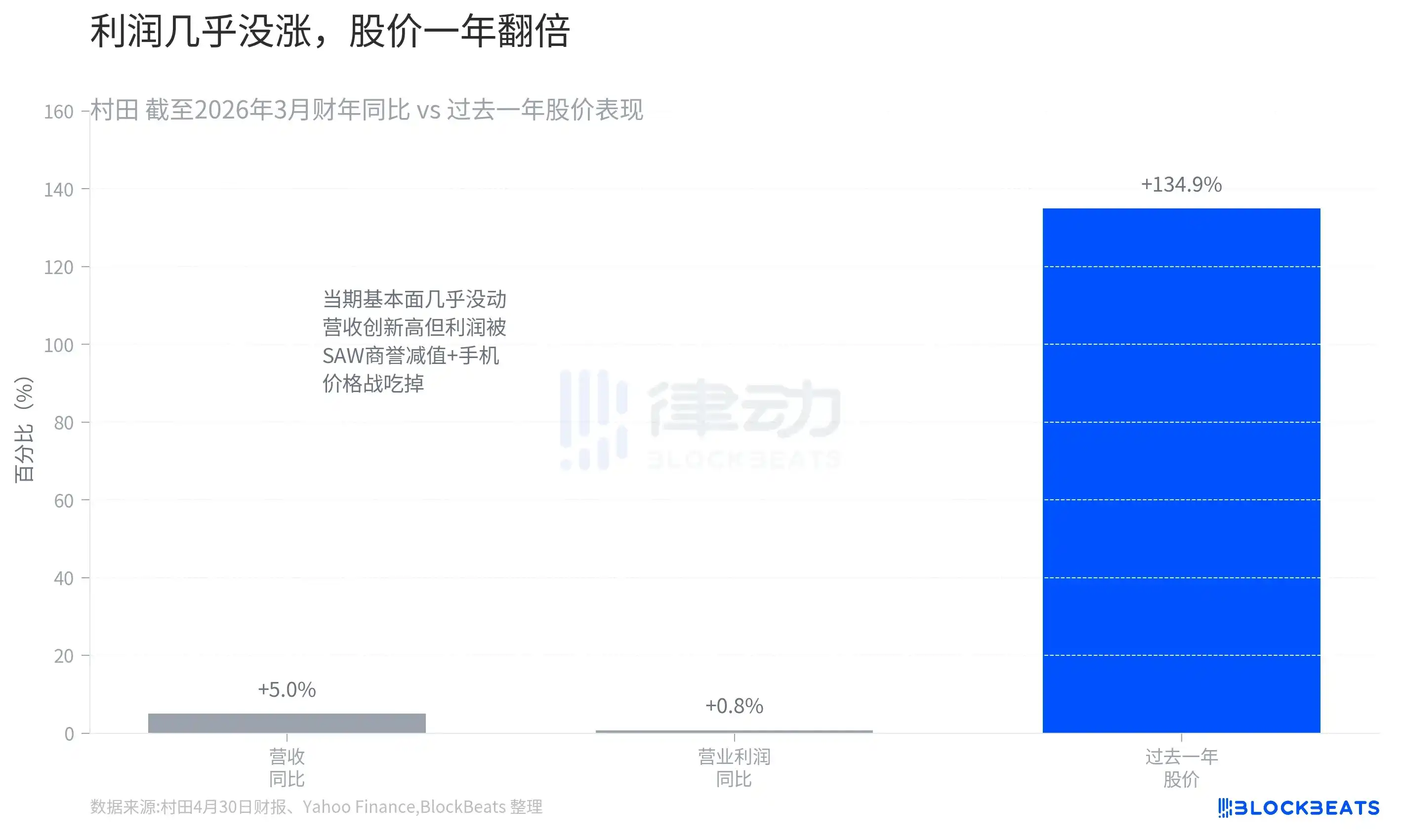
According to Murata's April 30th earnings report for the fiscal year ending March 2026, the company's revenue reached a record high of 1.83 trillion yen, but grew only 5.0% year-over-year. Operating profit was 281.8 billion yen, increasing a mere 0.8% YoY, essentially stagnating. Two factors dragged down profits: a goodwill impairment related to its SAW (Surface Acoustic Wave) filter business, and continued price wars in mature applications like smartphones. In other words, no matter how bright the AI segment shines, it's only making up for the losses in the mature businesses.

Yet during the same period, Murata's stock price rose approximately 134.9% over the past year (according to Yahoo Finance data), recently breaking above the 9,000 yen level. Its market capitalization has surged to around the 17 trillion yen level, pushing its P/E ratio to about 75 times. The market valuing a passive component maker with zero current profit growth at a 75 P/E ratio can only mean one thing: the buyers don't care about this year's profits—they are betting on the story ahead.

The real catalyst was a briefing

The trigger for this surge wasn't a price increase or the earnings report, but a small meeting for securities analysts held by Murata on May 27th.

According to content from the meeting cited by investment blogger kabuya66, Murata's management delivered two key statements. The first was an upward revision of the expected AI investment peak from "around 2028" to "likely continuing until around 2030." For a capital-intensive component manufacturer that plans production based on orders, an extra two years of robust demand cycle means order backlogs will continue to accumulate, making investments in capacity expansion more certain to pay off. The second statement was more direct: customers now prioritize securing volume over price, with demand being roughly double the available capacity. This means downstream players are scrambling for supply regardless of cost, just to get their hands on the components.
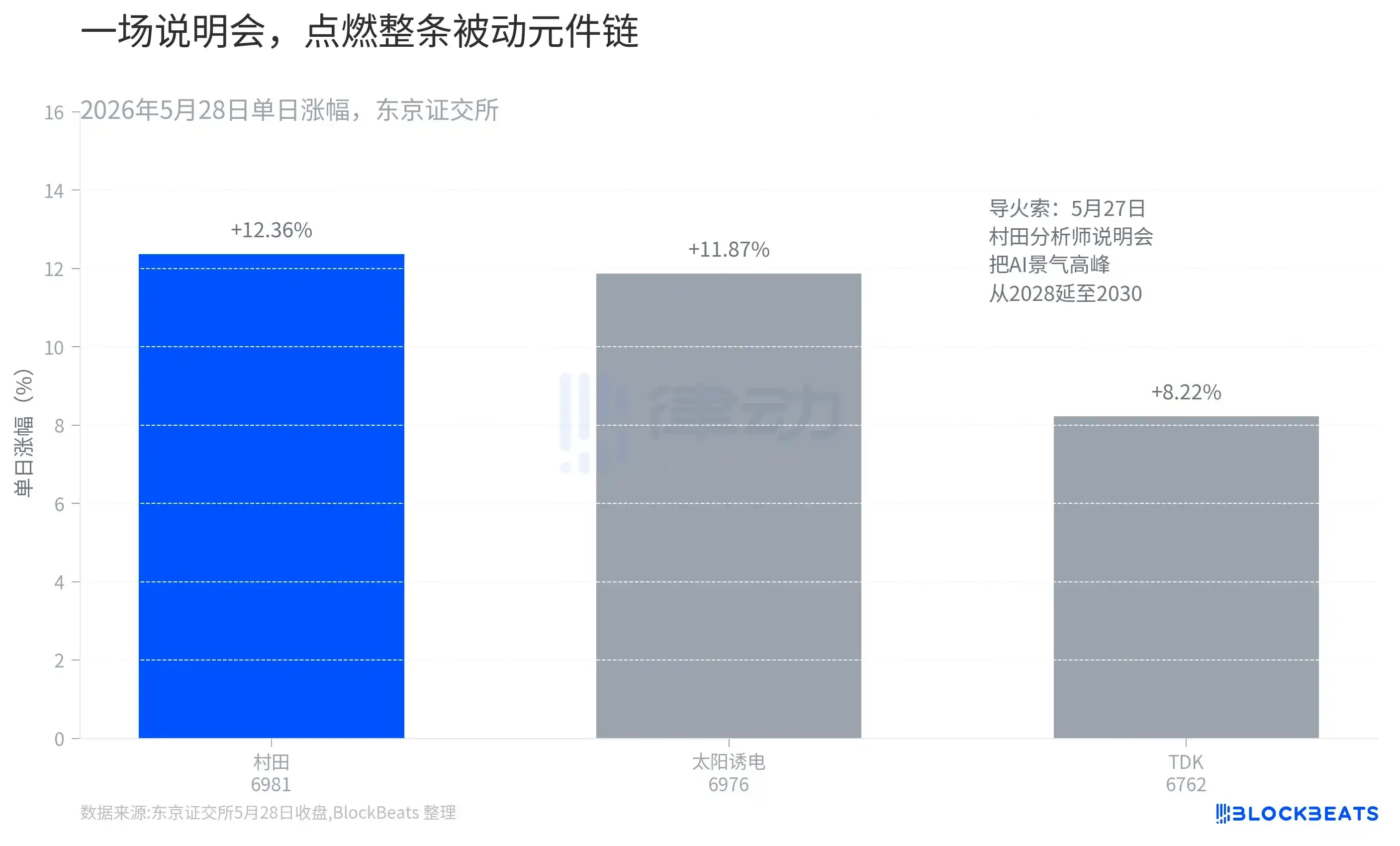
The impact of these statements was evident in the next day's trading. While Murata jumped 12.36%, peers Taiyo Yuden rose 11.87% and TDK climbed 8.22% (based on Tokyo Stock Exchange closing data). A single briefing from the industry leader led to a re-rating not just of one stock, but of the entire passive component chain. That day, the Nikkei 225 index also closed above 66,000 points for the first time, with the MLCC sector being one of the leading gainers.

What the market is buying is the "next year" pillar

The reason the briefing ignited such a rally is that it clarified Murata's potential profit elasticity for the coming year.

Visualize Murata's operating profit as three pillars, and the story becomes clear. For the fiscal years ending March 2025 (279.7 billion yen) and March 2026 (281.8 billion yen), profit was nearly flat for two consecutive years, with the operating margin also declining from 16.0% to 15.4%. However, Murata's guidance for the current fiscal year (ending March 2027) is an operating profit of 380 billion yen, a sharp 34.8% increase year-over-year, with the margin rebounding to 19.4%.
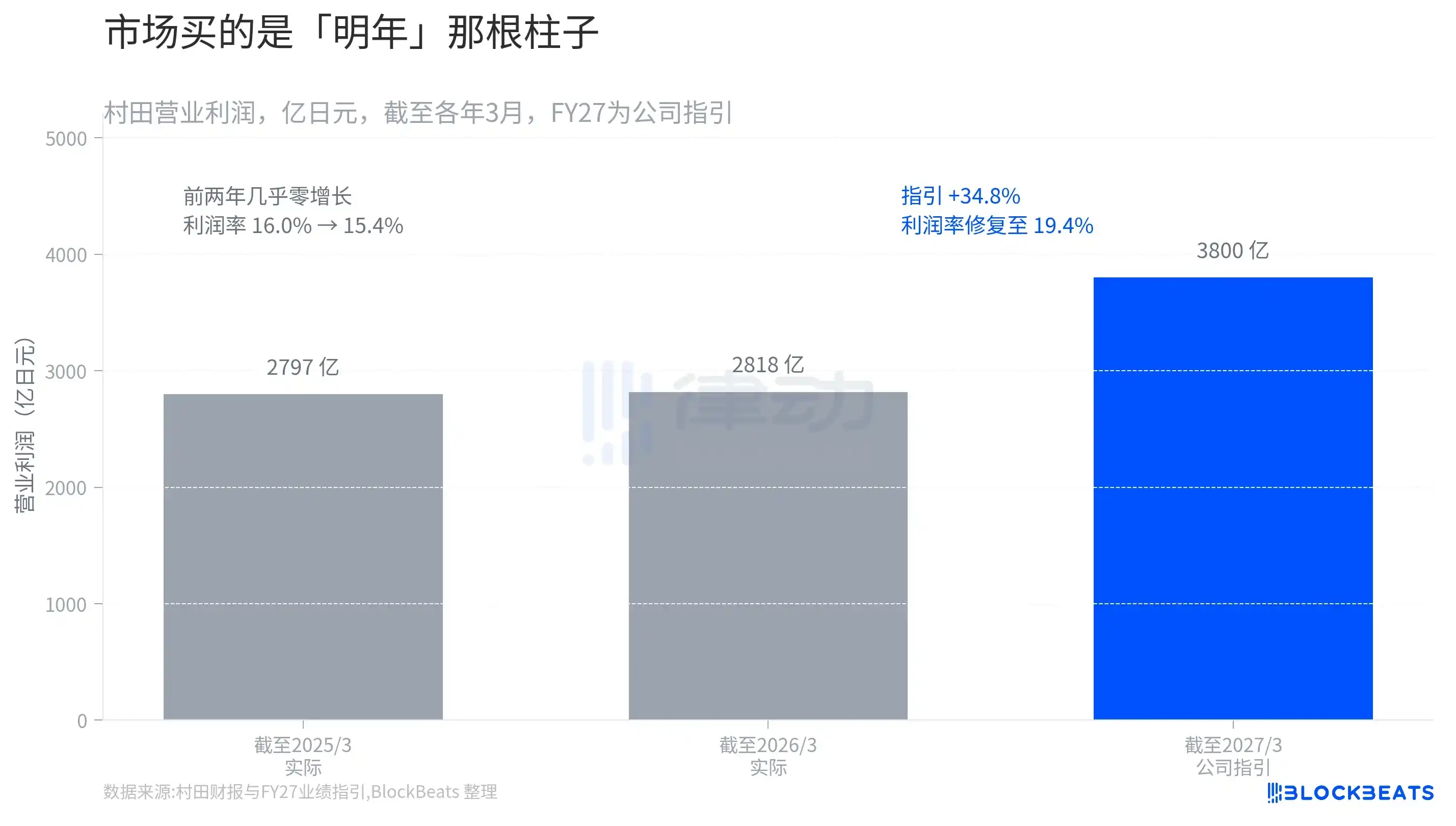
All the growth is locked into that rightmost pillar. The market is now buying not the past two years of flat performance, but this yet-to-be-realized guidance pillar. Supporting evidence comes from orders: according to a Nikkei Veritas survey, among listed companies with a market cap over 50 billion yen and expected profits this fiscal year, Murata ranked first in the growth rate of its order backlog last fiscal year. The order backlog directly translates to future revenue, providing the confidence behind that guidance pillar. Murata also announced a share buyback plan of up to 150 billion yen, aiming to repurchase 75 million shares, or 4.12% of its outstanding stock. Management's commitment of real money is an implicit admission that the current price isn't considered expensive.

What supports this pillar is AI revenue set to double again

Where does the 34.8% profit growth come from? The answer lies primarily in one segment.

According to data from Murata's briefing, the company's AI/data center-related revenue is projected to jump from about 170 billion yen last fiscal year to a guided 325 billion yen this fiscal year, an increase of 85-90%. This segment's contribution to total revenue will rise from roughly 9% to about 17%. In other words, within a year, AI will grow from a minor part of Murata's revenue to a pillar accounting for nearly one-fifth of the total.
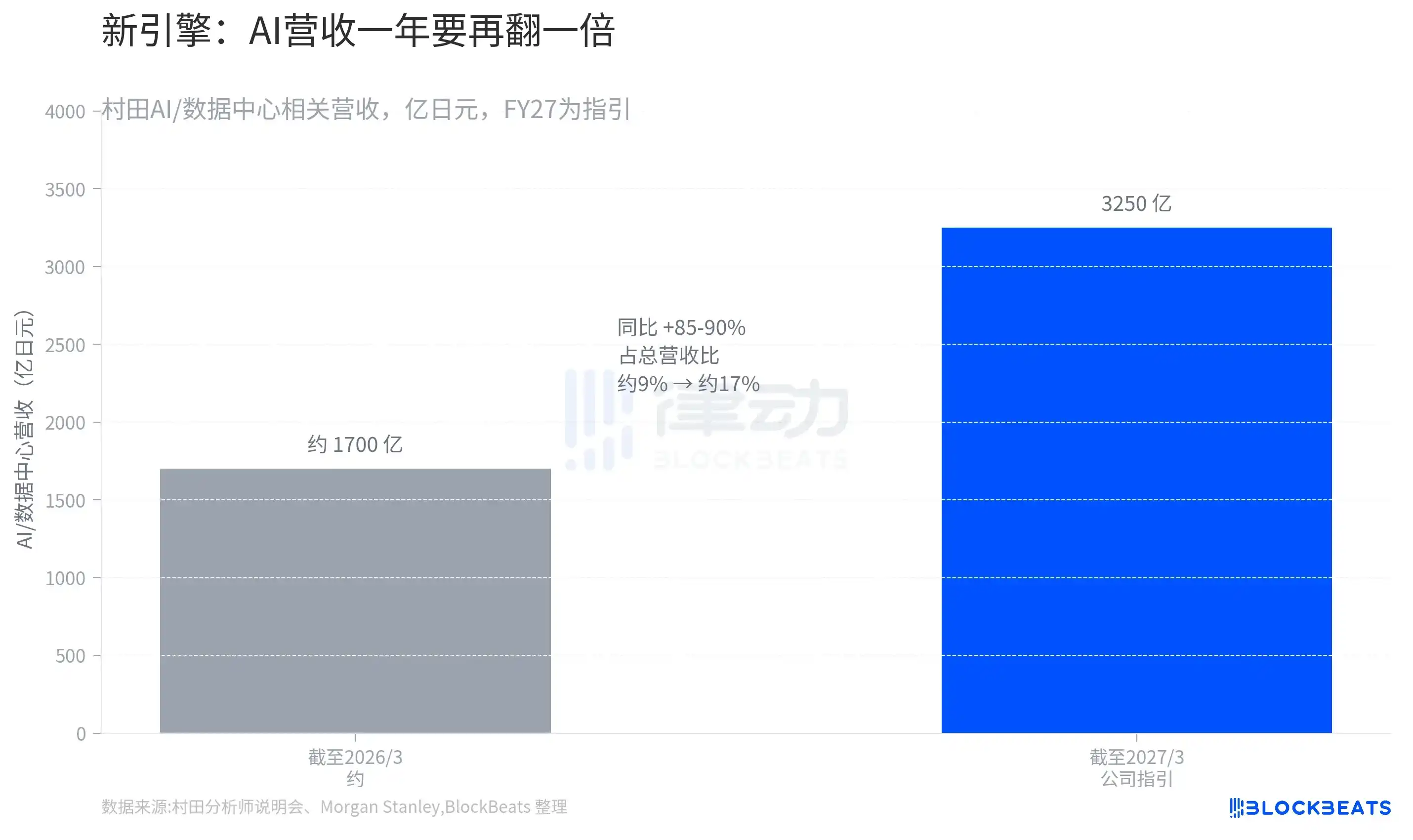
More crucial is the "quality" of this growth. According to analysis by Morgan Stanley MUFG Securities, this round of AI revenue growth for Murata is not primarily driven by price hikes on existing MLCC products, but by product mix upgrades—an increased proportion of cutting-edge products with smaller sizes and higher capacitance values, which pushes up the average selling price (ASP). Murata holds over a 70% share in the advanced-grade MLCCs required for AI servers, with almost no competitors able to keep pace. This means its price increases are not cyclical "price hikes due to short supply," but structural "higher prices because only we can make them." The market's willingness to assign a 75 P/E ratio is precisely pricing in this perceived sustainable pricing power.

Of course, the flip side of buying expectations to a record high is that expectations have already run ahead. Murata's President, Norio Nakajima, himself acknowledged the possibility that some customer demand forecasts might be "on the optimistic side." If the pace of AI investment slows, or if quarterly guidance subsequently falls short of expectations, this high valuation also carries the risk of a rapid correction. For high-multiple stocks, "not good enough" can be the best reason to sell.

Murata is still the same capacitor maker it was. What's changed is the yardstick the market uses to measure it: from a "destined for price declines" cyclical component manufacturer to an "AI picks-and-shovels" supplier with constrained supply and strong pricing power.


Related Questions

QWhy did Murata Manufacturing's stock surge 134.9% in one year despite nearly flat profit growth?

AThe stock surged because the market is pricing in future growth, specifically the company's forecast of a 34.8% increase in operating profit for the current fiscal year (ending March 2027). This is driven by strong expectations for its AI/data center-related business, which is projected to nearly double in revenue. A key catalyst was a small meeting where management extended the AI investment peak expectation to around 2030 and noted demand is about double the supply, indicating strong pricing power.

QWhat was the key catalyst that triggered Murata's recent sharp stock price increase?

AThe key catalyst was a small meeting Murata held for securities analysts on May 27. In the meeting, management revised their expectation for the peak of AI investment from 'around 2028' to 'lasting until around 2030'. They also stated that current client demand is about double their production capacity, with customers prioritizing securing volume over price.

QWhat is the main driver behind Murata's projected 34.8% operating profit growth for the current fiscal year?

AThe main driver is the expected explosive growth in its AI/data center-related revenue. This segment is forecast to jump approximately 85-90%, from about 170 billion yen last fiscal year to 325 billion yen in the current fiscal year. The growth is attributed not just to volume but to a product mix shift towards more advanced, higher-value MLCCs for AI servers, where Murata holds over 70% market share.

QWhy is the market willing to value Murata at a P/E ratio of around 75 times despite its low current profit growth?

AThe market is applying a premium valuation because it is re-rating Murata from a cyclical component manufacturer with predictable price declines to an 'AI pick-and-shovel' supplier with structural pricing power. Its dominant position (over 70% share) in high-end MLCCs for AI servers allows for sustainable price increases based on product sophistication, not just temporary supply shortages. Investors are paying for this perceived durable competitive advantage and future profit stream.

QWhat potential risk does the article mention for Murata's high stock valuation?

AThe article mentions the risk that the high expectations priced into the stock may not be met. Murata's president acknowledged that some client demand forecasts might be overstated. If AI investment slows down or the company's quarterly guidance falls short of expectations, the high P/E ratio could lead to a rapid correction in the stock price, as 'not good enough' becomes a sell signal for highly valued stocks.

Related Reads

The Midlife Crisis of Crypto GPs: No PMF, No Next Check from LPs

The article "The Midlife Crisis of Crypto GPs: No PMF, No Next LP Check" analyzes the shifting crypto fundraising landscape. It argues the era of selling grand visions to LPs is over; GPs must now offer products with clear Product-Market Fit (PMF). The author categorizes crypto fundraising products into three types: Primary (VC funds), Liquid (trading strategies), and CeFi/DeFi Native Yield. This summary focuses on the Primary market. Key points include: * **Market Shift:** LPs are impatient, demand immediate returns, and are skeptical of future promises. The "easy money" narrative has faded. * **GP Value Erosion:** LP learning curves have shortened (aided by AI), reducing the value of a GP's basic "crypto knowledge." Superior judgment is now rare. * **Weakened LP Motivations:** Traditional reasons for LPs to invest in crypto VC funds (capturing industry beta, gaining access, leveraging GP judgment) have weakened due to new products like ETFs and increased LP sophistication. * **Surviving in Primary:** The primary market will likely persist for: 1) large funds in endowment mandates treating it as a lottery ticket, 2) family offices/HNWIs using proprietary capital, 3) a few funds with proven recent outperformance, and 4) funds with strong ecosystem "deal-making" capabilities. * **Conclusion:** For most GPs, rebuilding trust requires starting over in a niche, demonstrating alpha-generating ability, or providing concrete value/services to LPs.

marsbit2h ago

The Midlife Crisis of Crypto GPs: No PMF, No Next Check from LPs

marsbit2h ago

Crypto GPs' Midlife Crisis: No PMF, No LP's Next Check

The article "The Midlife Crisis of Crypto GPs: No PMF, No LP's Next Check" analyzes the shifting crypto fundraising landscape. It argues that the era of LPs funding vague "vision" is over; GPs must now offer products with clear Product-Market Fit (PMF) to secure capital. The market has matured. LPs, disillusioned by the last cycle's failures and wary of long lock-up periods, now demand tangible, near-term returns rather than speculative narratives. The proliferation of accessible crypto ETFs and other liquid products has reduced the need for VC blind pools as an entry point. The author categorizes crypto fundraising products into three types: Primary (VC funds, with blind pools or clear pipelines), Liquid (alpha/beta, directional/market-neutral strategies), and CeFi/DeFi Native Yield (crypto-specific mechanisms like staking, farming). Focusing on the Primary market, the piece details why traditional LP rationales for investing in crypto VCs have weakened: easier beta access via ETFs, diminished "access" and "judgement" premiums as LPs build internal teams, and a widespread lack of proven superior returns from GPs. Ultimately, only specific players are likely to remain at the primary VC table: large funds with access to patient endowment capital, family offices/HNWIs investing proprietary capital, the few funds with demonstrable excess returns from the last cycle, and those with clear "deal-making" or ecosystem resource advantages. For others, the path forward is to rebuild trust by proving alpha-generation capability in a niche or providing concrete, valuable services.

链捕手3h ago

Crypto GPs' Midlife Crisis: No PMF, No LP's Next Check

链捕手3h ago

Trading

Spot
Futures

Hot Articles

Discussions

Welcome to the HTX Community. Here, you can stay informed about the latest platform developments and gain access to professional market insights. Users' opinions on the price of S (S) are presented below.

活动图片